
Tulane Programs that Have Been Successful, and Those That Have Not. Part 2 of Our Interview with AD David Harris
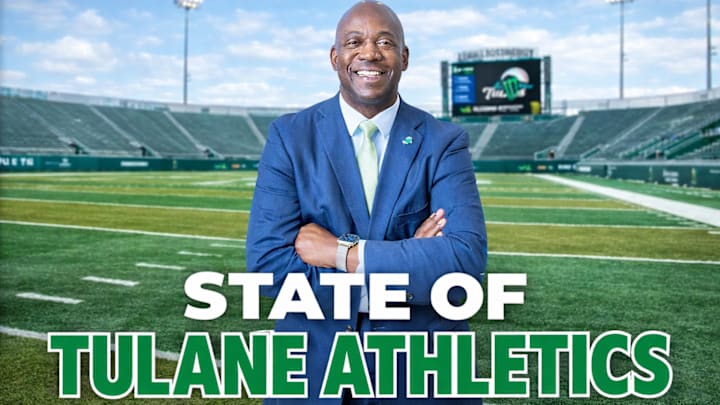
Part 2: TU Programs Which Are Succeeding, and Those That Aren't
Welcome to this special edition of The Green Wave Report from On SI Tulane. Today Part 1 of a wide-ranging interview with Tulane athletic director David Harris on the State of Tulane athletics.
This four-part series focuses on the NIL and the possibility of a Collective Bargaining Agreement with student-athletes, the athletic programs that are successful at Tulane and those that have not seen the ceiling yet, athletic facilities and their future, and what Harris’ vision is for Tulane athletics. The series will run on Mondays and Wednesdays at Noon for the next two weeks.
Part 1 was released Monday, April 6 at Noon. Part 2 was released at Noon on Wednesday, April 8. Then, we'll do it again next week with Parts 3 and 4 premiering on Monday, April 13th and Wednesday, April 15th. To see all the interviews with Harris on they day they post, go to our YouTube Channel.
Part one was about the Give Green campaign at Tulane. Then, we followed up with where the NCAA and Tulane in particular stands on NIL and where Harris thinks things will go on a possible CBA for athletes. If you'd like to see Part 1, check it out here.
In Part 2, we talk to the Tulane AD about those programs that have been successful in Uptown and those that still have a little ways to go.
A Lengthy List of Successful Tulane Programs
We have seen tremendous progress at Tulane University, specifically football, obviously, but also cross-country, which went to the NCAAs, track and field doing extremely as well as, bowling, the 17th ranked team in the nation, sailing is "drowning" everybody for the last month. There are so many things to brag about, concerning Tulane Athletics.
When you see a program not doing well, you certainly want to provide assistance, but I think there's only so much that you can do during a season, right? Most of the time from an administrative standpoint, all the things that you're going to put into the making of a successful season usually happen before the season begins.
Once the season begins, there's not a whole lot that I can tell Jay Ullman or Ron Hunter or Will Hall about adjustments that they need to make. I mean, if they're looking at me for adjustments, then we probably don't have the right people in those positions. Certainly, if they ask me a question what I think about something, then I'll answer that, but as an administrator, you know that a lot of the work that you're going to do to help your programs have success, whether or not it's during the season or a number of seasons, starts before those seasons begin, and so that's where you're concentrating your efforts, and so you try to make sure that you listen to your coaches.
You try to give them the resources that they need. You try to give them the facilities that they need. You help them in recruiting if there's something that they ultimately need.
You try to set up a culture and a framework that allows them the chance to have success. You try to support them by giving them a chance to bring in the assistant coaches to put together the type of staff that they want to have, and you just try to pour into those programs as much as you can from a positive perspective, trying to help them get the things that they need, because ultimately, you're trusting your head coach to be the person that sets the direction for that program, that identifies what the needs are, and helps you to understand how you can help them to have success, so you spend a lot of time listening and working behind the scenes to try to make sure that they have what they need once the season starts. You become a fan, to a certain extent, in that you're watching and you're cheering and you're wanting them to have success, and I wish there was a year where all of our sports programs were having success at the same time, but ultimately, no matter what you do and what you invest, you're going to have some teams that have good years and some teams that are kind of in the middle, and then some that are not having very good years, and so as that is happening, you begin to kind of think about, for those teams that are doing really well, how do we sustain that? For those that are in the middle, how do we help them to rise? And then for those who are not doing well at all, what do we need to do differently? How do we need to invest differently? What changes need to be made? How do we get them in a spot where they are not continuing to be in that spot for anything more than a year or so? So there's lots of conversations, lots of observation, lots of evaluation about the things that are happening within the program, but ultimately you're trying to figure out how to support that team, that head coach, that coaching staff, and how are you doing things to help them to have success.
Replacing a Coach
This year, you made a decision to start on a different path in volleyball. Is there a moment where you say, it's time to pull the trigger?
I don't know if it's always a moment. I've been in some situations where it can be a moment, something happens, something occurs, where it kind of crystallizes the changes we've made. More times than not, for me at least, it's more of a product of conversations that have happened over a period of time, observations that have happened over a period of time.
You're looking at where things are, and how they're progressing, or whether they're progressing or not, and so it's not necessarily a, hey, we lost a particular game, and so that means a change needs to be made, or some other thing that kind of culminates, it makes it clear that you need to make a change. Many times it can just be that you're observing something over a period of time, you feel like it's not in a position where it's going to improve significantly under the current leadership, and ultimately you have to make a decision to go in a different direction.
For entire second part of our interview, please go to this link here.
This Monday, April 13th, Part three of our exclusive interview with Tulane AD David Harris. We’ll be talking about Tulane facilities, what has been accomplished and what to expect in the future from the iconic venues that make up a part of Green Wave athletics. That’s Monday at noon.
In the meantime, please join us for our special Spring football edition of the Green Wave Report Thursday afternoon at 4:00 p.m. when we report on Day 11 of spring training for the Tulane football team.
 Add us as a preferred source on Google
Doug has covered a gamut of sporting events in his fifty-plus years in the field. He started doing sideline reporting for Louisiana Tech football games for the student radio station. Doug was Sports Director for KNOE-AM/FM in Monroe in the mid-80s, winning numerous awards from the Louisiana Sports Writers Association for Best Sportscast and Best Play-by-Play. High school play-by-play for teams in Monroe, Natchitoches, New Orleans, and Thibodaux, LA dot his resume. He did college play-by-play for Northwestern State University in Natchitoches for nine years. Then, moving to the Crescent City, Doug did television PBP of Tulane games and even filled in for legendary Tulane broadcaster, Ken Berthelot in the only game Kenny ever missed while doing the Green Wave games. His father was an alumnus of Tulane in the 1940s, so Doug has attended Tulane football games in old Tulane Stadium, the Superdome, and Yulman. He was one of the 86,000 plus on December 1, 1973, sitting in the North End Zone to seeTulane shutout the LSU Tigers, 14-0. He was there when the Posse ruled Fogelman and in Turchin when the Wave made it to the World Series. He currently is the public address voice of the Tulane baseball team.