
Where Does Tulane Stand on NIL & CBA: Exclusive Interview with AD David Harris
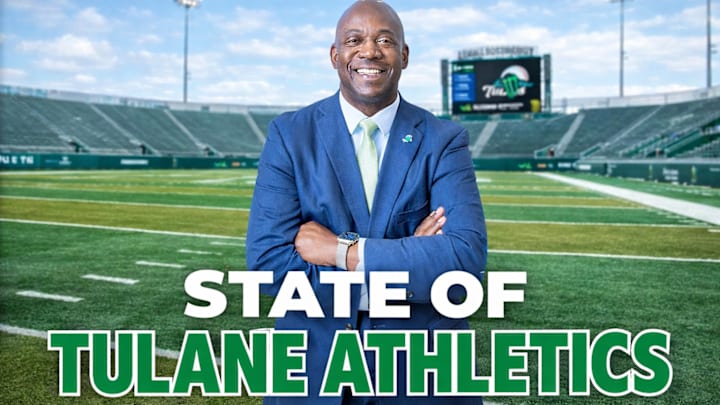
Welcome to this special edition of The Green Wave Report from On SI Tulane. Today Part 1 of a wide-ranging interview with Tulane athletic director David Harris on the State of Tulane athletics.
This four-part series focuses on the NIL and the possibility of a Collective Bargaining Agreement with student-athletes, the athletic programs that are successful at Tulane and those that have not seen the ceiling yet, athletic facilities and their future, and what Harris’ vision is for Tulane athletics. The series will run on Mondays and Wednesdays at Noon for the next two weeks.
Part 1 was released Monday, April 6 at Noon. Part 2 is set for Noon on Wednesday, April 8. Then, we'll do it again next week with Parts 3 and 4. To see all the interviews with Harris, go to our YouTube Channel. If you'd like to see Part 1, check it out here.
Part one is about the Give Green campaign at Tulane. Then, we follow up with where the NCAA and Tulane in particular stands on NIL and where Harris thinks will go on a possible CBA for athletes.
The Give Green Campaign
It's a big deal for the entire university.
And you can decide what area you would like to direct your giving toward. Well, those two areas, right? Those two areas now, right? Well, for athletics, that's right. Yeah, so if you're interested in giving to athletics, you can give to the annual fund or you can give to the Green Wave Talent Fund.
So as the athletics director, obviously it's my responsibility to try to make sure that we get as many donations as we can to athletics because we actually have a friendly competition that happens within the university where we're trying to win the Big Green Grand Prize by getting the most donors to give. To our particular department last year, we had 987 donors that gave about $400,000. So records in both respects.
This year, we would like to get over 1,000 donors. And so it's an important day for us. It's a day where everyone has an opportunity to decide to make a donation to help us.
And it's really not about the amount, but we have some big donations that come in. But if you're giving $20 or whatever it is that you give, all of that is important because what's really important for us is the engagement, that you're willing to take the time to go to the computer or to your phone and to make the donation and to want to do something that benefits Tulane Athletics. And so that's why we are counting the donors more so than the amount of money, although the amount is important as well.
NIL
Well, big picture is extremely important to us.
If you look at how college athletics is moving forward, the ability to be able to provide compensation for your student-athletes is, in a very short period of time, become extremely important. And now it's really become a dominant way that athletics departments are investing in competitive success. And so while everybody does it to a different level and everybody does it a little bit differently, if you're an athletic director's position, you are very likely actively involved in some form or fashion in making sure that you have the resources necessary to provide NIL opportunities or rev-share opportunities for your student-athletes.
So it's certainly an important thing for us at Tulane. It's an important part of my job on an everyday basis. Thankfully, we have a great team here that helps us to be able to gather the funds and raise the money necessary to be able to provide these opportunities.
But yes, it's become increasingly important in a very short period of time, and it's a really key component to future success that we're looking to have here at Tulane.
Collective Bargaining with Student-Athletes
Yeah, it's an interesting concept, and to be honest, I'm not well-versed enough to know whether or not it is a realistic option for college sports. I've certainly heard it discussed, and when you look at it on the surface, it sounds reasonable because the principle behind collective bargaining is that representation from the student athletes and representation from the universities come together, and they agree on a set of guidelines, a framework of principles, the benefits that each entity is going to have, and everybody's appropriately represented, so no one is being taken advantage of, and you have an industry that is working together to be able to move college athletics forward. Whether or not you can do that when you're student athletes or students as opposed to employees, that's where it starts to get murky for me.
I don't know if that's entirely possible. I will say that as you look at the framework that we're operating in now, it feels like any time that the NCAA or institutions want to institute a rule or a policy or a change, there's always going to be pushback on the other side that, hey, was that done with the appropriate representation or the appropriate feedback from student athletes? Is this being dictated to them, or are they working in partnership with you in making some of those decisions? And so that's always going to be a question, and so you could argue that collective bargaining maybe helps you to solve that, but getting from where we are now to that point, there's a question as to whether or not that's the best thing to do, and there's a question as to whether or not that can be done within our current framework or whether you have to go to a completely different framework, and if you do, then is that in our best interest? And so lots of discussions ahead to try to figure out what's best.
On Wednesday, at Noon, Part two of our exclusive interview with Tulane AD David Harris. We’ll be talking about those programs that are successful in Uptown and those that have not met his standards as of yet.
In the meantime, please join us for our regular edition of the Green Wave Report this afternoon at 4:00 p.m. when we’ll focus on baseball and the transfer portal. Until then, I’m Doug Joubert
 Add us as a preferred source on Google
Doug has covered a gamut of sporting events in his fifty-plus years in the field. He started doing sideline reporting for Louisiana Tech football games for the student radio station. Doug was Sports Director for KNOE-AM/FM in Monroe in the mid-80s, winning numerous awards from the Louisiana Sports Writers Association for Best Sportscast and Best Play-by-Play. High school play-by-play for teams in Monroe, Natchitoches, New Orleans, and Thibodaux, LA dot his resume. He did college play-by-play for Northwestern State University in Natchitoches for nine years. Then, moving to the Crescent City, Doug did television PBP of Tulane games and even filled in for legendary Tulane broadcaster, Ken Berthelot in the only game Kenny ever missed while doing the Green Wave games. His father was an alumnus of Tulane in the 1940s, so Doug has attended Tulane football games in old Tulane Stadium, the Superdome, and Yulman. He was one of the 86,000 plus on December 1, 1973, sitting in the North End Zone to seeTulane shutout the LSU Tigers, 14-0. He was there when the Posse ruled Fogelman and in Turchin when the Wave made it to the World Series. He currently is the public address voice of the Tulane baseball team.