
Florida Panthers aim to pick up pace after frustrating division losses
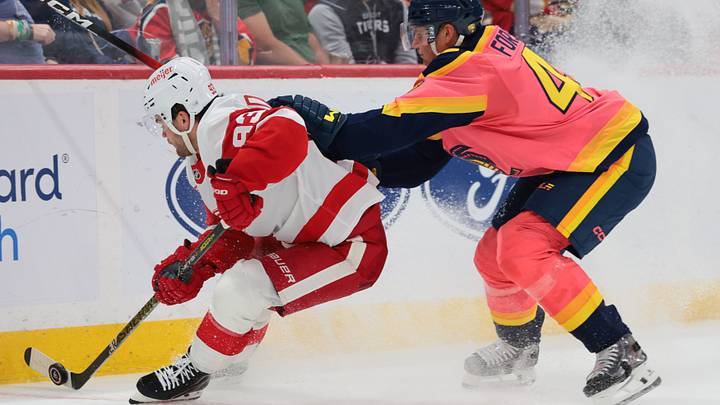
In assessing the Florida Panthers’ 5-3 loss to the Detroit Red Wings, coach Paul Maurice made three references to his team’s deficiency in pace as a contributing factor.
Notably he said, “We had pucks in the offensive zone that we had a hard time making anything happen with. We were just moving too slow.”
Maurice made similar remarks after other early-season losses. Moving too slow may help explain some of their shortcomings over the first 15 games.
Specifically, their 0-3 start within the Atlantic Division with losses against young, ascending opponents: Red Wings, Ottawa Senators and Buffalo Sabres.
When an opponent like Detroit utilizes dynamic skaters like Alex DeBrincat, or younger squads hit the Panthers with quick transition rushes, Florida’s lack of high-end, explosive skating speed leaves them a step slow in defensive coverage recoveries.
“There’s not easy puck movement for us right now,” Maurice said. “We're just slow with some things.”
Opponents make Panthers pay for mistakes
When their puck movement is slow, their possession shifts from dangerous to stagnant. They over-skate and over-cycle the puck in the offensive zone rather than attacking quickly.
This slow execution allows teams with faster, more opportunistic transition models (like Ottawa, Buffalo and Detroit) to weather long cycles, intercept a sluggish pass, and punish Florida on odd-man rushes going the other way.
Maurice’s eyes aren’t deceiving him. The Panthers’ “slow” play is reflected in their tracking data on NHL EDGE.
The Panthers rank 30th in the NHL in maximum skating speed. Their top tracked speed belongs to defenseman Gustav Forsling at 22.59 mph, which is well below the league average max of 23.24 mph.
They are also near the bottom of the league at 29th with just 237 speed bursts over 20 mph, compared to a league average of 309.
Panthers dominant in puck possession
The paradox of the Panthers is that they don't appear slow by the measure of how much time they spend with the puck. They are second in the NHL in Even-Strength Offensive Zone Time Percentage at 43.2 percent. They also rank 10th in total skating distance (640.15 miles).
Most vexing for the Panthers, they rank in expected goal percentage (xG%) in 5-on-5 play, yet they have struggled to translate that dominance into actual goals and consistent results.
Their 5-on-5 shooting percentage is an anemic 7.6 percent. At 5-on-5, their expected goals are 27.0, but their actual goals scored at 5-on-5 is just 22.
They are second in Even-Strength Offensive Zone Time Percentage at 43.2 percent.
Some nights that translates into goals aplenty — they already have five hat tricks, including two in one game.
Monday against Detroit, the Panthers had a 43-23 advantage in scoring chances. But they never led in the game.
Slow start tough to overcome
“I thought we were a little slow to start, and it kind of just carried on throughout the game,” said forward Sam Bennett, who scored a late goal with the goalie pulled against the Red Wings. “We know we need to be better against divisional teams, and that’s obviously going to be a focus for us. So, yeah, we’ll be aware of that for sure.”
Encouraging for the Panthers, analytics suggest their shooting percentage inevitably will progress back toward the league average (8.9 percent), and these types of games could swing in their favor.
There is certainly no panic around the Panthers, who conclude the current homestand Wednesday against Chicago. They were 8-5-2 and held the second wild card in the Eastern Conference after Monday.
They are also buoyed by the expected return of star forwards Sasha Barkov and Brad Marchand later this month.
But the issue of pace is worth watching as every opponent brings its best against the two-time Stanley Cup champions. The Panthers will need to meet the challenge within their division in order to end their one-year absence from the playoffs.
 Add us as a preferred source on Google

Craig has covered South Florida sports and teams, including the Florida Panthers, since 1978. On NHL assignments, he was especially fond of games at Canadian cities and arenas, where the crowd joined in singing “O Canada,” and recalls a memorable visit to the Coldest Corner in the NHL at the intersection of Portage and Main in Winnipeg. In 50 years as a newspaper journalist, he covered a wide range of sports and events from the winless inaugural season of the Tampa Bay Buccaneers to the America’s Cup in Western Australia. In South Florida, he spent forty years in a variety of roles for the Sen Sentinel and four and a half years as a sports copy editor with the Miami Herald. He is in his ninth year writing columns about the Miami Dolphins for Five Reasons Sports Network. Follow him on the site formerly known as Twitter @CraigDavisRuns.