
Red Wings Offensive Struggles Run Deeper Than Lack of Scoring
In this story:
The Detroit Red Wings have plenty of players capable of putting the puck in the net. Getting them to work together to create those chances has become an entirely different proposition.
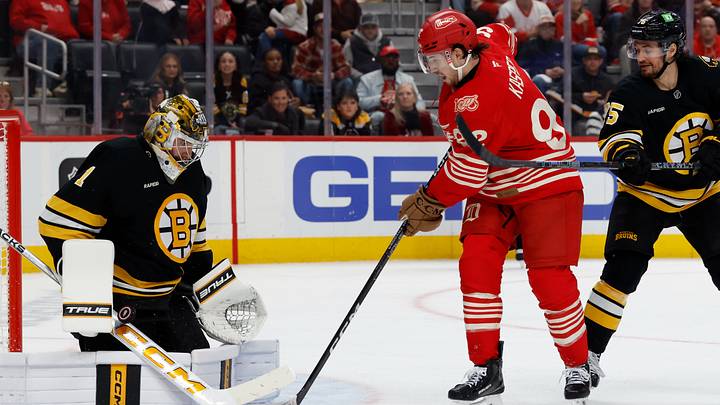
Wednesday's 4-1 loss to the Boston Bruins offered another frustrating example of an offense that has struggled to find cohesion.
The Red Wings managed just 21 shots on goal, while the Bruins blocked 23 attempts. The Red Wings frequently found themselves working along the perimeter, unable to penetrate the Bruins' defensive coverage or generate meaningful traffic around Boston goaltender Jeremy Swayman.
For Andrew Copp, the problem extended beyond missed shots.
Too Much Individual Effort, Not Enough Cooperation

Following the defeat, Copp offered a candid assessment of the Red Wings' offensive difficulties.
"We were getting spread out and playing fives games 1-on-1 instead of setting up some 2-on-1s to create some chaos," Copp told Dave Hogg of NHL.com.
His comments identified a fundamental weakness in Detroit's approach.
Rather than forcing defenders to make difficult decisions through coordinated movement, the Red Wings have too often relied on individual efforts to manufacture offense.
The consequences have become increasingly apparent.
The Red Wings have lost six of their past seven games, scoring just 12 goals during that stretch while surrendering 22. Six of those contests saw the Red Wings finish with two goals or fewer.
Even Saturday's victory over the Tampa Bay Lightning required a 31-save shutout from Daniil Tarasov, with the Red Wings' second goal coming into an empty net.
McLellan Needs More From His Entire Lineup
Lucas Raymond has remained one of the Red Wings' few consistent offensive contributors. His first period goal against the Bruins gave the Red Wings an early lead, extending his goal-scoring streak to three games. Copp also extended his point streak to four contests.
However, individual production has done little to disguise the team's broader problem.
Red Wings coach Todd McLellan acknowledged that only two of his forward lines were performing effectively against the Bruins, according to Hogg.
"When we did get momentum, we weren't able to sustain it," McLellan said. "We had two lines playing well, but you can't play all night with two lines."
Alex DeBrincat and Viktor Arvidsson are among the forwards experiencing prolonged scoring droughts. McLellan has expressed confidence that his struggling scorers will eventually regain their touch, but waiting for individual players to break through cannot substitute for a functioning offensive system.
Boston showed the difference on Wednesday.
The Bruins repeatedly forced the Red Wings into uncomfortable defensive situations, creating passing lanes and converting opportunities around the net. Their ability to maintain pressure contrasted sharply with the Red Wings' sporadic attacks.
The Red Wings' offensive woes have also placed an unreasonable burden on their goaltenders, who have little margin for error when their teammates struggle to score. The Red Wings will look to right the ship on Saturday night, when they go up against the New York Islanders at Little Caesars Arena.
 Add us as a preferred source on Google

Jason Fink is an NHL writer and lifelong hockey fan who fell in love with the game when he watched Wayne Gretzky’s Edmonton Oilers defeat the Philadelphia Flyers in the 1987 Stanley Cup Final. When he’s not writing, Jason enjoys spending time with his wife Michelle and their son Theo and daughter Stella. Whether he’s following the latest NHL news or cheering from the rink, his passion for the sport has been a constant throughout his life.