%22%3E%0A%3Cpath%20d%3D%22M214.538%204.86816C220.361%20-0.955348%20229.802%20-0.955327%20235.625%204.86816C241.449%2010.6917%20241.449%2020.1325%20235.625%2025.9561L225.082%2036.5L214.538%2025.9561C208.714%2020.1325%20208.714%2010.6917%20214.538%204.86816ZM222.347%2014.9268C219.32%2014.9268%20217.066%2015.8417%20217.066%2017.8711V18.2441C217.066%2020.016%20217.975%2020.8155%20221.371%2021.5303C222.446%2021.76%20222.816%2021.7883%20222.816%2022.418V22.79C222.816%2023.1623%20222.715%2023.3047%20222.311%2023.3047C221.84%2023.3046%20221.806%2023.0476%20221.806%2022.7627V21.79H217.064V22.2471C217.064%2024.6489%20218.646%2025.3642%20222.446%2025.3643C226.046%2025.3643%20227.727%2024.7068%20227.727%2022.3623V21.8154C227.727%2020.1584%20226.685%2019.4718%20223.422%2018.8145C222.448%2018.6145%20222.078%2018.4141%20222.078%2017.8145V17.4414C222.078%2017.1546%20222.347%2017.0118%20222.583%2017.0117C222.919%2017.0117%20223.087%2017.2138%20223.087%2017.4414V18.6143H227.561V17.8994C227.561%2015.9569%20226.517%2014.9268%20222.347%2014.9268ZM228.594%2015.2363V25.0576H233.095V15.2363H228.594ZM221.008%206.40625C220.272%206.40626%20219.628%206.47371%20219.076%206.6123C218.522%206.74889%20218.084%206.94683%20217.759%207.2041C217.435%207.4614%20217.241%207.7469%20217.179%208.05762C217.118%208.3685%20217.085%208.898%20217.085%209.64648V10.9189C217.085%2011.6833%20217.118%2012.2204%20217.183%2012.5273C217.249%2012.8322%20217.448%2013.1176%20217.787%2013.377C218.125%2013.6383%20218.573%2013.8322%20219.127%2013.9629C219.682%2014.0936%20220.27%2014.1592%20221.006%2014.1592C221.743%2014.1592%20222.387%2014.0917%20222.939%2013.9531C223.491%2013.8165%20223.932%2013.6178%20224.256%2013.3604C224.581%2013.103%20224.775%2012.8176%20224.836%2012.5068C224.898%2012.1959%20224.929%2011.667%20224.929%2010.9189V9.64648C224.929%208.88216%20224.898%208.345%20224.833%208.03809C224.767%207.73315%20224.567%207.44985%20224.228%207.18848C223.889%206.92717%20223.442%206.7332%20222.887%206.60254C222.333%206.47191%20221.705%206.40625%20221.008%206.40625ZM225.529%206.56055V14.002H228.363V10.6201L230.125%2014.002H233.095V6.56055H230.261V9.91113L228.363%206.56055H225.529ZM221.021%207.59277C221.229%207.59279%20221.368%207.64037%20221.435%207.7373C221.502%207.83235%20221.536%208.05485%20221.536%208.40137V11.8203C221.536%2012.2577%20221.504%2012.5354%20221.439%2012.6523C221.374%2012.7692%20221.224%2012.8262%20220.995%2012.8262L220.998%2012.8281C220.774%2012.8281%20220.629%2012.7768%20220.568%2012.6758C220.507%2012.5748%20220.474%2012.3076%20220.474%2011.876V8.40137C220.474%208.01934%20220.522%207.78727%20220.615%207.70996C220.708%207.63274%20220.845%207.59277%20221.021%207.59277Z%22%20fill%3D%22white%22%2F%3E%0A%3Cpath%20d%3D%22M195.595%2032.2359L193.251%2028.0096L190.907%2032.2359H181.648L188.41%2021.7469L181.648%2011.2578H191.061L193.366%2015.4842L195.71%2011.2578H204.97L198.246%2021.7469L205.008%2032.2359H195.595Z%22%20fill%3D%22white%22%2F%3E%0A%3Cpath%20d%3D%22M171.663%209.75861V4.1875H180.692V9.75861H171.663ZM171.817%2032.2352V11.257H180.538V32.2352H171.817Z%22%20fill%3D%22white%22%2F%3E%0A%3Cpath%20d%3D%22M154.969%2032.2358V11.2577H163.691V15.4841C164.882%2012.6409%20166.803%2010.7966%20170.261%2010.9503V20.2099H169.339C165.65%2020.2099%20163.691%2022.2462%20163.691%2026.8952V32.2358H154.969Z%22%20fill%3D%22white%22%2F%3E%0A%3Cpath%20d%3D%22M129.161%2032.2349V5.33984H141.263C148.41%205.33984%20153.289%208.52882%20153.289%2014.9068V14.9836C153.289%2021.4769%20148.333%2024.9348%20141.071%2024.9348H138.151V32.2349H129.161ZM138.151%2018.5184H140.572C142.877%2018.5184%20144.414%2017.481%20144.414%2015.5599V15.4831C144.414%2013.5236%20142.992%2012.5247%20140.61%2012.5247H138.151V18.5184Z%22%20fill%3D%22white%22%2F%3E%0A%3Cpath%20d%3D%22M101.625%2032.7346C96.5531%2032.7346%2092.5957%2028.3162%2092.5957%2021.8998V21.8229C92.5957%2015.176%2096.5915%2010.7576%20101.548%2010.7576C104.737%2010.7576%20106.504%2012.1407%20107.849%2013.6392V4.1875H116.571V32.2352H107.849V29.6609C106.427%2031.1978%20104.814%2032.7346%20101.625%2032.7346ZM104.545%2025.5498C106.543%2025.5498%20108.041%2023.8977%20108.041%2021.7845V21.7077C108.041%2019.6329%20106.543%2017.9424%20104.545%2017.9424C102.547%2017.9424%20101.048%2019.5945%20101.048%2021.7077V21.7845C101.048%2023.8977%20102.547%2025.5498%20104.545%2025.5498Z%22%20fill%3D%22white%22%2F%3E%0A%3Cpath%20d%3D%22M68.4463%2032.2354V11.2573H77.1679V14.1773C78.5126%2012.4484%2080.6258%2010.7578%2083.5842%2010.7578C88.0027%2010.7578%2090.769%2013.6778%2090.769%2018.4037V32.2354H82.0474V21.2084C82.0474%2019.4026%2080.9716%2018.3653%2079.6653%2018.3653C78.359%2018.3653%2077.1679%2019.4026%2077.1679%2021.2084V32.2354H68.4463Z%22%20fill%3D%22white%22%2F%3E%0A%3Cpath%20d%3D%22M51.2163%2032.7335C47.182%2032.7335%2044.3389%2030.4283%2044.3389%2026.2787V26.2019C44.3389%2022.014%2047.451%2019.6702%2052.3305%2019.6702C54.0979%2019.6702%2056.3647%2020.0545%2057.2868%2020.4387V20.0929C57.2868%2018.1718%2056.0957%2017.0576%2053.4063%2017.0576C51.2547%2017.0576%2049.4489%2017.5186%2047.6047%2018.2487L46.0678%2012.447C48.4884%2011.5249%2051.2547%2010.9102%2054.9047%2010.9102C59.1694%2010.9102%2061.9358%2011.7938%2063.78%2013.6381C65.3553%2015.2134%2065.97%2017.2497%2065.97%2020.285V32.2341H57.2484V30.1209C55.7884%2031.6962%2053.8289%2032.7335%2051.2163%2032.7335ZM54.6742%2027.7003C56.211%2027.7003%2057.3636%2026.4708%2057.3636%2024.4729V23.5892C56.8642%2023.3971%2056.0958%2023.2434%2055.3657%2023.2434C53.6368%2023.2434%2052.6763%2024.2808%2052.6763%2025.5871V25.664C52.6763%2026.8935%2053.5599%2027.7003%2054.6742%2027.7003Z%22%20fill%3D%22white%22%2F%3E%0A%3Cpath%20d%3D%22M29.3491%2032.2358V11.2577H38.0707V15.4841C39.2618%2012.6409%2041.1828%2010.7966%2044.6408%2010.9503V20.2099H43.7186C40.0302%2020.2099%2038.0707%2022.2462%2038.0707%2026.8952V32.2358H29.3491Z%22%20fill%3D%22white%22%2F%3E%0A%3Cpath%20d%3D%22M15.0995%2032.8113C6.72371%2032.8113%200%2027.2018%200%2018.8643V18.7875C0%2010.7574%206.33949%204.76367%2014.8306%204.76367C19.4411%204.76367%2023.168%206.30053%2026.088%208.83635L21.0548%2014.9069C19.2874%2013.4085%2017.328%2012.5632%2015.0995%2012.5632C11.6032%2012.5632%209.0674%2015.2527%209.0674%2018.9028V18.9796C9.0674%2022.7833%2011.7185%2025.396%2015.4837%2025.396C17.0206%2025.396%2017.8659%2025.1655%2018.5574%2024.7812V22.0917H13.9469V16.3285H26.9717V28.7771C24.0517%2031.1592%2019.979%2032.8113%2015.0995%2032.8113Z%22%20fill%3D%22white%22%2F%3E%0A%3C%2Fg%3E%0A%3Cdefs%3E%0A%3CclipPath%20id%3D%22clip0_17412_50443%22%3E%0A%3Crect%20width%3D%22240%22%20height%3D%2236%22%20fill%3D%22white%22%20transform%3D%22translate(0%200.5)%22%2F%3E%0A%3C%2FclipPath%3E%0A%3C%2Fdefs%3E%0A%3C%2Fsvg%3E%0A)
A2RL: The Futuristic Racing Series Marking a Major Milestone for Autonomy at Imola
Formula 1's visit to the historic Monza circuit for the Italian Grand Prix may be at the top of motorsport's agenda this weekend, but elsewhere in the country, a series just as important has taken a major step in its fledgling history.
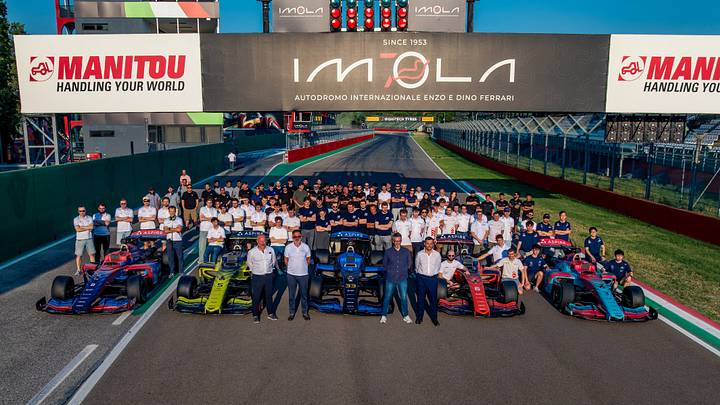
The A2RL [Abu Dhabi Autonomous Racing League] is at Imola for its first race event held away from Abu Dhabi's Yas Marina Circuit, which has held races across the first two seasons - events that have primarily been an introductory ground for the technology used by the series.
It is an impressive feat of engineering and technological sophistication with human drivers replaced by 'agents', computers, radar and LiDAR working together to get an adapted Japanese SuperFormula car - which has been stripped of the unnecessary weight of crash safety structures and the Halo, for example - around the circuit in the fastest time possible.
Tomorrow, we make history. 🇮🇹🏁
— Abu Dhabi Autonomous Racing League (@A2RLeague) September 4, 2026
The cars are ready. The teams are locked in. Imola is waiting.
No drivers. No limits. Just autonomous racing at the edge. 🔥
5 September. This is A2RL at Imola.#A2RL #Imola #AutonomousRacing pic.twitter.com/gz4GtzIOnT
All cars are regulated by series mechanics, meaning base set-ups are used. The only thing the teams can change to make their machinery go faster is the coding. Control is aided by circuit CCTV feeds, live onboard cameras, and the telemetry from the car itself, with teams in the garage constantly adjusting to the information given.
It's then up to the LiDAR scanners to perform within the boundaries set and react to what is scanned in real time, working hand in hand with the coding and radar.
And while this is a racing championship, A2RL champions innovation and technological progression. In just two years, the time delta between an autonomous agent and the series' reference human drivers, who are former F1 driver Daniil Kvyat and SuperFormula driver Juju Noda, has been slashed from nine seconds to just 0.850 seconds. But the series, created by ASPIRE, isn't stopping there.
Speaking to Grand Prix on SI at Imola ahead of the weekend's racing action, Executive Director, House of Challenges Alessandro Tucci, revealed just how big a step racing outside of Abu Dhabi really is for A2RL.
"Last November, in Yas Marina, for the first time we were able to put six cars together - the first time in history that six autonomous cars were together on track racing one another. So after that race, we said we want to push further, we want to do the next step and this represents the next step," said Tucci.

"We have five teams [at Imola], one of them for organizational reasons couldn't attend, otherwise there would have been six.
"And why is this the next step? Well, because after the November race, we understood we had a product of racing, the technology was mature enough to race - they have overtakes, crashes and everything.
"So the decision was 'let's go overseas, let's go out of Abu Dhabi'. It's well-known for the teams, so that's a first level of complexity.
"The second level of complexity was 'let's choose a track that has technical complexities for traditional motorsport - for the drivers and cars - so that the teams, the agents, let's see how they respond'.
"Yas Marina is a very modern track, very wide, the walls are not so close to the track, it's comfortable. Imola is not, Imola is narrow, is old style, difficult, has ups and downs from the hills. All this is totally new.
Behind every lap is the work you don’t see. 🔧🏁
— Abu Dhabi Autonomous Racing League (@A2RLeague) September 3, 2026
Mechanics locked in. Cars fine-tuned. Controlled chaos before we hit the track. 👀🔥#A2RL #Imola pic.twitter.com/U9Qj7u8TV7
"For the autonomous cars, the LiDAR, the visor that works horizontally, going up and down is something they haven't tested before, so this is why we have chosen Imola.
"A2RL is a motorsport competition, yes, but it remains and always will remain a technology challenge. So we will continue to try and merge and keep together these two components in order to make it appealing and entertaining on one side, but also innovative on the other."
A key aspect of A2RL is the fact that innovation works both ways, for the series and for partners and providers. LiDAR systems are by no means new technology, but previous generations did not meet the needs of the autonomous league.
New LiDAR systems have since been developed and are currently being used on the new cars, with the improvements felt by the series and beyond.
"This is how technology research and evolution works, right?" Tucci says.
"You test the car or the software, or the components that we are using for the autonomous car, we use it, we test it and we identify problems - sometimes we fail because it is a part of the research - we continue investigating, we continue modifying until we find the solution and then we continue testing until we are successful. This is the objective of A2RL."
The move away from Abu Dhabi provides challenges far greater than just needing to learn a new circuit. Climate and conditions are vastly different from those experienced at Yas Marina and while heat, humidity, and the rain pose challenges for human drivers, this is also the case for autonomous agents.

"Every element is a new variable for the car, for the mechanic of the car, and the agent that needs to drive the car. It needs to consider the wet of the rain or the humidity. Imola is a very humid situation, the track changes and they need to consider all the changes."
With the focus on ramping up technological development, the teams' challenge remains focused on the agent itself. As well as standardized setups across the grid, there has been little change in the machinery used for the new season compared to season two.
And while the agent development is clearly a focal point, the R&D extends beyond just the car itself, as Tucci explained.
"We are working on two levels - one is continuously developing single parts of the car where we see we had failures or we had issues, etcetera. One of the next steps will be developing a new computer exactly for what we were saying before regarding weather conditions, sand, dust, temperature - all that is affecting the current computer that under certain circumstances may break, so we need to find a solution.
"The second layer is the infrastructure around the car. In Abu Dhabi last November, we developed a 5G private network with Du [Abu Dhabi Telecommunications company] fully dedicated to the transmission of the data of the car.
"For them, it was an incredible opportunity to test a new product, a new technology. For us, it was a fantastic solution in order to have a private network fully dedicated to the transmission of the data, that is very heavy for these cars.
"This is a way we are developing the infrastructure, not only in the car but also around the car."

And with progression the focus for ASPIRE, there is no reason why attention is fixed on circuit racing. The world-famous Dakar Rally and off-road racing in general could provide an interesting challenge for automation.
"Any application, any commercial application outside the races of A2RL can be considered. I'm thinking about applications in agriculture, logistics, or the future of mobility in our cities with public transportation, robo-taxis, et cetera," revealed Tucci.
"Other competitions? Why not. The Dakar, the off-road, brings other complexities versus track racing that, for the teams ,will be like a separate project. But yes, this is something we are considering. We are looking maybe with a different product, with a different technological challenge, but yes, definitely."
As for A2RL, what registers as a success for Tucci? Progression of the championship that could see races further afield, or progression of the technology far beyond what is achieved by the racing series?
"A mix of the two," he insists. "We have five teams here, should have been six because one couldn't attend, then five teams more that will join the October Yas Marina tests, and we expect that maybe one or two of them will be able to become top teams as these are.

"So we want to increase the number of teams on the track, we want to go to different tracks to offer new opportunities and new challenges to the teams.
"We are thinking to mix the physical races with the digital races. We run the Sim Sprint across five tracks in our simulator, why not create a competition that mixes the two?
"We are working on all these options and many more we have in order to make A2RL always innovative from a technology point of view, but also from a competition point of view."
 Add us as a preferred source on Google
Ewan is a motorsport journalist covering F1 for Grand Prix On SI. Having been educated at Silverstone, the home of the British Grand Prix, and subsequently graduating from university with a sports journalism degree, Ewan made a move into F1 in 2021. Ewan joins after a stint with Autosport as an editor, having written for a number of outlets including RacingNews365 and GPFans, during which time he has covered grand prix and car launches as an accredited member of the media.
Follow ewangale