%22%3E%0A%3Cpath%20fill-rule%3D%22evenodd%22%20clip-rule%3D%22evenodd%22%20d%3D%22M156.868%204.36764C162.691%20-1.45588%20172.132%20-1.45588%20177.956%204.36764C183.779%2010.1912%20183.779%2019.6324%20177.956%2025.4559L167.412%2036L156.868%2025.4559C151.044%2019.6324%20151.044%2010.1912%20156.868%204.36764ZM159.509%207.55761C159.448%207.86849%20159.416%208.39718%20159.416%209.14566V10.4189C159.416%2011.1832%20159.448%2011.7198%20159.513%2012.0267C159.578%2012.3317%20159.778%2012.6168%20160.117%2012.8762C160.456%2013.1376%20160.903%2013.3316%20161.458%2013.4623C162.012%2013.593%20162.6%2013.6584%20163.337%2013.6584C164.073%2013.6584%20164.717%2013.591%20165.269%2013.4524C165.822%2013.3158%20166.261%2013.1178%20166.586%2012.8604C166.911%2012.6029%20167.105%2012.3178%20167.166%2012.0069C167.228%2011.6961%20167.259%2011.1674%20167.259%2010.4189V9.14566C167.259%208.38134%20167.228%207.84473%20167.162%207.53781C167.097%207.23287%20166.897%206.94971%20166.558%206.68834C166.22%206.42696%20165.772%206.23291%20165.218%206.10223C164.663%205.97154%20164.036%205.90619%20163.339%205.90619C162.602%205.90619%20161.959%205.97352%20161.406%206.11213C160.852%206.24875%20160.414%206.44677%20160.089%206.70418C159.765%206.9616%20159.571%207.24673%20159.509%207.55761ZM164.776%2024.8638C168.376%2024.8638%20170.057%2024.2064%20170.057%2021.862V21.858V21.3155C170.057%2019.6581%20169.016%2018.971%20165.752%2018.3136C164.778%2018.1136%20164.408%2017.9136%20164.408%2017.3136V16.9414C164.408%2016.6543%20164.677%2016.5117%20164.913%2016.5117C165.249%2016.5117%20165.418%2016.7137%20165.418%2016.9414V18.1136H169.891V17.3988C169.891%2015.4563%20168.847%2014.4266%20164.677%2014.4266C161.65%2014.4266%20159.396%2015.3414%20159.396%2017.3711V17.7433C159.396%2019.5155%20160.305%2020.3155%20163.701%2021.0303C163.78%2021.0472%20163.855%2021.063%20163.927%2021.0781C164.829%2021.2674%20165.147%2021.3341%20165.147%2021.9174V22.2897C165.147%2022.6619%20165.046%2022.8045%20164.642%2022.8045C164.17%2022.8045%20164.137%2022.5471%20164.137%2022.262V21.2897H159.394V21.7471C159.394%2024.149%20160.976%2024.8638%20164.776%2024.8638ZM170.924%2024.5569H175.425V14.7355H170.924V24.5569ZM172.455%2013.5019H175.425V6.06064H172.592V9.411L170.693%206.06064H167.859V13.5019H170.693V10.1199L172.455%2013.5019ZM163.769%2012.152C163.704%2012.2688%20163.555%2012.3262%20163.325%2012.3262L163.327%2012.3282C163.104%2012.3282%20162.959%2012.2767%20162.898%2012.1758C162.836%2012.0748%20162.805%2011.8074%20162.805%2011.3758V7.90068C162.805%207.51852%20162.852%207.28684%20162.945%207.20962C163.038%207.13239%20163.175%207.09279%20163.351%207.09279C163.559%207.09279%20163.698%207.14031%20163.765%207.23734C163.832%207.33239%20163.866%207.55416%20163.866%207.90068V11.3203C163.866%2011.7579%20163.834%2012.0352%20163.769%2012.152Z%22%20fill%3D%22white%22%2F%3E%0A%3Cpath%20d%3D%22M134.707%2035.9991C129.823%2035.9991%20126.029%2035.0305%20122.478%2033.2547L125.303%2027.7255C127.765%2029.017%20130.227%2029.8242%20133.254%2029.8242C136.684%2029.8242%20138.5%2028.0484%20138.5%2024.9811V24.3354C137.249%2025.7479%20135.191%2027.3623%20132.124%2027.3623C126.433%2027.3623%20122.316%2023.3264%20122.316%2017.2322V17.1515C122.316%2010.9766%20126.514%206.90039%20131.599%206.90039C134.828%206.90039%20136.724%208.11115%20138.339%209.76586V7.42506H147.5V23.8914C147.5%2027.9677%20146.653%2030.7524%20144.635%2032.7704C142.657%2034.748%20139.63%2035.9991%20134.707%2035.9991ZM134.868%2020.6627C137.128%2020.6627%20138.541%2019.1291%20138.541%2017.1919V17.1112C138.541%2015.2143%20137.088%2013.6807%20134.868%2013.6807C132.608%2013.6807%20131.195%2015.2547%20131.195%2017.1919V17.2726C131.195%2019.1695%20132.648%2020.6627%20134.868%2020.6627Z%22%20fill%3D%22white%22%2F%3E%0A%3Cpath%20d%3D%22M96.9492%2029.4629V7.42701H106.111V10.4943C107.523%208.67813%20109.743%206.90234%20112.851%206.90234C117.492%206.90234%20120.398%209.96961%20120.398%2014.9337V29.4629H111.236V17.8799C111.236%2015.9831%20110.106%2014.8934%20108.734%2014.8934C107.362%2014.8934%20106.111%2015.9831%20106.111%2017.8799V29.4629H96.9492Z%22%20fill%3D%22white%22%2F%3E%0A%3Cpath%20d%3D%22M84.8096%205.85202V0H94.2939V5.85202H84.8096ZM84.971%2029.4619V7.42602H94.1324V29.4619H84.971Z%22%20fill%3D%22white%22%2F%3E%0A%3Cpath%20d%3D%22M58.877%2029.4619V0H68.0384V10.3722C69.451%208.55606%2071.6707%206.90135%2074.7783%206.90135C79.4196%206.90135%2082.3254%209.96862%2082.3254%2014.9327V29.4619H73.164V17.8789C73.164%2015.9821%2072.0339%2014.8924%2070.6617%2014.8924C69.2895%2014.8924%2068.0384%2015.9821%2068.0384%2017.8789V29.4619H58.877Z%22%20fill%3D%22white%22%2F%3E%0A%3Cpath%20d%3D%22M47.3991%2029.9876C43.1211%2029.9876%2039.2466%2028.8979%2036.0986%2026.7992L39.2063%2021.5929C41.8699%2023.2477%2044.8565%2024.0548%2047.3587%2024.0548C48.2466%2024.0548%2048.6906%2023.853%2048.6906%2023.3284V23.2477C48.6906%2022.8037%2048.287%2022.5212%2046.0673%2021.9562C40.4977%2020.584%2037.0672%2019.0907%2037.0672%2014.5302V14.4494C37.0672%209.60638%2040.9417%206.90234%2046.6726%206.90234C50.3049%206.90234%2053.8969%207.8306%2056.5605%209.44495L53.6547%2014.8934C51.3139%2013.6019%2048.4888%2012.8351%2046.6323%2012.8351C45.7444%2012.8351%2045.3408%2013.0772%2045.3408%2013.5212V13.6019C45.3408%2014.0458%2045.8251%2014.3284%2048.0448%2014.8934C53.6143%2016.2656%2056.9641%2017.7992%2056.9641%2022.3194V22.4001C56.9641%2027.2028%2053.3722%2029.9876%2047.3991%2029.9876Z%22%20fill%3D%22white%22%2F%3E%0A%3Cpath%20d%3D%22M25.5312%205.85202V0H35.0156V5.85202H25.5312ZM25.6927%2029.4619V7.42602H34.8541V29.4619H25.6927Z%22%20fill%3D%22white%22%2F%3E%0A%3Cpath%20d%3D%22M0%2029.4621V1.21094H23.6503V9.2827H9.44396V12.8746H22.6413V20.2199H9.44396V29.4621H0Z%22%20fill%3D%22white%22%2F%3E%0A%3C%2Fg%3E%0A%3Cdefs%3E%0A%3CclipPath%20id%3D%22clip0_16330_64756%22%3E%0A%3Crect%20width%3D%22182%22%20height%3D%2236%22%20fill%3D%22white%22%2F%3E%0A%3C%2FclipPath%3E%0A%3C%2Fdefs%3E%0A%3C%2Fsvg%3E%0A)
How to Modify a Flipping Jig to Catch More Largemouth Bass
Why the Flipping Jig Is My Go-To Lure for Largemouth Bass
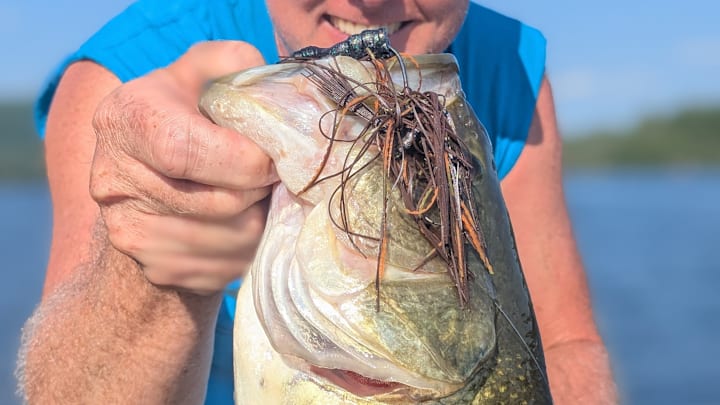
I get asked often what my number one lure is for targeting largemouth bass. Each time, without hesitation, I state that it's a flipping jig. And to be honest, that answer hasn't changed for decades.
A flipping jig exudes fishability. It’s designed to be pitched, dunked, swum, or skipped into any and all cover or structure a bass calls home. Not only will this bait get you numbers of fish, it excels at tempting the true giants.

I have the utmost confidence in a flipping jig. No matter what the weather conditions or season, or if targeting open water or cover, a flipping jig consistently triggers bites.
Flipping jigs fished straight out of the package will produce, but not as well as they could. That's why a few simple tweaks—trimming the weed guard and skirt, gluing the rubber skirt band, and sharpening up the hook—will help increase your catch rate and put more bass in the boat.
Trim the Weed Guard for Better Hook Penetration
Most stock flipping jig weed guards come in a standard length. In my opinion, all are too long and too stiff. Trimming and thinning the weed guard allows for more efficient hook penetration without compromising the snag-resistant qualities of the bait.
I cut approximately 1/4 inches of guard, at a 45-degree angle, leaving the bottom of the guard just past the tip of the hook point. I also cut out roughly six full nylon strands, cutting them flush at the jig head and adjacent to the line tie.


The final step is to fan out the weed guard. This will increase its weedless properties while also offering less resistance to a bass when biting.

Add a Few Drops of Glue to Secure the Skirt
After landing a bunch of bass, the rubber band that holds the jig skirt in place can begin to loosen and slide. As a preventative measure, I like to put a few drops of Super Glue along the edge of this band before I pitch any of my flipping jigs for the first time.

This is an easy tweak and will ensure your flipping jig skirt stays in place and maintains a life-like appearance in the water.
Trim the Skirt for a Better Profile
The undulation of the jig skirt, coupled with the plastic trailer, is what triggers largemouth bass to bite. By trimming a little bit from the bottom and top of the skirt, in a 45-degree angle, while leaving the middle section alone, will create a more natural profile while showcasing more of the plastic trailer pairing.


Don't trim too much. Removing 1/8 inch should suffice, unless it’s an unusually long skirt.
Sharpen the Hook Before It Hits the Water
How many anglers sharpen their hooks before getting a lure wet? We're all guilty of skipping this one, but it can make a huge difference in how many largemouth bass are swung into the boat.

Modern, chemically sharpened hooks, found on many flipping jigs, don't require a lot of sharpening. But I give them a few swipes just in case some glue or shellac has accidentally covered the tip during the manufacturing process. For hooks that aren't chemically sharpened, work each angle of the point until it is razor sharp.
Tools Needed To Tweak Your Flipping Jigs
1. Sharp scissors
2. Super glue
3. Hook hone
My Favorite Flipping Jig
I've tried dozens of flipping jigs over the years—some have been great; others not so much. For the last three years I've fished exclusively with Weapons of Bass Destruction jigs.
This Canadian company hand-manufactures flipping jigs that come in some incredible color patterns, have high-quality components, and truly excel when it comes to hooking and keeping bass pinned.
Out of the 10 color combination this company currently offers, my hands-down favorite is the #4 Sparkly Specs... (but keep that hot tip to yourself ;))

Want to learn my best four flipping jig trailers for largemouth bass? Read that informative guide HERE.
 Add us as a preferred source on Google
Justin Hoffman is an outdoor writer and photographer with 25 years of experience producing media content for a host of North American fishing and hunting publications. With an ardent passion for bass fishing, as well as chasing panfish on the fly, this Ontario-based angler is always seeking out new water to wet a line - and along with that, interesting stories to write and share.
Follow HoffmanOutdoors