%22%3E%0A%3Cpath%20fill-rule%3D%22evenodd%22%20clip-rule%3D%22evenodd%22%20d%3D%22M156.868%204.36764C162.691%20-1.45588%20172.132%20-1.45588%20177.956%204.36764C183.779%2010.1912%20183.779%2019.6324%20177.956%2025.4559L167.412%2036L156.868%2025.4559C151.044%2019.6324%20151.044%2010.1912%20156.868%204.36764ZM159.509%207.55761C159.448%207.86849%20159.416%208.39718%20159.416%209.14566V10.4189C159.416%2011.1832%20159.448%2011.7198%20159.513%2012.0267C159.578%2012.3317%20159.778%2012.6168%20160.117%2012.8762C160.456%2013.1376%20160.903%2013.3316%20161.458%2013.4623C162.012%2013.593%20162.6%2013.6584%20163.337%2013.6584C164.073%2013.6584%20164.717%2013.591%20165.269%2013.4524C165.822%2013.3158%20166.261%2013.1178%20166.586%2012.8604C166.911%2012.6029%20167.105%2012.3178%20167.166%2012.0069C167.228%2011.6961%20167.259%2011.1674%20167.259%2010.4189V9.14566C167.259%208.38134%20167.228%207.84473%20167.162%207.53781C167.097%207.23287%20166.897%206.94971%20166.558%206.68834C166.22%206.42696%20165.772%206.23291%20165.218%206.10223C164.663%205.97154%20164.036%205.90619%20163.339%205.90619C162.602%205.90619%20161.959%205.97352%20161.406%206.11213C160.852%206.24875%20160.414%206.44677%20160.089%206.70418C159.765%206.9616%20159.571%207.24673%20159.509%207.55761ZM164.776%2024.8638C168.376%2024.8638%20170.057%2024.2064%20170.057%2021.862V21.858V21.3155C170.057%2019.6581%20169.016%2018.971%20165.752%2018.3136C164.778%2018.1136%20164.408%2017.9136%20164.408%2017.3136V16.9414C164.408%2016.6543%20164.677%2016.5117%20164.913%2016.5117C165.249%2016.5117%20165.418%2016.7137%20165.418%2016.9414V18.1136H169.891V17.3988C169.891%2015.4563%20168.847%2014.4266%20164.677%2014.4266C161.65%2014.4266%20159.396%2015.3414%20159.396%2017.3711V17.7433C159.396%2019.5155%20160.305%2020.3155%20163.701%2021.0303C163.78%2021.0472%20163.855%2021.063%20163.927%2021.0781C164.829%2021.2674%20165.147%2021.3341%20165.147%2021.9174V22.2897C165.147%2022.6619%20165.046%2022.8045%20164.642%2022.8045C164.17%2022.8045%20164.137%2022.5471%20164.137%2022.262V21.2897H159.394V21.7471C159.394%2024.149%20160.976%2024.8638%20164.776%2024.8638ZM170.924%2024.5569H175.425V14.7355H170.924V24.5569ZM172.455%2013.5019H175.425V6.06064H172.592V9.411L170.693%206.06064H167.859V13.5019H170.693V10.1199L172.455%2013.5019ZM163.769%2012.152C163.704%2012.2688%20163.555%2012.3262%20163.325%2012.3262L163.327%2012.3282C163.104%2012.3282%20162.959%2012.2767%20162.898%2012.1758C162.836%2012.0748%20162.805%2011.8074%20162.805%2011.3758V7.90068C162.805%207.51852%20162.852%207.28684%20162.945%207.20962C163.038%207.13239%20163.175%207.09279%20163.351%207.09279C163.559%207.09279%20163.698%207.14031%20163.765%207.23734C163.832%207.33239%20163.866%207.55416%20163.866%207.90068V11.3203C163.866%2011.7579%20163.834%2012.0352%20163.769%2012.152Z%22%20fill%3D%22white%22%2F%3E%0A%3Cpath%20d%3D%22M134.707%2035.9991C129.823%2035.9991%20126.029%2035.0305%20122.478%2033.2547L125.303%2027.7255C127.765%2029.017%20130.227%2029.8242%20133.254%2029.8242C136.684%2029.8242%20138.5%2028.0484%20138.5%2024.9811V24.3354C137.249%2025.7479%20135.191%2027.3623%20132.124%2027.3623C126.433%2027.3623%20122.316%2023.3264%20122.316%2017.2322V17.1515C122.316%2010.9766%20126.514%206.90039%20131.599%206.90039C134.828%206.90039%20136.724%208.11115%20138.339%209.76586V7.42506H147.5V23.8914C147.5%2027.9677%20146.653%2030.7524%20144.635%2032.7704C142.657%2034.748%20139.63%2035.9991%20134.707%2035.9991ZM134.868%2020.6627C137.128%2020.6627%20138.541%2019.1291%20138.541%2017.1919V17.1112C138.541%2015.2143%20137.088%2013.6807%20134.868%2013.6807C132.608%2013.6807%20131.195%2015.2547%20131.195%2017.1919V17.2726C131.195%2019.1695%20132.648%2020.6627%20134.868%2020.6627Z%22%20fill%3D%22white%22%2F%3E%0A%3Cpath%20d%3D%22M96.9492%2029.4629V7.42701H106.111V10.4943C107.523%208.67813%20109.743%206.90234%20112.851%206.90234C117.492%206.90234%20120.398%209.96961%20120.398%2014.9337V29.4629H111.236V17.8799C111.236%2015.9831%20110.106%2014.8934%20108.734%2014.8934C107.362%2014.8934%20106.111%2015.9831%20106.111%2017.8799V29.4629H96.9492Z%22%20fill%3D%22white%22%2F%3E%0A%3Cpath%20d%3D%22M84.8096%205.85202V0H94.2939V5.85202H84.8096ZM84.971%2029.4619V7.42602H94.1324V29.4619H84.971Z%22%20fill%3D%22white%22%2F%3E%0A%3Cpath%20d%3D%22M58.877%2029.4619V0H68.0384V10.3722C69.451%208.55606%2071.6707%206.90135%2074.7783%206.90135C79.4196%206.90135%2082.3254%209.96862%2082.3254%2014.9327V29.4619H73.164V17.8789C73.164%2015.9821%2072.0339%2014.8924%2070.6617%2014.8924C69.2895%2014.8924%2068.0384%2015.9821%2068.0384%2017.8789V29.4619H58.877Z%22%20fill%3D%22white%22%2F%3E%0A%3Cpath%20d%3D%22M47.3991%2029.9876C43.1211%2029.9876%2039.2466%2028.8979%2036.0986%2026.7992L39.2063%2021.5929C41.8699%2023.2477%2044.8565%2024.0548%2047.3587%2024.0548C48.2466%2024.0548%2048.6906%2023.853%2048.6906%2023.3284V23.2477C48.6906%2022.8037%2048.287%2022.5212%2046.0673%2021.9562C40.4977%2020.584%2037.0672%2019.0907%2037.0672%2014.5302V14.4494C37.0672%209.60638%2040.9417%206.90234%2046.6726%206.90234C50.3049%206.90234%2053.8969%207.8306%2056.5605%209.44495L53.6547%2014.8934C51.3139%2013.6019%2048.4888%2012.8351%2046.6323%2012.8351C45.7444%2012.8351%2045.3408%2013.0772%2045.3408%2013.5212V13.6019C45.3408%2014.0458%2045.8251%2014.3284%2048.0448%2014.8934C53.6143%2016.2656%2056.9641%2017.7992%2056.9641%2022.3194V22.4001C56.9641%2027.2028%2053.3722%2029.9876%2047.3991%2029.9876Z%22%20fill%3D%22white%22%2F%3E%0A%3Cpath%20d%3D%22M25.5312%205.85202V0H35.0156V5.85202H25.5312ZM25.6927%2029.4619V7.42602H34.8541V29.4619H25.6927Z%22%20fill%3D%22white%22%2F%3E%0A%3Cpath%20d%3D%22M0%2029.4621V1.21094H23.6503V9.2827H9.44396V12.8746H22.6413V20.2199H9.44396V29.4621H0Z%22%20fill%3D%22white%22%2F%3E%0A%3C%2Fg%3E%0A%3Cdefs%3E%0A%3CclipPath%20id%3D%22clip0_16330_64756%22%3E%0A%3Crect%20width%3D%22182%22%20height%3D%2236%22%20fill%3D%22white%22%2F%3E%0A%3C%2FclipPath%3E%0A%3C%2Fdefs%3E%0A%3C%2Fsvg%3E%0A)
Shad Spawn 101: David Walker’s Best Baits for Catching Big Bass on Tennessee River Bars
Top 3 Reaction Baits for Shad Spawn Bass on the Tennessee River
Although throwing topwater baits is exciting, expecting those explosive blow-ups, reaction baits with better hook-up ratios will put more fish in your boat during Tennessee River reservoir shad-spawns. So when big bass are tying on the feedbag, tie on Chatterbaits, spinnerbaits and shallow-running crankbaits.
“Those are the primary ones,” Major League Fishing pro David Walker says. “You can catch them on a topwater, and it's fun and all, but a spinnerbait, Chatterbait and crankbait are gonna be the most effective.”
How David Walker Targets Shell Beds for Aggressive Spring Bass
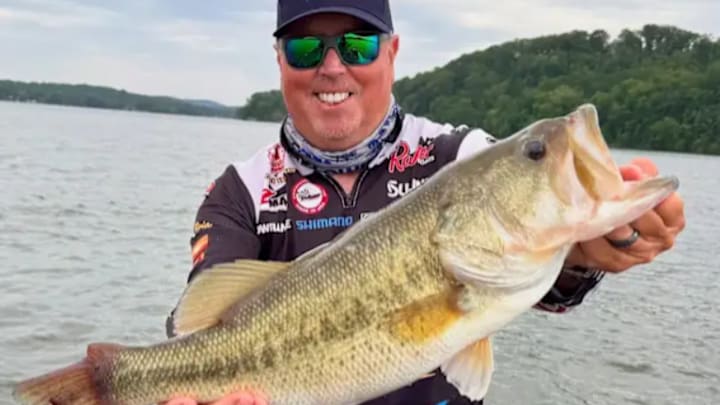
On May 1 this spring, Walker was fishing on camera in an MLF Now! Livestream of the Bass Pro Tour’s Stage 4 tournament on Chickamauga, one of several famed Tennessee River reservoirs. Viewers watched as the Tennessee native caught several keeper bass per hour during a shad-spawn bite that, thanks to an overcast sky, lasted uncharacteristically into the late morning.
Having virtually anchored his boat in seven to nine feet of water, Walker was targeting a freshwater mussel colony atop an offshore bar that topped out in three to four feet. He says he was catching “the easier ones first” with reaction baits, then following up with finesse rigs.
Why the Chatterbait Dominates During the Shad Spawn
“The Chatterbait was really the primary thing, because the top of that bar was pretty shallow,” Walker explains. “The next best things are a spinnerbait and a crankbait. Those are my three best reaction baits.”

Walker’s primary reaction bait on Chickamauga was a white, 3/8th oz. Z-Man Chatterbait Jackhammer.
“For that situation, 3/8ths was fine because it wasn't very deep,” Walker says. “I use a 3/8th oz. and a ½ oz. most of the time.”
He dressed the Jackhammer with a pearl-white Z-Man Razor ShadZ trailer.

“It's got a super amount of action as that bladed jig is shaking back and forth, it follows along really well,” Walker says. “Because it is just super soft. It's crazy the way it looks like it's swimming – the action of the head just being transmitted all the way through that body.”
Walker throws Chatterbaits on 18- or 20-pound test Sunline FC Sniper fluorocarbon line.
“That is the best-casting fluorocarbon,” he says. “It's very manageable, it's extremely strong and it casts super well. It does everything that I want it to do. And it's fluorocarbon, so you get that added sensitivity and the density. So I use it for about everything.”
What Is a Shad Spawn and Why Does It Matter for Bass Fishing?
Quite simply, a “shad spawn” is a period in the spring when female shad lay eggs and male shad fertilize them. Shad – both gizzard and threadfin – are a main forage species for bass. They spawn at night, through dawn and sunrise, and into the early morning.
An overcast day can extend a shad-spawn bite into late morning or early afternoon, but don’t bet on it. To learn more about Walker’s strategies for catching Tennessee River bass all day during a shad spawn, check out Pt. 2 of our Shad Spawn 101 series here.
Tennessee River shad generally spawn between late April and early June on shallow, hard-bottom areas when water temps are between 65 and 75 degrees. Hard-bottom areas can include rip-rap banks and shallow offshore bars topped with gravel or freshwater mussel colonies – more often just called “shell beds” in bass-pro parlance. Shad will spawn also on hard bottoms around docks and marinas, on grass flats and in shallow backwaters.
On Chickamauga on May 1, Walker began targeting shallow offshore shell beds in the morning, at the peak of the day’s shad spawn.
“Where those shad were spawning was on top of that bar, where the mussels were,” he explains. “So the bass were sitting up on top of that, or just off the little break there, waiting for those shad to get piled back up again, and then they just rush in there [to feed].”
Throw Reaction Baits First, Follow up with Finesse Baits
While shad-spawn bites can be epic, one-after-another extravaganzas, they almost never last all day. When a feeding frenzy wanes – usually in mid- to late morning, Walker trades reaction baits for finesse offerings. Although “more of the quality fish” will come on reaction baits, Walker says, you can usually catch a few more with your follow-ups. You’ll know your reaction-bait bite is fading, he says, when bass begin to “slap it, hit it two or three times,” before you hook them.
Walker’s favorite finesse shad-spawn follow-ups are shaky head, Neko and drop-shot rigs dressed with straight-tail plastic worms.“It's just it's kind of situational as to which one of those I would lean towards,” he says, noting that the depth of the structure he’s targeting is a key determinant.
“You can fish a drop-shot shallow, but it’s far more effective in deeper water,” Walker explains. “And a shaky head, you can fish it deep, but it’s more effective in that shallower water. Same with a wacky rig. But a Neko rig works really well in deeper water.”
When he’s targeting shallow offshore shell beds, a rod rigged with a shaky head-straight-tail worm combo will often be the first one Walker picks up off his Ranger Z520R’s front deck when it’s time to transition from reaction to finesse baits.

On Chickamauga, Walker’s best finesse bait was a 6-inch, green-pumpkin Z-Man SMH Worm rigged on a ¼ oz. Z-MAN Football NedZ jig.
“That works really well, because you can kind of slow down and drag it around a little bit,” he explains. “On Chickamauga that day, I was only fishing maybe 3-foot deep, so I knew I didn't need I didn't need a lot of weight to get it to them quick.”
Walker threw his shaky-head rig on 12-pound test Sunline FC Sniper fluorocarbon line.
Secondary Strategies Include Deep Ledges, Shallow Banks, Backs of Creeks, Vegetation Edges
Numerous options are available for secondary strategies, including: dredging deep offshore ledges; beating the bank in backs of creeks, hitting docks and laydowns; probing the edges of mid-depth eelgrass and/or milfoil; and targeting rip-rap near dams and bridges.
When a shad-spawn bite goes bust, Walker says, “you’ll see a lot of variety out there,” as far as anglers’ secondary strategies. He will often target shallow banks with a swim jig or flippin’ jig. “There’s probably not one best way, but you just gotta make the most of the way you choose. You can kind of get screwed up trying to do it all.”
Match the Hatch – Choose Baits in Gizzard Shad Sizes and Colors
Gizzard shad are more populous than threadfin shad on Tennessee River and other reservoirs – something to remember when choosing bait sizes and colors.
Gizzard shad generally measure from 8–14 inches. Threadfin Shad are much shorter and slender, averaging from 3 to 6 inches. Gizzard shad feature dark gray to olive-green-colored backs, silvery-purple sides and a dusky gray, forked tail fin often with a purple tint. Threadfin shad feature blue to bluish-gray backs, bright silver sides and often yellowish deeply forked tail fins.
Walker's Shad Spawn Tactics Can Work on Your Reservoir or River
The construction of multiple power-generation dams on the Tennessee River created a string of world-class fisheries from Kentucky, through Tennessee, into Alabama, and back into Tennessee. The jewels in the river’s crown, most bass anglers would agree, are Chickamauga (TN), Guntersville Lake (AL), Pickwick Lake (AL/TN/MS), Kentucky Lake (KY/TN) and Wheeler Lake (AL). Other reservoirs on the river are Wilson Lake (AL), Nickajack Lake (TN), Fort Loudoun Reservoir (TN), Tellico Reservoir (TN) and Watts Bar Reservoir (TN).
With slight modifications for local variables, Walker’s Tennessee River shad-spawn tactics can work on other rivers and reservoirs throughout the country, including destination fisheries such as Alabama’s Walter F. George Reservoir (AKA “Lake Eufaula”) on the Chatahoochee River, Lake Dardenelle and some other areas on the Arkansas River, Mississippi River pools 4-9, and the Ohio River and its tributaries, Cumberland River and Green River.
Editor’s note: Similar sections of boilerplate background information about shad spawns, David Walker and the Tennessee River appear for context in parts 1, 2 and 3 of this series.
Part 1: How to Catch Tennessee River Bass on Offshore Shell Bars
Part 2: David Walker’s Strategy for Tennessee River Tournaments
Recommended Articles:
 Add us as a preferred source on Google
A writer, videographer, video editor and podcaster, Greg Huff has worked in fishing media since 2011. He’s created content for North American Fisherman, In-Depth Outdoors, Bassmaster.com, BASS Times, Rapala and Lowrance/C-MAP. Articles and press releases he’s ghost-written have appeared in dozens of fishing publications across the U.S. When he’s not engaged in something fishing related, he writes and performs roots-rock music and volunteers as a Cub Scout leader, youth soccer coach and youth hockey play-by-play announcer.