%22%3E%0A%3Cpath%20fill-rule%3D%22evenodd%22%20clip-rule%3D%22evenodd%22%20d%3D%22M156.868%204.36764C162.691%20-1.45588%20172.132%20-1.45588%20177.956%204.36764C183.779%2010.1912%20183.779%2019.6324%20177.956%2025.4559L167.412%2036L156.868%2025.4559C151.044%2019.6324%20151.044%2010.1912%20156.868%204.36764ZM159.509%207.55761C159.448%207.86849%20159.416%208.39718%20159.416%209.14566V10.4189C159.416%2011.1832%20159.448%2011.7198%20159.513%2012.0267C159.578%2012.3317%20159.778%2012.6168%20160.117%2012.8762C160.456%2013.1376%20160.903%2013.3316%20161.458%2013.4623C162.012%2013.593%20162.6%2013.6584%20163.337%2013.6584C164.073%2013.6584%20164.717%2013.591%20165.269%2013.4524C165.822%2013.3158%20166.261%2013.1178%20166.586%2012.8604C166.911%2012.6029%20167.105%2012.3178%20167.166%2012.0069C167.228%2011.6961%20167.259%2011.1674%20167.259%2010.4189V9.14566C167.259%208.38134%20167.228%207.84473%20167.162%207.53781C167.097%207.23287%20166.897%206.94971%20166.558%206.68834C166.22%206.42696%20165.772%206.23291%20165.218%206.10223C164.663%205.97154%20164.036%205.90619%20163.339%205.90619C162.602%205.90619%20161.959%205.97352%20161.406%206.11213C160.852%206.24875%20160.414%206.44677%20160.089%206.70418C159.765%206.9616%20159.571%207.24673%20159.509%207.55761ZM164.776%2024.8638C168.376%2024.8638%20170.057%2024.2064%20170.057%2021.862V21.858V21.3155C170.057%2019.6581%20169.016%2018.971%20165.752%2018.3136C164.778%2018.1136%20164.408%2017.9136%20164.408%2017.3136V16.9414C164.408%2016.6543%20164.677%2016.5117%20164.913%2016.5117C165.249%2016.5117%20165.418%2016.7137%20165.418%2016.9414V18.1136H169.891V17.3988C169.891%2015.4563%20168.847%2014.4266%20164.677%2014.4266C161.65%2014.4266%20159.396%2015.3414%20159.396%2017.3711V17.7433C159.396%2019.5155%20160.305%2020.3155%20163.701%2021.0303C163.78%2021.0472%20163.855%2021.063%20163.927%2021.0781C164.829%2021.2674%20165.147%2021.3341%20165.147%2021.9174V22.2897C165.147%2022.6619%20165.046%2022.8045%20164.642%2022.8045C164.17%2022.8045%20164.137%2022.5471%20164.137%2022.262V21.2897H159.394V21.7471C159.394%2024.149%20160.976%2024.8638%20164.776%2024.8638ZM170.924%2024.5569H175.425V14.7355H170.924V24.5569ZM172.455%2013.5019H175.425V6.06064H172.592V9.411L170.693%206.06064H167.859V13.5019H170.693V10.1199L172.455%2013.5019ZM163.769%2012.152C163.704%2012.2688%20163.555%2012.3262%20163.325%2012.3262L163.327%2012.3282C163.104%2012.3282%20162.959%2012.2767%20162.898%2012.1758C162.836%2012.0748%20162.805%2011.8074%20162.805%2011.3758V7.90068C162.805%207.51852%20162.852%207.28684%20162.945%207.20962C163.038%207.13239%20163.175%207.09279%20163.351%207.09279C163.559%207.09279%20163.698%207.14031%20163.765%207.23734C163.832%207.33239%20163.866%207.55416%20163.866%207.90068V11.3203C163.866%2011.7579%20163.834%2012.0352%20163.769%2012.152Z%22%20fill%3D%22white%22%2F%3E%0A%3Cpath%20d%3D%22M134.707%2035.9991C129.823%2035.9991%20126.029%2035.0305%20122.478%2033.2547L125.303%2027.7255C127.765%2029.017%20130.227%2029.8242%20133.254%2029.8242C136.684%2029.8242%20138.5%2028.0484%20138.5%2024.9811V24.3354C137.249%2025.7479%20135.191%2027.3623%20132.124%2027.3623C126.433%2027.3623%20122.316%2023.3264%20122.316%2017.2322V17.1515C122.316%2010.9766%20126.514%206.90039%20131.599%206.90039C134.828%206.90039%20136.724%208.11115%20138.339%209.76586V7.42506H147.5V23.8914C147.5%2027.9677%20146.653%2030.7524%20144.635%2032.7704C142.657%2034.748%20139.63%2035.9991%20134.707%2035.9991ZM134.868%2020.6627C137.128%2020.6627%20138.541%2019.1291%20138.541%2017.1919V17.1112C138.541%2015.2143%20137.088%2013.6807%20134.868%2013.6807C132.608%2013.6807%20131.195%2015.2547%20131.195%2017.1919V17.2726C131.195%2019.1695%20132.648%2020.6627%20134.868%2020.6627Z%22%20fill%3D%22white%22%2F%3E%0A%3Cpath%20d%3D%22M96.9492%2029.4629V7.42701H106.111V10.4943C107.523%208.67813%20109.743%206.90234%20112.851%206.90234C117.492%206.90234%20120.398%209.96961%20120.398%2014.9337V29.4629H111.236V17.8799C111.236%2015.9831%20110.106%2014.8934%20108.734%2014.8934C107.362%2014.8934%20106.111%2015.9831%20106.111%2017.8799V29.4629H96.9492Z%22%20fill%3D%22white%22%2F%3E%0A%3Cpath%20d%3D%22M84.8096%205.85202V0H94.2939V5.85202H84.8096ZM84.971%2029.4619V7.42602H94.1324V29.4619H84.971Z%22%20fill%3D%22white%22%2F%3E%0A%3Cpath%20d%3D%22M58.877%2029.4619V0H68.0384V10.3722C69.451%208.55606%2071.6707%206.90135%2074.7783%206.90135C79.4196%206.90135%2082.3254%209.96862%2082.3254%2014.9327V29.4619H73.164V17.8789C73.164%2015.9821%2072.0339%2014.8924%2070.6617%2014.8924C69.2895%2014.8924%2068.0384%2015.9821%2068.0384%2017.8789V29.4619H58.877Z%22%20fill%3D%22white%22%2F%3E%0A%3Cpath%20d%3D%22M47.3991%2029.9876C43.1211%2029.9876%2039.2466%2028.8979%2036.0986%2026.7992L39.2063%2021.5929C41.8699%2023.2477%2044.8565%2024.0548%2047.3587%2024.0548C48.2466%2024.0548%2048.6906%2023.853%2048.6906%2023.3284V23.2477C48.6906%2022.8037%2048.287%2022.5212%2046.0673%2021.9562C40.4977%2020.584%2037.0672%2019.0907%2037.0672%2014.5302V14.4494C37.0672%209.60638%2040.9417%206.90234%2046.6726%206.90234C50.3049%206.90234%2053.8969%207.8306%2056.5605%209.44495L53.6547%2014.8934C51.3139%2013.6019%2048.4888%2012.8351%2046.6323%2012.8351C45.7444%2012.8351%2045.3408%2013.0772%2045.3408%2013.5212V13.6019C45.3408%2014.0458%2045.8251%2014.3284%2048.0448%2014.8934C53.6143%2016.2656%2056.9641%2017.7992%2056.9641%2022.3194V22.4001C56.9641%2027.2028%2053.3722%2029.9876%2047.3991%2029.9876Z%22%20fill%3D%22white%22%2F%3E%0A%3Cpath%20d%3D%22M25.5312%205.85202V0H35.0156V5.85202H25.5312ZM25.6927%2029.4619V7.42602H34.8541V29.4619H25.6927Z%22%20fill%3D%22white%22%2F%3E%0A%3Cpath%20d%3D%22M0%2029.4621V1.21094H23.6503V9.2827H9.44396V12.8746H22.6413V20.2199H9.44396V29.4621H0Z%22%20fill%3D%22white%22%2F%3E%0A%3C%2Fg%3E%0A%3Cdefs%3E%0A%3CclipPath%20id%3D%22clip0_16330_64756%22%3E%0A%3Crect%20width%3D%22182%22%20height%3D%2236%22%20fill%3D%22white%22%2F%3E%0A%3C%2FclipPath%3E%0A%3C%2Fdefs%3E%0A%3C%2Fsvg%3E%0A)
Texas-Rigged Soft Plastics: The Ultimate Deep Weedline Bite for Summer Bass
My Three Favorite Ways to Catch Bass
I love to catch bass no matter which lure I use. But there still has to be a best way, right? On my way up to a recent Northwoods bass fishing week, a friend asked if there was some specific bite I hoped I would encounter—some specific lure or set of conditions I hoped I’d find.
That got me thinking about my favorite ways to catch bass. Yes, on tournament day my answer would always be whatever way catches the most fish. But for a top-level, memorable day of fun fishing, what would I choose?
I gave my friend a pretty quick answer, but then as I thought more about it, I think I’ve ended up with a three-way tie. What followed was a series of articles covering my three favorite, exciting, cool, memorable ways to catch bass. These aren’t always the best way to catch them every day, but when conditions are right, these are the most fun.
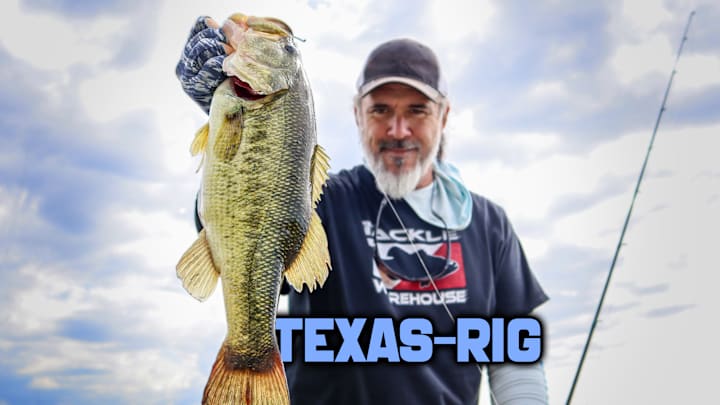
Part one of this series was about the pre-spawn smallmouth jerk bait bite. Part two covered the shallow, explosive, slop frog bite. If you’re not familiar you’ll definitely want to check them out. But now let’s dive into another one of my tied-for-first, best ways to catch ‘em—the Texas-rigged soft plastic. I’ll share what I love about this bite and share a few bass fishing tips so you can experience it for yourself.
Why Texas-Rigged Soft Plastics Are Perfect for Summer Bass

The specific bite that I’m looking starts in early summer and stretches through late fall. This bite happens in locations all over the country, but the best I’ve found is on natural, medium-clear water lakes of the northern states—like Minnesota, Wisconsin, Michigan, New York, etc. I’m talking about fishing the lake’s deepest weed edges, usually from ten to maybe twenty-feet deep, letting the perfect Texas-rigged soft plastic bait free-fall right down the line where thick weed growth stops as the bottom contour breaks into water too deep to support vegetation.
On all but the toughest days, the fish will hit with a satisfying “pop” that travels right up the line, through the rod, and right into your hands. You quickly reel any slack out of the line and set the hook hard. Because the fish may be as deep as 20-feet and your line may have to cut through some vegetation, you really want to swing for all you’re worth to make sure the hook finds purchase.
For a split-second after you set the hook, you’re locked up like a statue in that classic, leaned back, hook set pose with that long baitcasting rod doubled over, pointed at the fish. You’re just waiting for something to move—either the fish starts sliding toward you (a small one) or it resists with a powerful head shake (the fish you’re looking for). But then that beautiful millisecond scenario that somehow feels like slow motion, plays out again and again—equally exciting every time.
Best Gear for Texas-Rigging Soft Plastics in Deep Water

Yes, Texas-Rigged is a category as big as…well, Texas, and could include a lot of variations from a weightless finesse rig up to a 1.5-ounce, extra-stout hook, punch rig. While I genuinely love to throw all of them, in this specific case of the deep weed edge I’m talking about Texas-rigs utilizing a range of weights from 3/8 up to 3/4 of an ounce, with a 4/0 hook rigged with the point just slightly buried in a craw or creature-style soft plastic.
For gear, I would go 100-percent baitcasting. There are lots of great options from lots of manufacturers but my current favorite is a Shimano Poison Adrena rod, 7-foot, 3-inch, medium-heavy with a medium fast tip. I pair it with a Shimano Bantam MGL A 150 reel, 7.1:1 gear ratio, spooled up with 20lb. test fluorocarbon (maybe, down to 15lb. if it’s super clear).

How to Fish a Deep Weed Edge for Summer Bass
While forward-facing sonar might help your efficiency, it isn’t required to catch bass this way. For me, down-imaging and side-imaging are a huge help, and on most lakes a requirement. In rare case cases of ultra-clear water or vegetation that grows up from the depths, topping out near enough to the surface to be seen from above water, you can work the edge fairly well. For everywhere else, you’ll have one eye on your depth finder to make sure you’re following the edge.
Position your boat parallel to the edge, out over deeper water, twenty-to-thirty feed away, and ease your boat along that line. I usually make light underhand pitches to the edge. You’ll want to experiment a little until you figure exactly how they’re positioned on a given day.

Start by trying to get your bait to fall just in front of the “wall of weeds” in open water. As you know, bass love to follow edges, and this one can be a real hang out. But some days, they’ll be tucked into the vegetation a little. Start landing your casts so the bait is falling into that first several feet of vegetation. Pay attention to where your bites seem to come from—out on the edge, always on the bottom, a couple feet from the surface, in the middle of the thickest clumps, only where the edge makes a sharp turn—and then refine your casts to hit the optimal spots for that day.
Top 3 Soft Plastic Craws for Texas Rigs
There seems to be a nearly infinite number of soft plastic bass lures, many with their own unique variations and strengths. Most of you already have your personal favorites. That’s great! I own and throw a lot of different makes and models but following are three I’ve really dialed in on that seem to cover just about every situation I encounter.
Rapala Crush City Cleanup Craw

I’ve been super impressed with all of the Rapala Crush City soft plastic baits that have hit the scene over the past year or two, but the Crush City Cleanup Craw is a personal favorite and an absolute killer for this deep weed edge bite. The claws of this design spring to life from the slightest movement with a wild, rippling, flapping motion that triggers aggressive bass to strike. Plus, since BPT Pro Jacob Wheeler was integral in the design process, you know it’s good.
Strike King Rage Craw

I’ve caught a lot of bass on this next craw. The Strike King Rage Craw has a wild, kicking action like the Cleanup Craw, but a slightly different profile with a narrower body, but wider claws. This is for days when the bass are really chomping. Use a slightly heavier 1/2 to 3/4 ounce weight and get this in their face fast.
Berkley Powerbait Chigger Craw

And finally, when temps are a little cooler and the bass aren’t quite as aggressive I go to the Berkley Powerbait Chigger Craw. It’s far from a finesse bait, but the flatter shape of the claws on this one ripple subtly and seductively more than they kick and flash. But some days that’s what the fish want. Plus, it’s Powerbait, so less active fish are more likely to bite and hold on a little longer. This was one of the first craws I started throwing back in the day when I was first falling love with the deep weed edge bite, and it still works today.
Honorable Mention: Deep Weed Edge Bait Variation
I should mention, that a 1/2 to 3/4-ounce pitching jig (designed for vegetation, with a slightly pointed head design), dressed with any of these same craw trailers can be a very viable option on certain days. It has a different fall rate and bigger, bulkier profile that can sometimes be the best choice. The gear I use is the same and the bite is equally exciting. As long as you’re all set to fish that deep weed edge, keep a couple jigs in your box for experimentation.
The Best Ways to Catch Bass
Now you know my three-way tie for the best ways to catch bass—the pre-spawn smallmouth jerk bait bite, the hollow-bodied slop frog in heavy cover, and the Texas-rigged soft plastic bite on the deep weed edge all summer. Catching bass is always fun, and on some days these may not be the most productive choice, but whenever you get the chance to catch them like this, these particular bites always take it to another level.
Recommended Articles:
 Add us as a preferred source on Google
Kurt Mazurek writes about all things fishing and the outdoor lifestyle for Fishing On SI -a division of Sports Illustrated. Before writing On SI he enjoyed a successful career in the fishing industry, developing marketing campaigns and creative content for many of the sport’s most recognizable brands. He is a dedicated husband and father, an enthusiastic bass tournament competitor, YouTuber, photographer, musician, and author of the novel "Personal Best: fishing and life”.