%22%3E%0A%3Cpath%20fill-rule%3D%22evenodd%22%20clip-rule%3D%22evenodd%22%20d%3D%22M156.868%204.36764C162.691%20-1.45588%20172.132%20-1.45588%20177.956%204.36764C183.779%2010.1912%20183.779%2019.6324%20177.956%2025.4559L167.412%2036L156.868%2025.4559C151.044%2019.6324%20151.044%2010.1912%20156.868%204.36764ZM159.509%207.55761C159.448%207.86849%20159.416%208.39718%20159.416%209.14566V10.4189C159.416%2011.1832%20159.448%2011.7198%20159.513%2012.0267C159.578%2012.3317%20159.778%2012.6168%20160.117%2012.8762C160.456%2013.1376%20160.903%2013.3316%20161.458%2013.4623C162.012%2013.593%20162.6%2013.6584%20163.337%2013.6584C164.073%2013.6584%20164.717%2013.591%20165.269%2013.4524C165.822%2013.3158%20166.261%2013.1178%20166.586%2012.8604C166.911%2012.6029%20167.105%2012.3178%20167.166%2012.0069C167.228%2011.6961%20167.259%2011.1674%20167.259%2010.4189V9.14566C167.259%208.38134%20167.228%207.84473%20167.162%207.53781C167.097%207.23287%20166.897%206.94971%20166.558%206.68834C166.22%206.42696%20165.772%206.23291%20165.218%206.10223C164.663%205.97154%20164.036%205.90619%20163.339%205.90619C162.602%205.90619%20161.959%205.97352%20161.406%206.11213C160.852%206.24875%20160.414%206.44677%20160.089%206.70418C159.765%206.9616%20159.571%207.24673%20159.509%207.55761ZM164.776%2024.8638C168.376%2024.8638%20170.057%2024.2064%20170.057%2021.862V21.858V21.3155C170.057%2019.6581%20169.016%2018.971%20165.752%2018.3136C164.778%2018.1136%20164.408%2017.9136%20164.408%2017.3136V16.9414C164.408%2016.6543%20164.677%2016.5117%20164.913%2016.5117C165.249%2016.5117%20165.418%2016.7137%20165.418%2016.9414V18.1136H169.891V17.3988C169.891%2015.4563%20168.847%2014.4266%20164.677%2014.4266C161.65%2014.4266%20159.396%2015.3414%20159.396%2017.3711V17.7433C159.396%2019.5155%20160.305%2020.3155%20163.701%2021.0303C163.78%2021.0472%20163.855%2021.063%20163.927%2021.0781C164.829%2021.2674%20165.147%2021.3341%20165.147%2021.9174V22.2897C165.147%2022.6619%20165.046%2022.8045%20164.642%2022.8045C164.17%2022.8045%20164.137%2022.5471%20164.137%2022.262V21.2897H159.394V21.7471C159.394%2024.149%20160.976%2024.8638%20164.776%2024.8638ZM170.924%2024.5569H175.425V14.7355H170.924V24.5569ZM172.455%2013.5019H175.425V6.06064H172.592V9.411L170.693%206.06064H167.859V13.5019H170.693V10.1199L172.455%2013.5019ZM163.769%2012.152C163.704%2012.2688%20163.555%2012.3262%20163.325%2012.3262L163.327%2012.3282C163.104%2012.3282%20162.959%2012.2767%20162.898%2012.1758C162.836%2012.0748%20162.805%2011.8074%20162.805%2011.3758V7.90068C162.805%207.51852%20162.852%207.28684%20162.945%207.20962C163.038%207.13239%20163.175%207.09279%20163.351%207.09279C163.559%207.09279%20163.698%207.14031%20163.765%207.23734C163.832%207.33239%20163.866%207.55416%20163.866%207.90068V11.3203C163.866%2011.7579%20163.834%2012.0352%20163.769%2012.152Z%22%20fill%3D%22white%22%2F%3E%0A%3Cpath%20d%3D%22M134.707%2035.9991C129.823%2035.9991%20126.029%2035.0305%20122.478%2033.2547L125.303%2027.7255C127.765%2029.017%20130.227%2029.8242%20133.254%2029.8242C136.684%2029.8242%20138.5%2028.0484%20138.5%2024.9811V24.3354C137.249%2025.7479%20135.191%2027.3623%20132.124%2027.3623C126.433%2027.3623%20122.316%2023.3264%20122.316%2017.2322V17.1515C122.316%2010.9766%20126.514%206.90039%20131.599%206.90039C134.828%206.90039%20136.724%208.11115%20138.339%209.76586V7.42506H147.5V23.8914C147.5%2027.9677%20146.653%2030.7524%20144.635%2032.7704C142.657%2034.748%20139.63%2035.9991%20134.707%2035.9991ZM134.868%2020.6627C137.128%2020.6627%20138.541%2019.1291%20138.541%2017.1919V17.1112C138.541%2015.2143%20137.088%2013.6807%20134.868%2013.6807C132.608%2013.6807%20131.195%2015.2547%20131.195%2017.1919V17.2726C131.195%2019.1695%20132.648%2020.6627%20134.868%2020.6627Z%22%20fill%3D%22white%22%2F%3E%0A%3Cpath%20d%3D%22M96.9492%2029.4629V7.42701H106.111V10.4943C107.523%208.67813%20109.743%206.90234%20112.851%206.90234C117.492%206.90234%20120.398%209.96961%20120.398%2014.9337V29.4629H111.236V17.8799C111.236%2015.9831%20110.106%2014.8934%20108.734%2014.8934C107.362%2014.8934%20106.111%2015.9831%20106.111%2017.8799V29.4629H96.9492Z%22%20fill%3D%22white%22%2F%3E%0A%3Cpath%20d%3D%22M84.8096%205.85202V0H94.2939V5.85202H84.8096ZM84.971%2029.4619V7.42602H94.1324V29.4619H84.971Z%22%20fill%3D%22white%22%2F%3E%0A%3Cpath%20d%3D%22M58.877%2029.4619V0H68.0384V10.3722C69.451%208.55606%2071.6707%206.90135%2074.7783%206.90135C79.4196%206.90135%2082.3254%209.96862%2082.3254%2014.9327V29.4619H73.164V17.8789C73.164%2015.9821%2072.0339%2014.8924%2070.6617%2014.8924C69.2895%2014.8924%2068.0384%2015.9821%2068.0384%2017.8789V29.4619H58.877Z%22%20fill%3D%22white%22%2F%3E%0A%3Cpath%20d%3D%22M47.3991%2029.9876C43.1211%2029.9876%2039.2466%2028.8979%2036.0986%2026.7992L39.2063%2021.5929C41.8699%2023.2477%2044.8565%2024.0548%2047.3587%2024.0548C48.2466%2024.0548%2048.6906%2023.853%2048.6906%2023.3284V23.2477C48.6906%2022.8037%2048.287%2022.5212%2046.0673%2021.9562C40.4977%2020.584%2037.0672%2019.0907%2037.0672%2014.5302V14.4494C37.0672%209.60638%2040.9417%206.90234%2046.6726%206.90234C50.3049%206.90234%2053.8969%207.8306%2056.5605%209.44495L53.6547%2014.8934C51.3139%2013.6019%2048.4888%2012.8351%2046.6323%2012.8351C45.7444%2012.8351%2045.3408%2013.0772%2045.3408%2013.5212V13.6019C45.3408%2014.0458%2045.8251%2014.3284%2048.0448%2014.8934C53.6143%2016.2656%2056.9641%2017.7992%2056.9641%2022.3194V22.4001C56.9641%2027.2028%2053.3722%2029.9876%2047.3991%2029.9876Z%22%20fill%3D%22white%22%2F%3E%0A%3Cpath%20d%3D%22M25.5312%205.85202V0H35.0156V5.85202H25.5312ZM25.6927%2029.4619V7.42602H34.8541V29.4619H25.6927Z%22%20fill%3D%22white%22%2F%3E%0A%3Cpath%20d%3D%22M0%2029.4621V1.21094H23.6503V9.2827H9.44396V12.8746H22.6413V20.2199H9.44396V29.4621H0Z%22%20fill%3D%22white%22%2F%3E%0A%3C%2Fg%3E%0A%3Cdefs%3E%0A%3CclipPath%20id%3D%22clip0_16330_64756%22%3E%0A%3Crect%20width%3D%22182%22%20height%3D%2236%22%20fill%3D%22white%22%2F%3E%0A%3C%2FclipPath%3E%0A%3C%2Fdefs%3E%0A%3C%2Fsvg%3E%0A)
Time on the Water Won’t Make You an Expert Bass Fisherman—But This Will
Why “Time on the Water” Isn’t Enough to Become a Bass Expert
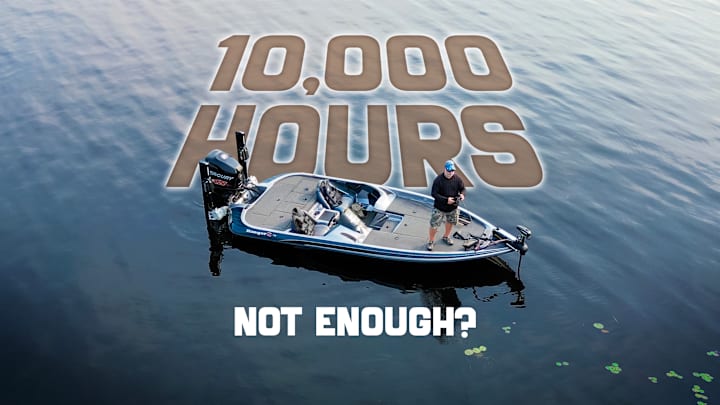
I know we’ve all heard, and possibly all repeated, the fishing advice that you can’t beat time on the water to improve your bass fishing game. We’ve probably also heard that it takes 10,000 hours practicing your craft to become an expert in anything. And while neither of these things sound quick and easy, they do sound attainable. Unfortunately, it turns out neither of them are entirely true.
First, let me say very clearly that I do not consider myself an expert bass fisherman. And for that reason I’ve been researching the path to becoming an expert as it relates to tournament bass fishing performance. On one hand, I’m a little disappointed because it would appear this activity we all love, would be very difficult to measure and determine whether someone is truly an expert. And it’s important to note, expert is different than pro. But, on the bright side, I think I’ve uncovered something that would be incredibly helpful in becoming the greatest angler any of us can be.

What Science Says About Becoming an Expert at Anything
First let’s take a quick look at what makes someone an expert. According to a Harvard Business Review article titled, The Making of an Expert, real expertise must pass three tests.
The Three Traits of True Experts, According to Harvard
- First, it must lead to performance that is consistently superior to that of the expert’s peers.
- Second, real expertise produces concrete results. Brain surgeons, for example, not only must be skillful with their scalpels but also must have successful outcomes with their patients. A chess player must be able to win matches in tournaments.
- Third, true expertise can be replicated and measured in the lab. As the British scientist Lord Kelvin stated, “If you cannot measure it, you cannot improve it.”
Can a bass angler be a true expert?
And there’s the rub for expert tournament bass fishing, right there in point 3, above. It would be pretty difficult to produce a test that is consistent enough to meet scientific standards. Unlike chess which has a specific standard board and a clear winner, or a marathon which has one finish line to cross, a bass tournament is loaded with variables.
Bass Tournaments Are Loaded With Unpredictable Variables
Some days it takes 30-pounds to win and some days it takes ten. Sometimes it takes smallmouth to win, sometimes largemouth, and sometimes a combination. Yes, the winner is always the person with the heaviest weight (or, most total inches, depending on the tournament format. Ha, another variable!), but every win has something unique about it. The weather is different, the current condition of the water is different, the number of non-tournament boats on the water is different, and so on to infinity.

The 4-Step Path to True Bass Fishing Expertise
Stay with me because like I said, I uncovered something really useful, even if science wouldn’t be willing to bestow the title of expert on us. I found a version of the steps below in a video called The Expert Myth by noted, science, YouTube channel, Veritasium. Everyone goes through four steps on their way to becoming an expert, and within them is the critical point I’m most excited to apply to tournament bass fishing.
1. Repeated Attempts
For every discipline, the process is the same. A tennis players hit hundreds of forehands in practice. Chess players play thousands of games. An angler makes cast after cast trying to get a bass to react.
2. Timely Feedback
In each of those cases, they get immediate feedback about how well they’ve done each step of the way. The tennis player can see if the ball goes over the net and whether it hits in or out of bounds. The chess player wins or loses. The angler gets a bite or not.
3. A Valid Environment
The practice and the competition must be in an environment that contains regularities or is at least somewhat predictable. This is the step that makes bass fishing especially challenging to describe anyone as a true expert by the scientific definition. The bass tournament playing field contains an awful lot of variables. But who cares about the official title the science community gives you if the bass community knows you as a consistent winner? I think the real juice is in paying special attention to the next step.
4. Intentional, Deliberate Practice
This means spending thousands of hours in an uncomfortable zone, doing things you can’t quite do yet. Again, from that Harvard Business Review article: To people who have never reached a national or international level of competition, it may appear that excellence is simply the result of practicing daily for years or even decades. That sure sounds like that “time on the water” advice we’ve all heard.
The Harvard article continues: However, living in a cave does not make you a geologist. Not all practice makes perfect. You need a particular kind of practice—deliberate practice—to develop expertise. When most people practice, they focus on the things they already know how to do. Deliberate practice is different. It entails considerable, specific, and sustained efforts to do something you can’t do well—or even at all. Research across domains shows that it is only by working at what you can’t do that you turn into the expert you want to become.
Redefining Practice for Tournament Bass Fishing
What about official tournament practice?
The confusion for tournament bass fishermen is the terminology we’ve assigned to some critical parts of the process. Most obviously, we call that time spent immediately before the tournament starts “official practice days”. But that’s definitely not the time when anyone goes out and tries anything new or anything they aren’t already really confident in. And honestly, “official practice” probably isn’t the best time to be practicing. But that’s the only time most anglers would think about and describe what they’re doing as practice.

How to Make Your Practice More Deliberate
So, let’s say I’m an old school power fisherman (pretty accurate). I’ve got some time to go fishing outside of a specific tournament and I’ve packed my jig rod, my chatter bait rod, and my crankbait rod and I’m ready to put in some practice. But with that arsenal, I’m just setting out to re-prove what I already know.
If I want to advance my skills, to actually become the closest to expert level any angler can become, I should work on something that isn’t already my specialty—maybe use spinning rods and finesse techniques in super deep water, for example.
And before you stop reading and say, “I don’t enjoy those other techniques! I won’t do it!”, understand that you can still fish lots of tournaments with the same techniques you’re already comfortable with. Remember, this is just referring to the specific deliberate practice time you put in to advance your skills. Even if you decide your power fishing approach is your best bet during the tournament hours, the time spent practicing something else will only make you better at power fishing and all your fishing skills.
The Real Power of Deliberate Fishing Practice

Again, from that Harvard Business Review article: Genuine experts not only practice deliberately but also think deliberately. The golfer Ben Hogan once explained, “While I am practicing I am also trying to develop my powers of concentration. I never just walk up and hit the ball.” Hogan would decide in advance where he wanted the ball to go and how to get it there.
Deliberate practice involves two kinds of learning: improving the skills you already have and extending the reach and range of your skills. The enormous concentration required to undertake these twin tasks limits the amount of time you can spend doing them. Most experts find that just a couple hours per day of this kind of practice is all that is required to make amazing advancements.
Time On the Water Isn’t Enough to Make You an Expert Bass Fisherman
It’s easy for an experienced angler to feel like they ”know” what will work so they’re rarely thinking about deliberate practice. Competitors who reach a high level of performance and experience some success often find themselves responding to specific situations in auto-mode and may eventually rely exclusively on intuition. But when the lake or the fish or the weather behave in an unusual way, their ability to analyze the situation and find the best possible solution in that moment, may be dulled. It’s entirely possible those seasoned competitors may not recognize this slow change over the years as they rely more and more on intuition bias, until inevitably they encounter several less-than-perfect or unpredictable sets of conditions in a row, and the habitual response hasn’t produced. It can seem confusing and frustrating and is often explained away as a slump.
ALERT: Controversial Bass Fishing Thinking!
Maybe It’s Not Just Forward-Facing Sonar That Explains Why the Young Anglers Are So Good
I don’t mean to ruffle any feathers of the fishing heroes I have looked up to forever, but it just occurred to me that the information in that last paragraph may explain, at least in part, how so many younger, relative newcomers have been finding so much success in the professional ranks. They’re still going through, or have only recently completed, that phase of their fishing career where they are super focused on deliberate practice (even if they never consciously call it that) and learning new skills. It’s all new to them, so they’re open to learning and practicing all of the possible ways to catch a bass.
You Can Be a Bass Fishing Expert
So, even for that power fisherman (like me), putting in deliberate practice hours beyond your comfort zone, broadens your skill set and gives you more tools to work with during the tournament—even if you never pick up that spinning rod during competition hours. You’ll have that trophy you earned with your good ol’ black and blue jig, but you’ll be just as proud of the nine other trophies you won because your deliberate practice sharpened your ability to quickly adapt to whatever was the best approach that day—like a true bass fishing expert.
Recommended Articles:
 Add us as a preferred source on Google
Kurt Mazurek writes about all things fishing and the outdoor lifestyle for Fishing On SI -a division of Sports Illustrated. Before writing On SI he enjoyed a successful career in the fishing industry, developing marketing campaigns and creative content for many of the sport’s most recognizable brands. He is a dedicated husband and father, an enthusiastic bass tournament competitor, YouTuber, photographer, musician, and author of the novel "Personal Best: fishing and life”.