%22%3E%0A%3Cpath%20fill-rule%3D%22evenodd%22%20clip-rule%3D%22evenodd%22%20d%3D%22M156.868%204.36764C162.691%20-1.45588%20172.132%20-1.45588%20177.956%204.36764C183.779%2010.1912%20183.779%2019.6324%20177.956%2025.4559L167.412%2036L156.868%2025.4559C151.044%2019.6324%20151.044%2010.1912%20156.868%204.36764ZM159.509%207.55761C159.448%207.86849%20159.416%208.39718%20159.416%209.14566V10.4189C159.416%2011.1832%20159.448%2011.7198%20159.513%2012.0267C159.578%2012.3317%20159.778%2012.6168%20160.117%2012.8762C160.456%2013.1376%20160.903%2013.3316%20161.458%2013.4623C162.012%2013.593%20162.6%2013.6584%20163.337%2013.6584C164.073%2013.6584%20164.717%2013.591%20165.269%2013.4524C165.822%2013.3158%20166.261%2013.1178%20166.586%2012.8604C166.911%2012.6029%20167.105%2012.3178%20167.166%2012.0069C167.228%2011.6961%20167.259%2011.1674%20167.259%2010.4189V9.14566C167.259%208.38134%20167.228%207.84473%20167.162%207.53781C167.097%207.23287%20166.897%206.94971%20166.558%206.68834C166.22%206.42696%20165.772%206.23291%20165.218%206.10223C164.663%205.97154%20164.036%205.90619%20163.339%205.90619C162.602%205.90619%20161.959%205.97352%20161.406%206.11213C160.852%206.24875%20160.414%206.44677%20160.089%206.70418C159.765%206.9616%20159.571%207.24673%20159.509%207.55761ZM164.776%2024.8638C168.376%2024.8638%20170.057%2024.2064%20170.057%2021.862V21.858V21.3155C170.057%2019.6581%20169.016%2018.971%20165.752%2018.3136C164.778%2018.1136%20164.408%2017.9136%20164.408%2017.3136V16.9414C164.408%2016.6543%20164.677%2016.5117%20164.913%2016.5117C165.249%2016.5117%20165.418%2016.7137%20165.418%2016.9414V18.1136H169.891V17.3988C169.891%2015.4563%20168.847%2014.4266%20164.677%2014.4266C161.65%2014.4266%20159.396%2015.3414%20159.396%2017.3711V17.7433C159.396%2019.5155%20160.305%2020.3155%20163.701%2021.0303C163.78%2021.0472%20163.855%2021.063%20163.927%2021.0781C164.829%2021.2674%20165.147%2021.3341%20165.147%2021.9174V22.2897C165.147%2022.6619%20165.046%2022.8045%20164.642%2022.8045C164.17%2022.8045%20164.137%2022.5471%20164.137%2022.262V21.2897H159.394V21.7471C159.394%2024.149%20160.976%2024.8638%20164.776%2024.8638ZM170.924%2024.5569H175.425V14.7355H170.924V24.5569ZM172.455%2013.5019H175.425V6.06064H172.592V9.411L170.693%206.06064H167.859V13.5019H170.693V10.1199L172.455%2013.5019ZM163.769%2012.152C163.704%2012.2688%20163.555%2012.3262%20163.325%2012.3262L163.327%2012.3282C163.104%2012.3282%20162.959%2012.2767%20162.898%2012.1758C162.836%2012.0748%20162.805%2011.8074%20162.805%2011.3758V7.90068C162.805%207.51852%20162.852%207.28684%20162.945%207.20962C163.038%207.13239%20163.175%207.09279%20163.351%207.09279C163.559%207.09279%20163.698%207.14031%20163.765%207.23734C163.832%207.33239%20163.866%207.55416%20163.866%207.90068V11.3203C163.866%2011.7579%20163.834%2012.0352%20163.769%2012.152Z%22%20fill%3D%22white%22%2F%3E%0A%3Cpath%20d%3D%22M134.707%2035.9991C129.823%2035.9991%20126.029%2035.0305%20122.478%2033.2547L125.303%2027.7255C127.765%2029.017%20130.227%2029.8242%20133.254%2029.8242C136.684%2029.8242%20138.5%2028.0484%20138.5%2024.9811V24.3354C137.249%2025.7479%20135.191%2027.3623%20132.124%2027.3623C126.433%2027.3623%20122.316%2023.3264%20122.316%2017.2322V17.1515C122.316%2010.9766%20126.514%206.90039%20131.599%206.90039C134.828%206.90039%20136.724%208.11115%20138.339%209.76586V7.42506H147.5V23.8914C147.5%2027.9677%20146.653%2030.7524%20144.635%2032.7704C142.657%2034.748%20139.63%2035.9991%20134.707%2035.9991ZM134.868%2020.6627C137.128%2020.6627%20138.541%2019.1291%20138.541%2017.1919V17.1112C138.541%2015.2143%20137.088%2013.6807%20134.868%2013.6807C132.608%2013.6807%20131.195%2015.2547%20131.195%2017.1919V17.2726C131.195%2019.1695%20132.648%2020.6627%20134.868%2020.6627Z%22%20fill%3D%22white%22%2F%3E%0A%3Cpath%20d%3D%22M96.9492%2029.4629V7.42701H106.111V10.4943C107.523%208.67813%20109.743%206.90234%20112.851%206.90234C117.492%206.90234%20120.398%209.96961%20120.398%2014.9337V29.4629H111.236V17.8799C111.236%2015.9831%20110.106%2014.8934%20108.734%2014.8934C107.362%2014.8934%20106.111%2015.9831%20106.111%2017.8799V29.4629H96.9492Z%22%20fill%3D%22white%22%2F%3E%0A%3Cpath%20d%3D%22M84.8096%205.85202V0H94.2939V5.85202H84.8096ZM84.971%2029.4619V7.42602H94.1324V29.4619H84.971Z%22%20fill%3D%22white%22%2F%3E%0A%3Cpath%20d%3D%22M58.877%2029.4619V0H68.0384V10.3722C69.451%208.55606%2071.6707%206.90135%2074.7783%206.90135C79.4196%206.90135%2082.3254%209.96862%2082.3254%2014.9327V29.4619H73.164V17.8789C73.164%2015.9821%2072.0339%2014.8924%2070.6617%2014.8924C69.2895%2014.8924%2068.0384%2015.9821%2068.0384%2017.8789V29.4619H58.877Z%22%20fill%3D%22white%22%2F%3E%0A%3Cpath%20d%3D%22M47.3991%2029.9876C43.1211%2029.9876%2039.2466%2028.8979%2036.0986%2026.7992L39.2063%2021.5929C41.8699%2023.2477%2044.8565%2024.0548%2047.3587%2024.0548C48.2466%2024.0548%2048.6906%2023.853%2048.6906%2023.3284V23.2477C48.6906%2022.8037%2048.287%2022.5212%2046.0673%2021.9562C40.4977%2020.584%2037.0672%2019.0907%2037.0672%2014.5302V14.4494C37.0672%209.60638%2040.9417%206.90234%2046.6726%206.90234C50.3049%206.90234%2053.8969%207.8306%2056.5605%209.44495L53.6547%2014.8934C51.3139%2013.6019%2048.4888%2012.8351%2046.6323%2012.8351C45.7444%2012.8351%2045.3408%2013.0772%2045.3408%2013.5212V13.6019C45.3408%2014.0458%2045.8251%2014.3284%2048.0448%2014.8934C53.6143%2016.2656%2056.9641%2017.7992%2056.9641%2022.3194V22.4001C56.9641%2027.2028%2053.3722%2029.9876%2047.3991%2029.9876Z%22%20fill%3D%22white%22%2F%3E%0A%3Cpath%20d%3D%22M25.5312%205.85202V0H35.0156V5.85202H25.5312ZM25.6927%2029.4619V7.42602H34.8541V29.4619H25.6927Z%22%20fill%3D%22white%22%2F%3E%0A%3Cpath%20d%3D%22M0%2029.4621V1.21094H23.6503V9.2827H9.44396V12.8746H22.6413V20.2199H9.44396V29.4621H0Z%22%20fill%3D%22white%22%2F%3E%0A%3C%2Fg%3E%0A%3Cdefs%3E%0A%3CclipPath%20id%3D%22clip0_16330_64756%22%3E%0A%3Crect%20width%3D%22182%22%20height%3D%2236%22%20fill%3D%22white%22%2F%3E%0A%3C%2FclipPath%3E%0A%3C%2Fdefs%3E%0A%3C%2Fsvg%3E%0A)
Don’t Be “That Guy” at the Boat Ramp: The Simple Checks Most Boaters Skip
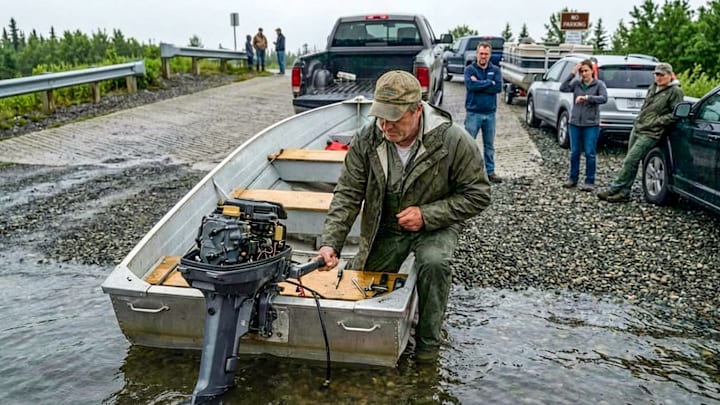
There's always "that guy" at the boat landing each spring cranking the starter, taking the cowl off his motor and scratching his head. Meanwhile, because of his negligence, you and everyone else trying to launch are held back from fishing. Don't be "that guy" this spring.
Most of the problems that guy is having didn’t just happen at the ramp. They were there weeks earlier—in his garage, his driveway, or his storage unit—when routine maintenance and small issues go unchecked.
Boat Maintenance: What Fails First

At the very root of many boat problems are your batteries. Make sure they are fully charged and in good working order. If not, replace them.
With fully charged batteries installed, make sure all wires attaching to them are in good condition. Inspect for mouse chews and make sure connections are properly secured and free of excessive corrosion. Test the bilge pump, horn, livewell, tilt and trim, electronics and all other battery-powered functions.
- Fully charge batteries (or replace if weak)
- Inspect terminal connections (look for corrosion or loose rings)
- Check for rodent damage on wiring
- Test:
-Bilge pump
-Livewell
-Trim/tilt
-Electronics
Electrical problems are one of the most common causes of early-season breakdowns and one of the easiest to prevent.
Motor Maintenance: Test It Before Opener

Yes, you’ve confirmed your batteries are in good shape, but just because your motor cranks doesn’t mean it will start—verify it. Complete any routine maintenance you may have put off when you winterized the boat last fall.
Start the season with fresh lower unit gear oil, motor oil for a four-stroke, a full oil reservoir for a two-stroke, and clean gasoline. Check spark plugs and replace if needed. Check for oil drips under your outboard and repair any leaks before your first trip.
Hooking a garden hose up to a set of motor muffs to start your motor at home and make sure it's running smoothly is the best way to avoid being “that guy” at the launch.
- Change lower unit gear oil (if not done in fall)
- Change engine oil (four-stroke) or top off reservoir (two-stroke)
- Confirm spark plug condition
- Make sure you have clean, usable fuel
- Reconnect fuel line (if disconnected during winterizing)
- Check for oil leaks under the motor
Before leaving home:
- Hook up motor muffs and a garden hose
- Start the engine and confirm it runs smoothly
Trailer Maintenance: The Most Overlooked Failure Point

The trailer is the easiest part to ignore. But neglect here could mean you never make it to the ramp on opening morning—or worse.
Make sure tires, including your spare, are properly inflated. Inspect tire tread and overall tire condition. If they’re worn or dry rotted, replace them.
Hook your truck up to your trailer and ensure all lights are working. Even if they were working when you put the boat in storage, you never know when electrical connections will corrode or mice will chew on wires.
Check and re-grease wheel bearings. Grease your trailer jack and you can even add a dab of grease to the pin in your swing tongue if the pin doesn't slide in easily.
- Check tire pressure (including the spare)
- Inspect tire tread for:
-Wear
-Dry rot - Test trailer lights:
-Running lights
-Brake lights
-Turn signals - Inspect wiring for corrosion or rodent damage
Prevent breakdowns:
- Grease or inspect wheel bearings
- Lubricate trailer jack
- Add grease to swing tongue pin (if applicable)
If you wait until you’re on the road to find out about trailer issues, you’re going to have much bigger problems.
Check Expiration Dates Before They Matter

These are all easy to check, easy to fix, and easy to miss. Don’t let these get to the point where they become difficult to fix.
- Confirm boat registration is current
- Check trailer registration (if required in your state)
- Verify insurance policy is active
- Renew fishing license if needed
- Check fire extinguisher expiration
- Replace expired signal flares
Safety Gear You’ll Wish You Had
Rods and tackle are easy to remember, but safety items are easily forgotten. And when you do need them, you’ll really wish had taken the time to make sure they’re ready.
Make sure essential gear is onboard and functional:
- Life vests (enough for all passengers, in good condition)
- Throwable flotation device
- Kill switch lanyard
- Boat plug
- Tow rope
- Anchor and anchor line
- Visual signaling device (if separate from flares)
- Audible signaling device (if separate from horn)
These aren’t just regulations, they’re vital equipment to keep you safe on the water.
Simple Checks to Avoid Being That Guy
Taking a few minutes to run through these simple checklists before your first trip can be the difference between a smooth start to your fishing season or a frustrating delay at the ramp followed by getting in line at your local mechanic’s shop.
For the sake of your precious fishing time and the safety of you and everyone you fish with, commit to never being “that guy” again.
 Add us as a preferred source on Google
Joe Shead is an accomplished outdoor writer, hunter, fishing guide and multi-species angler from Minnesota who will fish for anything, even if it won’t bite. Check out more of his work at goshedhunting.com and superiorexperiencecharters.com.