%22%3E%0A%3Cpath%20fill-rule%3D%22evenodd%22%20clip-rule%3D%22evenodd%22%20d%3D%22M156.868%204.36764C162.691%20-1.45588%20172.132%20-1.45588%20177.956%204.36764C183.779%2010.1912%20183.779%2019.6324%20177.956%2025.4559L167.412%2036L156.868%2025.4559C151.044%2019.6324%20151.044%2010.1912%20156.868%204.36764ZM159.509%207.55761C159.448%207.86849%20159.416%208.39718%20159.416%209.14566V10.4189C159.416%2011.1832%20159.448%2011.7198%20159.513%2012.0267C159.578%2012.3317%20159.778%2012.6168%20160.117%2012.8762C160.456%2013.1376%20160.903%2013.3316%20161.458%2013.4623C162.012%2013.593%20162.6%2013.6584%20163.337%2013.6584C164.073%2013.6584%20164.717%2013.591%20165.269%2013.4524C165.822%2013.3158%20166.261%2013.1178%20166.586%2012.8604C166.911%2012.6029%20167.105%2012.3178%20167.166%2012.0069C167.228%2011.6961%20167.259%2011.1674%20167.259%2010.4189V9.14566C167.259%208.38134%20167.228%207.84473%20167.162%207.53781C167.097%207.23287%20166.897%206.94971%20166.558%206.68834C166.22%206.42696%20165.772%206.23291%20165.218%206.10223C164.663%205.97154%20164.036%205.90619%20163.339%205.90619C162.602%205.90619%20161.959%205.97352%20161.406%206.11213C160.852%206.24875%20160.414%206.44677%20160.089%206.70418C159.765%206.9616%20159.571%207.24673%20159.509%207.55761ZM164.776%2024.8638C168.376%2024.8638%20170.057%2024.2064%20170.057%2021.862V21.858V21.3155C170.057%2019.6581%20169.016%2018.971%20165.752%2018.3136C164.778%2018.1136%20164.408%2017.9136%20164.408%2017.3136V16.9414C164.408%2016.6543%20164.677%2016.5117%20164.913%2016.5117C165.249%2016.5117%20165.418%2016.7137%20165.418%2016.9414V18.1136H169.891V17.3988C169.891%2015.4563%20168.847%2014.4266%20164.677%2014.4266C161.65%2014.4266%20159.396%2015.3414%20159.396%2017.3711V17.7433C159.396%2019.5155%20160.305%2020.3155%20163.701%2021.0303C163.78%2021.0472%20163.855%2021.063%20163.927%2021.0781C164.829%2021.2674%20165.147%2021.3341%20165.147%2021.9174V22.2897C165.147%2022.6619%20165.046%2022.8045%20164.642%2022.8045C164.17%2022.8045%20164.137%2022.5471%20164.137%2022.262V21.2897H159.394V21.7471C159.394%2024.149%20160.976%2024.8638%20164.776%2024.8638ZM170.924%2024.5569H175.425V14.7355H170.924V24.5569ZM172.455%2013.5019H175.425V6.06064H172.592V9.411L170.693%206.06064H167.859V13.5019H170.693V10.1199L172.455%2013.5019ZM163.769%2012.152C163.704%2012.2688%20163.555%2012.3262%20163.325%2012.3262L163.327%2012.3282C163.104%2012.3282%20162.959%2012.2767%20162.898%2012.1758C162.836%2012.0748%20162.805%2011.8074%20162.805%2011.3758V7.90068C162.805%207.51852%20162.852%207.28684%20162.945%207.20962C163.038%207.13239%20163.175%207.09279%20163.351%207.09279C163.559%207.09279%20163.698%207.14031%20163.765%207.23734C163.832%207.33239%20163.866%207.55416%20163.866%207.90068V11.3203C163.866%2011.7579%20163.834%2012.0352%20163.769%2012.152Z%22%20fill%3D%22white%22%2F%3E%0A%3Cpath%20d%3D%22M134.707%2035.9991C129.823%2035.9991%20126.029%2035.0305%20122.478%2033.2547L125.303%2027.7255C127.765%2029.017%20130.227%2029.8242%20133.254%2029.8242C136.684%2029.8242%20138.5%2028.0484%20138.5%2024.9811V24.3354C137.249%2025.7479%20135.191%2027.3623%20132.124%2027.3623C126.433%2027.3623%20122.316%2023.3264%20122.316%2017.2322V17.1515C122.316%2010.9766%20126.514%206.90039%20131.599%206.90039C134.828%206.90039%20136.724%208.11115%20138.339%209.76586V7.42506H147.5V23.8914C147.5%2027.9677%20146.653%2030.7524%20144.635%2032.7704C142.657%2034.748%20139.63%2035.9991%20134.707%2035.9991ZM134.868%2020.6627C137.128%2020.6627%20138.541%2019.1291%20138.541%2017.1919V17.1112C138.541%2015.2143%20137.088%2013.6807%20134.868%2013.6807C132.608%2013.6807%20131.195%2015.2547%20131.195%2017.1919V17.2726C131.195%2019.1695%20132.648%2020.6627%20134.868%2020.6627Z%22%20fill%3D%22white%22%2F%3E%0A%3Cpath%20d%3D%22M96.9492%2029.4629V7.42701H106.111V10.4943C107.523%208.67813%20109.743%206.90234%20112.851%206.90234C117.492%206.90234%20120.398%209.96961%20120.398%2014.9337V29.4629H111.236V17.8799C111.236%2015.9831%20110.106%2014.8934%20108.734%2014.8934C107.362%2014.8934%20106.111%2015.9831%20106.111%2017.8799V29.4629H96.9492Z%22%20fill%3D%22white%22%2F%3E%0A%3Cpath%20d%3D%22M84.8096%205.85202V0H94.2939V5.85202H84.8096ZM84.971%2029.4619V7.42602H94.1324V29.4619H84.971Z%22%20fill%3D%22white%22%2F%3E%0A%3Cpath%20d%3D%22M58.877%2029.4619V0H68.0384V10.3722C69.451%208.55606%2071.6707%206.90135%2074.7783%206.90135C79.4196%206.90135%2082.3254%209.96862%2082.3254%2014.9327V29.4619H73.164V17.8789C73.164%2015.9821%2072.0339%2014.8924%2070.6617%2014.8924C69.2895%2014.8924%2068.0384%2015.9821%2068.0384%2017.8789V29.4619H58.877Z%22%20fill%3D%22white%22%2F%3E%0A%3Cpath%20d%3D%22M47.3991%2029.9876C43.1211%2029.9876%2039.2466%2028.8979%2036.0986%2026.7992L39.2063%2021.5929C41.8699%2023.2477%2044.8565%2024.0548%2047.3587%2024.0548C48.2466%2024.0548%2048.6906%2023.853%2048.6906%2023.3284V23.2477C48.6906%2022.8037%2048.287%2022.5212%2046.0673%2021.9562C40.4977%2020.584%2037.0672%2019.0907%2037.0672%2014.5302V14.4494C37.0672%209.60638%2040.9417%206.90234%2046.6726%206.90234C50.3049%206.90234%2053.8969%207.8306%2056.5605%209.44495L53.6547%2014.8934C51.3139%2013.6019%2048.4888%2012.8351%2046.6323%2012.8351C45.7444%2012.8351%2045.3408%2013.0772%2045.3408%2013.5212V13.6019C45.3408%2014.0458%2045.8251%2014.3284%2048.0448%2014.8934C53.6143%2016.2656%2056.9641%2017.7992%2056.9641%2022.3194V22.4001C56.9641%2027.2028%2053.3722%2029.9876%2047.3991%2029.9876Z%22%20fill%3D%22white%22%2F%3E%0A%3Cpath%20d%3D%22M25.5312%205.85202V0H35.0156V5.85202H25.5312ZM25.6927%2029.4619V7.42602H34.8541V29.4619H25.6927Z%22%20fill%3D%22white%22%2F%3E%0A%3Cpath%20d%3D%22M0%2029.4621V1.21094H23.6503V9.2827H9.44396V12.8746H22.6413V20.2199H9.44396V29.4621H0Z%22%20fill%3D%22white%22%2F%3E%0A%3C%2Fg%3E%0A%3Cdefs%3E%0A%3CclipPath%20id%3D%22clip0_16330_64756%22%3E%0A%3Crect%20width%3D%22182%22%20height%3D%2236%22%20fill%3D%22white%22%2F%3E%0A%3C%2FclipPath%3E%0A%3C%2Fdefs%3E%0A%3C%2Fsvg%3E%0A)
Collecting Antique & Vintage Fishing Lures: Where Nostalgia Meets Big Bucks
Why Collect Antique Fishing Lures? Nostalgia, Craftsmanship, and Value

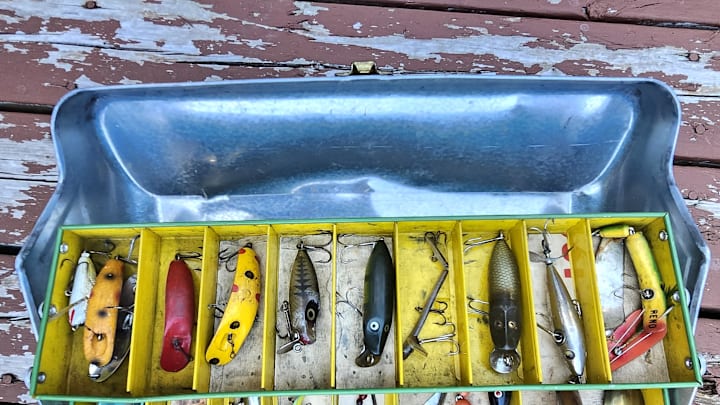
The interest in collecting antique fishing tackle has increased in recent years, explained in part by the simple law of supply and demand. But just because a lure looks old doesn’t mean it is necessarily collectible. Finding and identifying valuable antique fishing lures requires knowledge, a good eye and a bit of luck.
As with any original work of art, the age of the work, the impact it has on the viewer, and the artist’s reputation are all factors affecting its value. Finding that rare treasure motivates collectors more than anything. And never knowing when or where that next find will come, adds to the excitement. Your grandpa's old tackle box may hold treasures aplenty and untold wealth.
The Antique Lure Collector Mindset

Michael Echols is a foremost authority on vintage fishing tackle. Drawn to this passion by the craftsmanship of the lures made in the early-1900s, his deep appreciation for the aesthetic value of old fishing tackle inspires him to preserve fishing heritage through these old lures.
Plus, Echols sees his collection as a great financial investment. Considering his collection is worth over one million dollars today, he appears to be right.
Antique and vintage lure collectors are among the most dedicated collectors in the world. For these diehards, monetary value is a consideration when searching for rarities, but not the only factor. The nostalgic treasure-hunter excitement of capturing a small part of fishing history has its own special appeal.
Where to Find Vintage Lures and What to Look For

The average vintage or antique fishing lure sells for $10-50, while more rare lures in mint condition, including original box etc, go for hundreds and even thousands of dollars. Scan the various online marketplaces like Etsy, eBay and Facebook Marketplace for locations to buy and sell old lures. You will learn quickly which old lures are worth money, and those that are less desirable.

A high-level of craftsmanship and the complexity of the lure’s design can dictate its collectibility. Collectors look for the oddities in a set rather than the run-of-the-mill generic looking fishing plugs.

For some, focusing on a specific lure manufacturer, region of origin, manufacturing date range, or lure type, can be a satisfying approach. It allows you to dig deep and really become an expert on your chosen niche. For example, some collectors specialize in fishing tackle and memorabilia from manufactures such as Lucky Strike lures and AL&W tackle, both made in Canada.

The Midwestern U.S. -Antique and Vintage Fishing Lure Mecca

Enthusiasts in the U.S. are true pioneers of antique lure collecting and still lead the way today. All the most valuable antique and vintage fishing tackle was made in the U.S.A.
The Midwestern United States are the undeniable world mecca of vintage and antique lure manufacturing, from the late 19th and early 20th century. Old fishing lures from such makers as Pflueger of Akron, Ohio; Heddon of Dowagiac, Michigan; South Bend Baits from South Bend, Indiana; and Creek Chubb Bait Company of Garrett, Indiana are considered real classics. They are highly prized for their craftsmanship, historical significance, rarity, and brand reputation and therefore fetch the highest lure values.
The Importance of Lure Boxes in Antique Collecting

To collectors, an antique lure's original box can be as important as the lure itself. Since the factory box (usually cardboard) is the first thing to deteriorate, it can be more rare than the lure. Antique lures may double or even triple in value if the original box is present and in good condition. Original paperwork and box markings can also authenticate a lure's original model number.

These four manufacturer’s lures seem to increase value most when the original box is present: Creek Chub Bait Company, Heddon, Pflueger and South Bend. For example, an antique Heddon "Zara Spook" is worth $40-50 loose. The same lure with its original box is worth $200-300. The presence of a box can help or hinder the lure value and collectability depending on its condition.


The Holy Grail: The Legendary Haskell Minnow

When it comes to valuable fishing tackle, there is one lure in particular which stands head and shoulders above the rest. The Haskell Minnow made by Riley Haskell of Painesville, Ohio in 1859, fetched an incredible $101,200 at a recent Lang's auction! Tracey Shirley, who purchased the famous lure set a world record for the highest price ever shelled-out for a single fishing collectible! This special lure was sold with its original wooden box with R. Haskell stamped on one end. Only a handful of Haskell minnows have ever turned up.

Antique Fishing Lure Terminology Every Collector Should Know
Antique fishing lure collectors use buzz words and terminology unique to the industry, to describe condition. Understanding jargon used by collectors will educate and inform those wanting to get into vintage lure collecting.
1. Hook Drag

‘Hook drag’ describes markings left by the lure’s hook on the varnish or paint of the bait. The degree of hook drag is relative to its overall condition. If there is only very light hook drag, it may not detract from the value of the collected lure.
2. Crazing

‘Crazing’ in antique fishing lures indicates a minor separation of the paint, or varnish, which occurs with age. Antique lures like the Southbend or Heddon, which were heavily varnished in original production, will show natural crazing today, an indicator of age.
3. Whizzed

‘Whizzed’ describes a lure that is rubbed or polished extensively, beyond the point of practicality. Whizzed antique fishing tackle with outside varnish or finish removed greatly devalues the item.
4. Worm Burn

Worm burn occurs when a soft plastic worm is allowed to contact a lure’s paint for an extended period of time, like when stored together in a single compartment of a tackle box. The lure’s soft plastic can have a chemical reaction with the paint and melts a burn-like mark, similar to a cigarette burn, into the lure’s finish, decreasing its value.
Join the NFLCC: Connect with Antique Fishing Tackle Collectors

The National Fishing Lure Collectors Club (NFLCC) is an educational, non-profit organization founded in 1976, to foster awareness of antique fishing tackle, and a great way to get into lure collecting. NFLCC membership includes quarterly issues of their Gazette, loaded with articles by vintage tackle collectors plus useful historical information, and a calendar of club events. The organization holds Vintage Fishing Tackle Shows and one National Meeting in the U.S. each year.
Key Takeaways: Starting Your Vintage Lure Collection

- Antique and vintage fishing lure collecting is a hobby and activity enjoyed by thousands of avid collectors.
- Antique lure value can range greatly depending on condition, presence of original box and originality.
- Nostalgia, craftsmanship and financial profit are all is on motivating factors for antique and vintage lure collecting.
- Join an organization such as the NFLCC to expand your vintage lure knowledge and meet like-minded collectors.
- Online marketplaces such as Etsy, eBay and Facebook marketplace are great places for buying and selling old fishing lures.
 Add us as a preferred source on Google
Jeff Morrison (aka The Outdoors Guy) is an award-winning Canadian outdoor writer, book author, and nationally syndicated columnist with 30-years writing experience. With a background in fish & wildlife biology, Jeff’s passions include hunting, fishing, ATVing, camping and travel tourism. He has contributed to dozens of North American publications over the years under his ‘Outdoors Guy’ moniker. A dedicated father and family man, Jeff can usually be found pursuing bass, northern pike, muskie and trout near his mountain hunt camp or cottage.
Follow thatoutdoorsguy