%22%3E%0A%3Cpath%20fill-rule%3D%22evenodd%22%20clip-rule%3D%22evenodd%22%20d%3D%22M156.868%204.36764C162.691%20-1.45588%20172.132%20-1.45588%20177.956%204.36764C183.779%2010.1912%20183.779%2019.6324%20177.956%2025.4559L167.412%2036L156.868%2025.4559C151.044%2019.6324%20151.044%2010.1912%20156.868%204.36764ZM159.509%207.55761C159.448%207.86849%20159.416%208.39718%20159.416%209.14566V10.4189C159.416%2011.1832%20159.448%2011.7198%20159.513%2012.0267C159.578%2012.3317%20159.778%2012.6168%20160.117%2012.8762C160.456%2013.1376%20160.903%2013.3316%20161.458%2013.4623C162.012%2013.593%20162.6%2013.6584%20163.337%2013.6584C164.073%2013.6584%20164.717%2013.591%20165.269%2013.4524C165.822%2013.3158%20166.261%2013.1178%20166.586%2012.8604C166.911%2012.6029%20167.105%2012.3178%20167.166%2012.0069C167.228%2011.6961%20167.259%2011.1674%20167.259%2010.4189V9.14566C167.259%208.38134%20167.228%207.84473%20167.162%207.53781C167.097%207.23287%20166.897%206.94971%20166.558%206.68834C166.22%206.42696%20165.772%206.23291%20165.218%206.10223C164.663%205.97154%20164.036%205.90619%20163.339%205.90619C162.602%205.90619%20161.959%205.97352%20161.406%206.11213C160.852%206.24875%20160.414%206.44677%20160.089%206.70418C159.765%206.9616%20159.571%207.24673%20159.509%207.55761ZM164.776%2024.8638C168.376%2024.8638%20170.057%2024.2064%20170.057%2021.862V21.858V21.3155C170.057%2019.6581%20169.016%2018.971%20165.752%2018.3136C164.778%2018.1136%20164.408%2017.9136%20164.408%2017.3136V16.9414C164.408%2016.6543%20164.677%2016.5117%20164.913%2016.5117C165.249%2016.5117%20165.418%2016.7137%20165.418%2016.9414V18.1136H169.891V17.3988C169.891%2015.4563%20168.847%2014.4266%20164.677%2014.4266C161.65%2014.4266%20159.396%2015.3414%20159.396%2017.3711V17.7433C159.396%2019.5155%20160.305%2020.3155%20163.701%2021.0303C163.78%2021.0472%20163.855%2021.063%20163.927%2021.0781C164.829%2021.2674%20165.147%2021.3341%20165.147%2021.9174V22.2897C165.147%2022.6619%20165.046%2022.8045%20164.642%2022.8045C164.17%2022.8045%20164.137%2022.5471%20164.137%2022.262V21.2897H159.394V21.7471C159.394%2024.149%20160.976%2024.8638%20164.776%2024.8638ZM170.924%2024.5569H175.425V14.7355H170.924V24.5569ZM172.455%2013.5019H175.425V6.06064H172.592V9.411L170.693%206.06064H167.859V13.5019H170.693V10.1199L172.455%2013.5019ZM163.769%2012.152C163.704%2012.2688%20163.555%2012.3262%20163.325%2012.3262L163.327%2012.3282C163.104%2012.3282%20162.959%2012.2767%20162.898%2012.1758C162.836%2012.0748%20162.805%2011.8074%20162.805%2011.3758V7.90068C162.805%207.51852%20162.852%207.28684%20162.945%207.20962C163.038%207.13239%20163.175%207.09279%20163.351%207.09279C163.559%207.09279%20163.698%207.14031%20163.765%207.23734C163.832%207.33239%20163.866%207.55416%20163.866%207.90068V11.3203C163.866%2011.7579%20163.834%2012.0352%20163.769%2012.152Z%22%20fill%3D%22white%22%2F%3E%0A%3Cpath%20d%3D%22M134.707%2035.9991C129.823%2035.9991%20126.029%2035.0305%20122.478%2033.2547L125.303%2027.7255C127.765%2029.017%20130.227%2029.8242%20133.254%2029.8242C136.684%2029.8242%20138.5%2028.0484%20138.5%2024.9811V24.3354C137.249%2025.7479%20135.191%2027.3623%20132.124%2027.3623C126.433%2027.3623%20122.316%2023.3264%20122.316%2017.2322V17.1515C122.316%2010.9766%20126.514%206.90039%20131.599%206.90039C134.828%206.90039%20136.724%208.11115%20138.339%209.76586V7.42506H147.5V23.8914C147.5%2027.9677%20146.653%2030.7524%20144.635%2032.7704C142.657%2034.748%20139.63%2035.9991%20134.707%2035.9991ZM134.868%2020.6627C137.128%2020.6627%20138.541%2019.1291%20138.541%2017.1919V17.1112C138.541%2015.2143%20137.088%2013.6807%20134.868%2013.6807C132.608%2013.6807%20131.195%2015.2547%20131.195%2017.1919V17.2726C131.195%2019.1695%20132.648%2020.6627%20134.868%2020.6627Z%22%20fill%3D%22white%22%2F%3E%0A%3Cpath%20d%3D%22M96.9492%2029.4629V7.42701H106.111V10.4943C107.523%208.67813%20109.743%206.90234%20112.851%206.90234C117.492%206.90234%20120.398%209.96961%20120.398%2014.9337V29.4629H111.236V17.8799C111.236%2015.9831%20110.106%2014.8934%20108.734%2014.8934C107.362%2014.8934%20106.111%2015.9831%20106.111%2017.8799V29.4629H96.9492Z%22%20fill%3D%22white%22%2F%3E%0A%3Cpath%20d%3D%22M84.8096%205.85202V0H94.2939V5.85202H84.8096ZM84.971%2029.4619V7.42602H94.1324V29.4619H84.971Z%22%20fill%3D%22white%22%2F%3E%0A%3Cpath%20d%3D%22M58.877%2029.4619V0H68.0384V10.3722C69.451%208.55606%2071.6707%206.90135%2074.7783%206.90135C79.4196%206.90135%2082.3254%209.96862%2082.3254%2014.9327V29.4619H73.164V17.8789C73.164%2015.9821%2072.0339%2014.8924%2070.6617%2014.8924C69.2895%2014.8924%2068.0384%2015.9821%2068.0384%2017.8789V29.4619H58.877Z%22%20fill%3D%22white%22%2F%3E%0A%3Cpath%20d%3D%22M47.3991%2029.9876C43.1211%2029.9876%2039.2466%2028.8979%2036.0986%2026.7992L39.2063%2021.5929C41.8699%2023.2477%2044.8565%2024.0548%2047.3587%2024.0548C48.2466%2024.0548%2048.6906%2023.853%2048.6906%2023.3284V23.2477C48.6906%2022.8037%2048.287%2022.5212%2046.0673%2021.9562C40.4977%2020.584%2037.0672%2019.0907%2037.0672%2014.5302V14.4494C37.0672%209.60638%2040.9417%206.90234%2046.6726%206.90234C50.3049%206.90234%2053.8969%207.8306%2056.5605%209.44495L53.6547%2014.8934C51.3139%2013.6019%2048.4888%2012.8351%2046.6323%2012.8351C45.7444%2012.8351%2045.3408%2013.0772%2045.3408%2013.5212V13.6019C45.3408%2014.0458%2045.8251%2014.3284%2048.0448%2014.8934C53.6143%2016.2656%2056.9641%2017.7992%2056.9641%2022.3194V22.4001C56.9641%2027.2028%2053.3722%2029.9876%2047.3991%2029.9876Z%22%20fill%3D%22white%22%2F%3E%0A%3Cpath%20d%3D%22M25.5312%205.85202V0H35.0156V5.85202H25.5312ZM25.6927%2029.4619V7.42602H34.8541V29.4619H25.6927Z%22%20fill%3D%22white%22%2F%3E%0A%3Cpath%20d%3D%22M0%2029.4621V1.21094H23.6503V9.2827H9.44396V12.8746H22.6413V20.2199H9.44396V29.4621H0Z%22%20fill%3D%22white%22%2F%3E%0A%3C%2Fg%3E%0A%3Cdefs%3E%0A%3CclipPath%20id%3D%22clip0_16330_64756%22%3E%0A%3Crect%20width%3D%22182%22%20height%3D%2236%22%20fill%3D%22white%22%2F%3E%0A%3C%2FclipPath%3E%0A%3C%2Fdefs%3E%0A%3C%2Fsvg%3E%0A)
How to Fish for Carp: Knockout Techniques for Heavyweight Fish
Why Fish for Carp? Best Fighters Pound-for-Pound
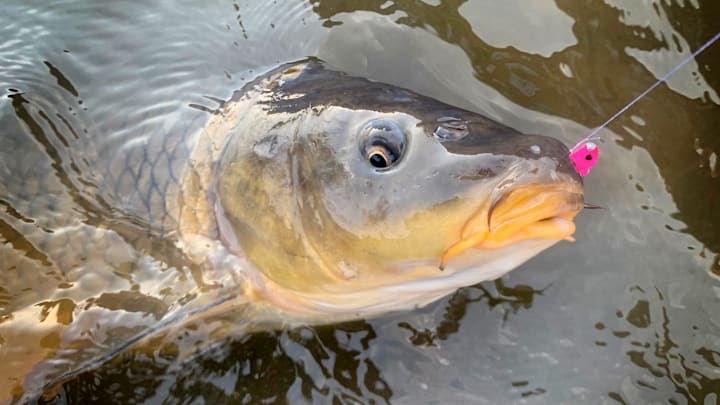
They wouldn’t be among the prettiest fish. In fact, some folks would say common carp are just plain ugly. These giant members of the minnow family were native to Europe and Asia, and were introduced to North America. They are now widespread in lakes, ponds and rivers all over the country. So why would anyone want to fish for carp? Because they fight like crazy!
Pound for pound, carp are some of the hardest-fighting fish anywhere. They’ve got thick, meaty bodies full of muscle and broad tails that can churn water away like a propeller. You’d be hard pressed to find a better fighting fish. Plus, they grow large, commonly ranging from 5 to 20 pounds and sometimes topping 50. And you don’t have to fly to an exotic destination and spend a week’s vacation to find good carp fishing. There’s probably a good carp hole near where you live.
Across the Pond, Carp Are King!

It’s worth noting that it’s only in the United States where an angler would describe a carp as ugly. They are a primary fishing target and highly revered in the United Kingdom and most of Europe. There, hardcore anglers have developed an endless array of very specialized carp techniques and high-tech gear that rival our most advanced approaches to bass, muskie or trout. For many Europeans, a trophy-sized carp is the fish of a lifetime.
Best Carp Baits for Fishing Success
Carp have sucker mouths and spend a lot of time feeding on the bottom, where they root up aquatic insects, worms, snails, crayfish and even seeds and berries. In fact, they are famous for eating mulberries that drop in the water. If you find a mulberry tree overhanging a river, make sure you fish near it when the berries are dropping!
Although worms can work, the best carp baits are corn, dough balls or boilies, which are manufactured dough baits. You can buy dough baits or make your own. Although you can wad up a chunk of white bread and put it on a hook, carp aficionados add scent to their dough baits like vanilla, Jell-o mix or even garlic; anything to put scent in the water to attract fish.
Speaking of attracting fish, chumming (where legal) is a great way to bring in the fish and incite a feeding frenzy. Chumming involves scattering whatever bait you’re using, like corn, bread, or pellets into the water around your baited hook to attract more fish to the area and get them into a feeding mood. If chumming isn’t legal or practical, fish at a pond or lagoon where people commonly throw bread or popcorn for ducks. Carp are used to feeding on the scraps the birds miss.

Top Carp Rigging Tips: Hooks, Dough Baits, and Hair Rigs
You might think your girlfriend is sensitive, but she’s got nothing on carp! For a big, bulky fish, carp are surprisingly dainty feeders. And thus, they’re hook shy. Completely cover the hook with corn kernels or dough to fool carp. A stout, but low-profile hook like a No. 4 Gamakatsu G-Carp Specialist R gets the nod.
Or, to help keep the dough from falling off the hook, try a dough holder hook which has wrapped wire that helps keep the bait on the hook.
Another method is the hair rig. A thin dropper coming off the hook is used. Thread a pre-made dough bait (boilie) with a bait needle. Run the hair dropper through the boilie and secure it with a stopper. I've included a quick video below to help explain.
The rest of your tackle needn’t be so sensitive. A medium-heavy rod paired with a sturdy baitcaster should get the job done. Spool up with 50-pound PowerPro braided line and you’re in business.
Where to Find the Best Carp Fishing Spots
Carp like warm, generally shallow water. Ponds or lagoons in parks where ducks are fed are great. In rivers, look for them around overhanging brush, near logs and in slack areas. In spring, they stack up below dams during their spawning migration. They also like shallow, marshy areas out of the main river current. In lakes and ponds, look for them near docks or in marinas. Try shallow weedy areas as well.
Carp often give visual clues to help you find them. Watch for jumping fish. And be assured, where you see one fish, there are probably more. Sometimes you can see them if the water is clear, but more often you’ll see bubbles from feeding fish. You might also see wakes or mud clouds left by spooked fish in the shallows. When you see these, you’ve probably already spooked the fish, but they’ll be back.
Casting for Carp

Once you’re rigged up and you’ve got a spot, it’s time to fish! Carp fishing is a waiting game. Generally you pitch out a bait, prop up the rod and wait for a bite. Use a sliding sinker rig fished below a swivel. This setup keeps your bait on the bottom, but lets a carp run without feeling resistance. If a carp feels something unnatural, it will quickly spit the bait.
A forked stick stuck into a river bank is standard fare for shore anglers, but commercially made models are available as well. In Europe, where carp fishing is extremely popular, anglers commonly use an elaborate horizontal multi-rod holder.
If allowed, chum the area first, then pitch out a line (or more if legal) and wait for a bite.
Why Carp Fishing
If you crave a battle with a big fish that pulls like a freight train and lives in nearly any of the waters closest to your home, wherever you live, carp fishing is a great bet. Get rigged up, find a spot, and get ready to connect with a real fighter!
 Add us as a preferred source on Google
Joe Shead is an accomplished outdoor writer, hunter, fishing guide and multi-species angler from Minnesota who will fish for anything, even if it won’t bite. Check out more of his work at goshedhunting.com and superiorexperiencecharters.com.