%22%3E%0A%3Cpath%20fill-rule%3D%22evenodd%22%20clip-rule%3D%22evenodd%22%20d%3D%22M156.868%204.36764C162.691%20-1.45588%20172.132%20-1.45588%20177.956%204.36764C183.779%2010.1912%20183.779%2019.6324%20177.956%2025.4559L167.412%2036L156.868%2025.4559C151.044%2019.6324%20151.044%2010.1912%20156.868%204.36764ZM159.509%207.55761C159.448%207.86849%20159.416%208.39718%20159.416%209.14566V10.4189C159.416%2011.1832%20159.448%2011.7198%20159.513%2012.0267C159.578%2012.3317%20159.778%2012.6168%20160.117%2012.8762C160.456%2013.1376%20160.903%2013.3316%20161.458%2013.4623C162.012%2013.593%20162.6%2013.6584%20163.337%2013.6584C164.073%2013.6584%20164.717%2013.591%20165.269%2013.4524C165.822%2013.3158%20166.261%2013.1178%20166.586%2012.8604C166.911%2012.6029%20167.105%2012.3178%20167.166%2012.0069C167.228%2011.6961%20167.259%2011.1674%20167.259%2010.4189V9.14566C167.259%208.38134%20167.228%207.84473%20167.162%207.53781C167.097%207.23287%20166.897%206.94971%20166.558%206.68834C166.22%206.42696%20165.772%206.23291%20165.218%206.10223C164.663%205.97154%20164.036%205.90619%20163.339%205.90619C162.602%205.90619%20161.959%205.97352%20161.406%206.11213C160.852%206.24875%20160.414%206.44677%20160.089%206.70418C159.765%206.9616%20159.571%207.24673%20159.509%207.55761ZM164.776%2024.8638C168.376%2024.8638%20170.057%2024.2064%20170.057%2021.862V21.858V21.3155C170.057%2019.6581%20169.016%2018.971%20165.752%2018.3136C164.778%2018.1136%20164.408%2017.9136%20164.408%2017.3136V16.9414C164.408%2016.6543%20164.677%2016.5117%20164.913%2016.5117C165.249%2016.5117%20165.418%2016.7137%20165.418%2016.9414V18.1136H169.891V17.3988C169.891%2015.4563%20168.847%2014.4266%20164.677%2014.4266C161.65%2014.4266%20159.396%2015.3414%20159.396%2017.3711V17.7433C159.396%2019.5155%20160.305%2020.3155%20163.701%2021.0303C163.78%2021.0472%20163.855%2021.063%20163.927%2021.0781C164.829%2021.2674%20165.147%2021.3341%20165.147%2021.9174V22.2897C165.147%2022.6619%20165.046%2022.8045%20164.642%2022.8045C164.17%2022.8045%20164.137%2022.5471%20164.137%2022.262V21.2897H159.394V21.7471C159.394%2024.149%20160.976%2024.8638%20164.776%2024.8638ZM170.924%2024.5569H175.425V14.7355H170.924V24.5569ZM172.455%2013.5019H175.425V6.06064H172.592V9.411L170.693%206.06064H167.859V13.5019H170.693V10.1199L172.455%2013.5019ZM163.769%2012.152C163.704%2012.2688%20163.555%2012.3262%20163.325%2012.3262L163.327%2012.3282C163.104%2012.3282%20162.959%2012.2767%20162.898%2012.1758C162.836%2012.0748%20162.805%2011.8074%20162.805%2011.3758V7.90068C162.805%207.51852%20162.852%207.28684%20162.945%207.20962C163.038%207.13239%20163.175%207.09279%20163.351%207.09279C163.559%207.09279%20163.698%207.14031%20163.765%207.23734C163.832%207.33239%20163.866%207.55416%20163.866%207.90068V11.3203C163.866%2011.7579%20163.834%2012.0352%20163.769%2012.152Z%22%20fill%3D%22white%22%2F%3E%0A%3Cpath%20d%3D%22M134.707%2035.9991C129.823%2035.9991%20126.029%2035.0305%20122.478%2033.2547L125.303%2027.7255C127.765%2029.017%20130.227%2029.8242%20133.254%2029.8242C136.684%2029.8242%20138.5%2028.0484%20138.5%2024.9811V24.3354C137.249%2025.7479%20135.191%2027.3623%20132.124%2027.3623C126.433%2027.3623%20122.316%2023.3264%20122.316%2017.2322V17.1515C122.316%2010.9766%20126.514%206.90039%20131.599%206.90039C134.828%206.90039%20136.724%208.11115%20138.339%209.76586V7.42506H147.5V23.8914C147.5%2027.9677%20146.653%2030.7524%20144.635%2032.7704C142.657%2034.748%20139.63%2035.9991%20134.707%2035.9991ZM134.868%2020.6627C137.128%2020.6627%20138.541%2019.1291%20138.541%2017.1919V17.1112C138.541%2015.2143%20137.088%2013.6807%20134.868%2013.6807C132.608%2013.6807%20131.195%2015.2547%20131.195%2017.1919V17.2726C131.195%2019.1695%20132.648%2020.6627%20134.868%2020.6627Z%22%20fill%3D%22white%22%2F%3E%0A%3Cpath%20d%3D%22M96.9492%2029.4629V7.42701H106.111V10.4943C107.523%208.67813%20109.743%206.90234%20112.851%206.90234C117.492%206.90234%20120.398%209.96961%20120.398%2014.9337V29.4629H111.236V17.8799C111.236%2015.9831%20110.106%2014.8934%20108.734%2014.8934C107.362%2014.8934%20106.111%2015.9831%20106.111%2017.8799V29.4629H96.9492Z%22%20fill%3D%22white%22%2F%3E%0A%3Cpath%20d%3D%22M84.8096%205.85202V0H94.2939V5.85202H84.8096ZM84.971%2029.4619V7.42602H94.1324V29.4619H84.971Z%22%20fill%3D%22white%22%2F%3E%0A%3Cpath%20d%3D%22M58.877%2029.4619V0H68.0384V10.3722C69.451%208.55606%2071.6707%206.90135%2074.7783%206.90135C79.4196%206.90135%2082.3254%209.96862%2082.3254%2014.9327V29.4619H73.164V17.8789C73.164%2015.9821%2072.0339%2014.8924%2070.6617%2014.8924C69.2895%2014.8924%2068.0384%2015.9821%2068.0384%2017.8789V29.4619H58.877Z%22%20fill%3D%22white%22%2F%3E%0A%3Cpath%20d%3D%22M47.3991%2029.9876C43.1211%2029.9876%2039.2466%2028.8979%2036.0986%2026.7992L39.2063%2021.5929C41.8699%2023.2477%2044.8565%2024.0548%2047.3587%2024.0548C48.2466%2024.0548%2048.6906%2023.853%2048.6906%2023.3284V23.2477C48.6906%2022.8037%2048.287%2022.5212%2046.0673%2021.9562C40.4977%2020.584%2037.0672%2019.0907%2037.0672%2014.5302V14.4494C37.0672%209.60638%2040.9417%206.90234%2046.6726%206.90234C50.3049%206.90234%2053.8969%207.8306%2056.5605%209.44495L53.6547%2014.8934C51.3139%2013.6019%2048.4888%2012.8351%2046.6323%2012.8351C45.7444%2012.8351%2045.3408%2013.0772%2045.3408%2013.5212V13.6019C45.3408%2014.0458%2045.8251%2014.3284%2048.0448%2014.8934C53.6143%2016.2656%2056.9641%2017.7992%2056.9641%2022.3194V22.4001C56.9641%2027.2028%2053.3722%2029.9876%2047.3991%2029.9876Z%22%20fill%3D%22white%22%2F%3E%0A%3Cpath%20d%3D%22M25.5312%205.85202V0H35.0156V5.85202H25.5312ZM25.6927%2029.4619V7.42602H34.8541V29.4619H25.6927Z%22%20fill%3D%22white%22%2F%3E%0A%3Cpath%20d%3D%22M0%2029.4621V1.21094H23.6503V9.2827H9.44396V12.8746H22.6413V20.2199H9.44396V29.4621H0Z%22%20fill%3D%22white%22%2F%3E%0A%3C%2Fg%3E%0A%3Cdefs%3E%0A%3CclipPath%20id%3D%22clip0_16330_64756%22%3E%0A%3Crect%20width%3D%22182%22%20height%3D%2236%22%20fill%3D%22white%22%2F%3E%0A%3C%2FclipPath%3E%0A%3C%2Fdefs%3E%0A%3C%2Fsvg%3E%0A)
Lake Sturgeon Fishing: How to Catch the Biggest Freshwater Fish in the Midwest
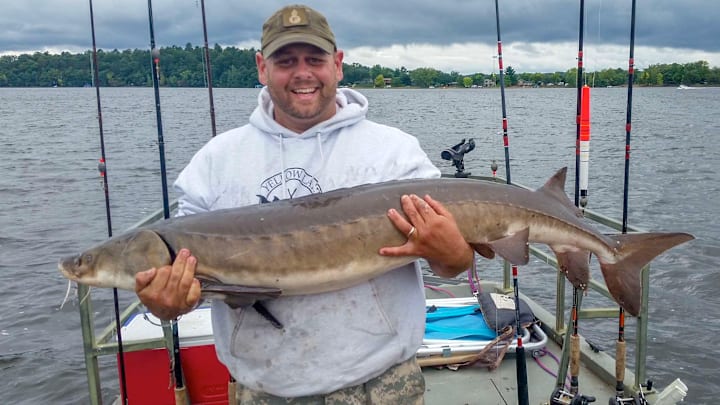
Why Lake Sturgeon Are the Real Giants of Freshwater Fishing
A lot of anglers in the Upper Great Lakes Areas covet the muskellunge, calling them the kings of freshwater. But these anglers must not fish for lake sturgeon. Indeed, in Wisconsin, which has dubbed the muskie its state fish, the state record muskie weighed 69 pounds, 11 ounces. Meanwhile, the state hook-and-line record lake sturgeon weighed 170 pounds and the largest legally speared through the ice weighed a whopping 212 pounds -- triple the state record muskie!
These massive, strange-looking fish were alive when dinosaurs roamed the earth. They grow large and can live for more than a century. They clean up dead fish off the bottom and live a peaceful coexistence with other fish species. But when hooked, these fish fight to the finish. You'll never fight a muskie for more than a few minutes, but when you hook up with a sturgeon that decides it wants to stay on the bottom, you're in for a long ride. It may take 20 minutes or more to subdue a giant sturgeon, even on heavy tackle. Here's how to catch these giant fish.
The History of Lake Sturgeon
Sturgeon species are some of the most imperiled fish in the world. Overharvest, damming of rivers and a general sense that they are trash fish has nearly wiped them out in many parts of the world. In fact, in the age of steamships, lake sturgeon were actually used as fuel to power steam engines (since they were deemed good for nothing else). Commercial anglers hated them because they tore nets intended for other species.
However, sturgeon are prized for their caviar, and in olden days they were easily exploited when they moved into the shallows to spawn. They were hauled away by the truck load, their eggs sold for caviar and their carcasses left to rot. This is especially shameful, since female sturgeon don't reach maturity until they are about 25 years old, and then only spawn about once every five years!
When people realized their swim bladders contained isinglass (which is a clarifier used for beer and wine making) they were further exploited. They went from a species thrown on river banks simply to have them out of the way, to a species commercially exploited almost to extinction.
Finally, protection for this long-lived species helped save it, and the cleaning up of polluted waters, the creation of spawning habitat and the removal of some dams (allowing access to traditional spawning habitat), along with restocking programs have helped this species recover. In fact, in some areas of Wisconsin and Minnesota, lake sturgeon are thriving. In other parts of the world, other sturgeon species are severely threatened.
Where to Fish for Lake Sturgeon in the U.S.
Lake sturgeon are native to the St. Lawrence River and Great Lakes drainages, the Mississippi River basin and even the Hudson Bay drainages. Originally, they ranged north to Hudson Bay and south to Louisiana, and west to Nebraska and east to Vermont. Today, the healthiest lake sturgeon populations are in Wisconsin, Minnesota and Michigan, with restoration efforts just beginning in many places, like the Maumee and Cuyahoga Rivers in Ohio.

Sturgeon Fishing Seasons and Regulations by State
Because sturgeon populations are low or recovering in many areas, fishing opportunities are limited across much of their native range. For example, there is no fishing for them in New York, Pennsylvania, Vermont, Indiana, Illinois and Iowa (just to name a few).
There is limited opportunity in Ohio.
There's a catch-and-release season in Manitoba and in the northern part of Ontario.
Michigan allows catch-and-release fishing on some waters and harvest opportunities on a select few. And Black Lake has a winter spearing season with a quota of six fish. In 2025, the quota was reached in 17 minutes!
In Minnesota, there are catch-and-release seasons, with some harvest seasons on the St. Croix River and Canadian border waters, which essentially means Lake of the Woods, the Rainy River and Rainy Lake.
In Wisconsin, there's a season on the Chippewa River, Flambeau River, Butternut Lake, Jump River, Yellow Lake, Little Yellow, the Danbury Flowage, Wisconsin River, Menominee River, Mississippi River, St. Louis River, St. Croix River and Lake Superior. There's also a winter sturgeon spearing season on Lake Winnebago and the connecting Upriver Lakes.
Heavy Rods, Reels, and Line for Sturgeon Fishing
Due to their large size and powerful runs, you need a rod and reel designed for big fish. Sure, you can land one on walleye gear, but when you're spooled up with heavy line on a rod and reel designed for fish measured in feet, not inches, you can land your fish faster and get your line back out there for another.
You can use a large-capacity spinning reel, but most die-hard sturgeon addicts fish with a bait-casting reel. Make sure you get one with plenty of line capacity because sturgeon can make blistering runs. This is especially critical if you're bank fishing and can't chase a big fish with a boat.
For rods, think long and limber. Go with something at least 7 feet long, and longer isn't a bad idea. It should have a flexible tip for detecting bites, some backbone for setting the hook, but also some flexibility to absorb the shock of powerful fish.
Braided line in the 50- to 80-pound-test range works well. It doesn't stretch, and sturgeon aren't particularly line shy.

The Best Bait and Rigs for Catching Lake Sturgeon
Sturgeon are bottom feeders that prey on dead fish, mollusks, crayfish, worms and aquatic invertebrates. So you want to keep your bait on the bottom. A lot of sturgeon fishing takes place in rivers, so you need a heavy sinker to keep your bait down. A pyramid or flat sinker works well because it won't roll in the current. Depending on the depth and the current, you could go with a sinker as light as 1 ounce or as heavy as 5 ounces. A 3-ounce sinker works well for most applications.
Slide the sinker on your mainline, then attach a heavy-duty barrel swivel -- no cheap little swivel here! You can add a bead as an option as well to protect your knot. To the opposite end of the swivel, attach a short leader of maybe 18 inches. Then you want a stout hook. A 5/0 circle hook works well. You could even use a wide-gap hook designed for bass fishing with soft plastic baits.
Load up the hook with bait. You want to get a lot of scent in the water. You could gob of minimum of three nightcrawlers on the hook. Or try a dead gizzard shad. Or add both minnows and nightcrawlers. Some anglers spray scent on their bait for extra attraction. Beware that fish like perch like to peck away at your nightcrawlers, so check your hooks frequently.
Proven Sturgeon Fishing Tactics for Rivers and Lakes
Side imaging and live sonar have greatly helped sturgeon anglers. Sturgeon are, well, big, so they are easier to see on electronics. Some anglers drive their boats until they find fish before they set up.
Otherwise, the tried and true method of many river anglers is to anchor at the top of a hole, place lines and hope fish in the middle and tail ends of the hole will smell your bait and move in. But sturgeon aren’t always in holes; sometimes they are up on flats feeding. If you know what they are feeding on, it can help you narrow your search. For example, if they're feeding on invertebrates in the mud, look for soft-bottomed areas. Of just pitch out a line and wait for a fish to come to you.
No matter how you do it, it's usually a waiting game. Prop your rod in a holder, keeping a tight line, and wait for a bite. When a sturgeon sucks in your bait, it will jiggle the rod tip as it mouths the bait. Don't expect the fish to take off like a scene out of Jaws. Instead, give the fish some slack while you take the rod out of the holder, tighten up the line and if you feel the fish, quickly set the hook.

Top Sturgeon Hotspots in the Midwest
The Upper Great Lakes states hold the best sturgeon fishing opportunities. Here are some of the top prospects.
Otsego Lake, Michigan
Otsego Lake in northern Michigan has a healthy sturgeon population, thanks to a stocking program started in the 1980s. The long, narrow lake is relatively shallow and has little suitable spawning habitat, so the sturgeon population is maintained through stocking, but the fish are doing well and fishing for them has been popular for decades. The sturgeon season runs from mid-July to mid-March. One fish may be harvested per season, with a 50-inch minimum size limit.

Rainy River, Minnesota
The Rainy River attracts throngs of anglers each spring when lake sturgeon (and walleyes) leave the sprawling Lake of the Woods and congregate in the Rainy River for their spawning run. For two weeks in late April and early May, anglers can keep a sturgeon between 45 and 50 inches, or over 75 inches. Then there's a week of catch-and-release only fishing before the season closes for the rest of May and all of June. Harvest season reopens from July through September before reverting to catch and release only until the following April (see specific dates each year).
The Rainy River forms part of the border between Minnesota and Ontario, and Minnesota anglers must stay on the U.S. side of the water.
Lake Winnebago, Wisconsin
Lake Winnebago has held a sturgeon spearing season each February since 1932. The season runs 16 days or until a harvest cap is met. Naturally, water clarity plays a big part in spearing success and it varies each year. Thousands of anglers cut giant holes in the ice with chainsaws, then use decoys to not only attract sturgeon, but also to serve as a reference to ensure a fish meets the 36-inch size limit.
An unlimited number of licenses is sold to spearers on Lake Winnebago (but licenses must be purchased by Oct. 31). On the connecting Upriver Lakes (Butte des Morts, Winneconne and Poygan) spearers have to enter a lottery for the 500 available permits by Aug. 1. Success rates are higher on these lakes, thus the high demand.
St. Croix River, Minnesota/Wisconsin
This border water is very popular with sturgeon anglers. There's a catch-and-release season that runs from mid-June to early September and again from the beginning of October through February (and ice fishing for sturgeon is very popular!). There's also a short harvest season in September with a 60-inch minimum size limit. Anglers are allowed to keep one sturgeon per year (a tag is required to harvest a fish, but not to fish for them if you intend to release them). With close proximity to the Minneapolis/St. Paul metro area, lots of anglers head to this productive sturgeon fishery.
Recommended Articles:
 Add us as a preferred source on Google
Joe Shead is an accomplished outdoor writer, hunter, fishing guide and multi-species angler from Minnesota who will fish for anything, even if it won’t bite. Check out more of his work at goshedhunting.com and superiorexperiencecharters.com.