%22%3E%0A%3Cpath%20fill-rule%3D%22evenodd%22%20clip-rule%3D%22evenodd%22%20d%3D%22M156.868%204.36764C162.691%20-1.45588%20172.132%20-1.45588%20177.956%204.36764C183.779%2010.1912%20183.779%2019.6324%20177.956%2025.4559L167.412%2036L156.868%2025.4559C151.044%2019.6324%20151.044%2010.1912%20156.868%204.36764ZM159.509%207.55761C159.448%207.86849%20159.416%208.39718%20159.416%209.14566V10.4189C159.416%2011.1832%20159.448%2011.7198%20159.513%2012.0267C159.578%2012.3317%20159.778%2012.6168%20160.117%2012.8762C160.456%2013.1376%20160.903%2013.3316%20161.458%2013.4623C162.012%2013.593%20162.6%2013.6584%20163.337%2013.6584C164.073%2013.6584%20164.717%2013.591%20165.269%2013.4524C165.822%2013.3158%20166.261%2013.1178%20166.586%2012.8604C166.911%2012.6029%20167.105%2012.3178%20167.166%2012.0069C167.228%2011.6961%20167.259%2011.1674%20167.259%2010.4189V9.14566C167.259%208.38134%20167.228%207.84473%20167.162%207.53781C167.097%207.23287%20166.897%206.94971%20166.558%206.68834C166.22%206.42696%20165.772%206.23291%20165.218%206.10223C164.663%205.97154%20164.036%205.90619%20163.339%205.90619C162.602%205.90619%20161.959%205.97352%20161.406%206.11213C160.852%206.24875%20160.414%206.44677%20160.089%206.70418C159.765%206.9616%20159.571%207.24673%20159.509%207.55761ZM164.776%2024.8638C168.376%2024.8638%20170.057%2024.2064%20170.057%2021.862V21.858V21.3155C170.057%2019.6581%20169.016%2018.971%20165.752%2018.3136C164.778%2018.1136%20164.408%2017.9136%20164.408%2017.3136V16.9414C164.408%2016.6543%20164.677%2016.5117%20164.913%2016.5117C165.249%2016.5117%20165.418%2016.7137%20165.418%2016.9414V18.1136H169.891V17.3988C169.891%2015.4563%20168.847%2014.4266%20164.677%2014.4266C161.65%2014.4266%20159.396%2015.3414%20159.396%2017.3711V17.7433C159.396%2019.5155%20160.305%2020.3155%20163.701%2021.0303C163.78%2021.0472%20163.855%2021.063%20163.927%2021.0781C164.829%2021.2674%20165.147%2021.3341%20165.147%2021.9174V22.2897C165.147%2022.6619%20165.046%2022.8045%20164.642%2022.8045C164.17%2022.8045%20164.137%2022.5471%20164.137%2022.262V21.2897H159.394V21.7471C159.394%2024.149%20160.976%2024.8638%20164.776%2024.8638ZM170.924%2024.5569H175.425V14.7355H170.924V24.5569ZM172.455%2013.5019H175.425V6.06064H172.592V9.411L170.693%206.06064H167.859V13.5019H170.693V10.1199L172.455%2013.5019ZM163.769%2012.152C163.704%2012.2688%20163.555%2012.3262%20163.325%2012.3262L163.327%2012.3282C163.104%2012.3282%20162.959%2012.2767%20162.898%2012.1758C162.836%2012.0748%20162.805%2011.8074%20162.805%2011.3758V7.90068C162.805%207.51852%20162.852%207.28684%20162.945%207.20962C163.038%207.13239%20163.175%207.09279%20163.351%207.09279C163.559%207.09279%20163.698%207.14031%20163.765%207.23734C163.832%207.33239%20163.866%207.55416%20163.866%207.90068V11.3203C163.866%2011.7579%20163.834%2012.0352%20163.769%2012.152Z%22%20fill%3D%22white%22%2F%3E%0A%3Cpath%20d%3D%22M134.707%2035.9991C129.823%2035.9991%20126.029%2035.0305%20122.478%2033.2547L125.303%2027.7255C127.765%2029.017%20130.227%2029.8242%20133.254%2029.8242C136.684%2029.8242%20138.5%2028.0484%20138.5%2024.9811V24.3354C137.249%2025.7479%20135.191%2027.3623%20132.124%2027.3623C126.433%2027.3623%20122.316%2023.3264%20122.316%2017.2322V17.1515C122.316%2010.9766%20126.514%206.90039%20131.599%206.90039C134.828%206.90039%20136.724%208.11115%20138.339%209.76586V7.42506H147.5V23.8914C147.5%2027.9677%20146.653%2030.7524%20144.635%2032.7704C142.657%2034.748%20139.63%2035.9991%20134.707%2035.9991ZM134.868%2020.6627C137.128%2020.6627%20138.541%2019.1291%20138.541%2017.1919V17.1112C138.541%2015.2143%20137.088%2013.6807%20134.868%2013.6807C132.608%2013.6807%20131.195%2015.2547%20131.195%2017.1919V17.2726C131.195%2019.1695%20132.648%2020.6627%20134.868%2020.6627Z%22%20fill%3D%22white%22%2F%3E%0A%3Cpath%20d%3D%22M96.9492%2029.4629V7.42701H106.111V10.4943C107.523%208.67813%20109.743%206.90234%20112.851%206.90234C117.492%206.90234%20120.398%209.96961%20120.398%2014.9337V29.4629H111.236V17.8799C111.236%2015.9831%20110.106%2014.8934%20108.734%2014.8934C107.362%2014.8934%20106.111%2015.9831%20106.111%2017.8799V29.4629H96.9492Z%22%20fill%3D%22white%22%2F%3E%0A%3Cpath%20d%3D%22M84.8096%205.85202V0H94.2939V5.85202H84.8096ZM84.971%2029.4619V7.42602H94.1324V29.4619H84.971Z%22%20fill%3D%22white%22%2F%3E%0A%3Cpath%20d%3D%22M58.877%2029.4619V0H68.0384V10.3722C69.451%208.55606%2071.6707%206.90135%2074.7783%206.90135C79.4196%206.90135%2082.3254%209.96862%2082.3254%2014.9327V29.4619H73.164V17.8789C73.164%2015.9821%2072.0339%2014.8924%2070.6617%2014.8924C69.2895%2014.8924%2068.0384%2015.9821%2068.0384%2017.8789V29.4619H58.877Z%22%20fill%3D%22white%22%2F%3E%0A%3Cpath%20d%3D%22M47.3991%2029.9876C43.1211%2029.9876%2039.2466%2028.8979%2036.0986%2026.7992L39.2063%2021.5929C41.8699%2023.2477%2044.8565%2024.0548%2047.3587%2024.0548C48.2466%2024.0548%2048.6906%2023.853%2048.6906%2023.3284V23.2477C48.6906%2022.8037%2048.287%2022.5212%2046.0673%2021.9562C40.4977%2020.584%2037.0672%2019.0907%2037.0672%2014.5302V14.4494C37.0672%209.60638%2040.9417%206.90234%2046.6726%206.90234C50.3049%206.90234%2053.8969%207.8306%2056.5605%209.44495L53.6547%2014.8934C51.3139%2013.6019%2048.4888%2012.8351%2046.6323%2012.8351C45.7444%2012.8351%2045.3408%2013.0772%2045.3408%2013.5212V13.6019C45.3408%2014.0458%2045.8251%2014.3284%2048.0448%2014.8934C53.6143%2016.2656%2056.9641%2017.7992%2056.9641%2022.3194V22.4001C56.9641%2027.2028%2053.3722%2029.9876%2047.3991%2029.9876Z%22%20fill%3D%22white%22%2F%3E%0A%3Cpath%20d%3D%22M25.5312%205.85202V0H35.0156V5.85202H25.5312ZM25.6927%2029.4619V7.42602H34.8541V29.4619H25.6927Z%22%20fill%3D%22white%22%2F%3E%0A%3Cpath%20d%3D%22M0%2029.4621V1.21094H23.6503V9.2827H9.44396V12.8746H22.6413V20.2199H9.44396V29.4621H0Z%22%20fill%3D%22white%22%2F%3E%0A%3C%2Fg%3E%0A%3Cdefs%3E%0A%3CclipPath%20id%3D%22clip0_16330_64756%22%3E%0A%3Crect%20width%3D%22182%22%20height%3D%2236%22%20fill%3D%22white%22%2F%3E%0A%3C%2FclipPath%3E%0A%3C%2Fdefs%3E%0A%3C%2Fsvg%3E%0A)
How To Take Better Fishing Photos: 6 Easy Tips To Shoot Like A Pro
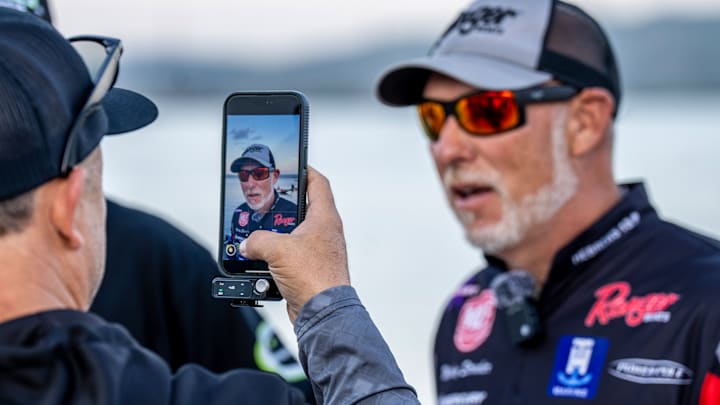
Fishing is an activity often tied tightly to photography. Did you really catch a big fish if you don’t have the picture to back up your story? And if you’re a professional angler, or trying to become a professional angler, I promise you, your ability to provide sponsors with clean, sharp, engaging photos and videos will give you a huge advantage over everyone else.
What Makes a Great Fishing Photo?
Photography is about capturing an entire story in a single frame. You know the old, “a picture is worth a thousand words,” cliche? If you keep an open mind and apply the following simple but very effective tips, you’ll be capturing your memories and telling your fishing story better than you ever thought possible.
And while all of these tips can improve your results regardless of the camera you're using, consider the possibility of getting a dedicated camera to make the most of these new skills. Yes, I get the convenience factor of a phone that's already in your pocket having a camera built in. While some of these boast impressive stats, they simply can't outperform a real camera. And tell me this, if your fishing gear is really just about convenience, why do you have so many rods? Wouldn't carrying just one be more convenient? Hmm.
1. What to Shoot: Beyond the Grip-and-Grin
Not every picture of fishing has to be an angler holding up the fish they just caught—the ol’ classic “grip-and-grin”. I’m not saying don’t take those, but don’t forget about everything else that happens during a day of fishing. Think about getting a shot of the angler tying on a lure, or casting in front of a beautiful sunset or other interesting background, or fighting the fish with the rod doubled over, or just as the fish goes into the net, or while they’re unhooking the fish, etc.

Get Creative with Angles and Storytelling
Mix up the shots a little. Sometimes, get really close filling the whole frame with just the lure, or just the fish (or maybe even just the fish’s eye). Sometimes, get farther back and include the surroundings—like a sunrise over the water or the boat—to provide context and atmosphere. Again, not every shot needs to be the angler holding the fish from a medium distance. If it is a shot of someone holding a fish, try a couple unique angles—really low, or really high, or looking back over their shoulder, or with the nose of the fish in tight focus right up in the lens.

Pro Tip: Take More Candid Photos
Most of your best shots will not require you saying, “Okay, ready? Smile!” or counting down, “3,2,1.” *click* If you see something cool happening while fishing, take a picture...no, take a bunch of pictures...and sort out the bad ones later (more on this in Tip 5).
Pro Tip: Remove Clutter to Project Authority
Make sure your surroundings and background are clutter-free, stain-free and generally in good condition. Get rid of trash and try to make your tackle look organized. A clean shot is just more visually appealing and makes you seem like more of a fishing authority.

2. Lighting Tips for Better Fishing Photography
Natural Light Photography
In fishing photography, you’re going to be using natural light from the sun almost exclusively. Always take a second to consider from which direction that sunlight is coming. In most cases, unless you’re trying to create a silhouette, position the sun behind you, the photographer. If it’s a candid shot, just keep clicking and try your best to find a good angle for the light, but if you are posing the shot, you’ll usually want to light the subject’s face.
Avoid Distracting Shadows In Your Photos
Also, take another second to note if there are any distracting shadows or harsh reflections or highlights on the fish or the fisherman. If so, try moving around. Rotate a couple degrees from the subject. Turn the boat. Have the photographer and angler trade places. You’ll be surprised how much of a difference a different light angle can make.
Shooting Outside of the Golden Hours
You’re probably aware that the best times for photos are early morning or late afternoon, when the sun is low, creating that soft, golden light that looks so good in a photo. But sometimes you’ll need to take a photo in the middle of the day. When the sun is high overhead, do your best to position the sun mostly behind the photographer for lighting that is as even as possible on the subject. And then double check for distracting shadows and adjust as needed.
For that midday harsh light situation, with most cameras you can force your flash to fire, which can fill in that hard shadow under an anglers hat. The lighting looks a little unnatural, but it’s much more pleasing than a shadow that makes the subject’s face unrecognizable.

Pro Tip: Show the Eyes
If you are posing a “grip-n-grin” photo, ask the subject to take their sunglasses off. Every portrait will be much more interesting and engaging if you can see the subject’s eyes.
3. Composition Counts: Consider the Rule of Thirds
One of the easiest ways to improve your chances of taking an interesting and engaging photo is to use the rule of thirds to frame your shot. A lot of cameras, including cell phones, have an option to show the screen with a grid overlay, splitting the photo area into thirds. Position the most important part of the photo on one of the spots where the grid lines intersect. This will create a pleasing, dynamic composition that will draw the eye right where you want it.

Of course, there are always exceptions. For example, you might get a great shot of something that is strongly symmetrical by intentionally putting the subject right in the middle. But either way, the composition—the way all of the elements balance in the frame and the part of the photo you want viewers to notice first—should always be a conscious decision.
And whatever you do, don’t compose every shot with the subject’s face in the exact middle of the frame with tons of sky above their head. Get way closer unless you’re trying to tell a story about the surroundings. And then, consider getting that subject to hit on the thirds.
PRO TIP: Horizons are Horizontal
Please make sure the horizon is horizontal! Take a look at the shoreline or the water's horizon line in the background of your photo. I understand that boats rock on waves making this tough for the photographer to hit every time. But every phone comes with photo editing capabilities that allow you to easily rotate the photo a couple degrees to correct this. Leaving a photo with the horizon rotated out of horizontal by a couple degrees gives the photo an overall uneasy feeling on a subconscious level. For the same reason most people can't walk by a crooked painting on the wall of their home without straightening it, your brain wants the horizon to be horizontal.
4. Check Your Camera, Then Check It Again
Clean Lens
Make sure your lens is clean—phone or camera. Check it again and again, all day. You’ll get that cool close-up shot of the fish being scooped into the net, but not realize that he splashed a couple drops of water that landed on your lens and end up as two, out-of-focus, black U.F.O.s in every shot the rest of the day. Use a soft cloth to wipe away dirt, water drops or dried water spots.
Sharp Intentional Focus
Use your camera or phone’s focus-lock feature, usually by tapping the screen on the part you want in focus, to ensure the fish or the product or whatever you’re trying to feature is sharp and vibrant. Most cameras show a highlighted box over the part of the frame in sharp focus. But you need to keep an eye on that with every picture you take because it will usually reset after the shot or after some amount of time.

5. Shoot More Than You Need: Edit Without Mercy
Since all of us are shooting digitally rather than on film in 2025, there’s no reason not to take a ton of shots. That’s right, kids. It used to require special film in a special camera to take a photo. And you had to pay extra and wait several days to see if you had taken a usable shot. Today there is no additional cost, no matter how many photos you take. So, while you’re fishing, just keep clicking off the shots. Then when you get home that night, delete everything but the best.
Pro Tip: Don't Save Bad Shots
Don’t publish a collection of 200 unedited photos on your Facebook. Shoot a lot, then get rid of everything but the best. I probably end up keeping maybe five shots out of every 100 I take.
6. Respect the Fish in Every Photo

We understand that fish are often harvested for food and that’s great. But it’s important
that the fish are handled and photographed respectfully. Rinse away excess blood. If a fish was accidentally dropped, make sure you’ve rinsed off any grass or dirt that may be stuck to it before you pose for a photo. Again, I totally get that some fish may end up in the fryer, but as true outdoors advocates it’s important that we present a sense of appreciation and respect for the resource.
Improve Your Photo Skills On and Off the Water
Whether you want to get better and documenting your memories, or add this skill to your resume to attractive fishing sponsors, great photography captures a moment and tells a story. With an open mind, the right direction and a little practice, your photos will soon be worthy of all the fish you’re catching.
Recommended Articles:
 Add us as a preferred source on Google
Kurt Mazurek writes about all things fishing and the outdoor lifestyle for Fishing On SI -a division of Sports Illustrated. Before writing On SI he enjoyed a successful career in the fishing industry, developing marketing campaigns and creative content for many of the sport’s most recognizable brands. He is a dedicated husband and father, an enthusiastic bass tournament competitor, YouTuber, photographer, musician, and author of the novel "Personal Best: fishing and life”.