%22%3E%0A%3Cpath%20fill-rule%3D%22evenodd%22%20clip-rule%3D%22evenodd%22%20d%3D%22M156.868%204.36764C162.691%20-1.45588%20172.132%20-1.45588%20177.956%204.36764C183.779%2010.1912%20183.779%2019.6324%20177.956%2025.4559L167.412%2036L156.868%2025.4559C151.044%2019.6324%20151.044%2010.1912%20156.868%204.36764ZM159.509%207.55761C159.448%207.86849%20159.416%208.39718%20159.416%209.14566V10.4189C159.416%2011.1832%20159.448%2011.7198%20159.513%2012.0267C159.578%2012.3317%20159.778%2012.6168%20160.117%2012.8762C160.456%2013.1376%20160.903%2013.3316%20161.458%2013.4623C162.012%2013.593%20162.6%2013.6584%20163.337%2013.6584C164.073%2013.6584%20164.717%2013.591%20165.269%2013.4524C165.822%2013.3158%20166.261%2013.1178%20166.586%2012.8604C166.911%2012.6029%20167.105%2012.3178%20167.166%2012.0069C167.228%2011.6961%20167.259%2011.1674%20167.259%2010.4189V9.14566C167.259%208.38134%20167.228%207.84473%20167.162%207.53781C167.097%207.23287%20166.897%206.94971%20166.558%206.68834C166.22%206.42696%20165.772%206.23291%20165.218%206.10223C164.663%205.97154%20164.036%205.90619%20163.339%205.90619C162.602%205.90619%20161.959%205.97352%20161.406%206.11213C160.852%206.24875%20160.414%206.44677%20160.089%206.70418C159.765%206.9616%20159.571%207.24673%20159.509%207.55761ZM164.776%2024.8638C168.376%2024.8638%20170.057%2024.2064%20170.057%2021.862V21.858V21.3155C170.057%2019.6581%20169.016%2018.971%20165.752%2018.3136C164.778%2018.1136%20164.408%2017.9136%20164.408%2017.3136V16.9414C164.408%2016.6543%20164.677%2016.5117%20164.913%2016.5117C165.249%2016.5117%20165.418%2016.7137%20165.418%2016.9414V18.1136H169.891V17.3988C169.891%2015.4563%20168.847%2014.4266%20164.677%2014.4266C161.65%2014.4266%20159.396%2015.3414%20159.396%2017.3711V17.7433C159.396%2019.5155%20160.305%2020.3155%20163.701%2021.0303C163.78%2021.0472%20163.855%2021.063%20163.927%2021.0781C164.829%2021.2674%20165.147%2021.3341%20165.147%2021.9174V22.2897C165.147%2022.6619%20165.046%2022.8045%20164.642%2022.8045C164.17%2022.8045%20164.137%2022.5471%20164.137%2022.262V21.2897H159.394V21.7471C159.394%2024.149%20160.976%2024.8638%20164.776%2024.8638ZM170.924%2024.5569H175.425V14.7355H170.924V24.5569ZM172.455%2013.5019H175.425V6.06064H172.592V9.411L170.693%206.06064H167.859V13.5019H170.693V10.1199L172.455%2013.5019ZM163.769%2012.152C163.704%2012.2688%20163.555%2012.3262%20163.325%2012.3262L163.327%2012.3282C163.104%2012.3282%20162.959%2012.2767%20162.898%2012.1758C162.836%2012.0748%20162.805%2011.8074%20162.805%2011.3758V7.90068C162.805%207.51852%20162.852%207.28684%20162.945%207.20962C163.038%207.13239%20163.175%207.09279%20163.351%207.09279C163.559%207.09279%20163.698%207.14031%20163.765%207.23734C163.832%207.33239%20163.866%207.55416%20163.866%207.90068V11.3203C163.866%2011.7579%20163.834%2012.0352%20163.769%2012.152Z%22%20fill%3D%22white%22%2F%3E%0A%3Cpath%20d%3D%22M134.707%2035.9991C129.823%2035.9991%20126.029%2035.0305%20122.478%2033.2547L125.303%2027.7255C127.765%2029.017%20130.227%2029.8242%20133.254%2029.8242C136.684%2029.8242%20138.5%2028.0484%20138.5%2024.9811V24.3354C137.249%2025.7479%20135.191%2027.3623%20132.124%2027.3623C126.433%2027.3623%20122.316%2023.3264%20122.316%2017.2322V17.1515C122.316%2010.9766%20126.514%206.90039%20131.599%206.90039C134.828%206.90039%20136.724%208.11115%20138.339%209.76586V7.42506H147.5V23.8914C147.5%2027.9677%20146.653%2030.7524%20144.635%2032.7704C142.657%2034.748%20139.63%2035.9991%20134.707%2035.9991ZM134.868%2020.6627C137.128%2020.6627%20138.541%2019.1291%20138.541%2017.1919V17.1112C138.541%2015.2143%20137.088%2013.6807%20134.868%2013.6807C132.608%2013.6807%20131.195%2015.2547%20131.195%2017.1919V17.2726C131.195%2019.1695%20132.648%2020.6627%20134.868%2020.6627Z%22%20fill%3D%22white%22%2F%3E%0A%3Cpath%20d%3D%22M96.9492%2029.4629V7.42701H106.111V10.4943C107.523%208.67813%20109.743%206.90234%20112.851%206.90234C117.492%206.90234%20120.398%209.96961%20120.398%2014.9337V29.4629H111.236V17.8799C111.236%2015.9831%20110.106%2014.8934%20108.734%2014.8934C107.362%2014.8934%20106.111%2015.9831%20106.111%2017.8799V29.4629H96.9492Z%22%20fill%3D%22white%22%2F%3E%0A%3Cpath%20d%3D%22M84.8096%205.85202V0H94.2939V5.85202H84.8096ZM84.971%2029.4619V7.42602H94.1324V29.4619H84.971Z%22%20fill%3D%22white%22%2F%3E%0A%3Cpath%20d%3D%22M58.877%2029.4619V0H68.0384V10.3722C69.451%208.55606%2071.6707%206.90135%2074.7783%206.90135C79.4196%206.90135%2082.3254%209.96862%2082.3254%2014.9327V29.4619H73.164V17.8789C73.164%2015.9821%2072.0339%2014.8924%2070.6617%2014.8924C69.2895%2014.8924%2068.0384%2015.9821%2068.0384%2017.8789V29.4619H58.877Z%22%20fill%3D%22white%22%2F%3E%0A%3Cpath%20d%3D%22M47.3991%2029.9876C43.1211%2029.9876%2039.2466%2028.8979%2036.0986%2026.7992L39.2063%2021.5929C41.8699%2023.2477%2044.8565%2024.0548%2047.3587%2024.0548C48.2466%2024.0548%2048.6906%2023.853%2048.6906%2023.3284V23.2477C48.6906%2022.8037%2048.287%2022.5212%2046.0673%2021.9562C40.4977%2020.584%2037.0672%2019.0907%2037.0672%2014.5302V14.4494C37.0672%209.60638%2040.9417%206.90234%2046.6726%206.90234C50.3049%206.90234%2053.8969%207.8306%2056.5605%209.44495L53.6547%2014.8934C51.3139%2013.6019%2048.4888%2012.8351%2046.6323%2012.8351C45.7444%2012.8351%2045.3408%2013.0772%2045.3408%2013.5212V13.6019C45.3408%2014.0458%2045.8251%2014.3284%2048.0448%2014.8934C53.6143%2016.2656%2056.9641%2017.7992%2056.9641%2022.3194V22.4001C56.9641%2027.2028%2053.3722%2029.9876%2047.3991%2029.9876Z%22%20fill%3D%22white%22%2F%3E%0A%3Cpath%20d%3D%22M25.5312%205.85202V0H35.0156V5.85202H25.5312ZM25.6927%2029.4619V7.42602H34.8541V29.4619H25.6927Z%22%20fill%3D%22white%22%2F%3E%0A%3Cpath%20d%3D%22M0%2029.4621V1.21094H23.6503V9.2827H9.44396V12.8746H22.6413V20.2199H9.44396V29.4621H0Z%22%20fill%3D%22white%22%2F%3E%0A%3C%2Fg%3E%0A%3Cdefs%3E%0A%3CclipPath%20id%3D%22clip0_16330_64756%22%3E%0A%3Crect%20width%3D%22182%22%20height%3D%2236%22%20fill%3D%22white%22%2F%3E%0A%3C%2FclipPath%3E%0A%3C%2Fdefs%3E%0A%3C%2Fsvg%3E%0A)
Proven Redfish Baits and Tips for Beginners
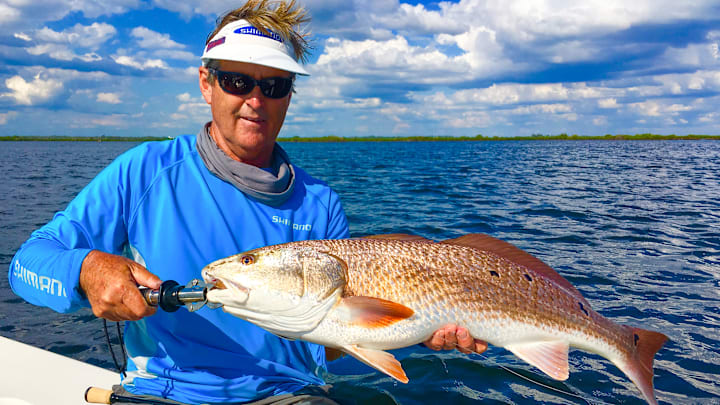
Redfish are one of the most reliable inshore species to catch, but that doesn’t mean catching them is always easy. The fish’s tendency to be a bit spooky in shallow water, combined with sloppy presentations and the wrong bait choice, can turn a promising flat full of tailing reds into a frustrating fishing experience.
The good news is that redfish generally respond very well to the right lures and stealthy presentations. Drawing on decades of inshore fishing experience, I’ll break down the best baits for consistent action and explain how, when and where to fish them most effectively.
Where to Find Redfish

If you’re fishing the inshore waters of the Gulf Coast states, around the Florida peninsula, and well up the Eastern Seaboard, you’ll likely be around redfish. Places to find them include oyster bars, grass flats, creeks, channel edges and deep holes. They also relate to structural features like piers, jetties and seawalls, and they are apt to feed in any of these places, seemingly on any given tide.
The Best Baits for Redfish and When to Use Them

In an ideal situation, when redfish "tail" or root along the bottom in the shallows with the tip of their tail visible above the water, they're vulnerable to a variety of lures and techniques. But they can also be very catchable in settings where you can’t see them.
Weedless spoons, jigs, swimbaits, spinnerbaits, and small plugs can all work well. Soft-plastics, like artificial shrimp, grubs and fluke-style lures are also excellent choices. The key is matching the bait to the current conditions and presenting it without spooking fish.
Weedless Spoons

When the water is high and the fish are cruising over the tops of oyster bars or through flooded spartina grass, a weedless spoon allows you to fish where other lures cannot. Their snagless nature lets them travel cleanly through cover, even when fish are tight to structure.
If it’s cloudy or windy, or the water is off-colored and you’re unsure of the fish’s exact location, spoons also shine as search baits. Try fan casting the general area you think may hold fish.
A 1/4- to 1/2-ounce Johnson Silver Minnow in gold or copper is a proven choice.
Swimbaits

Like spoons, swimbaits are excellent for covering water and avoiding snags while searching for fish. They can work well on lower-visibility cloudy or windy days thanks to the vibration produced by their tail allowing fish to find them. But they are more subtle than a flashy spoon, making them a perfect choice when the fish seem less aggressive.
My favorite swimbait is the Hildebrandt Drum Roller Jig pre-rigged with a Z-Man MinnowZ swimbait trailer. Constructed of pure tin rather than lead, this small-size swimbait can be retrieved at much slower speeds with less chance of snagging. The Z-Man trailer is also resistant to wear and tear caused by trash fish nipping at its tail.
Spinnerbaits

Another excellent search bait, spinnerbaits come into their own when visibility is reduced or fish are spread out. Spinnerbaits allow you to fan cast large areas efficiently, even through heavy cover, while giving fish both flash and vibration to key in on.
Hildebrandt’s Drum Roller is a reliable option. It features the company’s premium gold-plated No. 4 blade, Sampo ball-bearing swivel, heavy-gauge wire form with pivoting tin jighead, and a Z-Man MinnowZ trailer. Good color choices for redfish include Houdini, New Penny, and Red Bone.
For all three of these search baits (spoons, swimbaits and spinnerbaits), keep the rod tip up then gradually lower it as the lure nears the end of your retrieve. Varying the retrieve speed can help trigger strikes.
Soft Plastics: Flukes, Grubs and Shrimp

When it's flat calm, especially in shallow water, and the fish are easily spooked, a fluke or lightly weighted jig-and-grub combo might be your best bet. Present one of these subtly, in close proximity to the fish, and they will usually strike without hesitation.
For fluke-style soft plastics, Yamamoto’s D-Shad in white and various glitter finishes is a standout. The D-Shad is slightly heavier than others in its class, so it casts extremely well—even in a gale. It also has a unique gliding action compared to other fluke-style baits.
If the lifelike appearance of soft plastic shrimp imitations is your preference, Z-Man, Savage Gear, Live Target, and D.O.A. all make effective models.
Topwater Lures

Especially early and late in the day, topwaters can be the right choice. Poppers, chuggers and walking baits catch countless numbers of redfish, and they are fun to fish. The strikes are usually vicious, and because they sometimes miss the lure on the first try, follow ups are common. So don’t be too quick on the hookset, as that could foil your chances of connecting with a hot fish.
The better topwaters include a Heddon Spook Jr, Rapala SkitterWalk and Skitter V, and Shimano Current Sniper Splash Walk. For poppers, I like the Shimano World Pop. It features an internal, highly reflective Mylar strip called Flash Boost, which strobes even when the lure is at rest.
Subsurface Hard Baits

Shallow-running crankbaits and twitchbaits can be very effective, as well — particularly around oyster bars, piers and pilings, or along creek bends and over holes on the flats. If presented from a safe distance, you can sometimes fool numerous fish in a school.
Molded subsurface lures to try include a MirrOlure MirrOdine or Rapala Twitchin’ Mullet. These ultra-slow sinking lures can sometimes make a difference. Choose baitfish-matching patterns or those with gold and red highlights for best results.
Why Stealth and Presentation Still Matter Most

While lure selection can vary, what is arguably more important is a stealthy presentation. By casting at a distance, your odds of connecting increase significantly — especially when it's flat calm and the fish are easily spooked.
When redfish are aggressive, they will respond to just about any lure, at any rate of retrieve. But when they are sluggish or not in the mood to feed, lures that can be presented subtly with finesse are oftentimes required. But keep in mind, there are exceptions. Occasionally, quick, erratic movements of the lure within the strike zone can provoke passive or lethargic fish into biting. So be sure to experiment with different lures, actions and rates of retrieve.
Let the Fish Tell You What They Want

Redfish are often among the easiest fish to fool. But when they aren’t, the right bait, fished the right way, can turn a slow day into a memorable one. Just keep an open mind while trying these tactics. Don’t be afraid to mix it up. The fish will tell you what they want that day and you’ll be on the fast-track to success.
You Might Also Like These Fishing Articles:
 Add us as a preferred source on Google
Gainesville, Florida’s Bernie Schultz is a professional angler who has competed in bass and inshore saltwater tournaments for decades. He's a writer and illustrator whose work has been featured by the world’s biggest fishing media outlets. Over the years he has been a host and a guest on many television and podcast shows. And he is a multi-species fishing lure designer and an avid collector of vintage tackle.