
Toby's Take: Has The Next Gen Car Lost Its Luster On 1.5-Mile Tracks?
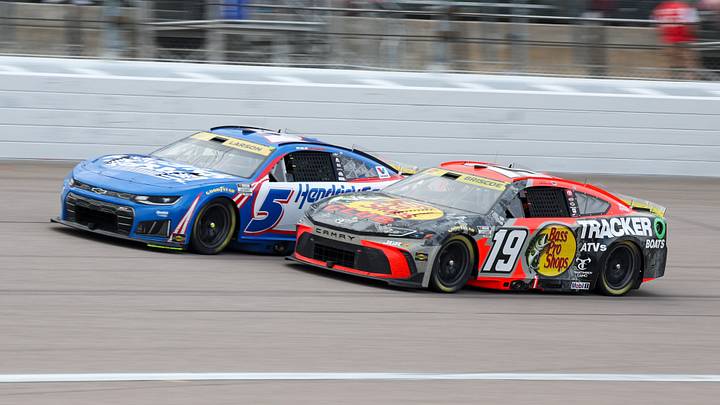
The Next Gen car, which was introduced in the NASCAR Cup Series ahead of the 2022 season, has produced interesting results in NASCAR's top division. Unquestionably, the car has dramatically reduced the speed deficit from the front of the field to the rear of the field compared to the era of cars that came before.
However, that has come with some unintended consequences at some tracks.
For instance, short tracks have suffered from a lack of overall passing since 2022. With competitors running essentially the same speed, it makes it even more difficult to pass one another. This has led to vastly softer Goodyear racing tire compounds and multiple tweaks to the aerodynamic and horsepower packages from NASCAR in an effort to improve the on-track package.
Five years into the Next Gen era, short track racing is still a work in progress.
Ditto with Superspeedway racing, which has turned into a fuel-saving game rather than a ruthless game of drivers drafting inches apart, giving it their all for 500 miles. There were incremental improvements made at Daytona International Speedway last month with a tweak to the drafting package, but more work still needs to be done.
However, the one shining light for the Next Gen car since day one has been the incredible shows that have been put on at the 1.5-mile intermediate ovals since the car was debuted. And Kansas Speedway, in particular, has put on some of the best racing in the NASCAR Cup Series since the 2022 season.
Now, let's look at Sunday's Hollywood Casino 400 at Kansas Speedway...
Kyle Larson took his second win of the season in convincing fashion, as he scored the maximum points possible (76) with a dominant performance that included the driver sweeping the Stage 1 and Stage 2 wins, turning the fastest lap of the race, and leading 235 of the 267 laps in the event.
For the majority of the race, Larson was able to pull out to a commanding five-plus-second lead on the field. Through the opening two Stages of the race, nobody even had a shot at contending for the win against Larson.
Had it not been for Chase Briscoe's car coming to life in the final Stage of the race, allowing Briscoe to surprisingly snag the lead away from Larson with 30 laps remaining, only to snap loose on him in the closing laps, allowing Larson to power back past him with seven laps to go, there wouldn't have been much to write home about with Sunday's race at Kansas Speedway.
It was a very lackluster show all the way around, at least until the drama at the front of the field saved things over than final stretch of the race.
It's a troubling sign for the 1.5-mile intermediate package. Have teams figured out the Next Gen car to the point that they can now field a car head-and-shoulders above the competition at this style of track again? Or was this simply the end result of Larson's team getting lucky, hitting the setup correctly off the truck on a weekend that practice and qualifying was washed out by weather?
That remains to be seen, but it has felt like the overall 1.5-mile intermediate racing has been just a little off all season, compared to the past four seasons. Still, this could just be a blip on the radar, and possibly just an odd bit of variance rather than the new norm. Still, it's something to keep an eye on going forward, especially with the next two races being contested on 1.5-mile intermediate ovals.
If one car comes out and flat-out dominates the next two events, and especially if that one car is the No. 5 Chevrolet, that is going to really be a cause for concern for the sanctioning body heading into the offseason.
Let me be clear, the entire industry hopes that Sunday's race was an odd weekend of a legendary team and driver just figuring it out randomly as opposed to intermediate ovals turning back into the product we were accustomed to for so long.
The style of track once dubbed "cookie cutter" tracks, as they all looked and generally performed the same, saw the racing product become quite subdued at the end of the Gen 6 car era in the NASCAR Cup Series.
No race embodied what racing had become at 1.5-mile intermediate ovals more than the 2016 Coca-Cola 600 at Charlotte Motor Speedway.
On that day, Martin Truex, Jr., was beyond dominant. He was in a zipcode by himself.
Of the 400 laps in the 600-mile marathon, Truex historically led 392 of them. After a debris caution with 56 laps remaining allowed the field to close back in, Truex was still able to easily charge to a victory by a margin of 2.572 seconds over Kevin Harvick.
While many have blamed Matt Kenseth's 2003 NASCAR Cup Series championship season as the reason NASCAR shifted from a season-long championship format to a 10-race Chase in 2004, I truly believe Truex's ultra-dominant Coca-Cola 600 in 2016 led to the invention of Stage racing, where races would be broken up into three (four in the Coca-Cola 600) mini-races.
Stage racing, which causes unnatural caution flags to fly during each NASCAR National Series race, was introduced going into the 2017 NASCAR Cup Series season.
And undoubtedly, the on-track product of 1.5-mile races led to Charlotte Motor Speedway creating a new layout, the ROVAL, to utilize for it's fall race weekend from 2018 to 2025. Let that sink in, the shows at intermediat ovals were so bad a track had to completely reinvent itself in order to bypass racing on that style of track layout at the end of the Gen 6 car's life.
Will we see a better show in the South Point 400 at Las Vegas Motor Speedway on Sunday? I certainly hope so.
 Add us as a preferred source on Google
Toby Christie is the Editor-in-Chief of Racing America. He has 15 years of experience as a motorsports journalist and has been with Racing America since 2023.
Follow toby_christie