
What Is It Like Flying On the Goodyear Blimp?
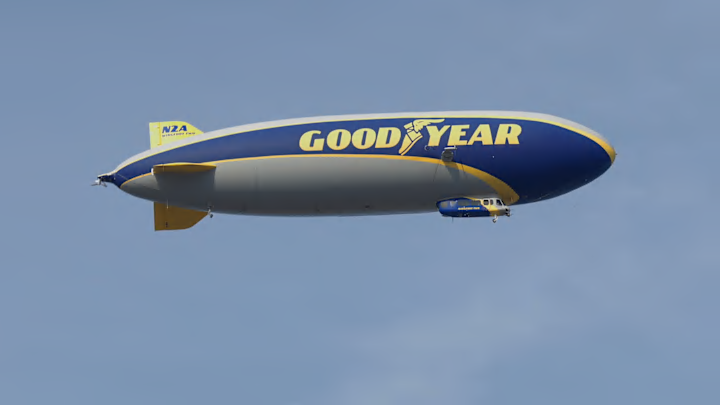
While the main focus on Sunday during the NASCAR Cup Series Daytona 500 was the action on the track, fans in the stands couldn't help but look to the skies at points in the race, as the Goodyear Blimp, in its 101st year in action, was flying high above the 2.5-mile superspeedway.
Ironically, as spectators at the Daytona International Speedway found themselves staring at the impressive piece of technology floating above them, fans watching on FOX from their televisions at home were treated to some incredible camera shots courtesy of the gravity-defying 246-foot-long object.
Have you ever wondered what it's like to take a trip in the Goodyear Blimp?
Fortunately, Racing America On SI was granted access to a 45-minute ride on Wingfoot Two, the helium-filled Zeppelin, which Goodyear has stationed in Florida. After arriving at New Smyrna Beach Airport at 10:30 AM ET on Wednesday, February 11th, it was time to see what the Goodyear Blimp was all about.
The Goodyear Blimp Is Even Larger Than You Can Imagine
My first takeaway, as we were transported to the Goodyear Blimp, which sat in an adjacent empty field at the New Smyrna Beach Airport, strapped to a truck to prevent it from floating away, was just how big a 246-foot-long, 57.5-foot-tall blimp really looks when it's not flying 1,000 feet above your head.
The balloon, which serves as the top of the blimp, is absolutely massive. And no matter how large you have in your mind that the blimp will be, the sheer size of the Blimp will likely surpass any pre-existing expectation you have as you exit the shuttle van, and begin walking towards the Goodyear Blimp to board the flight.
As you climb the ladder and breach the door of the blimp's cabin, incredibly, you notice that the cabin below the balloon, which looks minuscule in comparison from the outside, is actually quite spacious and comfortable inside.
The blimp has eight comfortable leather seats for passengers to utilize and two seats in the cockpit for the pilots. The eight seats are set up in four rows of two, and there is a wide walkway between the pair of seats in each row. The blimp also features a large rear-window with a bench seat that serves as a perch for passengers to get a better view from.
Take-Off And Turbulence
As all six passengers and two pilots, Jensen Kervern and Jeff Capek, had boarded the blimp and strapped into their seats, the remaining staff in the parking lot removed the straps that tethered the blimp to the truck. Jensen would fire up the propellers, and in an instant, the Goodyear Blimp began its ascension into the Florida sky.
Now, this is where the ride was truly fascinating, at least to me.
As the blimp began to thrust at an upward angle to gain altitude, my mind immediately expected the same intense sensations that we all experience during take-off in a commercial aircraft. At no point do you feel a knot or sinking feeling in your stomach. It's weird.
Take-off is so smooth and calm, you have to keep your eye pointed out of the window just to make sure you have indeed left the ground (we had).
You literally feel like you are a cloud floating into the sky. It's peaceful.
While we were assured that turbulence would feel almost non-existent prior to boarding, mentally, with it being an ultra-windy day, you expected there to be some discomfort while floating through the air in essentially a 246-foot-long helium balloon.
When the wind would hit the craft, you could see that the blimp would move slightly off path, but incredibly, there was no thud, no jarring sensation. It was the smoothest ride I have ever been on. And as a non-engineer, I still can't wrap my mind around any of that.
Flying The Goodyear Blimp During the Daytona 500
As we were in the air, Capek began answering questions that we all had about flying the blimp during the Daytona 500, which would take place a mere few days after our ride. According to Capek, the pilots are able to keep up with what's happening in the race from the blimp, which makes the Daytona 500 a unique sporting event for the pilots.
While they fly above college football games and other events, the pilots cannot easily see who is winning a game from above the field. However, Capek says they can see who is leading the Great American Race.
Another unique aspect of the Daytona 500 is the sound, which can be heard from the blimp.
"Every year, you forget the noise and energy of the cars. You can feel it all the way up here," Capek said.
Additionally, the blimp will have contact with the broadcast director and a television monitor onboard at all times as well, which increases the pilots' ability to know what is going on at the 2.5-mile speedway below them.
While you would expect there to be a lot of adjustments inside the blimp when it's used for overhead shots at sporting events, Capek explained to us that the inside of the blimp remains essentially the same, aside from the removal of the left front passenger seat to allow space for the camera, camera equipment, and camera operator.
And as far as the flight path during the race, Capek says that is totally up to the camera operator.
What Does It Take to Be a Goodyear Blimp Pilot?
Fully-staffed, Goodyear has room for a total of 13 pilots on staff, and the company currently has three blimps flying in America: the Wingfoot One, near Akron, OH, the Wingfoot Two, near Ft Lauderdale, FL, and the Wingfoot Three, near Los Angeles, CA.
Currently, Goodyear has around 10 blimp pilots on staff.
It does take a special "lighter than air" license to fly a blimp, and Capek, who flew blimps before he joined Goodyear more than a decade ago, says Goodyear will typically hire experienced helicopter and aircraft pilots and retrain them as blimp pilots for the program.
In the instance that the President of the United States travels to a sporting event, the only aircraft allowed in the airspace, aside from AirForce One is the Goodyear Blimp, which will also have secret service onboard in that scenario.
The Goodyear Blimp has hosted a lot of celebrities over the years, but Capek admits, when someone asks who the most famous person is that he's flown in the blimp, he "can always only think of the last famous person that was on one."
Capek pointed to NFL legends Peyton Manning and Chad Ochocinco as recent passengers in the Goodyear Blimp, as well as Gloria Estefan, who secured a ride for herself and some family through a charity auction recently.
Back to Earth
After the pleasant 45-minute excursion, it was time to get back down. Kervern would flip the switches on her control panel, and in mere minutes, the helium-filled Zeppelin would approach the same field that we departed from. As we slowly drifted downward, we would have one last plop into the grass, and the ground crew would secure the craft and attach the exit ladder.
With another group of passengers coming onto the blimp for their chance on the blimp, Capek would let two passengers off the blimp, and then bring two passengers immediately on, until the six passengers on board were all swapped out.
In order to keep the blimp stable on the ground, as it was no longer tethered to the truck in the lot, the crew tries to keep the shifting weight inside the cabin as similar as possible at all times.
As you climb down the exit ladder, you can physically see the ground moving below the blimp, which reminds you that the machine is no longer tethered. As your feet hit the ground, you're instructed to briskly jog to a safe distance away from the Goodyear Blimp, and once everyone reaches that area, the Blimp is cleared for its next departure.
Final Takeaway
Getting the chance to ride in the Goodyear Blimp, if it's not on your bucket list already, should be placed on there as soon as possible, and if you ever get the chance to partake in the ride, I would highly suggest doing it.
It's a unique experience, one that I will personally never forget. And as someone who likes to know how things work, it's incredibly insightful as the kind and knowledgeable pilots onboard will lay a great foundation of information about the Goodyear Blimp and how it operates.
Recommended Articles
 Add us as a preferred source on Google
Toby Christie is the Editor-in-Chief of Racing America. He has 15 years of experience as a motorsports journalist and has been with Racing America since 2023.
Follow toby_christie