
Grading Every 2026 WNBA First-Round Pick After the First Half of the Season
The season is about halfway over, which means it’s time to check in on the fifteen 2026 first-round picks. Some are off to phenomenal starts, while others are still trying to find their footing in the W.
The first twenty-something games of the season—fewer for some rookies—give a first idea of how well the picks panned out, but things can change quickly, and some of these grades could look foolish in just a few months.
1. Azzi Fudd, Dallas Wings: A

After a slow start, Azzi Fudd looks every bit like the player the Wings were hoping to get next to Paige Bueckers. She has recorded a few 20-point games, is making 36.9% of her five 3-point attempts per game, and has been outstanding defensively. She is one of just seven players to average at least one steal and one block per game and the only guard to block at least one shot per contest. Fudd will be a long-term two-way contributor, as the Wings try to build a championship contender around Bueckers.
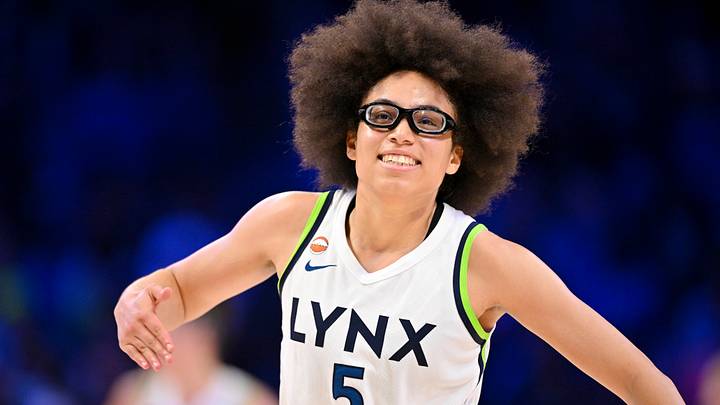
2. Olivia Miles, Minnesota Lynx: A+

This one is easy. Drafting Olivia Miles was an absolute home run for Cheryl Reeve. She was WNBA-ready from the second she left TCU and is now the leading scorer and playmaker on a Lynx team that sits in second place with a 15-6 record. Miles was voted an All-Star starter and put herself into the MVP race early. She will be a force in Minnesota for years to come.
3. Awa Fam, Seattle Storm: A+

Getting Awa Fam with the third overall pick almost seems like a steal. She is one of the youngest players in this draft class and missed training camp, but she has still been an effective offensive force for the Storm. What’s perhaps most impressive about Fam’s early career is her scoring efficiency. She is shooting 50.6% from the field and 39.1% from deep on 3.8 attempts per game. This is the worst she will ever be, and Fam and Dominique Malonga could soon be the scariest frontcourt duo in the league.
4. Lauren Betts, Washington Mystics: C+

No lottery pick has gotten fewer opportunities this season than Lauren Betts. She's averaging just 16.2 minutes per game, playing behind Shakira Austin, and that’s where the grade comes from more than Betts’s performances and potential. Since Austin is firmly locked into the starting role and playing like a perennial All-Star, what is the long-term vision for Betts? Will she ever get the minutes she needs to develop? The Mystics have put themselves in the exact same situation that led them to trade Aaliyah Edwards last year.
With Austin and Kiki Iriafen already on the roster, and Betts getting limited playing time, it just seems that someone like Kiki Rice would have been a better pick for Washington to maximize what they can get out of their lottery selection. Betts is a lottery-level talent, but the fit in Washington just isn’t great. Ideally, you don’t want your lottery pick to be a 15-minutes-per-game backup. You’d like there to at least be a pathway for her to fill a starting spot after a year or so, and that’s just not realistic with Austin under contract for two more years and playing incredibly well—Unless the organization is convinced that Austin will leave once she hits unrestricted free agency and wants to have a backup already in place. If that happens, and Betts can fill the void immediately, the pick will look great in hindsight.
5. Gabriela Jaquez, Chicago Sky: B

Jaquez going to Chicago in the lottery was the first surprise of the evening. The pick looked like another questionable decision in a long line of Sky missteps, but Jaquez got off to a great start, scoring double-digits in five out of her first six games and contributing notably on the glass. An injury, unfortunately, cost her four games. She also had a bunch of inefficient scoring games in June (which isn’t unusual for rookies), and her 3-point shot hasn’t been great. Nevertheless, Jaquez looks like a solid rotational player.
The selection looks much better than it did on draft night, in large part because of everything Jaquez does outside of scoring. She rebounds well, does the dirty work, and takes on tough defensive matchups. Jaquez may not become a star, but she promises to be a reliable contributor for the Sky alongside other young players in Sydney Taylor, Rickea Jackson, and Kamilla Cardoso.
6. Kiki Rice, Toronto Tempo: A-

Kiki Rice is currently out with an injury, and the Tempo are feeling her absence, especially with Brittney Sykes sidelined and Julie Allemand in and out of the lineup as well. Before her injury, Rice averaged 12.7 points on 53.3% shooting from the field, 39.1% from deep, and 84.4% on free throws. She still has lots of room to grow defensively—which isn’t unusual for rookie guards—but she has been a steady and efficient presence offensively. Rice was a great get for the Tempo’s first-ever draft pick.
7. Iyana Martin, Portland Fire:?
Martin is an interesting young prospect with plenty of experience playing in Europe, but she hasn’t suited up for the Fire yet, so there’s nothing to grade halfway through the season.
8. Flau’jae Johnson, Golden State Valkyries (traded to Seattle): D (Valkyries), B+ (Storm)

The Valkyries ended up waiving Marta Suarez, so they got nothing out of their first-round pick—but, given how good they’ve been this season, they didn’t really need to.
The Storm, meanwhile, got an absolute steal. They landed an immediate contributor in exchange for two second-round picks. Johnson has been good defensively, averaging 1 steal and 0.9 blocks per game and bringing the right energy for a young team.
Offensively, her inefficiency is a real concern. She’s shooting just 37.3% from the field and 29.5% from deep. Hopefully, that is just a result of her enormous role on offense and will get better once the Storm’s roster improves and she isn’t quite as overtaxed as a creator. The Storm have already seen in a few games what it looks like when Johnson is scoring efficiently and Fam and Malonga are playing well, and it’s a scary sight.
9. Angela Dugalic, Washington Mystics: B-

Dugalic wasn’t necessarily a great 3-point shooter in college, but she was at least solid for her position and size, shooting 34.8% and 32.6% in her final two seasons at UCLA. The ability to knock down the occasional 3-pointer made her an interesting player to add to a frontcourt of Kiki Iriafen and Shakira Austin. However, 20 games into the season, Dugalic is 3-26 from deep and scoring very little.
She doesn’t play a ton and doesn’t get many shot attempts, meaning that she’s had to find ways to impact games in small spurts and without the ball. She’s been solid on the glass, doesn’t mind doing the little things, and is used to being a role player next to a star big, so it’s at least worth seeing if her 3-point shot can come around to help with her offensive production. If it can, she could become a solid backup to Iriafen and Austin (a role that makes much more sense for her than a lottery pick like Betts).
10. Raven Johnson, Indiana Fever: B-

Johnson’s biggest asset is her defense, and she has brought that to the Fever—with a few hiccups, like fouling out in just 10 minutes against the Fire in May. With a starting backcourt of Caitlin Clark and Kelsey Mitchell, the Fever need a defender to bring off the bench. Her ability to do that has earned Johnson minutes, but her offense has been very up and down. She averages one turnover per game to her 1.8 assists and makes just 27.8% of her 3-point attempts. Johnson’s ceiling as a WNBA player depends largely on how much she can develop as a scorer, especially from behind the arc.
11. Cotie McMahon, Washington Mystics: B

McMahon has basically been what the Mystics should have expected from her. Physically, she is WNBA-ready, but she needs to become a more consistent and polished offensive player. She’s shooting the three quite well for the season at 36.6%, but she either has good shooting games or bad ones, and rarely anything in between. With some more experience and development work, McMahon should become a reliable contributor.
12. Nell Angloma, Connecticut Sun: B+

Angloma hasn’t been very productive so far this season, playing few minutes off the Sun’s bench most games. But she’s only 20 years old and has already shown talent as a driver who can put immense pressure on the rim. If she develops a 3-point shot to pair with her athleticism and physicality, she could become a great player. For an organization just starting what promises to be a long rebuild, it was the right choice to bet on a prospect who excelled in the French league and EuroCup play as a teenager and on its ability to develop her, even if it doesn’t yield immediate results.
13. Madina Okot, Atlanta Dream: B

Okot isn’t in an ideal situation right now. She should be learning and developing behind Brionna Jones, Angel Reese, and Naz Hillmon. However, because Jones is still out with a knee injury, Okot has had to play real minutes early in her young basketball career (she didn’t start playing basketball until she was a teenager and only played two seasons of college basketball in the U.S.).
Still, Okot has shown flashes of offensive talent and is certainly an intriguing long-term project for the Dream, especially if she can improve as a rim protector and maybe even rediscover the 3-point shot she showed at South Carolina. At 21 and with little experience, this is not the player Okot will be in a few years. The real value of the pick won’t be clear until much later, but for now it looks promising.
14. Taina Mair, Seattle Storm: F

Using their second first-round pick on Taina Mair, who played a strong NCAA Tournament but didn’t look like a first-round pick otherwise, was a complete swing and a miss for the Storm. Mair is the only first-round pick who didn’t make a twelve-man roster this season. She signed a development contract with the Storm and has only appeared in three games.
15. Gianna Kneepkens, Connecticut Sun: C-

Connecticut is in a full-blown rebuild but didn’t have a lottery pick. So, the best-case scenario in this year’s draft for them was to find young role players to develop for when they get that high draft pick and franchise star to build around.
Gianna Kneepkens looked like a solid future WNBA role player at UCLA, shooting 42.9% from three and doing a little bit of everything from rebounding to dishing out assists to getting 1.1 steals per game. Her transition to the W hasn’t been very smooth. She’s not a great athlete compared to other players, and she’s shooting just 15% from deep. Kneepkens looks like a player who would benefit from some time overseas before she can make a serious impact in the W, which makes sense considering that this pick was still a second-round selection just a year ago.
 Add us as a preferred source on Google
Elaine Blum covers women’s basketball for On SI from Europe. She has been writing about women's hoops since 2023 and holds a Bachelor’s degree in English and Journalism and a master’s degree in American Studies with a focus on women’s and gender studies. She started playing basketball when she was 10 years old and won several league and state championships at the youth and senior level.