%20%20--%3E%0A%3Csvg%20version%3D%221.1%22%20id%3D%22Layer_1%22%20xmlns%3D%22http%3A%2F%2Fwww.w3.org%2F2000%2Fsvg%22%20xmlns%3Axlink%3D%22http%3A%2F%2Fwww.w3.org%2F1999%2Fxlink%22%20x%3D%220px%22%20y%3D%220px%22%0A%09%20width%3D%2239px%22%20height%3D%2240px%22%20viewBox%3D%220%200%2039%2040%22%20enable-background%3D%22new%200%200%2039%2040%22%20xml%3Aspace%3D%22preserve%22%3E%0A%3Cpath%20fill%3D%22%23FFFFFF%22%20d%3D%22M38.5%2C7H28.2v26h10.3V7z%22%2F%3E%0A%3Cpath%20fill-rule%3D%22evenodd%22%20clip-rule%3D%22evenodd%22%20fill%3D%22%23FFFFFF%22%20d%3D%22M26.1%2C25.5c0%2C5.8-4.1%2C7.5-12.9%2C7.5C3.9%2C33%2C0%2C31.2%2C0%2C25.2v-1.1h11.6%0A%09v2.4c0%2C0.7%2C0.1%2C1.4%2C1.2%2C1.4c1%2C0%2C1.2-0.4%2C1.2-1.3v-0.9c0-1.6-0.9-1.6-3.5-2.2C2.2%2C21.7%2C0%2C19.7%2C0%2C15.3v-0.9C0%2C9.3%2C5.5%2C7%2C12.9%2C7%0A%09c10.2%2C0%2C12.8%2C2.6%2C12.8%2C7.4v1.8h-11v-2.9c0-0.6-0.4-1.1-1.2-1.1c-0.6%2C0-1.2%2C0.4-1.2%2C1.1v0.9c0%2C1.5%2C0.9%2C2%2C3.3%2C2.5%0A%09c8%2C1.6%2C10.5%2C3.3%2C10.5%2C7.5V25.5z%22%2F%3E%0A%3C%2Fsvg%3E%0A)
$60 Million Says Duke. So Why Is the Market Still Fighting About It?
Prediction markets have arrived at March Madness. Kalshi alone has cleared $60 million in trading volume on its championship futures market before a single first-round game tips off. Platforms are projecting $135–$150 million in total handle over the full three weeks. This isn’t a side show. It’s how a growing slice of America is now following the bracket — with real money, updating in real time.
And the most interesting thing about $60 million in collective conviction? It hasn’t reached a consensus.
Duke vs. Michigan: The Market Can’t Decide
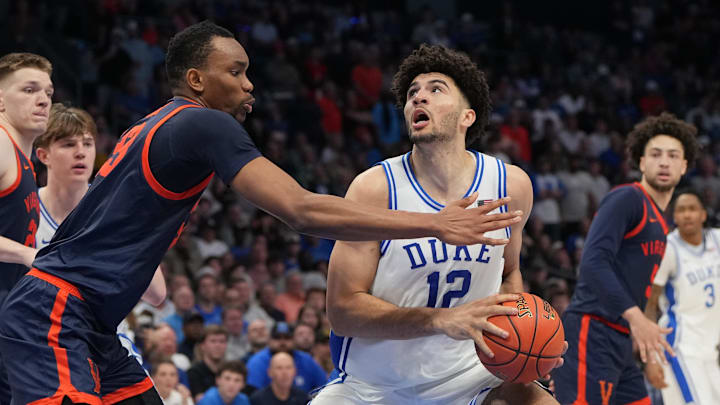
Duke is the No. 1 overall seed. Cameron Boozer is the National Player of the Year frontrunner. The Blue Devils beat Michigan head-to-head in February and went 32-2. By every traditional metric, they’re the team.
On Selection Sunday morning, Michigan was actually the Kalshi favorite. By Sunday evening — after the bracket draw revealed Duke’s tough East Region path, and after injury reports surfaced on starting center Patrick Ngongba II (foot) and point guard Caleb Foster (out for the season) — Duke moved back to the top. Both platforms now sit within 3 points of each other. That gap is the market saying: we’re not sure either.
The number: Duke 21%, Michigan 18–19%, Arizona 16–17%, Florida 11%. After that, a steep drop. Four real contenders. Everyone else is noise.
Championship Odds — Kalshi / Polymarket / Sportsbook
Duke (#1 seed) 21% 21% +300
Michigan (#1 seed) 18% 19% +350
Arizona (#1 seed) 17% 16% +475
Florida (#1 seed) 11% 11% +650
Houston (#2 seed) 7% 7% +900
Iowa State (#2) 5% 5% +1400
Kalshi / Polymarket / BetMGM. As of March 18, 2026. Verify at Kalshi.com and Polymarket.com before trading.
The $1 Billion Bracket
Kalshi is offering $1 billion for a perfect bracket — the largest contest prize in sports history, insured by SIG Parametrics. The odds of collecting: roughly 1 in 9.2 quintillion on a coin flip, or 1 in 120 billion for a sharp college basketball observer. No one has ever done it. Kalshi knows that. The real prize driving entries is the $1 million consolation for the top imperfect bracket — and the awareness play of getting millions of first-time users to engage with prediction market mechanics for free.
Three Markets Worth Watching
No. 12 seeds advancing. Kalshi prices one or more No. 12s beating a No. 5 at 60 cents (60% probability). History backs it — it happens almost every year. Easy value on the “yes.”
Iowa State creeping up. The market has been slowly moving ISU’s odds higher since the bracket dropped. At 5%, they’re the clearest value play among second-tier contenders if you like their draw.
St. John’s under-seeded. Nate Silver’s model thinks they should be a 3-seed, not a 5. They just won the Big East tournament. At 2% on both platforms, that’s either a value play or a trap. Worth a small position.
Why This Changes How You Watch
Even if you never trade a contract, prediction market pricing is live information. When a team’s odds spike mid-game after a run, or crater when a starter limps off the court, the market is processing the tournament in real time faster than any broadcast can. Duke at 21% is not a lock. Michigan at 18% is not a lock. That spread is $60 million of real money saying the same thing your bracket already knows: in March, nobody is safe.
Accuracy note: Odds as of March 18, 2026. Prediction market prices shift continuously. Verify current figures at Kalshi.com and Polymarket.com. Availability varies by state.
For More Prediction Market Articles...
 Add us as a preferred source on Google
I've been playing fantasy sports for over 25 years, dating back to the early internet days of sandbox.net, fanball.com, and the original Hector the Projector at ESPN. Today I compete primarily in season-long, high-stakes fantasy baseball and football leagues while always keeping an eye on DFS and sports betting markets." My edge comes from blending art and science. There's no shortage of data in fantasy sports anymore - the real skill is cutting through the noise to find what actually matters and where you can create leverage. I'm a volume trader who looks for small inefficiencies that compound exponentially over a full season. One percent edges don't sound sexy, but run enough volume and they print. As founder of Ozzie Goodboy LLC, I consult with sports betting and DFS platforms on growth strategy and customer analytics. I've built analytics systems tracking millions of player decisions, giving me a unique view into what separates winners from losers. I see where the market is slow, where sharp players are zigging, and where recreational players are bleeding money. I focus on MLB player valuation, free agency analysis, betting market implications for player roles, and how contract structure affects fantasy value. My content aims to identify actionable edges—the small market inefficiencies in player pricing and landing spot projections that compound over a full season.