
Why Oregon State is Moving on From Wayne Tinkle
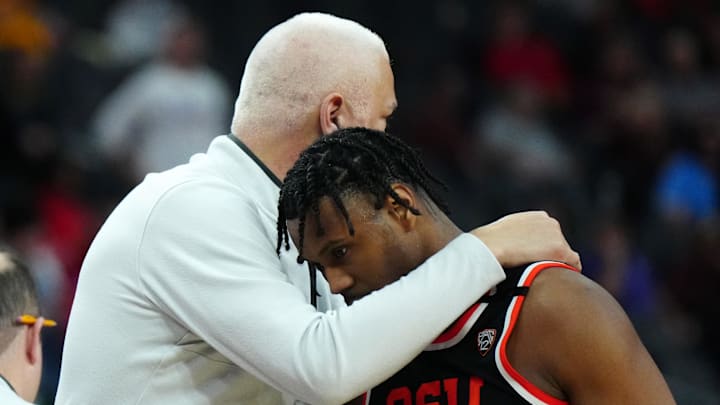
Last week, Oregon State athletic director Scott Barnes announced that the university would part ways with men's basketball head coach Wayne Tinkle following this season.
For his part, Tinkle has stayed positive and upbeat; in a wide-ranging interview with Portland-area independent columnist & radio host John Canzano, Tinkle refused to point fingers for why he got the axe. This piece addresses two reasons we believe Oregon State moved on from their third most victorious coach (176 wins) in school history.
Tinkle's program struggled with inconsistency
Oregon State's men's basketball program had fallen on hard times long before Wayne Tinkle's arrival. At the moment of Tinkle's hiring in 2014, the Beavers hadn't won an NCAA tournament game since 1982, and hadn't gone to the big dance at all since 1990. After the Montana alum left his alma mater to lead the orange & black, success quickly followed. In 2015, just Tinkle's second season in Corvallis, the Beavers advanced to their first NCAA tournament in a generation. Led by Gary Payton II and Langston Morris-Walker, Oregon State had a program on the rise. One season later, that program plummeted back to the depths. In 2016-17, the orange & black went a dismal 5-27.
As Tinkle explained in the aforementioned conversation with Canzano, injuries derailed the Beavers' momentum in 2016-17.
"After we go to the tournament in year two [the 2015-16 season], the next year, all that momentum, we lost GP2 [Gary Payton II], who meant so much to us. [We were] just blown away by injuries, illness, and other things: losing [Malcolm Duvivier] before school even started, Tres [Tres Tinkle] six games in the season gone for the season, Stevie Thompson gone for eight games, [Cheikh N'diaye], you know, season ending shoulder surgery, really brutal third year with all those circumstances."
Following a magical run to the Elite Eight in 2020-21, the Beavers fell back down to earth once again.
"After that Elite Eight run, which was incredible the way we win three in a row on the road in conference - at Cal, at Stanford, at Utah - before the Ducks got us. And then you go through UCLA, Oregon, and Colorado on the way to the tournament, and then go do what we did [at the NCAA tournament] was amazing. Then that swept away: Covid hits, we've got to sign guys in the Spring, two months I think we couldn't leave campus or bring anybody to campus, those are facts. I've admitted that I didn't get the right group together, and I did a bad job managing, but then we did the whole portal, NIL deal, and unfortunately we had zero dollars."
As Tinkle alludes at the end of that story, there is one more reason that his tenure will soon end in Corvallis.
The transfer portal and NIL fundamentally changed Tinkle's job requirements
In that moment of the conversation, Tinkle lets slip what many fans have doubted for years: Oregon State's financial commitment to basketball in the era of the transfer portal and NIL. Following a series of landmark Supreme Court cases, NCAA student-athletes in the 2020s are all de-facto free agents with the opportunity to chase money at different schools once each season ends. For coaches like Tinkle, who learned the ropes as a traditional four-year program builder, it was a new world. Was he, or Oregon State, prepared for that world?
Later in the interview, he explained the significance of NCAA rules changes and their impact on program-building in Corvallis.
"We've had to navigate through some tough times. That's just not the landscape across the country, because the haves have been able to make a pretty easy transition. Now, it's still nonsense. You got coaches having to deal with agents, but it's shifted from AAU coaches, high school coaches, I miss that. We used to have to talk to high school coaches and parents. Now, you've got agents...I'll give you an example: there were agents calling our players as early as December telling them how much money could get them in the portal, and the numbers they're throwing around, it's hard when you're 18 to 22 years old to kind of just shove that off and compartmentalize and stay locked in to what we had going."
In his decades of basketball before arriving at Oregon State, Tinkle never had to worry about any of that. Suddenly, roster retention became a core priority, and he struggled with it. Ahead of the 2022-23 season, six players transfered out of his program. Two years later, eight players transfered away. Following last season's College Basketball Crown appearance, eight more players waved goodbye.
For twelve years, Wayne Tinkle was the heartbeat of the Oregon State men's basketball program. Now, the Beavers are poised for a new direction, with an emphasis on consistent showings in the consistently erratic transfer portal era.
 Add us as a preferred source on Google
Matt fell in love with radio during his college days at Oregon Tech, and pursued a nine year career in sports broadcasting with Klamath Falls' and Medford's highest-rated sports radio stations. He currently lives in McMinnville wine country and is excited to talk about the Beavers again.