%22%3E%0A%3Cpath%20d%3D%22M0.00946364%2019.8543V4.2207H9.65269V19.7407C9.65269%2023.2611%2011.4791%2024.7658%2014.0248%2024.7658C16.5705%2024.7658%2018.3969%2023.3936%2018.3969%2019.9489V4.2207H28.0401V19.6555C28.0401%2029.3366%2022.4094%2033.1409%2013.9396%2033.1409C5.46986%2033.1409%200%2029.2515%200%2019.8543H0.00946364Z%22%20fill%3D%22white%22%2F%3E%0A%3Cpath%20d%3D%22M32.6682%2025.1633V17.5453H30.0752V10.4572H32.6682V4.91162H41.8666V10.4666H46.9674V17.5548H41.8666V23.1476C41.8666%2024.8132%2042.6332%2025.4189%2044.0905%2025.4189C44.9422%2025.4189%2045.917%2025.1728%2046.8822%2024.728V31.8161C45.4249%2032.5827%2043.2388%2033.0748%2041.0054%2033.0748C35.5734%2033.0748%2032.6587%2030.5575%2032.6587%2025.1728L32.6682%2025.1633Z%22%20fill%3D%22white%22%2F%3E%0A%3Cpath%20d%3D%22M48.3486%2026.299V26.2139C48.3486%2021.7944%2051.6324%2019.3245%2056.7711%2019.3245C58.6354%2019.3245%2061.0202%2019.7314%2061.9949%2020.1383V19.7693C61.9949%2017.7441%2060.7362%2016.5706%2057.9067%2016.5706C55.6355%2016.5706%2053.7333%2017.0533%2051.7933%2017.8293L50.1751%2011.7159C52.7302%2010.7412%2055.6449%2010.0977%2059.4965%2010.0977C63.9917%2010.0977%2066.9064%2011.0345%2068.8559%2012.9745C70.512%2014.6401%2071.1649%2016.7788%2071.1649%2019.9869V32.5922H61.9665V30.3588C60.424%2032.0244%2058.3609%2033.1127%2055.6071%2033.1127C51.358%2033.1127%2048.3581%2030.6806%2048.3581%2026.3085L48.3486%2026.299ZM62.0801%2024.3969V23.46C61.5501%2023.2613%2060.7457%2023.1004%2059.9697%2023.1004C58.1433%2023.1004%2057.1307%2024.1982%2057.1307%2025.5703V25.6555C57.1307%2026.952%2058.0676%2027.8037%2059.241%2027.8037C60.8593%2027.8037%2062.0801%2026.5072%2062.0801%2024.3969Z%22%20fill%3D%22white%22%2F%3E%0A%3Cpath%20d%3D%22M73.9092%203H83.1076V13.4098C84.5271%2011.5833%2086.751%209.92722%2089.874%209.92722C94.53%209.92722%2097.4542%2013.0028%2097.4542%2017.9901V32.5732H88.2557V20.9426C88.2557%2019.0405%2087.1201%2017.9427%2085.7479%2017.9427C84.3757%2017.9427%2083.1171%2019.0405%2083.1171%2020.9426V32.5732H73.9186V3H73.9092Z%22%20fill%3D%22white%22%2F%3E%0A%3Cpath%20d%3D%22M110.656%2019.8543V4.2207H120.299V19.7407C120.299%2023.2611%20122.126%2024.7658%20124.671%2024.7658C127.217%2024.7658%20129.043%2023.3936%20129.043%2019.9489V4.2207H138.687V19.6555C138.687%2029.3366%20133.056%2033.1409%20124.586%2033.1409C116.116%2033.1409%20110.646%2029.2515%20110.646%2019.8543H110.656Z%22%20fill%3D%22white%22%2F%3E%0A%3Cpath%20d%3D%22M143.314%2025.1633V17.5453H140.721V10.4572H143.314V4.91162H152.512V10.4666H157.613V17.5548H152.512V23.1476C152.512%2024.8132%20153.279%2025.4189%20154.736%2025.4189C155.588%2025.4189%20156.562%2025.1728%20157.528%2024.728V31.8161C156.07%2032.5827%20153.884%2033.0748%20151.651%2033.0748C146.219%2033.0748%20143.304%2030.5575%20143.304%2025.1728L143.314%2025.1633Z%22%20fill%3D%22white%22%2F%3E%0A%3Cpath%20d%3D%22M158.55%2021.643V21.5578C158.55%2014.9524%20163.291%209.93677%20169.934%209.93677C177.798%209.93677%20181.442%2015.4066%20181.442%2022.1257C181.442%2022.6083%20181.442%2023.1761%20181.404%2023.6682H167.18C167.824%2025.6177%20169.366%2026.6302%20171.354%2026.6302C173.01%2026.6302%20174.392%2025.8637%20175.849%2024.359L180.789%2028.2863C178.603%2031.1254%20175.48%2033.1032%20170.701%2033.1032C163.452%2033.1032%20158.55%2028.5229%20158.55%2021.6336V21.643ZM173.057%2019.6178C172.858%2017.5075%20171.6%2016.2962%20169.982%2016.2962C168.363%2016.2962%20167.351%2017.5927%20167.067%2019.6178H173.067H173.057Z%22%20fill%3D%22white%22%2F%3E%0A%3Cpath%20d%3D%22M182.048%2029.9045L185.171%2024.6807C187.839%2026.3368%20190.839%2027.1507%20193.357%2027.1507C194.246%2027.1507%20194.691%2026.9519%20194.691%2026.422V26.3368C194.691%2025.892%20194.284%2025.6081%20192.06%2025.0403C186.467%2023.6587%20183.023%2022.1634%20183.023%2017.5832V17.5074C183.023%2012.6432%20186.912%209.92725%20192.666%209.92725C196.309%209.92725%20199.915%2010.8547%20202.593%2012.4824L199.678%2017.9522C197.331%2016.6557%20194.492%2015.8892%20192.628%2015.8892C191.738%2015.8892%20191.331%2016.1353%20191.331%2016.58V16.6652C191.331%2017.11%20191.814%2017.3939%20194.047%2017.9617C199.64%2019.3434%20203%2020.8764%20203%2025.4189V25.504C203%2030.3209%20199.394%2033.1221%20193.394%2033.1221C189.098%2033.1221%20185.209%2032.0243%20182.048%2029.9235V29.9045Z%22%20fill%3D%22white%22%2F%3E%0A%3Cpath%20fill-rule%3D%22evenodd%22%20clip-rule%3D%22evenodd%22%20d%3D%22M212.368%204.36764C218.191%20-1.45588%20227.632%20-1.45588%20233.456%204.36764C239.279%2010.1912%20239.279%2019.6324%20233.456%2025.4559L222.912%2036L212.368%2025.4559C206.544%2019.6324%20206.544%2010.1912%20212.368%204.36764ZM215.009%207.55761C214.948%207.86849%20214.916%208.39718%20214.916%209.14566V10.4189C214.916%2011.1832%20214.948%2011.7198%20215.013%2012.0267C215.078%2012.3317%20215.278%2012.6168%20215.617%2012.8762C215.956%2013.1376%20216.403%2013.3316%20216.958%2013.4623C217.512%2013.593%20218.1%2013.6584%20218.837%2013.6584C219.573%2013.6584%20220.217%2013.591%20220.769%2013.4524C221.322%2013.3158%20221.761%2013.1178%20222.086%2012.8604C222.411%2012.6029%20222.605%2012.3178%20222.666%2012.0069C222.728%2011.6961%20222.759%2011.1674%20222.759%2010.4189V9.14566C222.759%208.38134%20222.728%207.84473%20222.662%207.53781C222.597%207.23287%20222.397%206.94971%20222.058%206.68834C221.72%206.42696%20221.272%206.23291%20220.718%206.10223C220.163%205.97154%20219.536%205.90619%20218.839%205.90619C218.102%205.90619%20217.459%205.97352%20216.906%206.11213C216.352%206.24875%20215.914%206.44677%20215.589%206.70418C215.265%206.9616%20215.071%207.24673%20215.009%207.55761ZM220.276%2024.8638C223.876%2024.8638%20225.557%2024.2064%20225.557%2021.862V21.858V21.3155C225.557%2019.6581%20224.516%2018.971%20221.252%2018.3136C220.278%2018.1136%20219.908%2017.9136%20219.908%2017.3136V16.9414C219.908%2016.6543%20220.177%2016.5117%20220.413%2016.5117C220.749%2016.5117%20220.918%2016.7137%20220.918%2016.9414V18.1136H225.391V17.3988C225.391%2015.4563%20224.347%2014.4266%20220.177%2014.4266C217.15%2014.4266%20214.896%2015.3414%20214.896%2017.3711V17.7433C214.896%2019.5155%20215.805%2020.3155%20219.201%2021.0303C219.28%2021.0472%20219.355%2021.063%20219.427%2021.0781C220.329%2021.2674%20220.647%2021.3341%20220.647%2021.9174V22.2897C220.647%2022.6619%20220.546%2022.8045%20220.142%2022.8045C219.67%2022.8045%20219.637%2022.5471%20219.637%2022.262V21.2897H214.894V21.7471C214.894%2024.149%20216.476%2024.8638%20220.276%2024.8638ZM226.424%2024.5569H230.925V14.7355H226.424V24.5569ZM227.955%2013.5019H230.925V6.06064H228.092V9.411L226.193%206.06064H223.359V13.5019H226.193V10.1199L227.955%2013.5019ZM219.269%2012.152C219.204%2012.2688%20219.055%2012.3262%20218.825%2012.3262L218.827%2012.3282C218.604%2012.3282%20218.459%2012.2767%20218.398%2012.1758C218.336%2012.0748%20218.305%2011.8074%20218.305%2011.3758V7.90068C218.305%207.51852%20218.352%207.28684%20218.445%207.20962C218.538%207.13239%20218.675%207.09279%20218.851%207.09279C219.059%207.09279%20219.198%207.14031%20219.265%207.23734C219.332%207.33239%20219.366%207.55416%20219.366%207.90068V11.3203C219.366%2011.7579%20219.334%2012.0352%20219.269%2012.152Z%22%20fill%3D%22white%22%2F%3E%0A%3C%2Fg%3E%0A%3Cdefs%3E%0A%3CclipPath%20id%3D%22clip0_15202_214749%22%3E%0A%3Crect%20width%3D%22238%22%20height%3D%2236%22%20fill%3D%22white%22%2F%3E%0A%3C%2FclipPath%3E%0A%3C%2Fdefs%3E%0A%3C%2Fsvg%3E%0A)
How transfers out of Utah basketball fared in 2025-26 season
In this story:
It's fair to say Alex Jensen wasn't necessarily put in the best position to turn the Utah men's basketball program around in his first season at the helm.
Having lost about 90% of the minutes played from the 2024-25 squad to the portal or graduation, Jensen and company had to rebuild their roster from scratch, and getting starting on the rebuild project in March didn't help necessarily help their cause, either.
The Runnin' Utes still managed to field a team with a dynamic backcourt tandem in Terrence Brown and Don McHenry, but lacked the depth and size needed to compete in the Big 12, resulting in a 10-22 (2-16 in league) season and first-round exit in the conference tournament.
Meanwhile, several of those players who left the program last offseason were off at other schools, including a few NCAA Tournament participants.
Here's a look at how the 10 transfers who departed Utah fared at their new homes in 2025-26.
How Utah Basketball Transfers Fared at New Schools
Ezra Ausar (USC)
After finishing No. 2 in scoring on the 2024-25 Utah squad, Ezra Ausar continued to serve as a solid second-option with his new team, USC, for his fourth and final year of college hoops.
The 6-foot-9 Atlanta native put up career highs across the board in the Trojans threads, averaging 14.8 points, 6.5 rebounds, 1.7 assists and 1.0 steals as a full-time starter for Eric Musselman. Ausar also knocked down 58.3% of his field goal attempts and finished No. 9 in the Big Ten with 158 made shots from inside the arc. He did, however, tally the most personal fouls of any player in the conference (112) after getting whistled for 79 fouls during his one season with the Utes.
Ausar's 2025-26 campaign was somewhat overshadowed by things that weren't necessarily in his control, such as the drama surrounding USC's leading scorer, Chad Baker-Mazara, and his exit from the program in March. It also didn't help that the Trojans finished No. 12 in the Big Ten standings and went 18-14 (7-13 in league).
Still, Ausar had his moments throughout his one-year stay in Los Angeles. He recorded a season-high 29 points on 10-of-12 shooting in a win at San Diego, and racked up five double-doubles, including four in Big Ten play. The Trojans were also 6-0 when he crossed the 20-point threshold.
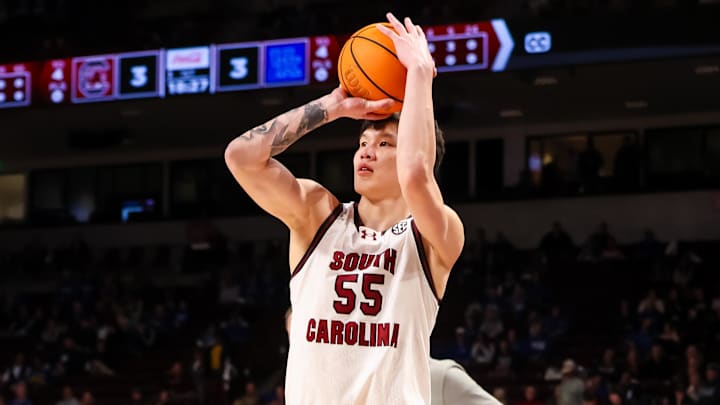
Mike Sharavjamts (South Carolina)
The fourth stop in four seasons for Mike Sharavjamts saw the talented 6-foot-8 wing put up career-bests in multiple categories, though unfortunately for him and the Gamecocks, the Mongolia native's productivity didn't translate to many wins.
Sharavjamts, whose journey started at Dayton before taking turns at San Francisco and Utah, was the second-leading scorer for South Carolina, which struggled in SEC play amid a 13-19 (4-14 in league) campaign for Lamont Paris and company.
Sharavjamts shouldered a good chunk of the offensive workload as he averaged 10.9 points, 5.6 rebounds and 2.3 assists while starting all 32 games and logging the third-most minutes of any Gamecocks player (29.8 per game). He went 49% from the field and 34.1% from the 3-point line, in addition to knocking down 87.6% of his free throw attempts.
Scoring against the top-tier teams in the SEC proved more difficult than getting buckets in nonconference play for Sharavjamts, who put up 9.8 points on 43.9% shooting in league play after averaging 11.8 on 54.1% in South Carolina's 13 nonleague contests. The senior did, however, record his season-high of 21 points in a win over Mississippi State, and had 19 on 7-of-10 from the field in his team's loss to Oklahoma in the conference tournament.
Jake Wahlin (Clemson)
Jake Wahlin's individual numbers weren't as gaudy as some of the other players who transferred out of Utah in the offseason, though he was one of the few who were able to say his departure was followed by an NCAA Tournament appearance.
Starting all but six games for the 24-11 Tigers, Wahlin put up 5.3 points and 3.9 rebounds per game while providing Brad Brownell's squad with some much-needed size in the frontcourt. Clemson, which was No. 114 in the country in average height according to KenPom, was also middle of the pack in the ACC in rebounding margin — likely because there was only two players 6-foot-9 or taller in the main rotation.
As such, the Provo native wasn't asked to score much. He did, however, have six double-digit performance between nonleague and ACC play, in addition to 12 games with five or more total rebounds.
Once Carter Welling, another Utah native, went down with a torn ACL in the ACC tournament, the path to go on a deep run in March became much trickier for the Tigers, who wound up bowing out to Iowa following a 67-61 final in the first round. Without the 6-foot-11 Welling in the fold, Clemson was outrebounded, 40-27, by the Hawkeyes and shot just 46.4% from inside the arc. Whalin was essentially a non-factor, as he went scoreless and grabbed three rebounds in 16 minutes off the bench.
Miro Little (UC Santa Barbara)
Injuries derailed what looked like was going to be a productive season from Miro Little.
The former four-star recruit and Baylor commit came out of the gate hot, averaging 14.4 points, 6.6 rebounds and 4.6 assists in UC Santa Barbara's first five games, helping the Gauchos to a 3-2 record before going down with a leg injury in the first half of the team's Nov. 24 win over non-Division I Nobel.
Little returned for the next few contests, during which he scored 20 points in a narrow win over Lehigh, but was sidelined once again after "tweaking" his foot on Dec. 4 against Long Beach State. The 6-foot-4 guard sat out for about a month, scored 20 points in his return against UC Davis on Jan. 8 and continued to put up double-figures on a nightly basis for the Gauchos through the first month of 2026.
Then a hand injury came about in early February, keeping Little out of action for what turned out to be a pivotal turning point in UC Santa Barbara's season. Without one of their point guards to help steer the offense, the Gauchos dropped five of their eight February games, including back-to-back overtime losses to CSUN and Hawaii.
UC Santa Barbara wound up going 18-14 and lost in the first round of the Big West tournament. Little, meanwhile, finished with averages of 11.9 points, 5.4 rebounds and 4.6 assists in 18 games played.
Hunter Erickson (Hawaii)
After two seasons at BYU, a junior college stint and two more years with Utah, Hunter Erickson finally got to play in the NCAA Tournament while playing a key role for Eran Ganot's Rainbow Warriors.
Starting in all 33 games, Erickson helped stir the pot to the tune of 8.4 points and 3.9 assists per game — both of which were career-highs. His 129 total assists were No. 4 in the Big West, and he checked in at No. 5 in the conference in defensive win shares at 2.1.
The Provo native also ripped down 3.8 rebounds per contest and shot 44.1% from the field. It was his scoring that really made a difference, though, as evidenced by Hawaii's record when he had 10 or more points (10-1) versus when he was held below that threshold (14-8).
Despite struggling from the field, Erickson helped the Rainbow Warriors punch their first ticket to the NCAA Tournament in 10 years with eight assists in the team's 71-64 victory over UC Irvine in the Big West championship game. He followed up with six assists in the first round of the tournament, but Arkansas proved to be too much for Hawaii to handle.
In 130 career games at the Division I level, Erickson averaged 4.6 points, 2 assists and 1.8 rebounds.
Zach Keller (Utah State)
Zach Keller managed to earn a starting role for the Mountain West champions prior to conference play, giving Jerrod Calhoun's squad size in the frontcourt as the Aggies' tallest player on the roster.
Utah State's guard tandem of MJ Collins and Mason Falslev did much of the heavy lifting on offense. Those two combined for about 40% of the team's total scoring output, with Falslev taking home league player of the year honors and Collins being tabbed to the all-conference second team as a result of their efforts. The Aggies also had the Mountain West Sixth Man of the Year, Karson Templin, score 8.8 points off the bench.
Keller, meanwhile, averaged 3.5 points and 2 rebounds in 13.6 minutes per game, and shot 56.1% from the field on 2.3 attempts per contest. Like Erickson, he got to make his NCAA Tournament debut after leaving the Utes, as the Aggies got the round of 32 as a No. 9 seed before bowing out to top-seeded Arizona. Keller scored six total points across his two tournament games.
Ayomide Bamisile (UL Monroe)
Ayomide Bamisile, a Montverde Academy product who enrolled at Utah in 2023, transferred to play for the Warhawks following his 2024-25 season with the Utes.
The 6-foot-7 Nigeria native appeared in 22 games, including six starts, and averaged 2.8 points and 3 rebounds for UL Monroe, which won just four games and finished last in the Sun Belt standings.
Joul Karram (Utah Valley)
Joul Karram, a native of Israel who brought international playing experience with him to Salt Lake City as a freshman in 2024, joined Utah Valley ahead of the 2025-26 season.
The 6-foot-10 center played in nine games for the Wolverines, who came ever-so close to earning their first NCAA Tournament bid but lost to Cal Baptist in the Western Athletic Conference tournament championship game. Karram's best performance of the season came Dec. 20 against Bethesda, when he scored nine points and grabbed eight rebounds in 12 minutes off the bench.
Brady Smith (Weber State)
After two seasons at Salt Lake Community College and one year with the Utes, Brady Smith continued his college career about 33 miles north at Weber State, where he served as mainly a reserve for Eric Duft's Wildcats.
Smith played in eight games and tallied a season-high six points against non-Division I Lincoln in December.
Brandon Haddock (Chaminade)
Brandon Haddock was once Utah's longest tenured player before his decision to transfer to Chaminade, the Division II school in Honolulu that's known for its role as the host of the Maui Invitational every year. The 2025-26 season was the Texas native's fourth full season of college hoops, though his career originally began in 2019 at Utah after he signed under former head coach Larry Krystkowiak.
Haddock, who sat out two seasons for his mission trip, played in 28 games with Chaminade (he played 18 games combined with the Utes in 2022-23 and 2023-24) and averaged 6.7 points on 33.3% shooting from the field. He also made sure to have one of his best games on the Silverswords' biggest stage of the season, scoring 14 points and recording three steals in the team's loss to Washington State in the Maui Invitational.
 Add us as a preferred source on Google
Cole Forsman has been a contributor with On SI for the past three years, covering college athletics. He holds a degree in Journalism and Sports Management from Gonzaga University.