
Inside Mark Byington and his Staff's Transfer Portal Success, Process
In this story:
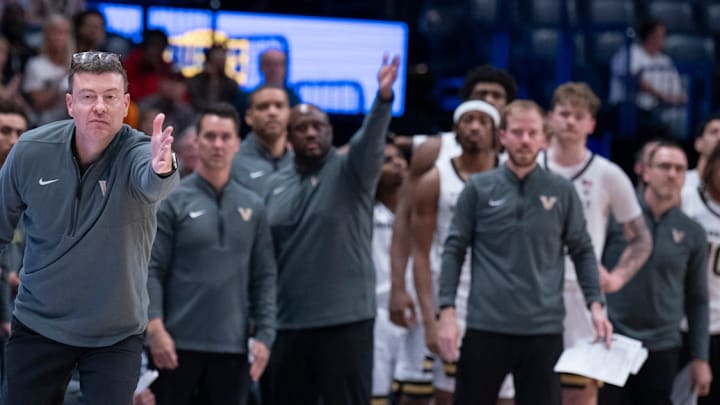
It’s Mar. 24 and each member of Mark Byington’s Vanderbilt staff has a few names in mind as they walk into their first-floor office room outside of the practice court at the Huber Center.
Whether they’re formally recorded or not, each of Byington’s assistants have lists of players in their minds. Some are long. Some are short. Not all of the names on those lists would end up being contacted, a smaller number made it to Vanderbilt’s campus for visits and only eight ultimately appeared on its roster when all was said and done.
Byington and his staff had to start somewhere, though. Although the transfer portal had only officially opened a few hours prior to each of the staff members walking into the office, they’ve been preparing for and talking about this day for as long as they can remember.
All the notes from years-old high school evaluations are brought back to life. Notes from scouting reports of previous opponents and standouts from teams that played against them are considered. Glimpses of midmajor conference stat leaders from months ago are recalled. Players and agents have already been contacted. Others are about to be once this meeting is over.
“Netflix needs to follow us around in the spring and at the end of the season and see what actually takes place in these conversations,” Byington told Vandy on SI. “It would be a historic episode, season, whatever.”
Any name, whether it was initially brought up by Byington or one of his staff members, has to go through the Huber Center meeting room before any next step is taken. The fit with Vanderbilt’s 2025 offseason pursuit of bringing in more 3-point shooting and getting bigger has to be accounted for. The game tape has to be evaluated. The analytics have to be glanced at. The skillset and the value have to make sense.
If any of it doesn’t, then someone on the staff won’t be shy about bringing that to the table.
“It’s like the movie the great debaters,” Vanderbilt assistant coach Rick Ray told Vandy on SI. “Some of these things are no brainers when somebody brings the name up, but you’ve also got to realize that along with those no brainers comes a lot of dollar signs behind those no brainers so you really become a capologist. You almost become like an NBA team where you’ve got a salary cap and you’re trying to figure out ‘how does this person fit into your salary cap and are they worth this amount of money and what does that do to the rest of your team.’”
Vanderbilt’s staff uses “three or four” analytics models to evaluate player NIL value based on their stats and competition in the previous season. The school’s NIL Collective Anchor Impact handled the negotiations with individual players, but the Vanderbilt staff did have a say on what they believe the value of a player is and whether the collective should pay it. Revenue sharing puts a few extra layers in the process.
Old-school coaches like Ray–who has been a college assistant or head coach since 1997–got into this for the betterment of their players and don’t want to think in terms of dollar signs, but if they want to keep signing contracts then they have to do that.
The monetary evaluation method and models that Vanderbilt uses are considered industry standard and are considered a “baseline” evaluation point for the Byington’s staff. Vanderbilt uses them for transfers and to assess current player value.
“It gives you a starting point of where guys should be based on their statistics,” Vanderbilt assistant Xavier Joyner told Vandy on SI. “Those tools have been very helpful for us to assess where guys are in the market.”
Joyner and his counterparts believe that to maximize value in regards to transfer portal prospects, they need to account for the person as well as what the models are telling them about the players they’re recruiting and the returners that they’re debating on holding on to. Byington has always had interest in players that have proven themselves at their previous stops, but believe that they still have another step left in their careers before moving on.
In that way, the fingerprints of Byington’s philosophy are all over Vanderbilt’s 2025-26. Cornell transfer AK Okereke was a walk-on that is getting his first power-five opportunity with Vanderbilt. Washington transfer Tyler Harris is getting the opportunity to become an off the bounce scoring two guard rather than the catch and shoot three man that he’s often been throughout his career. North Carolina transfer Jalen Washington–and everyone surrounding him–believe he’s got a chance to open up his perimeter game now that he’s out of the shadows of Chapel Hill.
To double check the the theories that those players have in regards to their futures and if they have the capability to do it based off of their habits, Vanderbilt’s staff does an in-depth background check on each player and their “circle.”
“We do a lot of checks to make sure it matches what we want character wise as well as basketball wise,” Joyner said. “We do heavy background checks with people who have been around them, people who have coached them, people who have been teammates with them.”
Over the course of the 2025 offseason, the contingent of assistants that followed Byington from James Madison–including Joyner, Matt Bucklin and Jon Cremins–contacted then Washington guard Tyree Ihenacho–who they coached at James Madison for two seasons–to ask him for an evaluation of Harris. They did the same with current Vanderbilt wing Tyler Nickel while doing a deep dive on Washington and former Vanderbilt wing Chris Mañon while poking around on Okereke.
The amount of evaluations on a player varies based on the amount of connection that Vanderbilt’s assistants have at their previous stops. Between Ray’s experience on the Purdue, Clemson, Colorado and Mississippi State staffs, Bucklin’s Michigan State connections, Kenneth Mangrum’s Troy ties—that ultimately helped Vanderbilt land Duke Miles—and Joyner’s northeast ties, they’re generally able to find someone to give them some background on a player in the short, “speed dating” window they have with players in the portal.
Whether it’s former teammates, coaches, trainers or medical staff, Vanderbilt is just looking for something to make them feel good about the decision to take a player. They’re looking for honesty more than anything, though. Vanderbilt’s staff tries to return the favor.
“That’s when having relationships with coaches on a different staff and being in this business for a little bit of a lengthy time helps so you can pick up the phone and call somebody,” Ray said. “You hope that you have enough of a relationship with that coach that he will tell you the truth. I just think the most important thing in the whole situation we’re in is making sure that we don’t want to run down a kid, but we’ve also got to be truthful about their habits.”
If Ray or someone else on the Vanderbilt staff makes the calls and vouches for a player on account of the calls he made and there quickly become problems with a player’s habits or work ethic, it reflects on the coach that didn’t get what he needed to through his background work.
The Vanderbilt staff also tries to cover its bases on official visit weekends as it meets with the player as a staff for a Q&A session. That’s a time for the staff to get the answers to their “pertinent” questions, but Ray says it’s not as much an interrogation as it is a time for players to get more information from the staff and for the player to open up about what they’re looking for and become more comfortable with the situation at Vanderbilt.
For a player to end up in that situation, there has to be some level of seriousness in the recruitment. It has to be a player that has “reciprocated” interest in Vanderbilt and is someone that the staff believes could be a fit, although them coming on a visit doesn’t necessarily mean there’s a committable offer in hand.
Vanderbilt’s staff hands those players off to a student host for the weekend and makes an effort to have its players evaluate the personality of the visitor and to give them a real look at how things are around the program. The staff is subsequently evaluating the player’s motives for being interested in Vanderbilt.
“You get a chance to be around the young men and his family and see what their values are,” Ray said. “‘Is this all you just interested in being in Nashville because Nashville is fun to be in? Are you just interested in the money piece of it? What we’re trying to do is build a team that wins. You don’t want to bring in guys that are just worried about their own agendas.”
Once Vanderbilt’s staff hears what they like in terms of the makeup of each player, they put the figurative full court press on. If Byington’s staff likes someone, they aren’t shy about texting and calling often.
One staff member–sometimes one who has a past connection like Ray did with Collins or Vanderbilt freshman Jayden Leverett–will be the primary contact point for the recruit and their family as well as their agents. Vanderbilt doesn’t like to leave a recruitment in one guy’s hands once it escalates to a visit, though.
“Everybody chips in to the recruiting process,” Joyner said. “We team up.”
If all goes well with the staff’s contact with a player and their family, Vanderbilt could land a commitment from a player on its board like it did with eight players in the 2025 cycle as it looked to build a roster with just three returning scholarship players.
Some of its staff members are skeptical even when a transfer publicly announces a commitment and signs an NIL deal, though. Vanderbilt hasn’t had a player flip his publicly-announced commitment in its two offseasons under Byington, but it has had players silently commit and later back off their pledges as a result of new opportunities and monetary figures they receive in the final hours.
As a result of that and his past as a college football fan, Ray never counts his chickens before they hatch. He’s seen the loads of football prospects that commit then subsequently take two or three more official visits. He’s lamented the changes in the football landscape at times, now he’s adjusting to similar ones in basketball.
“I'm like ‘you really don't know the definition of commitment do you?’” Ray said in regards to college football. “I just was always so taken aback about how difficult it is in the recruiting world for college football. Unfortunately college basketball has gotten that way with the transfer portal. I don't think it's that way with the high school recruiting but I do think it's gotten that way with the transfer portal, especially with the graduate students I mean they're the ultimate free agents.”
Vanderbilt has to sign free agents every year, though. It’s got to make sure that it doesn’t have too many of its own players become free agents. It’s got to find a way to win.
Easier said than done.
“You’re constantly feeling anxious as a coach,” Byington said of the portal window. “It’s hard to trust anybody. You just don’t want the bottom to fall out. It feels like everything’s so delicate. You can get a good player or two, but then you can lose everybody.”
 Add us as a preferred source on Google
_(1)-b3e453dfe426b2dd4b83a12540ebdb37.jpeg "Joey Dwyer")
Joey Dwyer is the lead writer on Vanderbilt Commodores On SI. He found his first love in college sports at nearby Lipscomb University and decided to make a career of telling its best stories. He got his start doing a Notre Dame basketball podcast from his basement as a 14-year-old during COVID and has since aimed to make that 14-year-old proud. Dwyer has covered Vanderbilt sports for three years and previously worked for 247 Sports and Rivals. He contributes to Seth Davis' Hoops HQ, Basket Under Review and Mainstreet Nashville.
Follow joey_dwy