
Vanderbilt Basketball's Foul Issues Came to Light in Texas Loss. So Did One of its Roster Deficiencies.
In this story:
Somewhere in the back of Devin McGlockton and Jalen Washington’s minds, it was there pestering them.
The thought was clear to anyone that had been watching and there’s no conceivable way that they were able to shake it and play with the freedom that Vanderbilt coach Mark Byington often pitches to his big men. As much as McGlockton and Washington aimed to worry about their individual matchups, they had to worry about staying on the floor.
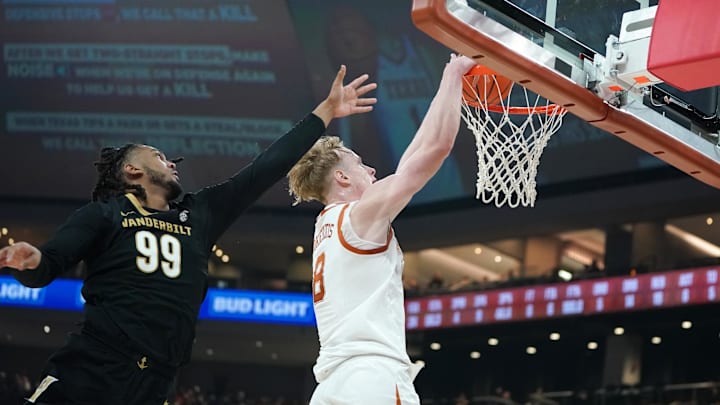
Vanderbilt knew this would be the case as a result of Texas being the most efficient team in the nation at drawing fouls prior to Wednesday night, but it experienced the Longhorns’ super power in its 80-64 loss in Austin.
“The big guy got us in foul trouble early and kind of disjointed us early,” Byington said in his postgame radio hit. “We had to go deep into our bench and play Leverett some.”

When it had all wrapped, Washington fouled out in just 15 minutes, was scoreless, grabbed just two rebounds and had a negative plus/minus. McGlockton only picked up one second-half foul, but had to play conservatively at times and only played 23 minutes.
Byington says two of Washington's fouls were “some sloppy fouls” and that McGlockton’s second foul included a call that was “hard to take,” but those claims don’t change the reality that Vanderbilt had to live off of freshman big man Jayden Leverett for a total of six minutes. When Leverett wasn't in the game, Vanderbilt had to be careful with its usage of its go-to bigs. Texas couldn’t say the same in regard to its big man Matas Vokietaitis–who went for 22 points on 7-for-9 shooting while drawing most of McGlockton and Washington’s fouls.
“The big fella inside, he did cause us some problems,” Byington said. “I give him credit, he’s got some great flailing and head bobs in there. We said on tape that ‘listen, you can’t be in these situations because he is going to kind of add some drama to it, don’t get caught up in it’ and we did.”
The team Vanderbilt saw Wednesday does that to just about everyone and made Vanderbilt play left-handed in the frontcourt enough to all but end this thing. Vanderbilt had some flukey numbers–like its 4-for-13 mark on layups and combined six turnovers from Duke Miles and Tyler Tanner–go against it, but the difference on Wednesday was its frontcourt. Perhaps the biggest frontcourt discrepancy was the mere idea that Texas had its bigs on the floor for the entirety of the night while Vanderbilt didn’t.
Why that’s significant is because of how that affects things in a scope beyond Wednesday night.

It hasn’t been quite this drastic, but Vanderbilt has struggled often with similar issues throughout the course of the season–and perhaps more than Byington anticipated as he built this roster. Washington’s 2.3 fouls per game matched his average at North Carolina last season–albeit, he was playing more minutes per game at Vanderbilt heading into Wednesday night–and McGlockton’s 3.3 average eclipsed his 3.0 per night.
Heading into Wednesday, McGlockton had recorded at least four fouls in five games, fouled out of one and recorded at least three fouls in eight additional games. Washington had four games in which he recorded at least four, fouled out of one and recorded three or more in four additional games.
Vanderbilt’s roster evolution is noticeable year over year in the improved physicality and positional size it has across the board as well as the improved guardplay it has. It was supposed to make it significantly more dynamic than it has at the five, though. It was supposed to take enough pressure off of McGlockton to where he didn’t have to be in as many positions that could get him in foul trouble.
Purely at the five–the position where McGlockton accounted for most of his minutes–Vanderbilt still only has two go-to bigs in Washington and McGlockton. Washington is taller and longer than former Vanderbilt center Jaylen Carey–and his shotblocking threat has made Vanderbilt better defensively–but his addition doesn’t solely solve Vanderbilt’s frontcourt problems. Byington still doesn’t have a third big he can turn to with trust as Leverett gets his bearings and Jacksonville State transfer Mason Nicholson has seemingly fallen to the bottom of the depth chart.
Vanderbilt is more physical and bigger across the board and is better as a result, but it may not have some of the answers at the five that it appeared as if it may. It’s got enough to be better there than it was on Wednesday, but it’s created a smaller margin for error for its go-to guys than it likely wanted to.
 Add us as a preferred source on Google
_(1)-b3e453dfe426b2dd4b83a12540ebdb37.jpeg "Joey Dwyer")
Joey Dwyer is the lead writer on Vanderbilt Commodores On SI. He found his first love in college sports at nearby Lipscomb University and decided to make a career of telling its best stories. He got his start doing a Notre Dame basketball podcast from his basement as a 14-year-old during COVID and has since aimed to make that 14-year-old proud. Dwyer has covered Vanderbilt sports for three years and previously worked for 247 Sports and Rivals. He contributes to Seth Davis' Hoops HQ, Basket Under Review and Mainstreet Nashville.
Follow joey_dwy