
Don't Mistake Clark Lea's Deliberateness for Apathy. He's Got Some Fire in Him, Too.
In this story:
It’s Mar. 27 and everything is stopped, Vanderbilt’s entire team is kneeling on the grass practice field around Clark Lea. Anyone who is still talking is quickly silenced by Lea’s assistants as he prepares to rip into the offensive and defensive linemen who just engaged in a scuffle.
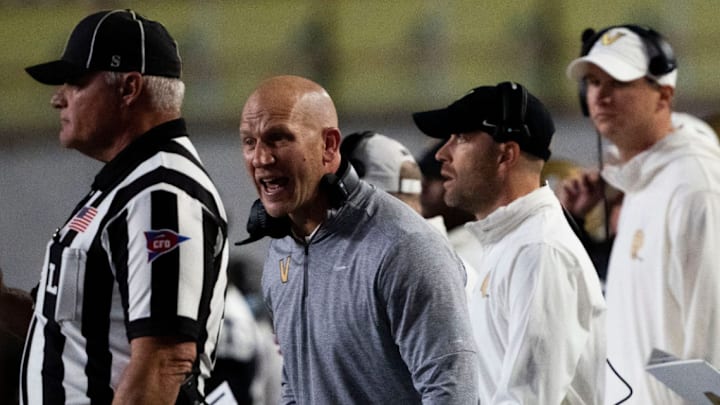
The Vanderbilt head coach is as deliberate a thinker as any SEC head coach and can often be publicly perceived as not fiery enough, but the public hasn’t seen this.
For the next few minutes, you can hear a pin drop in Vanderbilt’s facility as Lea rips into his team with profanity and an edge that his naysayers believe isn’t in there. On a morning that was just hot enough to make his players a little extra irritable and groggy, he sensed that his practice was getting out of hand and had seen enough. Lea knows that if Vanderbilt is going to win, it can’t waste time when it should be getting better.
“Last I checked, fighting isn’t a part of our game,” Lea told Vandy on SI. “In fact, it can lead to ejection, it can lead to penalties. It’s gonna compromise the mission. If we were a baseball team, then I’d want to be the best mound charging, bench clearing team in the country. If we were a hockey team, I’d want a team of guys that were ready to drop the gloves at any point. It’s just not a part of our game so we have to channel our aggression in very specific ways.”
As the leader of an SEC program, Lea has had to learn that same lesson himself. When he steps in front of his team in moments like that one in late March, he knows that he can’t wear the same soft-spoken tone that he does when he steps up to his media session on the sideline after practice. He knows that if he wants to stay true to his principles, he can’t let this one go.
If he does, who knows how this thing could go from here. Perhaps it's just one spring practice that is otherwise unmemorable, but this is Vanderbilt football. This is the program that has smaller margins than perhaps any other in the country.
This is the one that can’t afford to fight over a little irritability or some chirping on the practice field.
“I see my job as to interject when human emotion undercuts our strategic objectives, undercuts our mission,” Lea said. “On the whole we have a very intentional team, but what you witnessed was them getting into a fight. Where do we draw the lines? What boundaries do we create where it’s okay to fight in this instance or it’s okay to give into these impulses here, but not there? I don’t know that the brain works that way. So when you train responses, you train responses that are aimed towards winning football.”
Lea and his program experienced their first real glimpse of winning football and what it would take to get there a few months before the scuffle. They beat No. 1 Alabama. They became bowl eligible. They were the best Vanderbilt football team in the past decade.
Perhaps the biggest feather in Lea’s cap is that his group did it his way. They were disciplined. They took care of the ball better than just about anyone. They were sound in their systems. Their standards were high in every facet of their day-to-day operations. When they fell below that standard, Lea could almost predict a loss.
Complacency has the potential to be the biggest killer of what Lea has built on West End. That’s why he was so upset that everyone who took a knee in that huddle got up at the end of his speech and jogged towards their next drill looking like they had seen a ghost.
“The number one thing that sets me off is apathy or a lack of intentionality,” Lea said. “If I feel like we’re going through the motions or we’re giving in to our impulses, they’re gonna hear it from me very directly.”
If Lea has a problem with a player and their attitude towards what they’re doing in their day-to-day operations, he’ll address them swiftly. That will rarely make it out into the public like Lea’s mid-practice monologue did that day. Lea does that intentionally.
The Vanderbilt head coach’s press conferences are for communicating vision and updates regarding the state of his team. They aren’t for publicly airing out his players or media members who he doesn’t agree with. Perhaps that’s why he’s got the perception that he does.
Lea says he isn’t out to win the perception battle, though. He believes that would indicate that he’s focusing on the wrong areas of being an SEC head coach and would take away his intention on giving those that he’s accountable to everything he has. The fifth-year Vanderbilt head coach says that external and internal personalities are often different for coaches in his position and that he’s not worried about how they’re different.
The parts that often come out regarding Lea aren’t necessarily similar to the ones that the people who get to access him on the practice field or the meeting rooms get to see. His forward-facing approach is generally calm and deliberate, which is a part of his personality. It’s not the whole story, though.
“I’ve got a hot flame,” Lea said. “It burns slow, though. It doesn’t burn fast so there’s patience involved in that. I’ve got the ability to turn it up or turn it down depending on what the situation calls for, but there’s no way you can shepherd 120 18-to-22 year olds at a time and not put your foot down and say what needs to be said. I do those things behind closed doors because I’m not the hero in the story, it’s their story. I’m a guide.”
So, when Lea stands on the sidelines in a quarter zip–and is primarily only losing his head in regards to the referees–he’s not looking to raise his brand with camera time or grill his players to prove a point. Instead, he’s himself.
When Lea acts that way, he believes he’s acting in the best interest in his team. What he cautions against is getting out of character and becoming overly emotional. That’s what his
“When it comes to how I make decisions and how I carry myself on gameday, the mission is winning, so I have to have a clear mind to be very deliberate, intentional,” Lea said. “If you want to win games in tight margins, it takes a sober-minded head coach and someone who can see the situation clearly and make the right call.”
He ultimately feels as if that’s best, even if the public feels like his demeanor leaves something to be desired. Lea isn’t changing anytime soon as he aims to lead Vanderbilt to a resurgence unlike it’s seen before.
“My team, they get every part of me,” Lea said. “They know how I bleed out when I’m cut open and I would never want a team otherwise.”
 Add us as a preferred source on Google
_(1)-b3e453dfe426b2dd4b83a12540ebdb37.jpeg "Joey Dwyer")
Joey Dwyer is the lead writer on Vanderbilt Commodores On SI. He found his first love in college sports at nearby Lipscomb University and decided to make a career of telling its best stories. He got his start doing a Notre Dame basketball podcast from his basement as a 14-year-old during COVID and has since aimed to make that 14-year-old proud. Dwyer has covered Vanderbilt sports for three years and previously worked for 247 Sports and Rivals. He contributes to Seth Davis' Hoops HQ, Basket Under Review and Mainstreet Nashville.
Follow joey_dwy