
Everything to Expect from Virginia Tech Athletic Director Whit Babcock's Board of Visitors Presentation
In this story:
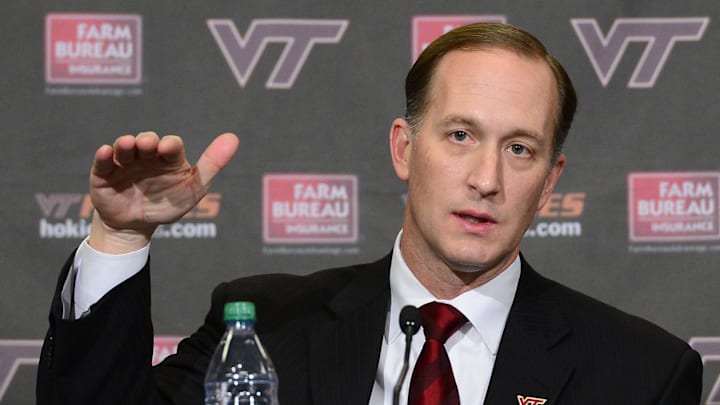
On August 18, Virginia Tech Athletic Director Whit Babcock will be giving a momentous presentation to the Virginia Tech Board of Visitors, explaining the future of Hokies athletics and the support required.
On Aug. 18, @WhitBabcock will give a BIG presentation to Virginia Tech's BOV on the future of VT athletics and the support needed.
— Doug Bowman (@DougBowman247) August 9, 2025
Public docs reveal the 54 slides, which cover ACC rev share, TV, mixed use real estate, LEDs, and more. It's a banger.
Let's do this. #Hokies pic.twitter.com/hdAG2zOApj
The presentation itself encompasses the upcoming decade and beyond for the Virginia Tech revenue and funding related to the Hokies' sports. More of the fine details will be shown during the presentation itself, but for now, public documents give insight into a 54-page slideshow, outlining Babcock's plan.
Babcock has formatted the presentation into four main categories: the economics and changing elements of college sports, the new ACC revenue distribution model resulting from the settlement with Clemson and Florida State, a peer analysis of Virginia Tech Athletics' budget and resources and lastly, strategic investment opportunities and strategies to win.
1. The Economics and Changing Elements of College Sports
For the 2025-26 athletic season for Tech, the Hokies have a revenue share of $20.98 million. The brunt ($9.96 million) of the share is going towards student fees, with an expected $715,000 planned increase in such fees.
Currently, out of the Power 4 conferences, the ACC possesses the third most annual distribution. With a new TV deal starting in 2030 for the Big 12, however, Babcock expects the ACC to be passed by the Big 12. The ACC has the largest range ($30 million) among all conferences in distribution amounts in 2025 due to its settlement with Clemson and Florida State.
Babcock ends the first segment of his presentation by explaining four ways the NCAA will pan out due to conference realignment.
Now, conference realignment. Babcock lays out 4 scenarios. #Hokies
— Doug Bowman (@DougBowman247) August 9, 2025
1. BIFURCATION = P4 & OTHERS
2. TRIFURCATION = SEC/B1G & ACC/B12 & OTHERS
3. SUPER LEAGUE = 3 tiers. Over half of CFB programs.
4. REORGANIZATION = Top 1/2 = Power 12 (72). Bottom 1/2 = Group of 8 (64) pic.twitter.com/gcanshw4Z9
Regardless of which of these four scenarios pans out, exposure is key for success. In 2024, the Hokies generated $122 million through broadcasts and social media; for reference, a Super Bowl ad is worth around $8 million. Babcock includes five universities that in the past have seen surges in their overall revenue and educational interest with their sports teams. George Mason and VCU's Final Four runs in 2006 and 2011, respectively, LSU's 2019 CFP title, Cincinnati football's undefeated season, and SMU joining the ACC all resulted in sudden spikes in admission numbers and revenue sharing for the universities, with George Mason receiving 40% more out-of-state applications than the year prior.
2. New ACC Revenue Distribution Model
With the settlement reached between Clemson, Florida State and the ACC, the conference will now share revenue based on a 40% evenly among the universities, leaving the remaining 60% to be divvied up based on five-year TV weighted viewership.
So, where do the Hokies sit in TV viewership in the ACC? Babcock provides the prior five years of data on the top 9 most viewed ACC schools for both basketball and football. For basketball, the Hokies ranked eighth from 2021-23, being the only appearance for basketball. Football viewership is higher in Blacksburg, but the overall support is declining based on viewership, going from fourth in 2019 to now being outside of the top 7 in both of the last two campaigns.
The best way to draw in higher interest is to produce successful sports programs; Babcock listed five main points to increase viewership and return on investment: on-field performance, non-conference scheduling, game buyout return on investment, stand-alone game value, and tune-in campaigns.
Nationally televised games are given out based on the number of wins racked up in a season. A six-win squad can expect to have two nationally broadcast games a season, while reaching 11 wins can grant upwards of seven such contests.
3. Virginia Tech Athletics Budget and Resources: Peer Analysis
With the Hokies' current $122 million budget, they sit 14th in the ACC and a staggering $93 million behind the private institution (presumably Notre Dame) that sits atop the conference. Out of the nine public institutions where all data is publicly available, Tech ranks last in discretionary budget as well, the budget after scholarship and debt service amounts are subtracted.
By using a direct comparison to Virginia over the last five seasons, Babcock shows how they have obtained more funding from increased student fees and how much that has potentially cost the Hokies.
Babcock is obviously asking for more cash at this point. And so he gets into what to do about it. First up, a bunch of stuff about increasing student fees and institutional support.
— Doug Bowman (@DougBowman247) August 9, 2025
He even lays out examples of institutional support at other schools. #Hokies pic.twitter.com/HddtBL8ZFq
4. Strategic Investment Opportunities; Strategies to Win
Babcock provides a graph showing which strategies would be easy to execute and, at the same time, have an overall worthwhile return on investment. The five main strategies that Babcock looks to bring to Blacksburg are: enhanced premium events, athletics-led major partnerships, professionalized fundraising initiatives, professional-style revenue generation, and customer relationship management optimization.
The Hokies currently spend below the conference average in every sport besides women's basketball. Tech spends nearly a third ($40.97 million) of its budget on football expenses, yet that sits over $22 million behind what Clemson spends per year funding its gridiron squad.
If Babcock's presentation goes smoothly, expect the Hokies to reach upwards of $52 million of extra funding for their sports programs, a number given by Babcock stating the investment amount needed to win.
Again, the 54 slides provided just scratch the surface of the detail Babcock will provide during his presentation, but until then, this is a solid indicator of how the presentation will plan out for Babcock and what the Virginia Tech Board of Visitors expects to hear.
More Virginia Tech Sports News:
 Add us as a preferred source on Google
-c647d0570ffad1263447dc3c4ea97f33.jpg "Kaden Reinhard")
Kaden Reinhard started his sports media career covering sports for his local alma mater, the Floyd County Buffaloes, through Citizens Telephone Coop. Has commentated for football, basketball, baseball, and softball. Began writing 3304 Sports in the Spring of 2025, covering lacrosse and softball. Currently a Junior at Virginia Tech, majoring in sports media and analytics.
Follow kadenreinhard