
A Virginia Tech Transfer Who Will Ease NFL Draft Losses and A Group That Won't
In this story:
Virginia Tech did not have much of a 2026 NFL Draft class to speak of. After all, no Hokies were drafted in Pittsburgh — the second time in three years the program sent no one across the stage.
However, several players from the 2025 roster still moved on, signing undrafted free agent deals or accepting minicamp invites, and the departures left real questions about what the 2026 team will look like.
The answer to most of those questions runs through James Franklin's first transfer class in Blacksburg — a haul, according to 247Sports, ranked 20th nationally and fourth in the ACC, built almost entirely on younger Power Four talent with room to grow. Some of it will show up immediately. Some of it is a long-term investment dressed up as a short-term fix.
There is no position on this roster where the departure stings more obviously than quarterback. Kyron Drones — who signed an undrafted free agent deal with the Green Bay Packers — spent three seasons in Blacksburg as the Hokies' starting signal caller. It's not so much about the loss of production, but rather, the hole it left at the most important position on the offense.
There is no position in Franklin's transfer class where the answer is more clearly defined, either, despite the coaching staff not having named a starter at this point.
Ethan Grunkemeyer is my pick as the transfer to ease the draft loss of Drones.
Grunkemeyer is a redshirt sophomore who started nine games for Penn State last season after Drew Allar went down with a season-ending injury in October. He threw for 1,339 yards and eight touchdowns. He capped the season by going 24-for-34 for 260 yards and two scores against Clemson in the Pinstripe Bowl — completing 85 percent of his passes in the second half — and posted a 87.9 PFF passing grade, the highest mark of any quarterback through that bowl slate.
When Franklin was fired at Penn State and Matt Campbell came in, Grunkemeyer followed Franklin to Blacksburg, bringing quarterback coach Danny O'Brien with them.
The quarterback battle heading into fall camp is technically still open. Franklin has yet to officially name Grunkeymeyer as the starter, and UNC transfer Bryce Baker has made the competition real.
At the spring game, Baker actually led all quarterbacks with 140 passing yards — though he did so on a 15-for-27 clip and showed a tendency to rush the ball out under pressure.
Grunkemeyer, meanwhile, went 13-for-17 for 136 yards and a touchdown, operating the entirety of the first half for the Maroon team before handing the reins off to Troy Huhn (5-for-8, 64 passing yards, six sacks). He threw one interception on a miscommunication with wide receiver Takye Heath, a correctable issue with a full fall camp ahead.
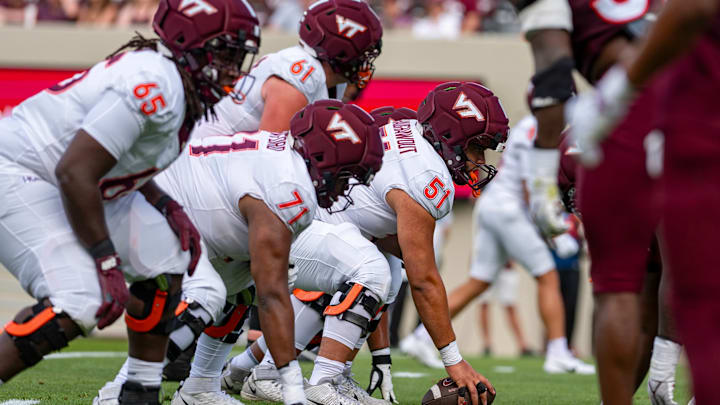
A group that may not be able to ease the draft losses — at least not immediately — is the offensive line, which mostly brought in redshirt freshmen.
Tomas Rimac signed an undrafted free agent deal with the Minnesota Vikings. The interior lineman had followed offensive line coach Matt Moore from West Virginia a year earlier, and his departure leaves a unit that was already thin now needing a rebuild. Franklin and Moore addressed it in the portal, bringing in Justin Terry (Ohio State), Justin Bell (Michigan State), Logan Howland (Oklahoma) and Michael Troutman III (Penn State) to add bodies and pedigree to a room that needed both.
The problem is that none of them are plug-and-play solutions beyond perhaps Howland (who was out for spring ball), and the position group as a whole is being asked to do something very difficult: come together quickly around a new system, new coaching relationships and a new quarterback who needs time to throw the ball.
This is not a criticism of the players Franklin brought in. The offensive line additions are good for the program's future. Moore has a track record of developing NFL-caliber linemen — Rimac's UDFA deal with Minnesota is evidence of that pipeline working — and the talent level of the incoming group reflects the recruiting clout Franklin brings to a room.
But developing offensive linemen takes time in a way that developing other positions simply does not. Chemistry along the line is built over months of practice, not weeks of practice, not weeks of spring ball. A group of players who have never lined up together, in a new system, with a new coordinator, is almost structurally incapable of being what it needs to be in September.
That is not a 2026 story. That is a 2027, maybe a 2028 story, which is likely how Franklin and his staff are thinking about it.
Franklin's first transfer class in Blacksburg is a good one. It answers the most pressing question on the roster with a real answer in Grunkemeyer. What it does not do is paper over every need, which will be a multi-year process, and the offensive line is the clearest example of that. Some of what Franklin built this offseason is for right now. Some of it is foundation. The trick, for a program still finding its footing under new leadership, is knowing which is which and being patient enough to let the foundation set.
 Add us as a preferred source on Google