
Everything Providence Bruins Head Coach Trent Whitfield Said at Introductory Press Conference
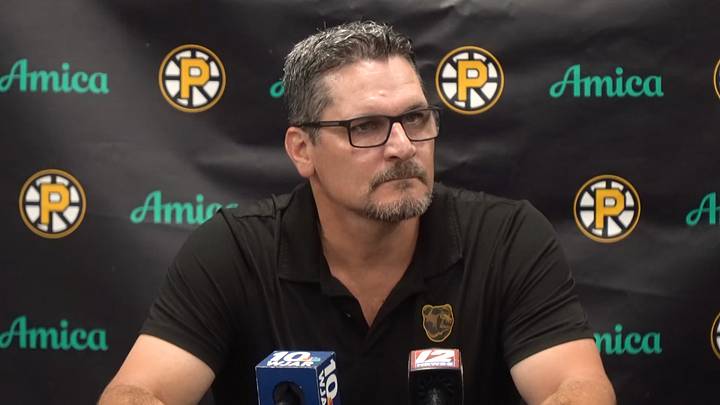
Earlier in the week, the Boston Bruins announced that Trent Whitfield will serve as Providence’s next head coach.
On Wednesday, Whitfield held his introductory press conference where he spoke to the media about this new chapter.
Below is a transcript of everything Whitfield said.
WHITFIELD: "Yeah, first of all, just want to thank you guys all for coming today. I appreciate it. Obviously real excited for the opportunity that the Boston Bruins organization has given me here to kind of take the reigns down here and kind of take over working with these young prospects. Obviously it's an exciting, new time for the organization with a lot of young players [that are] going to be coming through the organization here in the near future. So, I'm real excited about that opportunity."
Q: The whole process is about development. That's a challenge every year. Year after year.
WHITFIELD: "Yeah, that's always been our main goal down here is to develop players, get them ready for the NHL, right? That's always been a priority of mine as an assistant and with the previous head coaches, that's always been our number one priority. Every day, how do we get these guys better? How do we get them one step closer to their ultimate goal to be prepared and ready to go when they get to the NHL and that opportunity comes? So, that's something that we take a lot of pride in down here."
Q: Most of it is on the player to get to the next level, but do you think that there needs to be anything done differently to help them to get there?
WHITFIELD: "Well, we're trying new things all the time, right? Every player is different. Some players need to be pushed. Some players you need to let them. They're just going to take some time and you got to work with them and it's a little bit slower and a little bit longer of a process. It's just the way it is. All players are made differently. Some are really driven and they're set and they're to get there and some guys just need a little bit more time to to figure it out. They got to get a little bit stronger, a little bit quicker, you make a few more plays, finish around the net, stuff like that. It takes time and that's what we're ultimately here for is to work with them on a daily basis on and off the ice. Sometimes it's mentally, sometimes it's physically, sometimes they just got to gain that confidence. Now they're coming out of junior, [they’re] coming out of college. Now they're pros playing against men and the adjustment's different for everybody.
"Some guys are physically ready to meet that challenge. Some of these young kids just aren't quite physically there yet to be able to win those puck battles that they need to win at that next level. And that's what we're here for is to work on that stuff, technique, work on their skill set, be strong around their net whether if it's a defenseman being able to win pucks, box out hard in front of the net, maybe that's something that we got to build into their game to be successful at the next level. Some of these young players pride themselves in offense. We got to get them into the middle of the ice, get into those dangerous scoring areas more often, right?
"Where they can have more success. And that's all stuff that we got to talk to them about, teach them about, and just, again, it's a process every day. And some of these guys, some of these young kids have had a ton of success at every level through their life. Now they get to this American League level and then into the NHL where they're playing against guys that have gone through what they went through. Now they have to get through that process as well. And it takes time. I know everybody wants to say, ‘Oh, why is he not in the NHL?’ Well, they got to take the steps necessary. There's got to be opportunity. And then when they get that opportunity, they have to be ready to grab it to get that full-time job in the NHL."
Q: The high-end kids, are they any less patient to take that next step than like back when you were a player or even at the start of your coaching career?
WHITFIELD: “Well, no. I don't think they're less patient. I think they're ready. These kids now, they're so ready on the skilled side of the puck. Like they got unbelievable skill sets now. Now you just got to teach them how to get inside, play that, get a little bit more physical. You got smarter, bigger, more powerful players now that they're playing against men that have already gone through the steps to get to the NHL or to get to this league and have success in this league. Now they have to figure it out. And some kids figure it out real quick. Some kids take a little bit of time. There's frustration that sets in. They're unable to win those pucks or get to the inside like they used to be able to. So, how do we get them now to take those steps now to win those pucks [and] to score goals at this level.”
Q: What can you draw on from your own professional career as a player who, what four-fifths of it was American League versus National? And so a lot of times the last camp cuts to get the deflation and that early part of the season can be tough on players that thought they might make it and then they didn't and now they got to regroup. Did you have your own experiences like that you can draw on to kind of help some of these guys when that happens?
WHITFIELD: “Yeah, I think about that all the time. I've been in the American League for 30 years now. And I tell right from my son to all these guys, I've been cut. I played for 17 years. I got cut probably 40 times. And it never gets easier. It still hurts, right? So that's just the message for me to them is like now we can't have that disappointment [and] frustration of not making it bleed into your game. We need to get that positive mindset back. So where your mind and your game is in a good spot for when that next opportunity comes, right? We don't want you to be hanging your head, I get the call, and you're not mentally ready to go for that next opportunity.
“And it's not easy. It's not easy. Like you said, all the kids nowadays, all the players, they all think they're NHL players right away. And sometimes it's just [that] there's just not an opportunity at a camp. Sometimes they're just not quite there, like I said, physically, mentally, or somewhere there in between. So, it's just one of those things where we just got to get them in a mindset that every day you're here to get better, right? You get a good frame of mind and when that next call comes, you're ready to go and you're there ready to grab that spot and not let it go.”
Q: When you've been cut that many times, what does it do for you? If it doesn't get easier in the long term, what's the benefit of it?
WHITFIELD: “Well, it makes you stronger, right? You got to be able to learn how to deal with different emotions that you go through. A lot of kids have never been cut in their life up to this point. So, it's a new feeling. And I'm not saying that new feeling gets better and better every time it happens to you, but it's a real thing. And we talk about it all the time with guys that get sent down. There's a little bit of a dip right away, right? Whether their energy is not there in practice, but you got to let them work through that stuff. And again, it's part of the process. You don't just go up to them and say, ‘Hey, forget about it.’ You got to go up and have a good conversation with these young kids and say, ‘Hey, it's okay. It's okay. Let's get better today.’ Right? Let's make sure we got a good mindset.
“We don't want to have be moping around for the next two weeks and then setting yourself back for when that next opportunity comes. You want to be ready coming into the rink tomorrow. That if the Boston Bruins call and [say] we need a forward, you got to be that guy. You got to be ready to go. You can't be like, ‘Wow, he hasn't been very good. He's not ready.’ You got to be ready every single day. And that's the challenge that we have as coaches and the players have is to every day come in with a good mindset.”
Q: You could have been in that position right now several years ago when Ryan Mougenel was hired. Did those players, those experiences you're alluding to now help you as far as dealing with being a good assistant right off the hop when he needed you to be?
WHITFIELD: “Yeah. I think that that's part of me being [where] I was. I've been a pro player and coach now for the last 30 years. So, all those experiences now just play [into it]. I just come to work. I have a job to do. I come to work and I do it every day, right? Good mindset, positive, good energy every day. No matter if I was the assistant coach, the stick boy, the player, anything. I come to work with the same mindset every day to get better. Get personally better, get everybody else to have everyone else around me be better, and that's part of my process every day is to come into that room every day with a good mindset, positive. And that's going to be a huge thing with me this year is I want those kids to come into the rink every day energized. They want to be here. They're excited to get better. We're never not going to be moping around the room. We set the stage that way. When the second they walk through that door in the mornings, they know that we're there. We're not going to harp on them about what happened last night. It's about what we're going to do today to get better both individually and as a team and all those aspects.”
Q: Trent, I don't know how long you wanted to be the head guy… Let's assume it's been 10 years you wanted to be the head guy. When you finally got it, what was the feeling?
WHITFIELD: “I was really excited. It's been a long time. I've been coaching for 12 years now. Been really kind of just working on everything. It's like everything, it's a process. I would say the first five or six years you're just trying to get your footing trying to figure out ‘hey, how am I gonna [do this], do I have what it takes to be a head coach, right?’ It’s trying to go through all those things with ‘can I lead the locker room?’ And then the last five or so years with Ryan things just started to grow and I just started to really feel that I was ready and I knew that the time would eventually come and this is the year for me to take over the reigns. I'm super excited for the opportunity now.”
Q: Is there a coach you played for along the way that had a bigger influence on you now going into a head coaching job than maybe some of the others?
WHITFIELD: "Yeah, probably one of the bigger influences would be Mike Babcock. He coached me in junior for four years which was a long time ago now. I've stayed in touch with him over the years, obviously. He was a huge influence on my career, both playing and now in coaching. So, he's probably the one guy that I've really looked to a lot over the years."
Q: What do you want the culture of your team to be?
WHITFIELD: “Well first of all, the one thing that we have here in Providence and we've always had since I've been here is we've always had good leadership and I want the players to take ownership of the room, right? Obviously, it starts with me and how I approach every day, but I want those guys to be an extension of me and I want them to take the initiative and run and take control of that room in themselves, right? Obviously, I'll oversee everything, but we've always had great leadership here and obviously the leadership, it all stems from what I do and how I've presented every day. But I want those guys to really take control of each other. We're not in junior [or] in college now. We’re men now and it's time that they start [to] take control of their locker room. I'll be obviously overseeing it like I said, but that's the kind of culture that I want.”
Q: I spoke to someone who trained with you previously. He described you as blue collar, all business. How would you describe your coaching style and how does it differ from some of the other guys you worked with?
WHITFIELD: “Well yeah, when I was a player I was full blue collar, work, work, work. As you kind of mature and you grow as a player and now into coaching, you kind of learn it's not all about just go, go, go, right? Sometimes you got to take a deep breath, right? Have conversations, right? A lot of times it's not just hockey with some of these young athletes now. Sometimes you pull them in and you're not talking about video or what they did wrong on the ice. Maybe it's something that is going on at home with them. Something that you can relate to them. What's going on in your family? How's life away from the rink, right? Some of them have young families, different kinds of distractions that they're not used to. So, it's not always about hockey, right? Sometimes you got to take a step back and realize that they're young men that have real life stuff going on away from the rink and just understanding that and not just being like, ‘Okay, let's talk about what happened last night. I'm not concerned about last night. I'm concerned about you. How's everything going? Is everything good?’ So, I think that's stuff that I've learned as I've matured into this coaching role and now that I can take into being a head coach.”
Q: Was there anything that from David Krejci catastrophic wrist injury there in the 2010 series against the Flyers and you went into the lineup and I was watching some of that on YouTube and you looked pretty good. You were right on brand with their identity as a hockey team and how you played and then your black ace when they win it in Vancouver. I think I remember seeing you on the ice after Game 7 and just the whole experience of being part of that climb, the terrible disappointments on the way to it, and then finally seeing the win and being so connected to it. What can you take from that as far as marshalling a group of your own players forward?
WHITFIELD: “Well, just being a part of the whole Boston Bruins organization since 2009-10. Just being around the great leaders, right? The Patrice Bergeron’s, Zdeno Chara’s, two of the best leaders in the NHL for years. Just being around those guys, you learn so much. First of all it’s being a player and then stuff that you take in after being a player. Just how they commanded the room, how they took charge in tough times. Like you said, I was fortunate enough to be able to play some of those games. That series didn't go great for us, but it was a great learning experience for me to go into a situation like that under a lot of pressure trying to help a team win after they lost one of their best players.
“So that was a great learning tool for me. And then just to be around that whole experience in 2011 when they went and won the cup in Vancouver, [that] was something that I'll never forget. You learn a lot about the ups and downs of playoff hockey. How to respond, how the team responded, what did they do, how did they react. They didn't get down. They just kept playing. And those are the life lessons that you learn and you never forget. And that's something now that I am ready to implement on my own and with my teams moving forward.”
Q: You talked about the development piece and that's obviously the key to the job. The contradiction woven into these jobs is you got to develop kids, but you got to win too because you got to sell seats. You got to bring fans into the building. So you've got a kid who's a winger. You want to use him 10 games at the center, but you know he's going to get hammered for those 10 games. Consequently, you're going to get hammered. So, how do you balance that?
WHITFIELD: "Well, I think that's part of the AHL, right? If I learned something over the years it's [that] this is a hard league. There's a lot of moving parts. We have probably more movement in our roster than any other league, maybe even in professional sports. Every day we have moving parts. We have two or three guys in, two or three guys out, two guys get called up. You practice the power play all day on Thursday, on Friday morning your quarterback gets called up to the NHL. It happens all the time, right? So, you're always going to have moving parts like that. You always have centermen that come out of junior or college that maybe have to start on the wing, right? Just to get acclimated to the new league, the higher level, right? Till they build some strength, then they're able to win those battles as a centerman at this level and then into the NHL. So every year we have guys that are centermen that we move to the wall for for 10 games to kind of let them breathe a little bit, have some success, not have so much responsibility right out of the gate, right? And then now that you see the progression in their game now, you can put them back into that into the middle for say the next 10 games, see how he responds, right?
And a lot of players really do just need that little bit of time. And it's a good thing to have some ability to move around, right? Cause there's only four spots in the NHL for a centerman to jump into. But if there's a winger spot that is available and you have the ability to move over to the wing for a couple games, that's another opportunity to get to the NHL. And that's what a lot of the young kids learn here is we want you to have that best opportunity to be in the NHL and having a little bit of the ability to move up and not be stubborn and say I'm a centerman. Have the ability to move to wing, right? Maybe for that opportunity. And we never say you're never going to go back to center, but have that in your tool bag, in your toolkit to be able to say, ‘Yeah, I can go up to the NHL. I'll play on the wing and work and wait my time for that opening in the middle.’”
Q: Don and Cam are eager for you to get guys developed. You get them to advance, stick there. You have to fight this, as you say, institutionalized issue about development and winning. Are they tolerant of you losing? How tolerant are they of you getting guys upstream?
WHITFIELD: “Well, that's obviously our main goal. That's always been our main goal is to get these players to the NHL. Yeah I mean, there's always a little bit of give and take. They want us to win obviously, but it's more of a priority for us to get these players better on a daily basis. And for me, in the American Hockey League, if you got a good group of guys and we've always had a good group of leaders, the winning will take care of itself. If you have that good energy, good positive feeling every day coming to the rink and guys love to be together and be around each other, the winning will take care of itself.
“We've had a lot of success winning here over the past 10 years. And that's not because we're not worrying about development. Our plan here is always development first, but the culture that we've had in the room has always been really good, really strong group of leaders that have shown the young kids how to come to work every night at puck drop when it counts. And that's attributed to all the great leadership that we've had here over the years. And that's something that we're going to continue on moving forward. And I think as anything, winning is real important for development because it creates a good mood, a good environment to be in every day and it'll get these kids here wanting to come to the rink every day to get better and work and they'll do it together that way.”
Q: I want to get your opinion on some of the guys we'd like to see in Boston this season. Somebody like Matt Poitras [and] Frederic Brunet. Just your opinion on how close they are and maybe where they are in terms of what they might need to do a little bit more of or better to make that jump from seemingly being close to to the NHL?
WHITFIELD: “Well, those two are two really good hockey players. Freddy Brunet has come a long way from year one to now. Last year [he] took huge strides. [He] was probably our best defenseman from day one right through the end of the season, right? He put some offense in his game. He put the work in away from the rink. He came in after every summer stronger, faster, and more prepared than he was the year before. So he's well on his way. Now he just needs a little bit of runway in Boston to get his feet wet. Doesn't have any NHL experience yet. So, he's going to have to learn that level, but he's ready to go mentally, physically, [and with] his skill set. He's an NHL player. He moves really well around the ice, right? Real excited for Freddy over the next couple of years and where he's going.
“Potsy’s had a little bit different of a path. But again, I think Potsy really did a good job last year. I think it was hard. He was one of those guys that was real hard on him to get sent down, right? And we put a lot of good, hard conversations with him just to get his mindset in a good spot. Because it's always just going to be a matter of time with Matt. He's a great kid, really talented player. I'm real excited for his opportunity to come this year and to really make his mark up there in Boston.”
Q: His details just looked a lot better in the playoffs…
WHITFIELD: “Yeah. And I think that's just a tribute to him and the work that he's put in. That can't be understated. I mean, Potsy works hard. He really puts in the work. He's the first on the ice, the last guy off the ice almost every day. So, there's no issues with his work ethic. I think it was just always going to be just about getting a little bit stronger like I talked about earlier, right? To be a centerman at this level and then into the NHL, physically you got to be strong because you're playing against, there's 6’3”- 6'4”, 215 lb. centerman in the NHL. If you're not strong, you're going to get taken advantage of at times up there and I think that's a part of Potsy's game that's really changed is his ability just to get stronger. By the second half of last year, he's winning a lot more pucks, making a lot more plays, and he just looked a lot more comfortable to me. So, I'm looking forward to seeing Potsy when he comes back from the summer, the work that he's put in, and I'm excited for him going into camp.”
Q: Were there lessons to be learned from a coaching standpoint why [Georgii] Merkulov and [Fabian] Lysell didn't make it?
WHITFIELD: “Yeah, there's always lessons to be learned, I think. Those guys did a lot of good things for us here, right? Fabian was a really good offensive player for us. Again, I'm not going to get too much into that. We would have liked him to dig in a little bit more defensively, but he was a really offensively, highly shifted kind of a player. And same with Merk. Merk was the all-time leading scorer for the Providence Bruins. He was awesome for us. Great American League player. And I wish nothing but the best for those two guys moving forward.”
Q: But you're not left wondering why didn't they get over the hump?
WHITFIELD: “Yeah, sometimes. Maybe it's a little bit of opportunity. Maybe they weren't exactly interested in how he was playing or he didn't really fit the mold. I can't really answer that as to why they didn't really make it, but sometimes the size, the strength, but those are two really gifted offensive players that yeah, of course it leaves you wondering a little bit, but that's part of it.”
Q: I'm not thinking [of] these two players individually when I bring up this point, but two of the failings I see in many kids and this is the failings of the guys who've been in the league too. You brought up inside ice, but not getting inside ice and not doing the work on the wall, either avoiding it completely or looking lost on the wall. How much are those two elements [are] a focus of yours and why is it so hard for some of these guys to grasp?
WHITFIELD: “Well, that's 100% our focus with these guys on a daily basis. We're constantly showing them stuff. We're constantly working on it on the ice before practice, after practice, and then within our practice structure itself. We're constantly talking to these guys about that. And 80% of the game’s played on the walls. And you don't score goals if you don't get to the middle of the ice. And that's what we talk about ad nauseam every single day with these guys. And some guys just mentally, they just get it right away. Some guys have gotten away with it for so long being able to score from outside the dots, being able to just beat goalies that it's a little bit of you got to reprogram them a little bit.
“Now they got to learn the goalies are bigger [and] are a little bit faster. Now they got to get into the better scoring areas and so you just got to shift their mindset a little bit and make them understand and then once they have a little bit of success, small increments, now they start to learn [that] it's a learned trait, right? And it takes courage. Some guys' level of courage is different than another guy, right? So you got to take that into account. You try to get those guys that maybe are a little bit shy to get on the inside. Now you got to find a way to get them to believe that just those two feet more inside gives you that better chance to finish that play off.”
Q: Do you see a link in those characters?
WHITFIELD: “Well, for sure. There's different skill sets, right? There's guys that have a nose for the net and they find a way to score at every level and there's guys that take a lot of pride on the walls and they win a lot of battles on the walls and they've always done that who maybe don't have a nose for the net. So that's where that balance comes in. You got to [go] okay, you have this down now let's get you let's start working on the other side, right? So there's a balance there. There's different personalities. There's different skill sets in all these players that you got to figure out.”
Q: Your many years as an assistant coach now a blessing because Marco's in here. He's got a new system that he's brought to the Bruins for D-Zone coverage. And it seems like more than ever American League teams are having to reflect what the NHL is doing so that guys are as ready as they can be when they get the call.
WHITFIELD: “Yeah. I mean, everything we do structurally is aligned with the Boston Bruins. We play how they play. So, we're going to go in a week before training camp and Marco will tell us exactly how they're going to play and then that's how we're going to align our structure with exactly what they do defensively, offensively, neutral zone. It's all the same. So then there's no questions when those guys go up. Everything's the exact same. They don't got to think about, well, what are we doing in the D-Zone? What are we doing in the neutral zone? That's hammered in them here. Same as what they would be saying, talking up there. Same language, everything.”
Q: I want to get your opinion on [Michael] DiPietro as well because it seems like we'll see him in Boston this year, too. How important has he been the last few seasons here? And how do you think he'll transition to being in the NHL? It seems like he will be the backup this year.
WHITFIELD: “Well, I mean, Mike has been outstanding for us. I mean his record, his awards, everything. They speak for themselves. Last year, he was unbelievable every single day. And he puts the work in. Like every single day he's on the ice. He's taking all the steps that he's needed to. He started out in the East Coast League, came up, and then just continually just gets better and better every year. So, I have no concerns with Mike. He's going to do a great job in the NHL. He's an NHL goalie. He's ready to go now and he's outgrowing the American League and it's time for him now to take a job up there in the NHL.”
Q: You finally get a job like this after all this time. Often when that happens, you hear from somebody you hadn't heard from for 15 years or 20 years. When this happened, did the Zamboni driver from Saskatoon call or your elementary school teacher? Anybody reach out?
WHITFIELD: “Yeah, I mean there's lots of people. Like there's a bunch of people just from management or a coach that I hadn't talked to in probably 15 years back when I played hockey down back in Saskatchewan sent me a message, right? A buddy that I kind of lost touch with, I hadn’t talked to in like 15 years, he texted me out of the blue. Yeah, so there's a lot of that…. Not too big of a surprise, but those are all good messages to get to kind of reconnect that you kind of lose touch with over the years, but it's been a lot of fun the last couple weeks.”
Q: You've known Ryan Ward for a while. What do you think he brings to the coaching staff?
WHITFIELD: “Well, Ward or anybody that knows him, got great energy. He's got great energy. He's a really good guy. He's got a really good sense of humor. Carries himself really well and he's a smart hockey guy. I've been around him a lot. I'm on the ice with him a lot. He's a local guy. In the summers, we do camps together. So I've been on the ice with him a ton. So I know what I'm going to get from him and he's just a good kid around the room. And he's worked with a lot of high-end players in Youngstown for the last five years. So, he understands the players, he understands the level, and I'm real excited to have Ryan on our staff.”
Follow us on Twitter/X, Facebook, YouTube, Threads, Bluesky, and Instagram for the latest Boston Bruins news.
 Add us as a preferred source on Google
Kim Rankin is a lead writer for Boston Bruins on SI and Boston College On SI. A 2020 graduate of the University of Alabama. she joined Alabama Crimson Tide On SI in February 2024 covering baseball, softball, football, men’s basketball, and more for BamaCentral, but has also contributed to Missouri Tigers On SI. She previously worked as the brand manager at Tide 100.9 FM in Tuscaloosa, Ala. She has covered a wide variety of events including SEC Championships, NCAA Regionals, and bowl games.
Follow kmrankin1