
The Predators Have Eight Comeback Wins; Here’s the One That Stands Out
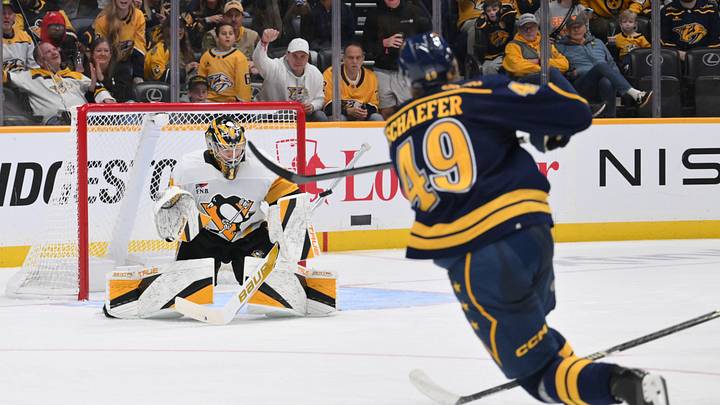
NASHVILLE — The Predators gave Pittsburgh a two-goal head start on Saturday. Generous, considering the Penguins hadn’t asked for one.
Jonathan Marchessault got one back before intermission, Filip Forsberg tied it early in the second, and Jayden Struble broke a 3–3 tie in the third. Nashville won 4–3. If you spent the first period mentally composing a group chat message about the Preds’ starts, you were probably right to leave it in drafts. You were also right to be writing it.
Head coach Andrew Brunette sounded like someone who could appreciate the result without wanting to sit through the first period again.
“I didn’t particularly love our game, but I thought we hung in there and showed some maturity as a group and some resiliency of what we are,” Brunette said after the game.
The numbers give both halves of that sentence a little more weight.
There’s trailing, and then there’s taking it to intermission
The NHL counted Nashville’s shootout win over Vegas on Nov. 13 as its seventh comeback win of the season. The Predators lost their next two games, then made it eight against Pittsburgh. That’s eight of their 12 wins in games they trailed at some point.
But through 23 games, Nashville is 6–4–2 when allowing the first goal and 1–5–2 when trailing after the first period. Saturday was that one win. The two records answer different questions: a team can give up the first goal and get even before intermission, or it can score first and still head to the room behind. Vegas is another wrinkle. Nashville scored first, fell behind in the second, and needed Ryan O’Reilly’s third-period equalizer to get to a shootout. That counts as a comeback too.
That’s why eight comeback wins can be impressive without making a 2–0 deficit feel like a manageable opening bid. Nashville has shown it can recover from a goal against. It has had much less success when the deficit remains after 20 minutes.
What to watch in Dallas
Saturday also had a detail that complicates the slow-start label: Nashville put 15 shots on goal in the first period to Pittsburgh’s nine. That doesn’t tell us whose chances were better. It does tell us the Predators were getting pucks to the net even as they fell behind. Compare that with Minnesota, where Nashville went into intermission down 4–0 and lost 7–3. Both games fit under “bad start,” but that description only gets you so far.
When the Predators visit Dallas on Wednesday, the first thing worth watching is how much work they make the Stars do to get shots. Can Nashville get the puck out cleanly after a long defensive shift? If Dallas scores, can the Preds spend the next shift in the other end? Those are more useful signs than whether the first shot happens to go in.
Smashville, which would tell you more about this team right now: a clean first period in Dallas or another comeback win? You can ask for both. It is, after all, Thanksgiving week.
Follow us on Twitter/X, Facebook, YouTube, Threads, Bluesky, and Instagram for the latest news.
 Add us as a preferred source on Google

Ava Gannon covers the Nashville Predators for Nashville Predators On SI. Originally from Iowa, she's studying Human and Organizational Development, with additional studies in Cinema and Media Arts and Sports, Culture, and Society at Vanderbilt University. She brings experience in digital content creation and events, along with an editorial background as the founder of a student-run publication. A former competitive runner and wrestler, she is especially interested in the people, personalities, and fan communities that make sports compelling.