%22%3E%0A%3Cpath%20d%3D%22M214.538%204.86816C220.361%20-0.955348%20229.802%20-0.955327%20235.625%204.86816C241.449%2010.6917%20241.449%2020.1325%20235.625%2025.9561L225.082%2036.5L214.538%2025.9561C208.714%2020.1325%20208.714%2010.6917%20214.538%204.86816ZM222.347%2014.9268C219.32%2014.9268%20217.066%2015.8417%20217.066%2017.8711V18.2441C217.066%2020.016%20217.975%2020.8155%20221.371%2021.5303C222.446%2021.76%20222.816%2021.7883%20222.816%2022.418V22.79C222.816%2023.1623%20222.715%2023.3047%20222.311%2023.3047C221.84%2023.3046%20221.806%2023.0476%20221.806%2022.7627V21.79H217.064V22.2471C217.064%2024.6489%20218.646%2025.3642%20222.446%2025.3643C226.046%2025.3643%20227.727%2024.7068%20227.727%2022.3623V21.8154C227.727%2020.1584%20226.685%2019.4718%20223.422%2018.8145C222.448%2018.6145%20222.078%2018.4141%20222.078%2017.8145V17.4414C222.078%2017.1546%20222.347%2017.0118%20222.583%2017.0117C222.919%2017.0117%20223.087%2017.2138%20223.087%2017.4414V18.6143H227.561V17.8994C227.561%2015.9569%20226.517%2014.9268%20222.347%2014.9268ZM228.594%2015.2363V25.0576H233.095V15.2363H228.594ZM221.008%206.40625C220.272%206.40626%20219.628%206.47371%20219.076%206.6123C218.522%206.74889%20218.084%206.94683%20217.759%207.2041C217.435%207.4614%20217.241%207.7469%20217.179%208.05762C217.118%208.3685%20217.085%208.898%20217.085%209.64648V10.9189C217.085%2011.6833%20217.118%2012.2204%20217.183%2012.5273C217.249%2012.8322%20217.448%2013.1176%20217.787%2013.377C218.125%2013.6383%20218.573%2013.8322%20219.127%2013.9629C219.682%2014.0936%20220.27%2014.1592%20221.006%2014.1592C221.743%2014.1592%20222.387%2014.0917%20222.939%2013.9531C223.491%2013.8165%20223.932%2013.6178%20224.256%2013.3604C224.581%2013.103%20224.775%2012.8176%20224.836%2012.5068C224.898%2012.1959%20224.929%2011.667%20224.929%2010.9189V9.64648C224.929%208.88216%20224.898%208.345%20224.833%208.03809C224.767%207.73315%20224.567%207.44985%20224.228%207.18848C223.889%206.92717%20223.442%206.7332%20222.887%206.60254C222.333%206.47191%20221.705%206.40625%20221.008%206.40625ZM225.529%206.56055V14.002H228.363V10.6201L230.125%2014.002H233.095V6.56055H230.261V9.91113L228.363%206.56055H225.529ZM221.021%207.59277C221.229%207.59279%20221.368%207.64037%20221.435%207.7373C221.502%207.83235%20221.536%208.05485%20221.536%208.40137V11.8203C221.536%2012.2577%20221.504%2012.5354%20221.439%2012.6523C221.374%2012.7692%20221.224%2012.8262%20220.995%2012.8262L220.998%2012.8281C220.774%2012.8281%20220.629%2012.7768%20220.568%2012.6758C220.507%2012.5748%20220.474%2012.3076%20220.474%2011.876V8.40137C220.474%208.01934%20220.522%207.78727%20220.615%207.70996C220.708%207.63274%20220.845%207.59277%20221.021%207.59277Z%22%20fill%3D%22white%22%2F%3E%0A%3Cpath%20d%3D%22M195.595%2032.2359L193.251%2028.0096L190.907%2032.2359H181.648L188.41%2021.7469L181.648%2011.2578H191.061L193.366%2015.4842L195.71%2011.2578H204.97L198.246%2021.7469L205.008%2032.2359H195.595Z%22%20fill%3D%22white%22%2F%3E%0A%3Cpath%20d%3D%22M171.663%209.75861V4.1875H180.692V9.75861H171.663ZM171.817%2032.2352V11.257H180.538V32.2352H171.817Z%22%20fill%3D%22white%22%2F%3E%0A%3Cpath%20d%3D%22M154.969%2032.2358V11.2577H163.691V15.4841C164.882%2012.6409%20166.803%2010.7966%20170.261%2010.9503V20.2099H169.339C165.65%2020.2099%20163.691%2022.2462%20163.691%2026.8952V32.2358H154.969Z%22%20fill%3D%22white%22%2F%3E%0A%3Cpath%20d%3D%22M129.161%2032.2349V5.33984H141.263C148.41%205.33984%20153.289%208.52882%20153.289%2014.9068V14.9836C153.289%2021.4769%20148.333%2024.9348%20141.071%2024.9348H138.151V32.2349H129.161ZM138.151%2018.5184H140.572C142.877%2018.5184%20144.414%2017.481%20144.414%2015.5599V15.4831C144.414%2013.5236%20142.992%2012.5247%20140.61%2012.5247H138.151V18.5184Z%22%20fill%3D%22white%22%2F%3E%0A%3Cpath%20d%3D%22M101.625%2032.7346C96.5531%2032.7346%2092.5957%2028.3162%2092.5957%2021.8998V21.8229C92.5957%2015.176%2096.5915%2010.7576%20101.548%2010.7576C104.737%2010.7576%20106.504%2012.1407%20107.849%2013.6392V4.1875H116.571V32.2352H107.849V29.6609C106.427%2031.1978%20104.814%2032.7346%20101.625%2032.7346ZM104.545%2025.5498C106.543%2025.5498%20108.041%2023.8977%20108.041%2021.7845V21.7077C108.041%2019.6329%20106.543%2017.9424%20104.545%2017.9424C102.547%2017.9424%20101.048%2019.5945%20101.048%2021.7077V21.7845C101.048%2023.8977%20102.547%2025.5498%20104.545%2025.5498Z%22%20fill%3D%22white%22%2F%3E%0A%3Cpath%20d%3D%22M68.4463%2032.2354V11.2573H77.1679V14.1773C78.5126%2012.4484%2080.6258%2010.7578%2083.5842%2010.7578C88.0027%2010.7578%2090.769%2013.6778%2090.769%2018.4037V32.2354H82.0474V21.2084C82.0474%2019.4026%2080.9716%2018.3653%2079.6653%2018.3653C78.359%2018.3653%2077.1679%2019.4026%2077.1679%2021.2084V32.2354H68.4463Z%22%20fill%3D%22white%22%2F%3E%0A%3Cpath%20d%3D%22M51.2163%2032.7335C47.182%2032.7335%2044.3389%2030.4283%2044.3389%2026.2787V26.2019C44.3389%2022.014%2047.451%2019.6702%2052.3305%2019.6702C54.0979%2019.6702%2056.3647%2020.0545%2057.2868%2020.4387V20.0929C57.2868%2018.1718%2056.0957%2017.0576%2053.4063%2017.0576C51.2547%2017.0576%2049.4489%2017.5186%2047.6047%2018.2487L46.0678%2012.447C48.4884%2011.5249%2051.2547%2010.9102%2054.9047%2010.9102C59.1694%2010.9102%2061.9358%2011.7938%2063.78%2013.6381C65.3553%2015.2134%2065.97%2017.2497%2065.97%2020.285V32.2341H57.2484V30.1209C55.7884%2031.6962%2053.8289%2032.7335%2051.2163%2032.7335ZM54.6742%2027.7003C56.211%2027.7003%2057.3636%2026.4708%2057.3636%2024.4729V23.5892C56.8642%2023.3971%2056.0958%2023.2434%2055.3657%2023.2434C53.6368%2023.2434%2052.6763%2024.2808%2052.6763%2025.5871V25.664C52.6763%2026.8935%2053.5599%2027.7003%2054.6742%2027.7003Z%22%20fill%3D%22white%22%2F%3E%0A%3Cpath%20d%3D%22M29.3491%2032.2358V11.2577H38.0707V15.4841C39.2618%2012.6409%2041.1828%2010.7966%2044.6408%2010.9503V20.2099H43.7186C40.0302%2020.2099%2038.0707%2022.2462%2038.0707%2026.8952V32.2358H29.3491Z%22%20fill%3D%22white%22%2F%3E%0A%3Cpath%20d%3D%22M15.0995%2032.8113C6.72371%2032.8113%200%2027.2018%200%2018.8643V18.7875C0%2010.7574%206.33949%204.76367%2014.8306%204.76367C19.4411%204.76367%2023.168%206.30053%2026.088%208.83635L21.0548%2014.9069C19.2874%2013.4085%2017.328%2012.5632%2015.0995%2012.5632C11.6032%2012.5632%209.0674%2015.2527%209.0674%2018.9028V18.9796C9.0674%2022.7833%2011.7185%2025.396%2015.4837%2025.396C17.0206%2025.396%2017.8659%2025.1655%2018.5574%2024.7812V22.0917H13.9469V16.3285H26.9717V28.7771C24.0517%2031.1592%2019.979%2032.8113%2015.0995%2032.8113Z%22%20fill%3D%22white%22%2F%3E%0A%3C%2Fg%3E%0A%3Cdefs%3E%0A%3CclipPath%20id%3D%22clip0_17412_50443%22%3E%0A%3Crect%20width%3D%22240%22%20height%3D%2236%22%20fill%3D%22white%22%20transform%3D%22translate(0%200.5)%22%2F%3E%0A%3C%2FclipPath%3E%0A%3C%2Fdefs%3E%0A%3C%2Fsvg%3E%0A)
Dallara and IBM Partner to Push Vehicle Development Toward a Faster Future
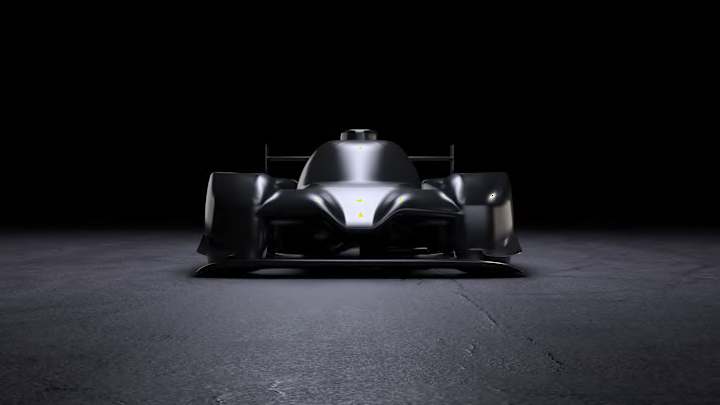
For decades, the idea of building, testing, and iterating on chassis and race car design has been as much about time as it has been about speed.
Every adjustment – from rear wing to diffusers to the simplest flap – requires simulation, validation, and iteration over weeks to years. The process is precise, but it is, frankly, slow. In a sport where milliseconds matter, the time spent developing is just as critical as the time spent on the track.
That is the gap that IBM and Dallara are aiming to close. In a newly announced partnership, the two companies are developing physics-based AI models designed to accelerate aerodynamic design. The goal? To reduce simulation times from hours to seconds, while still maintaining the accuracy and safety that engineers and teams rely on.
From Hours to Seconds – Without Losing Precision
At the center of modern car development in racing is computational fluid dynamics, the system used to simulate how air moves around in a car. It is one of the most powerful tools in motorsport, but the most resource-intensive. That is where this partnership has already stepped in.
Rather than replacing CFD, IBM and Dallara are building AI models trained on Dallara’s proprietary aerodynamic data to replicate those simulations.
In one early example, the AI model evaluated multiple rear diffuser configurations in about 10 seconds, compared to the hours required through traditional CFD, while identifying the same optimal solution with similar accuracy.

For Dallara CEO Andrea Pontremoli, that shift is less about replacing existing tools, per se, and more about expanding what’s possible for Dallara to achieve.
"We moved from hours to seconds and this is something incredible because it allows us to make much more development in the same time frame. This is the beauty of this partnership. IBM is also a partner that can apply to these algorithms the quantum computing capabilities in the future. We can even do much more things in the near future. It is something that is very unique in the market."Andrea Pontremoli, CEO Dallara
From IBM’s perspective, the timing aligns with a broader shift in how AI is being applied across industries.
"From our side, we are going through a really transformational revolution in computing. AI is evolving into something that can infuse everything we are doing. This new type of AI that can learn supervised from data and evolution in algorithms allow us to discover in a different way and they are orders of magnitudes faster."Alessandro Curioni, IBM
Why Dallara and Why Now
IBM themselves have steadily expanded its presence in sports through partnerships focused on data, AI, and fan engagement – including their work in Formula 1 with Ferrari.
Similarly, Dallara’s position in global motorsport makes it a unique testing ground for this kind of technology, especially for a global company like IBM. The company serves as the exclusive chassis supplier for IndyCar, Indy NXT, Formula 2, and Formula 3, while also supporting programs across IMSA, WEC, and more.

What is even more timely is new regulations coming to LMP2 cars across series and a new chassis in IndyCar, both expected in 2028, with testing beginning imminently.
The reach that both of these brands bring to the table is critical to motorsport: real-world validation for innovation.
"We have unlimited value in the amount of data that we have and we can validate what comes out of these models because we prototype what we design. We teach the algorithms made by IBM and surprisingly the results were better than what we had in the previous systems.”Andrea Pontremoli, CEO Dallara
Pontremoli added, when asked directly about IMSA and IndyCar, that innovations coming through this partnership are not limited to these expected advancements, but extend further. Something that he pointedly added is a "secret" until the time is right.
It’s that combination, though – deep data analysis and real-world testing – that allows these AI models to move beyond theory and into practical application. That application, for Dallara, is limitless.
More Ideas, Faster Decisions and a Different Kind of Future
The biggest shift that the partnership brings is not just speed; it's what that speed unlocks. With simulation times reduced so dramatically, Dallara engineers can explore far more options and ideas early in development.
They can test ideas that would have been too time-consuming or resource-intensive, even using the AI learning models to generate new ideas that their engineers may not have thought of yet.

That flexibility begins to change the design process itself. Instead of starting with a car and measuring its performance, engineers can begin to define the performance they want.
IBM’s Alessandro Curioni added that this idea was “not possible with computational technology before.” With these unlocked 'possibilities', the AI doesn't just deliver results, but helps explore what comes next.
IBM and Dallara are beginning to evaluate how quantum computing could further enhance simulation accuracy, particularly for complex aerodynamic problems that push beyond traditional computing limits.
What It Means for the Racing Product
At its core, IBM and Dallara agreed that the goal isn't just faster simulations – it's better cars. Faster. Safer. More innovative.
"Yes, we can design better cars. For us, better means more safe… and then performance. This is one important thing that is in our brand recognition – we try to build up safer car."Andrea Pontremolli, CEO Dallara
There’s another layer to that equation, of course. The performance and the racing product itself.

"Today, the performance is coming from thousands of these parameters that we keep together. AI allows us to keep together thousands of these parameters and to understand which one we change that changes the performance."Andrea Pontremolli, CEO Dallara
According to IBM's Curioni, improving how cars are designed could also improve how they race. It would likely make them more capable of following and overtaking each other on track. This doesn't just mean safer and faster cars overall, but better racing for drivers, fans, and stakeholders across motorsport series.
In a sport as dangerous and thrilling as racing, striking that balance between safety and speed matters.
Future of IBM, Dallara, and Racing
At its core, the partnership between Dallara and IBM is about more than just speed; it’s about redefining how performance is built.
By combining Dallara’s decades of real-world racing data with IBM’s advances in AI and quantum computing-powered research, the two are beginning to reshape a process that has long been limited by the greatest variable of all – time.
While the long-term implications stretch beyond motorsport, the immediate proving ground remains the same: designing faster, safer, and more competitive race cars.
“With Dallara, IBM is applying AI to speed up aerodynamic design today while advancing quantum computing in parallel to push simulation farther. Together, these technologies can help engineers move faster, explore more possibilities, and ultimately design better-performing vehicles.”Alessandro Curioni, IBM
From a wide lens, that shift may ultimately matter less in how fast teams can build cars than in how far they can push what the future of racing is capable of becoming.
 Add us as a preferred source on Google
Kaitlin Tucci has been a fan of motorsport for close to a decade. Before joining On SI in 2025, she contributed heavily to the marketing and media efforts at FanAmp, a motorsports startup for which she was the Head of Marketing. She has contributed to a number of publications covering series such as Formula 1, IndyCar, IMSA, and more... Kaitlin graduated from the Massachusetts Institute of Technology with both a degree in Business/Marketing and Political Science. She works full time as a marketer at high-growth tech startups while spending her weekends immersed in the world of racing. Kaitlin was raised in Las Vegas, Nevada, but has lived in New York City for the past 5 years with her 'giant chihuahua' Willow. You'll often catch Willow watching races alongside Kaitlin, but unfortunately she doesn't have enough airline miles to join her at the track just yet.