
The Bald Truth: The Early Fantasy Baseball Market Is Wrong on Spencer Strider
In this story:
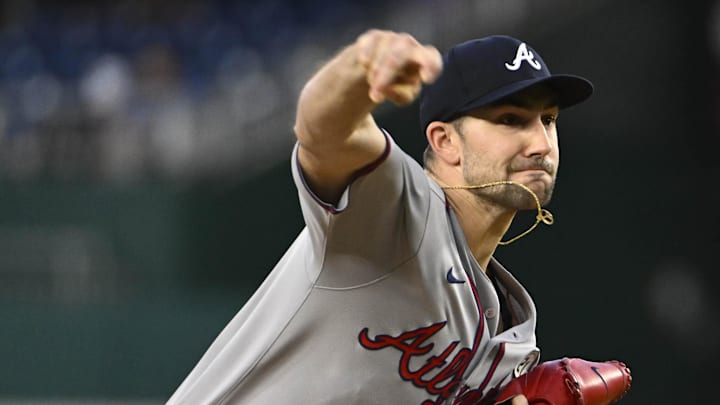
The market is treating Strider like a broken pitcher when he's actually a recalibrating one. His 2025 struggles weren't about permanent stuff decline - they were about mechanics. His arm angle dropped seven degrees post-surgery, from 48° to 41°, which fundamentally changed how his fastball moved and played. That's not damage. That's an adjustment period.
And here's what nobody is talking about: by the end of 2025, his arm angle was already creeping back up. His velocity climbed from 95.1 mph in his first five starts to 96.0 in his last five. The correction is already underway. Now give him a full offseason to lock it in.
You're getting a former Cy Young contender at SP27 because the market is pricing in a mechanical issue that's actively being fixed.
Spencer Strider's Injury They're Misreading
Let's start with what actually happened, because most people have this wrong.
Strider didn't blow out his UCL in the traditional sense. A bone fragment that had been lodged in his elbow - possibly for years - destabilized the ligament. It wasn't the result of max effort or overuse. It was a freak mechanical issue that's now been surgically addressed.
Because the UCL itself wasn't fully torn, Strider avoided a second Tommy John surgery. He got an internal brace procedure instead, which has a shorter recovery timeline but comes with its own uncertainty - there just isn't much data on how pitchers perform in year one back from this surgery.
And that's exactly what 2025 was: year one.
Spencer Strider's Mechanical Story Nobody's Telling
Here's where the analysis gets interesting - and where I think the market is completely missing the plot.
When Strider came back in 2025, his arm angle had dropped a full seven degrees. Instead of releasing the ball at his typical 48°, he was down at 41°. That might sound like inside baseball (pun intended), but the downstream effects were massive.
His fastball lost the elite vertical rise that made it unhittable at the top of the zone. Instead of 18.4 inches of induced vertical break, he was getting 17.6. Meanwhile, his horizontal movement ballooned from 6.1 inches to 8.5. That's a completely different pitch profile - one that hitters could suddenly catch up to.
But here's the key: when asked if the lower arm angle was intentional, Strider said no. It wasn't a conscious change. It was his body finding a new release point while rebuilding arm strength after surgery.
And by the second half of 2025, it was already correcting. His arm angle crept up from 41.7° in his first five starts to 42.4° in his last five.
Spencer Strider's Pitch Mix Evolution
Here's what gets me most excited. Strider has always been a two-pitch pitcher - fastball, slider, good luck. That worked when he was touching 100 mph and hitters couldn't catch up.
At 95-96 mph, that approach becomes riskier. So Strider adapted. He added a curveball in 2024 and refined it throughout 2025. His changeup, previously an afterthought, showed real improvement - opponents whiffed on 9 of 12 swings against it in his minor league rehab stint.
If Strider enters 2026 as a true four-pitch pitcher with his fastball back in the 96-97 range, you're looking at a completely different profile than the guy who struggled last year. You're looking at the guy who led MLB in strikeouts in 2023.
The 1% Edge
The market is pricing a mechanical issue as permanent decline. Look at the early reads from the NFBC. At SP27, you're paying for the floor and getting the ceiling free. If Strider gets back to 80% of his 2023 form, he's a top-15 starter. I'm drafting him everywhere and stacking exposure across leagues. If he's fully back, he's a Cy Young contender. The downside? A backend guy who gives you 150 okay innings. The upside? A staff ace at a discount that looks absurd by June.
That's the Bald Truth.
More Fantasy Baseball News
 Add us as a preferred source on Google
"I've been playing fantasy sports for over 25 years, dating back to the early internet days of sandbox.net, fanball.com, and the original Hector the Projector at ESPN. Today I compete primarily in season-long, high-stakes fantasy baseball and football leagues while always keeping an eye on DFS and sports betting markets." My edge comes from blending art and science. There's no shortage of data in fantasy sports anymore - the real skill is cutting through the noise to find what actually matters and where you can create leverage. I'm a volume trader who looks for small inefficiencies that compound exponentially over a full season. One percent edges don't sound sexy, but run enough volume and they print. As founder of Ozzie Goodboy LLC, I consult with sports betting and DFS platforms on growth strategy and customer analytics. I've built analytics systems tracking millions of player decisions, giving me a unique view into what separates winners from losers. I see where the market is slow, where sharp players are zigging, and where recreational players are bleeding money. I focus on MLB player valuation, free agency analysis, betting market implications for player roles, and how contract structure affects fantasy value. My content aims to identify actionable edges—the small market inefficiencies in player pricing and landing spot projections that compound over a full season.
Follow TheBaldTruthFB