
Forget Kittle: Trey McBride, Brock Bowers, and the Rookies Reshaping Fantasy TE in 2026
In this story:
The tight end position just got a lot more interesting heading into 2026 fantasy drafts.
George Kittle tore his Achilles on January 11th in the Wild Card round against Philadelphia. The 2025 rookie class delivered three legitimate starters. And Trey McBride turned in one of the most dominant fantasy seasons we've seen at the position in a decade.
Here's who I'm targeting when drafts roll around this summer—and why the consensus is already getting a few things wrong.
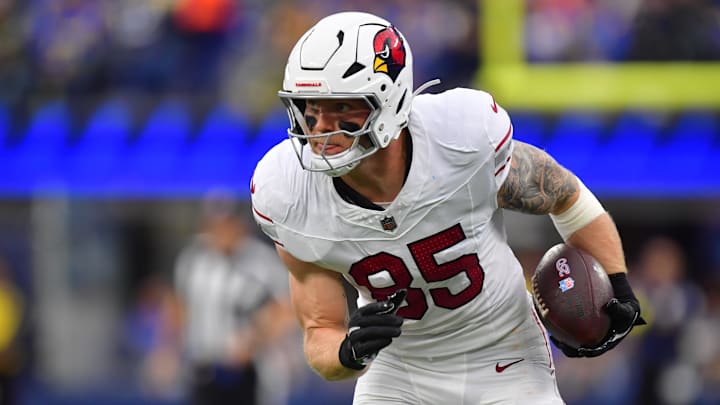
1. Trey McBride, Arizona Cardinals
This isn't even close.
McBride finished 2025 with 126 receptions, 1,239 yards, and 11 touchdowns. He averaged 18.6 PPR points per game. The next closest tight end was Kyle Pitts at 12.4. That's not a gap—that's a canyon.
The 27.5% target share is insane. For context, that's WR1 usage at the tight end position. McBride saw 169 targets, which would've ranked him 8th among all wide receivers if he played that position. And here's the thing—his efficiency held up. A 74.6% catch rate on that volume is elite.
The knock? Arizona fired their head coach, and we don't know who's throwing him the ball in 2026. Fair. But McBride produced this season with Kyler Murray missing time and Jacoby Brissett running the offense for a stretch. His floor is built on volume, not scheme. New coach, new QB—doesn't matter. He's the Cardinals' entire passing game.
I'm taking McBride in the second round of redraft leagues and not thinking twice about it.
The 1% Edge: McBride is the only tight end in fantasy who can be treated like a WR1. At his ADP, you're getting positional advantage that compounds every week. There's no decision here—he's the pick.
2. Brock Bowers, Las Vegas Raiders

The discount is coming.
Bowers dealt with a knee injury all season, played through it, and still finished as the TE11 in total points—but the TE3 in points per game among players who suited up for at least 10 games. The Raiders shut him down in December once they were out of playoff contention. Smart.
Let me remind everyone what this kid did as a rookie in 2024: 112 catches, 1,194 yards, and the best receiving grade among tight ends per PFF. The raw talent is obvious. What held him back in 2025 was health and the absolute disaster that is the Raiders' offense.
That's the opportunity.
Vegas will almost certainly address their quarterback situation this offseason. If Bowers gets even league-average QB play, he's pushing McBride for TE1. The ADP will be depressed because of the injury and the 2025 "disappointment." That's exactly when I'm buying.
The 1% Edge: Bowers' ADP will fall because of the injury narrative. His talent didn't change. If Vegas improves at QB—and they have to—he's a league-winner at a discount.
3. Tucker Kraft, Green Bay Packers
Here's where I'm going against the grain.
Kraft tore his ACL in early November, which means he'll miss most of training camp and might not be 100% until mid-season. The consensus has him falling outside the top 5 because of it. I get it. But let's look at what he did before the injury.
Through eight weeks, Kraft was the TE1 in fantasy. Not TE3, not TE5—the actual TE1. He was on pace for 80+ receptions, 1,000 yards, and double-digit touchdowns in an offense that's only getting better. Jordan Love is entering his prime. The Packers' young receiving corps is developing. And Matt LaFleur loves using tight ends in the red zone.
The ACL recovery timeline should have him back by mid-October at the latest. That gives you 10+ weeks of a top-3 tight end. At a depressed ADP because everyone's scared of the injury, that's value.
The 1% Edge: The market is pricing in a full season of risk. The reality is Kraft returns after your fantasy playoffs start, and you're getting a TE1 at a TE2 price. Buy the discount.
4. Kyle Pitts, Atlanta Falcons
I've been a Pitts skeptic for three years. This is the first time I'm buying.
Pitts finished 2025 as the TE2 with 88 catches, 928 yards, and 5 touchdowns—averaging 12.4 PPR points per game. That's not the unicorn we were promised when Atlanta drafted him 4th overall, but it's a legitimate high-end starter.
What changed? The Falcons finally committed to running the offense through him. His 22.8% target share was a career high. Kirk Cousins fed him consistently, and the red zone usage improved. Five touchdowns isn't elite, but positive regression is coming there—Pitts had 12 red zone targets and only converted 5. That's bad luck, not bad usage.
The concern is free agency. Pitts is a potential free agent this offseason, and landing spot matters. If he ends up somewhere with target competition or a run-heavy scheme, this ranking drops. But if Atlanta re-signs him—or he lands with a pass-happy team like Miami or the Chargers—he's a steal.
The 1% Edge: Pitts is finally being used correctly. If the situation holds, he's the TE4 at worst. If he hits a great landing spot, he's pushing for top 3.
5. Harold Fannin Jr., Cleveland Browns

The rookie delivered.
Fannin finished 2025 with 72 catches, 731 yards, 6 touchdowns, and added 13 rushing yards and another score on the ground. In PPR, that's 186.4 points—good for TE6 overall. And he did it in 16 games on a dysfunctional Browns offense with a revolving door at quarterback.
What I love about Fannin is the versatility. Cleveland used him as a traditional inline tight end, in the slot, and even as a ball carrier on designed runs. That kind of usage diversification creates a high floor—he's not dependent on one type of target to produce.
The question is Cleveland's coaching staff. The Browns are hiring a new head coach, and we don't know what the offense will look like. But Fannin's talent is undeniable, and whoever takes over would be crazy not to feature him.
I'm taking Fannin over Colston Loveland and Tyler Warren right now, though all three are close. Fannin gets the edge because of his slightly better target share and the fact that he's already proven he can produce in chaos.
The 1% Edge: The Browns are a mess, but Fannin is scheme-proof. His versatility means he'll produce regardless of who's calling plays. At his ADP, he's a value.
The Elephant in the Room: George Kittle
I have to address it.
Kittle tore his Achilles on January 11th during the Wild Card round. He underwent the "SpeedBridge" surgery, which has a 6-10 month recovery window. Best case, he's back for Week 1. Realistic case, he's back by mid-October. Worst case, he misses significant time or isn't the same player when he returns.
Kittle will be 33 in October. He's missed 6+ games in four of the last five seasons. The Achilles is the most concerning injury for a player who relies on explosiveness and after-the-catch ability.
I'm not ranking him in my top 5 right now because the risk is too high. If his recovery goes well and he's trending toward a Week 1 return by August, I'll move him back into the top 3. But right now, I can't put him ahead of Kraft—who has a similar injury timeline but is 10 years younger—or the established producers who don't carry that uncertainty.
Kittle is a watch. Not a buy.
Honorable Mention: Tyler Warren, Indianapolis Colts
Warren might be the biggest snub here, and I'll own that.
The rookie finished 2025 with 76 catches, 817 yards, and 4 touchdowns on 112 targets—good for TE4 overall in PPR scoring. That's elite production, especially considering the Colts' quarterback carousel. He saw targets from Daniel Jones, Philip Rivers, and Riley Leonard, and still delivered.
So why isn't he in my top 5? Two reasons.
First, Indianapolis still doesn't have a clear answer at quarterback heading into 2026. Warren produced despite the chaos, but his ceiling is capped until that situation stabilizes. Second, his efficiency dipped hard down the stretch—five straight games under 45 receiving yards once Jones went down with his Achilles injury.
If the Colts solve their QB problem this offseason, Warren jumps into my top 4. The talent is obvious. The situation isn't.
Honorable Mention: Colston Loveland, Chicago Bears
The 10th overall pick had a slow start—he ranked TE50 through the first eight weeks. Then something clicked.
From Week 9 on, Loveland was the TE2 behind only McBride. He finished his rookie season with 58 catches, 713 yards, and 6 touchdowns, including a monster playoff performance against Green Bay (8 catches, 137 yards). The connection with Caleb Williams is real, and Ben Johnson's scheme is tight end-friendly.
What's holding me back? The target share isn't there yet. Loveland's 15.5% target rate was lower than Fannin, Warren, and the other top options. Chicago has Rome Odunze, DJ Moore, and Luther Burden all competing for targets. Loveland's role will grow, but he's not the focal point the way McBride or Bowers are.
He's a safe TE1 with TE5 upside if the target share increases. I'm just not paying for that upside yet when the other options have higher floors.
More Fantasy Football Articles:
 Add us as a preferred source on Google
"I've been playing fantasy sports for over 25 years, dating back to the early internet days of sandbox.net, fanball.com, and the original Hector the Projector at ESPN. Today I compete primarily in season-long, high-stakes fantasy baseball and football leagues while always keeping an eye on DFS and sports betting markets." My edge comes from blending art and science. There's no shortage of data in fantasy sports anymore - the real skill is cutting through the noise to find what actually matters and where you can create leverage. I'm a volume trader who looks for small inefficiencies that compound exponentially over a full season. One percent edges don't sound sexy, but run enough volume and they print. As founder of Ozzie Goodboy LLC, I consult with sports betting and DFS platforms on growth strategy and customer analytics. I've built analytics systems tracking millions of player decisions, giving me a unique view into what separates winners from losers. I see where the market is slow, where sharp players are zigging, and where recreational players are bleeding money. I focus on MLB player valuation, free agency analysis, betting market implications for player roles, and how contract structure affects fantasy value. My content aims to identify actionable edges—the small market inefficiencies in player pricing and landing spot projections that compound over a full season.
Follow TheBaldTruthFB