
Justin Jefferson vs. CeeDee Lamb: The Ultimate Fantasy Football WR Debate
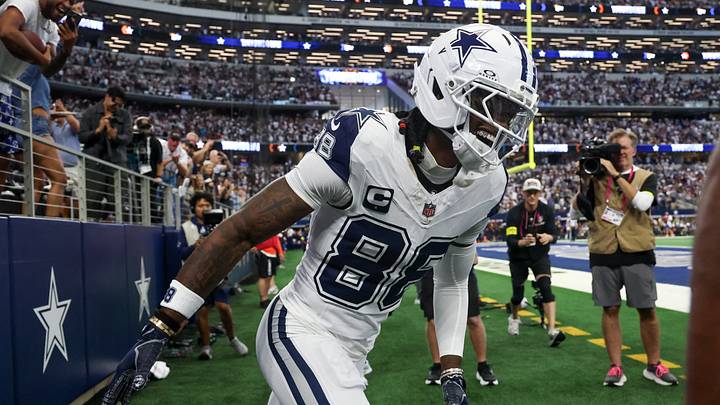
In this story:
Choosing a top-tier wide receiver early in fantasy drafts requires balancing individual talent against offensive ecosystem. As the 2026 fantasy football season arrives, managers face a classic clash of elite archetypes: Justin Jefferson's transcendent big-play ability versus CeeDee Lamb's overwhelming target volume.
Both superstars posted solid yardage floors during frustrating campaigns, yet both saw their elite fantasy ceilings capped by surprisingly low touchdown totals. Analyzing their profiles reveals who holds the higher ceiling for the upcoming season.
The Case for Justin Jefferson: Pure Talent & Explosive Floor
Jefferson remains one of the safest standard best-ball picks in fantasy football due to his unmatched individual efficiency and explosive downfield playmaking.
Dominant Target Command
Jefferson earned a commanding 29.4% target share in 2025. Even when defenses bracket him, Minnesota's game plan runs entirely through his hands.
If you are drafting this week, feel free to make Justin Jefferson your No. 7 pick.
— Shane McCormick (@SMcCormick_FF) August 25, 2026
5-year average: 16 PPG, 1,500+ yards. Even last year with Carson Wentz (when he had NO TDs!), he averaged 16 fantasy points.
That's a floor for him this year. pic.twitter.com/vVspSjgleN
Explosive Playmaking
Jefferson's route-running creates immediate separation, allowing him to turn routine catches into massive, game-changing gains.
Massive Touchdown Regression
Scoring just two touchdowns on 84 catches is an extreme statistical anomaly for a player of his caliber. Any stabilization in Minnesota's passing attack gives Jefferson huge scoring upside.
Unmatched Individual Floor
Even in a year widely considered a "down year", Jefferson still cleared 1,000 receiving yards with relative ease.
The Key Risk
Minnesota's quarterback situation must prove it can consistently stretch defenses and execute in the red zone to restore Jefferson's overall weekly ceiling.
The Case for CeeDee Lamb: Volume & Offensive Environment
Lamb offers the quintessential high-volume profile that dominates points-per-reception (PPR) formats, backed by a fast-paced Cowboys offense that feeds him religiously.
Relentless Target Pace
'Earning 117 targets across just 14 games translates to roughly 8.4 targets per contest. When healthy, few players see more guaranteed opportunities.
High-Volume Offensive System
Dallas continuously crafts play-calling to get Lamb the ball quickly, maximizing his yards-after-catch (YAC) potential.
Draft CeeDee Lamb in fantasy, you won’t regret it. pic.twitter.com/mSMXvlWQsO
— SleeperCowboys (@SleeperCowboys) August 27, 2026
Elite Route Efficiency
Matching Jefferson with a 24.7% target-per-route-run rate highlights how central Lamb is to every pass concept Dallas runs.
Red-Zone Bounce-Back Potential
Like Jefferson, Lamb's three touchdowns in 2025 were far below his career norm, leaving plenty of room for positive scoring regression.
The Key Risk
Lamb relies heavily on pure target volume to generate elite value. If Dallas struggles to convert drives inside the 20-yard line, his weekly upside could be capped.
Tale of the Tape
Vertical Threat vs. Intermediate Chain-Mover
Jefferson continues to run a significantly higher proportion of downfield routes, earning 28 deep targets compared to Lamb's 19. This vertical role keeps his per-catch upside massive, though it subjects his weekly output to higher variance when downfield accuracy wavers.
First-Read Priority
Both star wideouts serve as undisputed primary options in their passing designs. Jefferson's 35.1% first-read share demonstrates that Minnesota's initial progression looks to him over a third of the time, while Lamb's 32.3% first-read rate ensures steady intermediate targets that drive elite point-per-reception consistency.
Who would you rather draft in fantasy this season?
— SleeperNFL (@SleeperNFL) July 13, 2026
CeeDee Lamb
Justin Jefferson pic.twitter.com/FHNd0TOTpv
Strategic Draft Context & Verdict
In PPR Formats
Lamb holds a razor-thin advantage due to the sheer density of targets he receives per game in the Dallas offense. His reception floor provides weekly stability that is difficult to match.
In Standard, Half-PPR, or Best-Ball Formats
Jefferson remains the preferred pick. His downfield explosive profile and expected touchdown rebound gives him unmatched week-winning potential.
Ultimately, both players represent premier wide receiver assets with minimal long-term risk and immense bounce-back upside for 2026.
 Add us as a preferred source on Google
Daniel Outerbridge covers the NBA, NFL, WNBA, and MLB with an emphasis on the numbers behind the game. His work breaks down player performance, team strategy, and emerging statistical trends to provide actionable insights for fans and fantasy players. Outerbridge has written for a myriad of other outlets including Anubis Sports and FanSided.