
D'Andre Swift and More Fantasy Football Players to Avoid in Week 3
In this story:
Fantasy managers often get burned by chasing production from the first bit of action they see in Weeks 1 and 2. Fantasy points can be deceiving early in the season. A couple of big plays or unexpected touchdowns through the first two weeks can easily mask a struggling offense or a shrinking role.
Heading into Week 3, it's time to focus on underlying usage trends like snap percentage, red-zone touches, and expected vs. actual fantasy points. If a player relies on volatile big plays rather than steady volume, their fantasy production is ripe for a drop-off this week.
The Volume Mirage
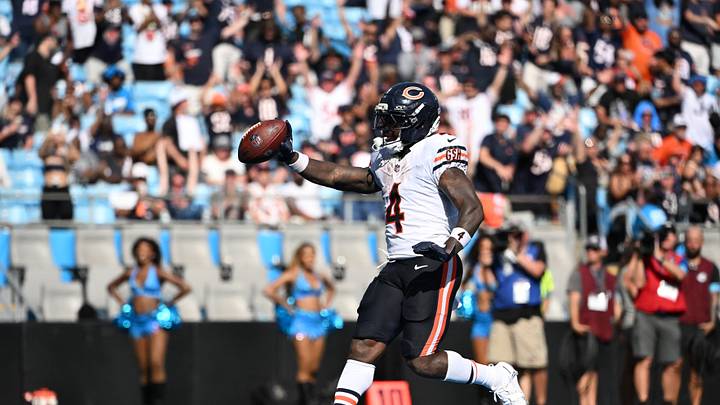
D'Andre Swift/RB/Chicago Bears
Swift turned in respectable production over the first two weeks, but the underlying usage reveals a concerning reality. He isn't holding down a true workhorse role, and his touch total relies heavily on game-flow variance rather than guaranteed volume.

Touches per game: 13.5 Opportunity Share: 51.2% Targets per route run 14.3% Snap Rate: 61%
The Angle: Swift's fantasy output has been sustained by a handful of chunk plays rather than steady, predictable volume. With backup Kyle Monangai siphoning off almost 30% of offensive snaps and taking over late-down work, Swift lacks the touch ceiling to remain a safe starter if the Bears fall behind early.
Efficiency Is Due for a Reality Check
Stefon Diggs/WR/Washington Commanders
Diggs came out of the gates hot, scoring 3 touchdowns over his first two games and rewarding managers who started him. His involvement is significantly lower than his fantasy output suggests.

Yards per reception: 9.4 Yards after catch (YAC): 18 yards Explosive-play rate: 8.3%
Touchdown Rate: 30% of receptions Fantasy points per opportunity: 2.45
Key Question: What happens if the big plays and touchdown variance disappear? Diggs is running shorter routes with a lower target share than in years past. Combined with a backup QB under center following Jayden Daniels' injury, his current efficiency is completely unsustainable without a major spike in target volume.
The Matchup Nobody Wants to Talk About
Aaron Jones Sr.,/RB/Minnesota Vikings
Jones Sr. enjoyed a solid Week 2 stat line, but Week 3 brings a brutal road matchup against the Tampa Bay Buccaneers defense, who consistently shuts down interior rushing lanes.

Opponent fantasy points allowed to RBs: 11.2 (5th lowest in NFL) Yards per play allowed: 4.1
Opponent success rate allowed on rushes: 31.5% Pressure rate generated: 38.2%
The Angle" This isn't just a case of "Tampa Bay has a good defense." The Bucs funnel opposing offenses directly into passing scripts by stonewalling light-box runs, especially with All-Pro Vita Vea anchoring the middle. If Minnesota cannot establish the run early, Jones risks getting scripted out in favor of passing-down scenarios.
The Snap Count Warning
Dalton Kincaid/TE/Buffalo Bills
Kincaid was drafted as an ascending elite tight end, but his playing time through two weeks reflects a tight end operating in a committee.

Snap percentage (Weeks1-2): 55% Route participation: 52.4% Third down snaps: 48%
Two-minute offense snaps: 33.3% Goal-line snaps: 40%
Key Question: Is Kincaid's role actually growing, or does the statistics mask a major split? Dawson Knox and Jackson Hawes continue to steal over 45% of total offensive snaps and valuable end-zone routes. Until Kincaid plays over 70% of the snaps, his weekly floor remains dangerously low.
Where Did the Red-Zone Work Go?
Rhamondre Stevenson/RB/New England Patriots
Stevenson's total volume through two weeks looks decent on paper, but a closer look at where those touches are occuring reveals a steep decline in high-value area usage.

Red-zone touches: 2 total across two games Red-Zone targets: 0 End-Zone Targets: 0
Goal-line carries (inside the 5-yard line): Red-Zone target share: 0% TD opportunities per game: 0.5
The Angle: Don't just look at total touches, but also check out where those touches are coming from. TreVeyon Henderson has taken over early-down third-quarter snaps and absorbed the bulk of inside-the-10 work, while Antonio Gibson continues to siphon off passing-down snaps. Without high-value red-zone carries, Stevenson relies strictly on empty-calorie yardage between the 20s.
Game Script Could Change Everything
Jared Goff/QB/Detroit Lions
Goff comes off a huge 300-yard, 4-touchdown performance in Week 2, but Week 3 projects a completely different structural game script against Aaron Glenn's New York Jets.

Team implied points: 20.5 (down from 27.0 in Week 2) Team pass rate: 52.1%
Neutral-situation pass rate: 46.5% Rush/pass split: 53% run/ 47% pass in positive game scripts
The Angle: The Jets boasts an elite pass defense that limits opponents volume. If the Lions build an early lead or control the pace, they will likely depend on their ground game, dramatically capping Goff's overall pass attempts and ceiling.
The "Proceed With Caution Tier"
If you don't have the bench depth to outright sit these players, enter Week 3 with eyes wide open.
Colston Loveland/TE/Chicago Bears (Medium-High Risk)
Why he's risky: Caleb Williams' injury uncertainty severely downgrades the overall efficiency of Chicago's passing attack.
What the numbers say: Managed just 1 catch on 3 targets in Week 2 while splitting route shares with secondary tight ends.

What could save the day: A goal-line touchdown or safety-valve dump-offs from a backup quarterback.
What would make him a better start: Clear confirmation of a 75% participation rate and healthy starting QB play.
Jerry Jeudy/WR/Cleveland Browns
Why he's risky: Shares target volume in an offense with a low team passing success rate.
What the numbers say: Earned a 15.2% target share in Week 2 with an aDOT under 8.0 yards.
What could save the day: A broken tackle inside the secondary or an unexpected uptick in target share.
What would make him a better starter: A consistently higher first-read target rate.
Kyle Pitts/TE/Atlanta Falcons
Why he's risky: Low target volume in a run-heavy scheme.
What the numbers say: Logged just 1 reception for 15 yards on 3 targets in Week 2 despite high route participation.
What could save the day: A deep post-route touchdown.
What would make him a better start: Sustained quarterback stability and a minimum floor of 5 targets per game.
Week 3 Strategy
Before locking in your Week 3 lineup, look beyond point totals. Prioritize high-value touches, stable snap counts, and route participation over short-term flash. Sitting a big-name player before regression hits isn't panicking, but it's keeping you one step ahead of the rest of your league
All stats provided by ProFootballReference.com & TheBigLead.com
 Add us as a preferred source on Google
Daniel Outerbridge covers the NBA, NFL, WNBA, and MLB with an emphasis on the numbers behind the game. His work breaks down player performance, team strategy, and emerging statistical trends to provide actionable insights for fans and fantasy players. Outerbridge has written for a myriad of other outlets including Anubis Sports and FanSided.