%22%3E%0A%3Cpath%20fill-rule%3D%22evenodd%22%20clip-rule%3D%22evenodd%22%20d%3D%22M156.868%204.36764C162.691%20-1.45588%20172.132%20-1.45588%20177.956%204.36764C183.779%2010.1912%20183.779%2019.6324%20177.956%2025.4559L167.412%2036L156.868%2025.4559C151.044%2019.6324%20151.044%2010.1912%20156.868%204.36764ZM159.509%207.55761C159.448%207.86849%20159.416%208.39718%20159.416%209.14566V10.4189C159.416%2011.1832%20159.448%2011.7198%20159.513%2012.0267C159.578%2012.3317%20159.778%2012.6168%20160.117%2012.8762C160.456%2013.1376%20160.903%2013.3316%20161.458%2013.4623C162.012%2013.593%20162.6%2013.6584%20163.337%2013.6584C164.073%2013.6584%20164.717%2013.591%20165.269%2013.4524C165.822%2013.3158%20166.261%2013.1178%20166.586%2012.8604C166.911%2012.6029%20167.105%2012.3178%20167.166%2012.0069C167.228%2011.6961%20167.259%2011.1674%20167.259%2010.4189V9.14566C167.259%208.38134%20167.228%207.84473%20167.162%207.53781C167.097%207.23287%20166.897%206.94971%20166.558%206.68834C166.22%206.42696%20165.772%206.23291%20165.218%206.10223C164.663%205.97154%20164.036%205.90619%20163.339%205.90619C162.602%205.90619%20161.959%205.97352%20161.406%206.11213C160.852%206.24875%20160.414%206.44677%20160.089%206.70418C159.765%206.9616%20159.571%207.24673%20159.509%207.55761ZM164.776%2024.8638C168.376%2024.8638%20170.057%2024.2064%20170.057%2021.862V21.858V21.3155C170.057%2019.6581%20169.016%2018.971%20165.752%2018.3136C164.778%2018.1136%20164.408%2017.9136%20164.408%2017.3136V16.9414C164.408%2016.6543%20164.677%2016.5117%20164.913%2016.5117C165.249%2016.5117%20165.418%2016.7137%20165.418%2016.9414V18.1136H169.891V17.3988C169.891%2015.4563%20168.847%2014.4266%20164.677%2014.4266C161.65%2014.4266%20159.396%2015.3414%20159.396%2017.3711V17.7433C159.396%2019.5155%20160.305%2020.3155%20163.701%2021.0303C163.78%2021.0472%20163.855%2021.063%20163.927%2021.0781C164.829%2021.2674%20165.147%2021.3341%20165.147%2021.9174V22.2897C165.147%2022.6619%20165.046%2022.8045%20164.642%2022.8045C164.17%2022.8045%20164.137%2022.5471%20164.137%2022.262V21.2897H159.394V21.7471C159.394%2024.149%20160.976%2024.8638%20164.776%2024.8638ZM170.924%2024.5569H175.425V14.7355H170.924V24.5569ZM172.455%2013.5019H175.425V6.06064H172.592V9.411L170.693%206.06064H167.859V13.5019H170.693V10.1199L172.455%2013.5019ZM163.769%2012.152C163.704%2012.2688%20163.555%2012.3262%20163.325%2012.3262L163.327%2012.3282C163.104%2012.3282%20162.959%2012.2767%20162.898%2012.1758C162.836%2012.0748%20162.805%2011.8074%20162.805%2011.3758V7.90068C162.805%207.51852%20162.852%207.28684%20162.945%207.20962C163.038%207.13239%20163.175%207.09279%20163.351%207.09279C163.559%207.09279%20163.698%207.14031%20163.765%207.23734C163.832%207.33239%20163.866%207.55416%20163.866%207.90068V11.3203C163.866%2011.7579%20163.834%2012.0352%20163.769%2012.152Z%22%20fill%3D%22white%22%2F%3E%0A%3Cpath%20d%3D%22M134.707%2035.9991C129.823%2035.9991%20126.029%2035.0305%20122.478%2033.2547L125.303%2027.7255C127.765%2029.017%20130.227%2029.8242%20133.254%2029.8242C136.684%2029.8242%20138.5%2028.0484%20138.5%2024.9811V24.3354C137.249%2025.7479%20135.191%2027.3623%20132.124%2027.3623C126.433%2027.3623%20122.316%2023.3264%20122.316%2017.2322V17.1515C122.316%2010.9766%20126.514%206.90039%20131.599%206.90039C134.828%206.90039%20136.724%208.11115%20138.339%209.76586V7.42506H147.5V23.8914C147.5%2027.9677%20146.653%2030.7524%20144.635%2032.7704C142.657%2034.748%20139.63%2035.9991%20134.707%2035.9991ZM134.868%2020.6627C137.128%2020.6627%20138.541%2019.1291%20138.541%2017.1919V17.1112C138.541%2015.2143%20137.088%2013.6807%20134.868%2013.6807C132.608%2013.6807%20131.195%2015.2547%20131.195%2017.1919V17.2726C131.195%2019.1695%20132.648%2020.6627%20134.868%2020.6627Z%22%20fill%3D%22white%22%2F%3E%0A%3Cpath%20d%3D%22M96.9492%2029.4629V7.42701H106.111V10.4943C107.523%208.67813%20109.743%206.90234%20112.851%206.90234C117.492%206.90234%20120.398%209.96961%20120.398%2014.9337V29.4629H111.236V17.8799C111.236%2015.9831%20110.106%2014.8934%20108.734%2014.8934C107.362%2014.8934%20106.111%2015.9831%20106.111%2017.8799V29.4629H96.9492Z%22%20fill%3D%22white%22%2F%3E%0A%3Cpath%20d%3D%22M84.8096%205.85202V0H94.2939V5.85202H84.8096ZM84.971%2029.4619V7.42602H94.1324V29.4619H84.971Z%22%20fill%3D%22white%22%2F%3E%0A%3Cpath%20d%3D%22M58.877%2029.4619V0H68.0384V10.3722C69.451%208.55606%2071.6707%206.90135%2074.7783%206.90135C79.4196%206.90135%2082.3254%209.96862%2082.3254%2014.9327V29.4619H73.164V17.8789C73.164%2015.9821%2072.0339%2014.8924%2070.6617%2014.8924C69.2895%2014.8924%2068.0384%2015.9821%2068.0384%2017.8789V29.4619H58.877Z%22%20fill%3D%22white%22%2F%3E%0A%3Cpath%20d%3D%22M47.3991%2029.9876C43.1211%2029.9876%2039.2466%2028.8979%2036.0986%2026.7992L39.2063%2021.5929C41.8699%2023.2477%2044.8565%2024.0548%2047.3587%2024.0548C48.2466%2024.0548%2048.6906%2023.853%2048.6906%2023.3284V23.2477C48.6906%2022.8037%2048.287%2022.5212%2046.0673%2021.9562C40.4977%2020.584%2037.0672%2019.0907%2037.0672%2014.5302V14.4494C37.0672%209.60638%2040.9417%206.90234%2046.6726%206.90234C50.3049%206.90234%2053.8969%207.8306%2056.5605%209.44495L53.6547%2014.8934C51.3139%2013.6019%2048.4888%2012.8351%2046.6323%2012.8351C45.7444%2012.8351%2045.3408%2013.0772%2045.3408%2013.5212V13.6019C45.3408%2014.0458%2045.8251%2014.3284%2048.0448%2014.8934C53.6143%2016.2656%2056.9641%2017.7992%2056.9641%2022.3194V22.4001C56.9641%2027.2028%2053.3722%2029.9876%2047.3991%2029.9876Z%22%20fill%3D%22white%22%2F%3E%0A%3Cpath%20d%3D%22M25.5312%205.85202V0H35.0156V5.85202H25.5312ZM25.6927%2029.4619V7.42602H34.8541V29.4619H25.6927Z%22%20fill%3D%22white%22%2F%3E%0A%3Cpath%20d%3D%22M0%2029.4621V1.21094H23.6503V9.2827H9.44396V12.8746H22.6413V20.2199H9.44396V29.4621H0Z%22%20fill%3D%22white%22%2F%3E%0A%3C%2Fg%3E%0A%3Cdefs%3E%0A%3CclipPath%20id%3D%22clip0_16330_64756%22%3E%0A%3Crect%20width%3D%22182%22%20height%3D%2236%22%20fill%3D%22white%22%2F%3E%0A%3C%2FclipPath%3E%0A%3C%2Fdefs%3E%0A%3C%2Fsvg%3E%0A)
5 Proven Tips to Catch the Biggest Largemouth Bass of Your Life
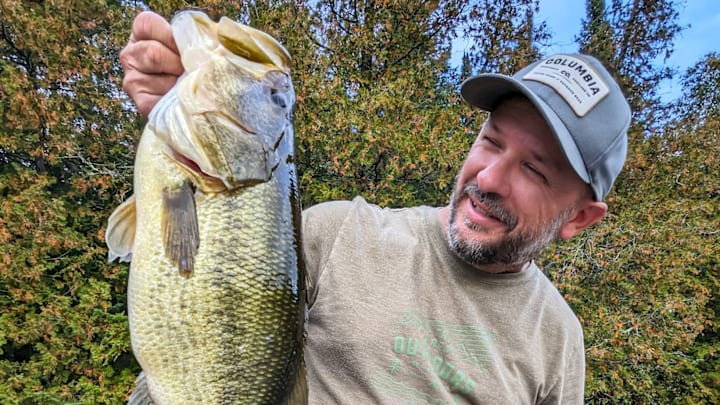
As anglers, our common goal is to catch the biggest fish possible. It's a game of inches for those who chase the elusive muskie, but for the fan-favorite largemouth bass, pounds is where it's at.
Where you reside, and therefore where the bass reside, dictates what qualifies as a trophy. Here in Ontario, Canada, the 'unofficial' mark is five-pounds. For those that fish the southern U.S. or California, a double digit fish gets the well-deserved recognition and fanfare.

Commonly called a 'PB' (Personal Best), this moniker gives credit to the milestone achieved upon landing your biggest largemouth ever. But raising the bar is what keeps us all fishing, because records are made to be broken.
Here are five proven fishing tips to help you catch the biggest largemouth bass of your life.
1. Fish the Best Seasons to Catch Trophy Largemouth Bass
Up north where I fish, most trophy largemouth bass catches occur in the fall. With a major shift in seasonal weather from fall to winter, bass will put on the feedbag in preparation of some lean and cold months creeping up on them. Fish are at their fattest, and thus, heaviest.

Nearly all of my 5+ pound largemouth bass have been hoisted into the boat during September, October and early November. If you're a northern angler, take that knowledge to the bank.
Fishing the spring spawn (or pre-spawn), where legal, is another seasonal period when largemouth bass attain massive weights. Female fish are ripe with eggs, adding extra inches, ounces and pounds to their dimensions.
Don't get me wrong, summer can also produce a trophy largemouth bass for you. But if you want to increase your chances of success, get out there during these prime and proven seasons and be prepared to put in the hard work for that PB.
2. Big Baits Catch Big Bass
Largemouth bass don't put on the pounds by simply snacking on appetizers. Tracking down food exerts energy and trophy bass know not to waste it on pint-size peanuts.
The science is simple: tie on big baits to target oversized largemouth bass. If you've ever seen the gaping yap of a five or six-pound largemouth bass, you'll know that it is cavernous. You could fit a freight train in there. So fishing an eight or 10-inch bait not only garners their attention but is an easy meal for them to gobble up.

Toss bulky flipping jigs, oversized cranks, extra-long worms, or big creature baits for trophy largemouth bass. You'll weed out the skinny fish while giving the big girls something to drool over.
3. Choose Waters Known for Trophy Bass
Not all lakes and rivers hold trophy largemouth bass. Sure, all water will hold decent-sized fish but certain conditions need to be present to grow a crop of giants.
Optimum and sufficient prey needs to live there. A healthy population of bluegill, big shad or crayfish help bass pack on the pounds. When I fished Mexico's Lake El Salto for trophy largemouth bass the main forage were massive tilapia. It makes sense these bass grow huge.
Here in the north I like to target lakes that have an abundance of rock and depths in the main lake basin of at least 50 feet. My reasoning behind this is that deeper water offers largemouth bass more space to move and live (as well as hide) and also supports a larger baitfish population. And the rock hosts a never-ending buffet of high-protein crayfish on which the bass thrive.

Pro Tip: Pay attention to bass tournament results. Note which lakes or rivers consistently produce trophy-sized largemouth bass. Look for above-average 5-fish limit weights and PB worthy big fish awards. Then target those proven water during prime seasons.
4. Target the Hidden Homes of Giant Largemouth
Trophy bass don't gain the size that they do by being stupid. And they most certainly do not hang out in water that is readily accessible to anglers.
Big largemouth bass are masters of concealment. They will seek out the gnarliest of snags or structure to lay low in, revealing themselves only when they choose to. But many anglers miss these fish by fishing the same 'easy' cover or shorelines that get pounded week after week. Big mistake.

Seek the thickest of cover—those hard-to-get to spots on a lake that you've previously thought "I don't think a fish would live there." I guarantee you they do.
And don't overlook offshore structure like small humps or saddles in the middle of nowhere. And remember some fish, some big fish, simply suspend and move through open water following transient pods of baitfish.
5. Think Like a Trophy Hunter
Catching any size of largemouth bass is fun. But hooking a giant—one that pulls like all heck and has you hyperventilating during the fight—is pretty much the best feeling in the world. After almost four decades of bass fishing, I've learned that to land those big fish you need to take on the mindset of a trophy hunter.

There are some days when I go out 'fun fishing', while on other days I am dialed in to upgrading my personal best bass. On those latter outings I am fishing for one bite—the right bite. It means putting in long hours from sunrise to sunset, executing each cast to perfection, and working big baits in hard-to-reach spots.
Think like a hunter. Understand your prey. Execute the game plan.
My Personal Best Largemouth Bass Story
My personal best largemouth bass was swung into the boat two years ago in September. I was fishing my good friend's small Quebec, Ontario, cottage lake, working down a weed and rock shoreline at the end of the day.
The big girl hit a topwater bait in seven-feet of water. I knew it was a trophy the moment I set the hook. After a few hairy moments of trying to get her in the net the battle was finally over. But that's when the story takes a twist.

While driving up to the cottage I asked my buddy if he had his scale in the boat. He said he did, which was true. Unfortunately, it had been left out in the elements and the battery contacts had corroded. It didn't work. Obviously, we still fished, but I never expected that would be the day I'd break my personal bass record that had stood for the previous 18 years.
So I'll never know exactly how much that bass weighed. I know it was well over six and quite possibly 7-pounds. It easily eclipsed my previous record, but I have no definitive measurement.
And yes, to this day I still rib my buddy (ahem, Andy) about his broken scale each time we share a boat for a day of fishing.
Key Takeaways: How to Catch Your Biggest Largemouth Bass
If you remember nothing else about this article, take these five quick trophy bass pointers with you.
- Focus your efforts on prime seasons: Fall is number one, with spring pre-spawn fish a close second the heaviest weights bass carry all year.
- Use big baits: Upsize your lures to target trophy fish. You’ll weed out some smaller bites and you’ll be amazed how easily a really big bass can gulp down a shockingly big bait.
- Pick the right waters: Focus on lakes with deep water, strong forage populations and a proven history of big fish.
- Fish hidden cover: Trophy bass stay where most anglers won’t cast. Don’t make easy casts all day.
- Adopt a trophy-hunter mindset: One bite can make your season. Fish smart and stay focused.
You Might Also Like These Fishing Stories:
 Add us as a preferred source on Google
Justin Hoffman is an outdoor writer and photographer with 25 years of experience producing media content for a host of North American fishing and hunting publications. With an ardent passion for bass fishing, as well as chasing panfish on the fly, this Ontario-based angler is always seeking out new water to wet a line - and along with that, interesting stories to write and share.
Follow HoffmanOutdoors