%22%3E%0A%3Cpath%20fill-rule%3D%22evenodd%22%20clip-rule%3D%22evenodd%22%20d%3D%22M156.868%204.36764C162.691%20-1.45588%20172.132%20-1.45588%20177.956%204.36764C183.779%2010.1912%20183.779%2019.6324%20177.956%2025.4559L167.412%2036L156.868%2025.4559C151.044%2019.6324%20151.044%2010.1912%20156.868%204.36764ZM159.509%207.55761C159.448%207.86849%20159.416%208.39718%20159.416%209.14566V10.4189C159.416%2011.1832%20159.448%2011.7198%20159.513%2012.0267C159.578%2012.3317%20159.778%2012.6168%20160.117%2012.8762C160.456%2013.1376%20160.903%2013.3316%20161.458%2013.4623C162.012%2013.593%20162.6%2013.6584%20163.337%2013.6584C164.073%2013.6584%20164.717%2013.591%20165.269%2013.4524C165.822%2013.3158%20166.261%2013.1178%20166.586%2012.8604C166.911%2012.6029%20167.105%2012.3178%20167.166%2012.0069C167.228%2011.6961%20167.259%2011.1674%20167.259%2010.4189V9.14566C167.259%208.38134%20167.228%207.84473%20167.162%207.53781C167.097%207.23287%20166.897%206.94971%20166.558%206.68834C166.22%206.42696%20165.772%206.23291%20165.218%206.10223C164.663%205.97154%20164.036%205.90619%20163.339%205.90619C162.602%205.90619%20161.959%205.97352%20161.406%206.11213C160.852%206.24875%20160.414%206.44677%20160.089%206.70418C159.765%206.9616%20159.571%207.24673%20159.509%207.55761ZM164.776%2024.8638C168.376%2024.8638%20170.057%2024.2064%20170.057%2021.862V21.858V21.3155C170.057%2019.6581%20169.016%2018.971%20165.752%2018.3136C164.778%2018.1136%20164.408%2017.9136%20164.408%2017.3136V16.9414C164.408%2016.6543%20164.677%2016.5117%20164.913%2016.5117C165.249%2016.5117%20165.418%2016.7137%20165.418%2016.9414V18.1136H169.891V17.3988C169.891%2015.4563%20168.847%2014.4266%20164.677%2014.4266C161.65%2014.4266%20159.396%2015.3414%20159.396%2017.3711V17.7433C159.396%2019.5155%20160.305%2020.3155%20163.701%2021.0303C163.78%2021.0472%20163.855%2021.063%20163.927%2021.0781C164.829%2021.2674%20165.147%2021.3341%20165.147%2021.9174V22.2897C165.147%2022.6619%20165.046%2022.8045%20164.642%2022.8045C164.17%2022.8045%20164.137%2022.5471%20164.137%2022.262V21.2897H159.394V21.7471C159.394%2024.149%20160.976%2024.8638%20164.776%2024.8638ZM170.924%2024.5569H175.425V14.7355H170.924V24.5569ZM172.455%2013.5019H175.425V6.06064H172.592V9.411L170.693%206.06064H167.859V13.5019H170.693V10.1199L172.455%2013.5019ZM163.769%2012.152C163.704%2012.2688%20163.555%2012.3262%20163.325%2012.3262L163.327%2012.3282C163.104%2012.3282%20162.959%2012.2767%20162.898%2012.1758C162.836%2012.0748%20162.805%2011.8074%20162.805%2011.3758V7.90068C162.805%207.51852%20162.852%207.28684%20162.945%207.20962C163.038%207.13239%20163.175%207.09279%20163.351%207.09279C163.559%207.09279%20163.698%207.14031%20163.765%207.23734C163.832%207.33239%20163.866%207.55416%20163.866%207.90068V11.3203C163.866%2011.7579%20163.834%2012.0352%20163.769%2012.152Z%22%20fill%3D%22white%22%2F%3E%0A%3Cpath%20d%3D%22M134.707%2035.9991C129.823%2035.9991%20126.029%2035.0305%20122.478%2033.2547L125.303%2027.7255C127.765%2029.017%20130.227%2029.8242%20133.254%2029.8242C136.684%2029.8242%20138.5%2028.0484%20138.5%2024.9811V24.3354C137.249%2025.7479%20135.191%2027.3623%20132.124%2027.3623C126.433%2027.3623%20122.316%2023.3264%20122.316%2017.2322V17.1515C122.316%2010.9766%20126.514%206.90039%20131.599%206.90039C134.828%206.90039%20136.724%208.11115%20138.339%209.76586V7.42506H147.5V23.8914C147.5%2027.9677%20146.653%2030.7524%20144.635%2032.7704C142.657%2034.748%20139.63%2035.9991%20134.707%2035.9991ZM134.868%2020.6627C137.128%2020.6627%20138.541%2019.1291%20138.541%2017.1919V17.1112C138.541%2015.2143%20137.088%2013.6807%20134.868%2013.6807C132.608%2013.6807%20131.195%2015.2547%20131.195%2017.1919V17.2726C131.195%2019.1695%20132.648%2020.6627%20134.868%2020.6627Z%22%20fill%3D%22white%22%2F%3E%0A%3Cpath%20d%3D%22M96.9492%2029.4629V7.42701H106.111V10.4943C107.523%208.67813%20109.743%206.90234%20112.851%206.90234C117.492%206.90234%20120.398%209.96961%20120.398%2014.9337V29.4629H111.236V17.8799C111.236%2015.9831%20110.106%2014.8934%20108.734%2014.8934C107.362%2014.8934%20106.111%2015.9831%20106.111%2017.8799V29.4629H96.9492Z%22%20fill%3D%22white%22%2F%3E%0A%3Cpath%20d%3D%22M84.8096%205.85202V0H94.2939V5.85202H84.8096ZM84.971%2029.4619V7.42602H94.1324V29.4619H84.971Z%22%20fill%3D%22white%22%2F%3E%0A%3Cpath%20d%3D%22M58.877%2029.4619V0H68.0384V10.3722C69.451%208.55606%2071.6707%206.90135%2074.7783%206.90135C79.4196%206.90135%2082.3254%209.96862%2082.3254%2014.9327V29.4619H73.164V17.8789C73.164%2015.9821%2072.0339%2014.8924%2070.6617%2014.8924C69.2895%2014.8924%2068.0384%2015.9821%2068.0384%2017.8789V29.4619H58.877Z%22%20fill%3D%22white%22%2F%3E%0A%3Cpath%20d%3D%22M47.3991%2029.9876C43.1211%2029.9876%2039.2466%2028.8979%2036.0986%2026.7992L39.2063%2021.5929C41.8699%2023.2477%2044.8565%2024.0548%2047.3587%2024.0548C48.2466%2024.0548%2048.6906%2023.853%2048.6906%2023.3284V23.2477C48.6906%2022.8037%2048.287%2022.5212%2046.0673%2021.9562C40.4977%2020.584%2037.0672%2019.0907%2037.0672%2014.5302V14.4494C37.0672%209.60638%2040.9417%206.90234%2046.6726%206.90234C50.3049%206.90234%2053.8969%207.8306%2056.5605%209.44495L53.6547%2014.8934C51.3139%2013.6019%2048.4888%2012.8351%2046.6323%2012.8351C45.7444%2012.8351%2045.3408%2013.0772%2045.3408%2013.5212V13.6019C45.3408%2014.0458%2045.8251%2014.3284%2048.0448%2014.8934C53.6143%2016.2656%2056.9641%2017.7992%2056.9641%2022.3194V22.4001C56.9641%2027.2028%2053.3722%2029.9876%2047.3991%2029.9876Z%22%20fill%3D%22white%22%2F%3E%0A%3Cpath%20d%3D%22M25.5312%205.85202V0H35.0156V5.85202H25.5312ZM25.6927%2029.4619V7.42602H34.8541V29.4619H25.6927Z%22%20fill%3D%22white%22%2F%3E%0A%3Cpath%20d%3D%22M0%2029.4621V1.21094H23.6503V9.2827H9.44396V12.8746H22.6413V20.2199H9.44396V29.4621H0Z%22%20fill%3D%22white%22%2F%3E%0A%3C%2Fg%3E%0A%3Cdefs%3E%0A%3CclipPath%20id%3D%22clip0_16330_64756%22%3E%0A%3Crect%20width%3D%22182%22%20height%3D%2236%22%20fill%3D%22white%22%2F%3E%0A%3C%2FclipPath%3E%0A%3C%2Fdefs%3E%0A%3C%2Fsvg%3E%0A)
How to Be the Bass Angler Companies Can’t Wait to Sponsor
The Unique World of Bass Fishing Sponsorships
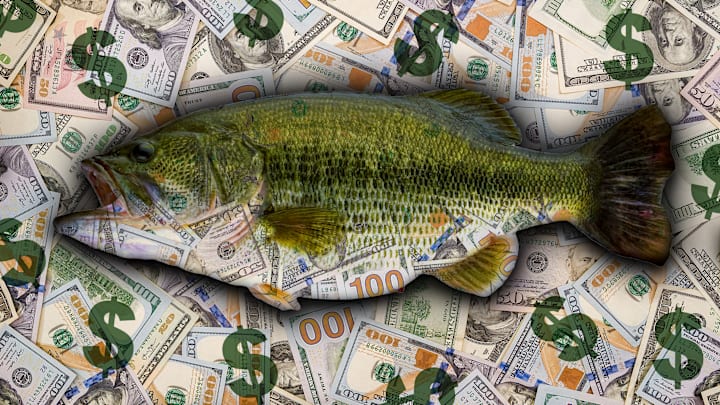
There’s a really unique side of bass tournament fishing, that’s unlike any other recreational pursuit or professional sports career—bass fishing sponsorship. Not that other activities don’t include manufacturer sponsorship deals for the most influential participants or players, but no other activity has created an environment where almost every participant either believes he is entitled to manufacturer support or that he can’t be a legitimate participant without it.
My personal insight straddles both sides of the sponsorship equation. My first several years of bass tournament fishing included an unbalanced and unnecessary amount of my time thinking about how to get sponsorship. And then the next couple decades were spent as fishing industry marketing director for several manufacturers, contemplating how spending my advertising budget on anglers could make sense as a positive return on investment.

Why Anglers Crave Sponsorships: A Closer Look
First, let’s look at it from the angler’s side. Especially, early in your tournament fishing journey, it can be easy to believe that lots of guys, even at a club or local level, have “deals”. You might think that if you don’t have sponsors, then you’re not to be taken seriously. I know from personal experience, that the ego can be a pretty fragile thing, particularly before you’ve proven yourself with consistent tournament results. Nobody wants to be taken for granted. Even the perception of sponsorship can be very soothing. You may not catch a single fish more than you would have without any logos of allegiance on your shirt, but you assure yourself that at least people will believe you’re a contender.
Entry-Level Sponsorship Deals: What They Really Mean
With very few exceptions, the “deals” that you see at the entry-level of tournament bass fishing are almost always just small pricing discounts offered by the manufacturers (often with virtually no qualification) in exchange for the angler displaying the company’s logos. I’m not saying this is a terrible thing. I’m just saying that if you’re intimidated by a guy in your club with a bunch of logos on his shirt, it probably doesn’t mean as much as you’ve let yourself believe it does.
Professional Anglers and Sponsorship Realities
Then let’s consider higher up the angler ladder—maybe you’re fishing national level tournaments, or even the highest professional levels. Does that mean you are guaranteed financial support from fishing industry manufacturers? Again, you look around at your competitors and it may feel that way. Also again, even though you’ve probably thickened your skin climbing to the top levels, the ego can still be a delicate and difficult thing to overcome.
And I understand that in most cases, if you’re participating at the top levels of the sport, you’ve made the commitment to this as your career. This is how you’re feeding your family, so the money part is very important. Professional angler sponsorship can provide the steady income that makes competing a possibility. But the unpopular truth is it still isn’t guaranteed that sponsors will provide that income.

What Sponsors Want: The Manufacturer’s Perspective
Let me give you a few fishing sponsorship tips as we look at the corporate manufacturer’s side. As Dave Davis, owner of DD26 Fishing said on an episode of the Angler’s Happy Hour podcast, “It’s got to help both parties.” And if you think about the simple math of the relationship, “If we sponsor somebody for $10,000, they pretty much have to go out and sell (or influence sales) of almost four times that amount in order for us just to break even. And in all honesty, that probably doesn’t happen in at least 50% of our sponsorship deals. So, all of the other intangible elements become very important to the relationship—product ideas, honest feedback, loyalty, product understanding, etc. There are lots of ways you can bring value and I think anglers really need to grasp that.”
I can tell you from my personal marketing experience that a shockingly small percent of fishing sponsorship applications I received, seemed to give much consideration to how a sponsorship deal could benefit the manufacturer. I received stacks of poorly written letters, loaded with poor grammar and bad spelling, letting me know they like to fish and they’d be glad to use my products and tell their friends about it. And that’s it.
I’m not sure how this industry got to this point, but it’s hard to imagine it anywhere else in life.
“Dear Puffs Tissues,
My name is Joe Blow. I have many allergies and blow my nose a lot. If you send me some of your Kleenex, I’ll use them and tell all of my friends. And if you’ve got anything else, I’d use them too.
Thanks,
Joe”

How to Create Value for Fishing Sponsors
When you reach out to the manufacturer, you are the seller. You are selling your services. The company is the buyer who generally wasn’t looking to buy your services at that moment. And, you’re not the only seller they’ve seen that week or even that day. And since you are trying to convince a business to sponsor you, the only thing that makes sense is to show how you are a good ROI (return on investment). As Davis mentioned, it doesn’t have to be in the form of an actual profit (although that certainly wouldn’t hurt). At the very least, demonstrate that you understand how this business relationship can work and that you are committed to the success of that company.

Putting together a resume of tournament victories and other accolades and awards is a good start, but most times that isn’t the most important thing to a manufacturer with a successful pro staff program.
7 Questions to Ask Yourself to Impress a Sponsor
- Are you thinking about how the products perform, then reporting to the company your favorite features or how to improve the product’s function?
- How could the product display could be improved in your local retailers?
- What is an important selling point that you think isn’t being communicated well in their current marketing?
- Have you offered to help with marketing whenever possible—from staffing a trade show booth to presenting seminars to being available for new product video shoots, etc.?
- Do you actively promote their products on your own social media channels?
- Are you able to provide the sponsor with high quality fishing photos or create your own fishing YouTube channel or podcast?
- If you don’t have that ability (and, not everyone does), do you actively seek opportunities to appear on other creators established channels?
Practical Tips for Building Strong Sponsorships
There are far more than the eight ideas above that would create ROI for fishing sponsorships, but hopefully that list gets you thinking in the right direction. Just consider the things you can do to benefit and promote them. And then make absolutely sure to report your activities to them on a regular basis. It seems like a lot of work, but you’ll be surprised how much of a positive, noticeable and memorable difference you can make with just a few hours investment per week.
And I suppose this should go without saying, but make sure that you always present yourself to the public in the best possible light. Practice perfect sportsmanship. Don’t get caught up in questionable, un-winnable, pointless wars on social media. You are the brand of the company that sponsors you.
Again, like Davis said, “It’s got to help both parties.” And with the right perspective and approach, you can make sure that it does.
CHECK THESE OUT NEXT!
2025 Bassmaster Kayak Series: Premier Kayak Bass Fishing Destinations and Fierce Competition
Mastering Bass Tournament Strategy: Fish the Moment for Big Wins


 Add us as a preferred source on Google
Kurt Mazurek writes about all things fishing and the outdoor lifestyle for Fishing On SI -a division of Sports Illustrated. Before writing On SI he enjoyed a successful career in the fishing industry, developing marketing campaigns and creative content for many of the sport’s most recognizable brands. He is a dedicated husband and father, an enthusiastic bass tournament competitor, YouTuber, photographer, musician, and author of the novel "Personal Best: fishing and life”.