%22%3E%0A%3Cpath%20fill-rule%3D%22evenodd%22%20clip-rule%3D%22evenodd%22%20d%3D%22M156.868%204.36764C162.691%20-1.45588%20172.132%20-1.45588%20177.956%204.36764C183.779%2010.1912%20183.779%2019.6324%20177.956%2025.4559L167.412%2036L156.868%2025.4559C151.044%2019.6324%20151.044%2010.1912%20156.868%204.36764ZM159.509%207.55761C159.448%207.86849%20159.416%208.39718%20159.416%209.14566V10.4189C159.416%2011.1832%20159.448%2011.7198%20159.513%2012.0267C159.578%2012.3317%20159.778%2012.6168%20160.117%2012.8762C160.456%2013.1376%20160.903%2013.3316%20161.458%2013.4623C162.012%2013.593%20162.6%2013.6584%20163.337%2013.6584C164.073%2013.6584%20164.717%2013.591%20165.269%2013.4524C165.822%2013.3158%20166.261%2013.1178%20166.586%2012.8604C166.911%2012.6029%20167.105%2012.3178%20167.166%2012.0069C167.228%2011.6961%20167.259%2011.1674%20167.259%2010.4189V9.14566C167.259%208.38134%20167.228%207.84473%20167.162%207.53781C167.097%207.23287%20166.897%206.94971%20166.558%206.68834C166.22%206.42696%20165.772%206.23291%20165.218%206.10223C164.663%205.97154%20164.036%205.90619%20163.339%205.90619C162.602%205.90619%20161.959%205.97352%20161.406%206.11213C160.852%206.24875%20160.414%206.44677%20160.089%206.70418C159.765%206.9616%20159.571%207.24673%20159.509%207.55761ZM164.776%2024.8638C168.376%2024.8638%20170.057%2024.2064%20170.057%2021.862V21.858V21.3155C170.057%2019.6581%20169.016%2018.971%20165.752%2018.3136C164.778%2018.1136%20164.408%2017.9136%20164.408%2017.3136V16.9414C164.408%2016.6543%20164.677%2016.5117%20164.913%2016.5117C165.249%2016.5117%20165.418%2016.7137%20165.418%2016.9414V18.1136H169.891V17.3988C169.891%2015.4563%20168.847%2014.4266%20164.677%2014.4266C161.65%2014.4266%20159.396%2015.3414%20159.396%2017.3711V17.7433C159.396%2019.5155%20160.305%2020.3155%20163.701%2021.0303C163.78%2021.0472%20163.855%2021.063%20163.927%2021.0781C164.829%2021.2674%20165.147%2021.3341%20165.147%2021.9174V22.2897C165.147%2022.6619%20165.046%2022.8045%20164.642%2022.8045C164.17%2022.8045%20164.137%2022.5471%20164.137%2022.262V21.2897H159.394V21.7471C159.394%2024.149%20160.976%2024.8638%20164.776%2024.8638ZM170.924%2024.5569H175.425V14.7355H170.924V24.5569ZM172.455%2013.5019H175.425V6.06064H172.592V9.411L170.693%206.06064H167.859V13.5019H170.693V10.1199L172.455%2013.5019ZM163.769%2012.152C163.704%2012.2688%20163.555%2012.3262%20163.325%2012.3262L163.327%2012.3282C163.104%2012.3282%20162.959%2012.2767%20162.898%2012.1758C162.836%2012.0748%20162.805%2011.8074%20162.805%2011.3758V7.90068C162.805%207.51852%20162.852%207.28684%20162.945%207.20962C163.038%207.13239%20163.175%207.09279%20163.351%207.09279C163.559%207.09279%20163.698%207.14031%20163.765%207.23734C163.832%207.33239%20163.866%207.55416%20163.866%207.90068V11.3203C163.866%2011.7579%20163.834%2012.0352%20163.769%2012.152Z%22%20fill%3D%22white%22%2F%3E%0A%3Cpath%20d%3D%22M134.707%2035.9991C129.823%2035.9991%20126.029%2035.0305%20122.478%2033.2547L125.303%2027.7255C127.765%2029.017%20130.227%2029.8242%20133.254%2029.8242C136.684%2029.8242%20138.5%2028.0484%20138.5%2024.9811V24.3354C137.249%2025.7479%20135.191%2027.3623%20132.124%2027.3623C126.433%2027.3623%20122.316%2023.3264%20122.316%2017.2322V17.1515C122.316%2010.9766%20126.514%206.90039%20131.599%206.90039C134.828%206.90039%20136.724%208.11115%20138.339%209.76586V7.42506H147.5V23.8914C147.5%2027.9677%20146.653%2030.7524%20144.635%2032.7704C142.657%2034.748%20139.63%2035.9991%20134.707%2035.9991ZM134.868%2020.6627C137.128%2020.6627%20138.541%2019.1291%20138.541%2017.1919V17.1112C138.541%2015.2143%20137.088%2013.6807%20134.868%2013.6807C132.608%2013.6807%20131.195%2015.2547%20131.195%2017.1919V17.2726C131.195%2019.1695%20132.648%2020.6627%20134.868%2020.6627Z%22%20fill%3D%22white%22%2F%3E%0A%3Cpath%20d%3D%22M96.9492%2029.4629V7.42701H106.111V10.4943C107.523%208.67813%20109.743%206.90234%20112.851%206.90234C117.492%206.90234%20120.398%209.96961%20120.398%2014.9337V29.4629H111.236V17.8799C111.236%2015.9831%20110.106%2014.8934%20108.734%2014.8934C107.362%2014.8934%20106.111%2015.9831%20106.111%2017.8799V29.4629H96.9492Z%22%20fill%3D%22white%22%2F%3E%0A%3Cpath%20d%3D%22M84.8096%205.85202V0H94.2939V5.85202H84.8096ZM84.971%2029.4619V7.42602H94.1324V29.4619H84.971Z%22%20fill%3D%22white%22%2F%3E%0A%3Cpath%20d%3D%22M58.877%2029.4619V0H68.0384V10.3722C69.451%208.55606%2071.6707%206.90135%2074.7783%206.90135C79.4196%206.90135%2082.3254%209.96862%2082.3254%2014.9327V29.4619H73.164V17.8789C73.164%2015.9821%2072.0339%2014.8924%2070.6617%2014.8924C69.2895%2014.8924%2068.0384%2015.9821%2068.0384%2017.8789V29.4619H58.877Z%22%20fill%3D%22white%22%2F%3E%0A%3Cpath%20d%3D%22M47.3991%2029.9876C43.1211%2029.9876%2039.2466%2028.8979%2036.0986%2026.7992L39.2063%2021.5929C41.8699%2023.2477%2044.8565%2024.0548%2047.3587%2024.0548C48.2466%2024.0548%2048.6906%2023.853%2048.6906%2023.3284V23.2477C48.6906%2022.8037%2048.287%2022.5212%2046.0673%2021.9562C40.4977%2020.584%2037.0672%2019.0907%2037.0672%2014.5302V14.4494C37.0672%209.60638%2040.9417%206.90234%2046.6726%206.90234C50.3049%206.90234%2053.8969%207.8306%2056.5605%209.44495L53.6547%2014.8934C51.3139%2013.6019%2048.4888%2012.8351%2046.6323%2012.8351C45.7444%2012.8351%2045.3408%2013.0772%2045.3408%2013.5212V13.6019C45.3408%2014.0458%2045.8251%2014.3284%2048.0448%2014.8934C53.6143%2016.2656%2056.9641%2017.7992%2056.9641%2022.3194V22.4001C56.9641%2027.2028%2053.3722%2029.9876%2047.3991%2029.9876Z%22%20fill%3D%22white%22%2F%3E%0A%3Cpath%20d%3D%22M25.5312%205.85202V0H35.0156V5.85202H25.5312ZM25.6927%2029.4619V7.42602H34.8541V29.4619H25.6927Z%22%20fill%3D%22white%22%2F%3E%0A%3Cpath%20d%3D%22M0%2029.4621V1.21094H23.6503V9.2827H9.44396V12.8746H22.6413V20.2199H9.44396V29.4621H0Z%22%20fill%3D%22white%22%2F%3E%0A%3C%2Fg%3E%0A%3Cdefs%3E%0A%3CclipPath%20id%3D%22clip0_16330_64756%22%3E%0A%3Crect%20width%3D%22182%22%20height%3D%2236%22%20fill%3D%22white%22%2F%3E%0A%3C%2FclipPath%3E%0A%3C%2Fdefs%3E%0A%3C%2Fsvg%3E%0A)
Terminal Tackle Guide for Bass Fishing Beginners: The Complete Starter Kit Checklist
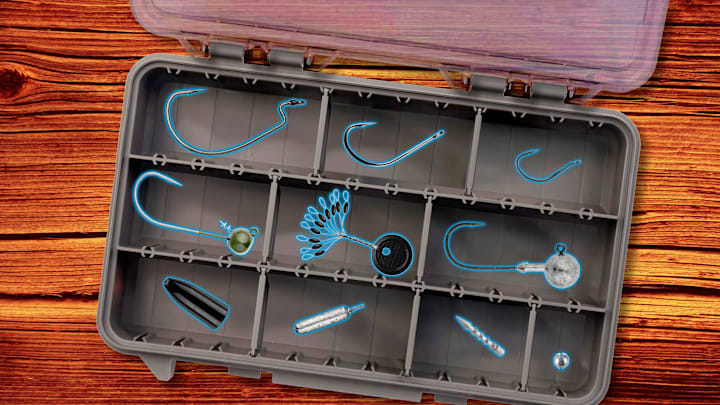
What Is Terminal Tackle?
For anyone thinking about trying bass fishing on their own for the first time, a real bass fishing beginner, the vast amount of gear and choices available can be confusing and intimidating. You know you’re supposed to have tackle boxes filled with all sorts of shiny, flashy, pointy, lures and hardware, but where do you start? The category of fishing gear known as terminal tackle—hooks, weights, jigs, and other miscellaneous rigging bits— really is the foundation for any angler’s fishing arsenal.
As someone who has been buying bass fishing gear for decades, I understand. And even better, I can help. I’ve already made the mistakes (some more than once) and have a great understanding of what you’ll actually need to get you started.
80/20 Fishing Tackle Principle
I can tell you that buying new gear is a fun and satisfying part of bass fishing. But wasting money on things you never end up using can get old. The main thing I’ve learned is that the 80/20 business principle, also known as the Pareto principle, definitely applies to bass fishing. The general idea is that 20% of your efforts produce 80% of the results. The whole concept is about producing more positive results using much less effort, time and resources. In the case of bass tackle, if most bass anglers carry 100 lures with them to fish, they likely catch 80% of their fish with just 20 of those lures.
With that concept in mind, I’ve created a reasonably comprehensive list that will allow you to be prepared to catch bass in 80% of the scenarios you’ll encounter. So, of course it doesn’t include every size, weight and style of tackle for every possible situation. But once you’ve experienced using this tackle, you’ll have a much better understanding of whether any additional specialized gear will actually help you catch more fish.

Following is a solid list of terminal tackle for a beginning bass angler. I’ve included the exact brands, models and sizes I’d buy if I was starting from zero, but there are lots of other brands that will work great. And, I’d recommend starting with relatively small quantities as I've indicated until you’ve tried them out and know they’re right for you.
For example, I probably have 20-to-30 wide gap hooks with me every time I’m on the water and a couple hundred in reserve in my garage. But that’s only because I know I’ll use them. For a beginner, buy the 5-pack first.
This list is linked to the exact products on TackleWarehouse.com. They are a very reputable retailer and I'm sure you'll get to know them well as you move forward with bass fishing. I am not earning a commission on these links, I just wanted to make this process as easy as possible for you.
Terminal Tackle: Complete Starter Kit Checklist
- HOOKS
- VMC Heavy Duty Wide Gap Hook 4/0 -5 pk
- Owner Sniper Finesse Neko Hook 1/0 -8pk
- Gamakatsu Aaron Martens G-Finesse Drop Shot Hook Size 1 -6pk
- JIGS
- Owner Ultrahead Round Jig Head 3/0 1/4 oz -5pk
- Owner Stick Bait Shakey Head 1/4 oz 4/0 - 4pk
- WEIGHTS
- Bullet Weights Lead Bullet Weights 1/4oz - 5pk, 3/8oz - 5pk, 1/2oz - 5pk
- Eagle Claw Lazer Sharp Cylinder Drop Shot Weights 1/8oz -12pk, 1/4oz -12pk
- VMC Neko Nail Weight 1/16oz -10pk
- Eagle Claw Round Split Shot Weights Size 7 - 20pk
- MC Sinker Stops Med -10pk
- STORAGE
- Plano StowAway 3600 Stow
Best Hooks for Bass Fishing Beginners

Wide-Gap Offset Worm Hook
This style hook in the 4/0 size is the standard for Texas rigging a soft plastic bait, from worms, to craws, to paddle-tail swimbaits. You can check out this other article I wrote for a little more detail about Texas-rigged soft plastics, but believe me, you will end up using them. That little stair step bend of the wire near the hook eye is designed to hold a soft plastic bait securely in place when Texas-rigged. And the curved belly of the hook which makes it “wide-gap,” allows the point of the hook to penetrate all the way through bulkier baits like creatures, swimbaits and even bigger worms.
Wacky/Neko Hook
Technically, there are specialized hooks that are designed specifically for a wacky-rigged bait which are slightly different than hooks designed for Neko-rigging, but a hook like the one I’ve recommended will be absolutely fine for a vast majority of the time. Remember, 80/20. But these are both very popular and very effective rigging techniques. It probably won’t be long before you’ll be putting one or both of these rigs to use.
These two rigs are very similar. For a wacky rig, you hook a soft plastic worm or stick bait through the middle, rather than through the nose. It can be fished as is, with no additional weight, or you can add a small weight to the hook shank or the line just in front of the hook. For a Neko rig, it’s also hooked in the middle, but then a small nail weight is added to the nose of the bait.
Drop Shot Hook
A drop shot rig is another presentation that will likely come into play pretty quickly in your bass fishing journey. This hook will be surprisingly small to be most effective when tied like this. In most rigs the hook is at the end of the line, but with a drop shot the hook is 10-inches to as much as a couple feet from the end of the line where a small sinker is tied. That means when the sinker is on the bottom of the lake, your bait is suspended up off the bottom. It’s an incredibly effective presentation.
Must-Have Jigs

Round Head Jig
A round head, or ball head jig, has become incredibly popular with the rise of subtle soft plastic minnow baits used in combination with forward-facing sonar. But don’t worry if you don’t own FFS. A subtle minnow soft plastic bait on a ball head jig is still an effective bass lure even if you’re not looking at them on a scope. Again, there are many choices available, but try something simple like this one first and refine your approach from there.
Shakey/Ned Head Jig
Again, there are more specialized design jigs, but on most days, you can rig a shakey worm or a Ned worm equally well on a “standup” jig like this. And these are both very useful techniques that will likely help you catch bass in a lot of situations.
Essential Fishing Weights Overview
With fishing weights these days, you’ll likely find all of these styles available in lead or tungsten. Over the past couple years, and I’m sure increasingly going forward, the negative environmental effects of lead are going to cause it to be phased out of a lot of products. The upsides of lead weights are its ease of use and its low cost. But one upside to tungsten is that it is denser than lead and therefore smaller in physical size for the same amount of weight. That means your presentations can sneak through vegetation and thick cover more easily, but again, it costs more. So, you decide what’s right for you. Personally, I have started to transition most of my tackle to tungsten whenever possible.

Bullet Worm Weights
The bullet-shaped weight is as common to a bass angler’s tackle box as the Texas-rig bait that’s likely tied on their line. In fact, the bullet weight is integral to that rig. Your line feeds through a small hole in the pointed end of the weight and runs the length of the weight. In most cases the weight is secured where the end of the line is tied to the eye of the hook. But in some cases, like a Carolina rig, it is left to slide freely up and down the line.
A variety of bullet weights will be useful. I’m suggesting to start with a small quantity of the most commonly used sizes—1/4, 3/8, and 1/2 ounce. But once an angler starts experimenting with techniques like punching through dense vegetation mats, sizes all the way up to 2 ounces can be helpful. But again, think 80/20 to get started.
Drop Shot Weight
As I mentioned earlier, a drop shot rig is likely to quickly become one of your favorites, or at least one your most effective. As with almost all of this terminal tackle, there is a range of specialized styles available for drop shot weights, but this thin, cylindrical style will work well enough almost anywhere. And while eventually you’ll want a wider range of weights, start with 1/8 and 1/4 ounce and you’ll be fine.
Nail Weight
This one is pretty much required for a proper Neko rig, but having nail weights available will come in handy for adding a little weight to any of your soft plastic baits.
Split Shot Weight
I remember having split shot weights in my tackle box way before my fishing was focused on bass. The split shot is probably considered standard fishing gear because of its incredible versatility. If you need any lure to get a little deeper, there’s probably a way to use split shot to make that happen. You can pinch one, or as many as you need, on your line ahead of your bait. Or you can pinch them onto the hook itself to make your bait dive. I don’t use a ton of split shot, but when the need arises I’m glad I have them. A size 7 is a little bigger than a BB and a great universal size. Remember, if you need more weight you can always add more.
Sinker Stops
This item is not a weight, but it is used in conjunction with your bullet weight, so I’ll include it here. These are small, egg-shaped rubber stoppers with a small hole drilled through them. They’re also called bobber stops which is originally what they were designed for. But bass fishermen found that these handy little stoppers can be used to hold the bullet weight in place and keep it from sliding free on the line without causing any damage to the line. Very handy!
Organizing & Storage Tips for Bass Fishing Tackle

Plano StowAway 3600 Stow
You’ll need a box to store your collection of terminal tackle. In the beginning, this 3600-size box will seem much bigger than you need to hold the list I’ve recommended, but it will get filled up soon enough as you refine your approach.
Plano is kind of the Kleenex of see-through, divided, hinged-lid, storage boxes. And while they’ve always been the go-to, the standard box was actually completely redesigned earlier this year. The result is a far nicer standard box that solves problems you didn’t necessarily realize you were having until you see this new style. And several of the upgrades work especially well for storing terminal tackle. For example, each box comes with more easy-to-adjust dividers and each divider fits tighter so small item like hooks can’t migrate from section to section.
Building Your Bass Fishing Tackle Collection
Once you’ve stocked up on the absolutely essential items like hooks, weights, and jigs, you’ll need to start selecting which soft plastic baits and lures you’d like to start fishing with.
I’ll be posting similar lists for everything else in the future, but in the mean time pick up one or two baits from the biggest categories. For soft plastics think worms, craws, creatures, paddle-tail swimbaits, and small minnow-style baits. For lures start with one or two topwater lures, hollow-bodied frogs, jerkbaits, crankbaits, spinnerbaits and vibrating jigs. And don’t forget the 80/20 principle.
Happy shopping and welcome to bass fishing!
Recommended Articles:
 Add us as a preferred source on Google
Kurt Mazurek writes about all things fishing and the outdoor lifestyle for Fishing On SI -a division of Sports Illustrated. Before writing On SI he enjoyed a successful career in the fishing industry, developing marketing campaigns and creative content for many of the sport’s most recognizable brands. He is a dedicated husband and father, an enthusiastic bass tournament competitor, YouTuber, photographer, musician, and author of the novel "Personal Best: fishing and life”.