%22%3E%0A%3Cpath%20fill-rule%3D%22evenodd%22%20clip-rule%3D%22evenodd%22%20d%3D%22M156.868%204.36764C162.691%20-1.45588%20172.132%20-1.45588%20177.956%204.36764C183.779%2010.1912%20183.779%2019.6324%20177.956%2025.4559L167.412%2036L156.868%2025.4559C151.044%2019.6324%20151.044%2010.1912%20156.868%204.36764ZM159.509%207.55761C159.448%207.86849%20159.416%208.39718%20159.416%209.14566V10.4189C159.416%2011.1832%20159.448%2011.7198%20159.513%2012.0267C159.578%2012.3317%20159.778%2012.6168%20160.117%2012.8762C160.456%2013.1376%20160.903%2013.3316%20161.458%2013.4623C162.012%2013.593%20162.6%2013.6584%20163.337%2013.6584C164.073%2013.6584%20164.717%2013.591%20165.269%2013.4524C165.822%2013.3158%20166.261%2013.1178%20166.586%2012.8604C166.911%2012.6029%20167.105%2012.3178%20167.166%2012.0069C167.228%2011.6961%20167.259%2011.1674%20167.259%2010.4189V9.14566C167.259%208.38134%20167.228%207.84473%20167.162%207.53781C167.097%207.23287%20166.897%206.94971%20166.558%206.68834C166.22%206.42696%20165.772%206.23291%20165.218%206.10223C164.663%205.97154%20164.036%205.90619%20163.339%205.90619C162.602%205.90619%20161.959%205.97352%20161.406%206.11213C160.852%206.24875%20160.414%206.44677%20160.089%206.70418C159.765%206.9616%20159.571%207.24673%20159.509%207.55761ZM164.776%2024.8638C168.376%2024.8638%20170.057%2024.2064%20170.057%2021.862V21.858V21.3155C170.057%2019.6581%20169.016%2018.971%20165.752%2018.3136C164.778%2018.1136%20164.408%2017.9136%20164.408%2017.3136V16.9414C164.408%2016.6543%20164.677%2016.5117%20164.913%2016.5117C165.249%2016.5117%20165.418%2016.7137%20165.418%2016.9414V18.1136H169.891V17.3988C169.891%2015.4563%20168.847%2014.4266%20164.677%2014.4266C161.65%2014.4266%20159.396%2015.3414%20159.396%2017.3711V17.7433C159.396%2019.5155%20160.305%2020.3155%20163.701%2021.0303C163.78%2021.0472%20163.855%2021.063%20163.927%2021.0781C164.829%2021.2674%20165.147%2021.3341%20165.147%2021.9174V22.2897C165.147%2022.6619%20165.046%2022.8045%20164.642%2022.8045C164.17%2022.8045%20164.137%2022.5471%20164.137%2022.262V21.2897H159.394V21.7471C159.394%2024.149%20160.976%2024.8638%20164.776%2024.8638ZM170.924%2024.5569H175.425V14.7355H170.924V24.5569ZM172.455%2013.5019H175.425V6.06064H172.592V9.411L170.693%206.06064H167.859V13.5019H170.693V10.1199L172.455%2013.5019ZM163.769%2012.152C163.704%2012.2688%20163.555%2012.3262%20163.325%2012.3262L163.327%2012.3282C163.104%2012.3282%20162.959%2012.2767%20162.898%2012.1758C162.836%2012.0748%20162.805%2011.8074%20162.805%2011.3758V7.90068C162.805%207.51852%20162.852%207.28684%20162.945%207.20962C163.038%207.13239%20163.175%207.09279%20163.351%207.09279C163.559%207.09279%20163.698%207.14031%20163.765%207.23734C163.832%207.33239%20163.866%207.55416%20163.866%207.90068V11.3203C163.866%2011.7579%20163.834%2012.0352%20163.769%2012.152Z%22%20fill%3D%22white%22%2F%3E%0A%3Cpath%20d%3D%22M134.707%2035.9991C129.823%2035.9991%20126.029%2035.0305%20122.478%2033.2547L125.303%2027.7255C127.765%2029.017%20130.227%2029.8242%20133.254%2029.8242C136.684%2029.8242%20138.5%2028.0484%20138.5%2024.9811V24.3354C137.249%2025.7479%20135.191%2027.3623%20132.124%2027.3623C126.433%2027.3623%20122.316%2023.3264%20122.316%2017.2322V17.1515C122.316%2010.9766%20126.514%206.90039%20131.599%206.90039C134.828%206.90039%20136.724%208.11115%20138.339%209.76586V7.42506H147.5V23.8914C147.5%2027.9677%20146.653%2030.7524%20144.635%2032.7704C142.657%2034.748%20139.63%2035.9991%20134.707%2035.9991ZM134.868%2020.6627C137.128%2020.6627%20138.541%2019.1291%20138.541%2017.1919V17.1112C138.541%2015.2143%20137.088%2013.6807%20134.868%2013.6807C132.608%2013.6807%20131.195%2015.2547%20131.195%2017.1919V17.2726C131.195%2019.1695%20132.648%2020.6627%20134.868%2020.6627Z%22%20fill%3D%22white%22%2F%3E%0A%3Cpath%20d%3D%22M96.9492%2029.4629V7.42701H106.111V10.4943C107.523%208.67813%20109.743%206.90234%20112.851%206.90234C117.492%206.90234%20120.398%209.96961%20120.398%2014.9337V29.4629H111.236V17.8799C111.236%2015.9831%20110.106%2014.8934%20108.734%2014.8934C107.362%2014.8934%20106.111%2015.9831%20106.111%2017.8799V29.4629H96.9492Z%22%20fill%3D%22white%22%2F%3E%0A%3Cpath%20d%3D%22M84.8096%205.85202V0H94.2939V5.85202H84.8096ZM84.971%2029.4619V7.42602H94.1324V29.4619H84.971Z%22%20fill%3D%22white%22%2F%3E%0A%3Cpath%20d%3D%22M58.877%2029.4619V0H68.0384V10.3722C69.451%208.55606%2071.6707%206.90135%2074.7783%206.90135C79.4196%206.90135%2082.3254%209.96862%2082.3254%2014.9327V29.4619H73.164V17.8789C73.164%2015.9821%2072.0339%2014.8924%2070.6617%2014.8924C69.2895%2014.8924%2068.0384%2015.9821%2068.0384%2017.8789V29.4619H58.877Z%22%20fill%3D%22white%22%2F%3E%0A%3Cpath%20d%3D%22M47.3991%2029.9876C43.1211%2029.9876%2039.2466%2028.8979%2036.0986%2026.7992L39.2063%2021.5929C41.8699%2023.2477%2044.8565%2024.0548%2047.3587%2024.0548C48.2466%2024.0548%2048.6906%2023.853%2048.6906%2023.3284V23.2477C48.6906%2022.8037%2048.287%2022.5212%2046.0673%2021.9562C40.4977%2020.584%2037.0672%2019.0907%2037.0672%2014.5302V14.4494C37.0672%209.60638%2040.9417%206.90234%2046.6726%206.90234C50.3049%206.90234%2053.8969%207.8306%2056.5605%209.44495L53.6547%2014.8934C51.3139%2013.6019%2048.4888%2012.8351%2046.6323%2012.8351C45.7444%2012.8351%2045.3408%2013.0772%2045.3408%2013.5212V13.6019C45.3408%2014.0458%2045.8251%2014.3284%2048.0448%2014.8934C53.6143%2016.2656%2056.9641%2017.7992%2056.9641%2022.3194V22.4001C56.9641%2027.2028%2053.3722%2029.9876%2047.3991%2029.9876Z%22%20fill%3D%22white%22%2F%3E%0A%3Cpath%20d%3D%22M25.5312%205.85202V0H35.0156V5.85202H25.5312ZM25.6927%2029.4619V7.42602H34.8541V29.4619H25.6927Z%22%20fill%3D%22white%22%2F%3E%0A%3Cpath%20d%3D%22M0%2029.4621V1.21094H23.6503V9.2827H9.44396V12.8746H22.6413V20.2199H9.44396V29.4621H0Z%22%20fill%3D%22white%22%2F%3E%0A%3C%2Fg%3E%0A%3Cdefs%3E%0A%3CclipPath%20id%3D%22clip0_16330_64756%22%3E%0A%3Crect%20width%3D%22182%22%20height%3D%2236%22%20fill%3D%22white%22%2F%3E%0A%3C%2FclipPath%3E%0A%3C%2Fdefs%3E%0A%3C%2Fsvg%3E%0A)
Why Bass Follow But Don’t Bite—And 5 Steps to Fix It
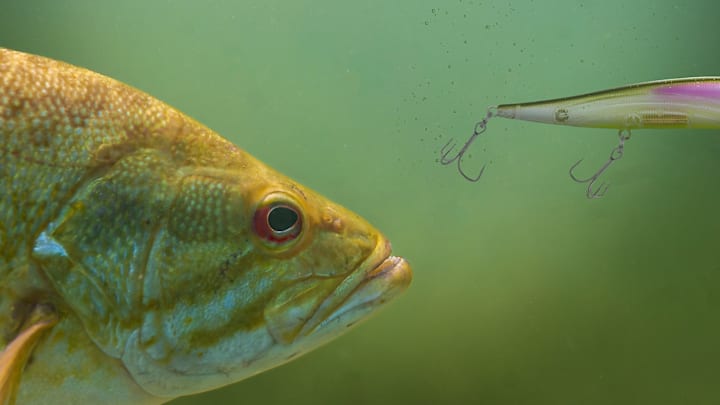
If you’ve been fishing for any length of time, you know the frustration. As your lure gets closer, you notice a large shadowy figure just under or behind your lure. It’s the bass you’ve been waiting for all day—maybe all year. It’s casually easing up closer to your bait, but it’s just looking, not attacking. Then as quickly as it appeared, it vanishes back out of sight.
Jerkbaits and glide baits are two of the most notorious lures that you’ll see bass following without striking. As maddening as that experience can be, that same scene likely played out many times that day, just out of your range of sight. But once you have a confirmed sighting, there are steps you can take to increase the likelihood of a strike.
Why Bass Follow But Don’t Bite

There are a number of factors that trigger a bass to strike a lure. Solving the puzzle is figuring out which combination of factors close the deal that day.
I remember a lesson I learned from In-Fisherman several decades ago, but it’s still just as true today. The order of importance for the triggering factors of a lure is depth, speed, size, sound, and then color. With that in mind, let’s look at the 5 steps to dialing in your lure and converting those followers to biters.
1. Depth -Confirm Before Changing
The fact that you’ve seen a bass tracking your lure, means that you’ve probably got the depth right. While this is an important factor, I’d save it until after you’ve worked your way through the rest of the list. You may consider trying a lure that works shallower or deeper in the water column, but let’s save those adjustments for later.
2. Speed -The Most Critical Trigger
This is the one that I have used to dial in the biters more often than anything else. In the case of a jerk bait or a glide bait, it can be all about the cadence. How fast or slow are you moving it? How long are you pausing, if at all, between movements? The next time you spot a fish tracking your bait, speed it up like you’re trying to take it away from him. I promise you once he’s committed you can’t go fast enough to get it away.
If that doesn’t do it, try killing the bait’s movement all together and sit perfectly still. Wait a full five seconds, which is going to feel like an hour, and then give it just the slightest twitch.
This slow approach works really well on frog fish too. When a fish blows up but doesn’t get hooked, just wait. He’s still down there looking at it. Then when you finally give that frog just a little quiver of movement, he’ll come unglued on it.
3. Size -Start With a Smaller Bait

My first move with size would be to step it down. Many lures like the Berkley Chop Block shown above are available in a range of sizes. Try to match as many other factors as possible from the bait the fish just followed, but go smaller. They can get pretty dialed in to a specific size of baitfish at certain times of the year, and something dramatically bigger or smaller seems suspicious.
4. Sound -Think About the Vibration
I feel like the term sound might be a little misleading here. Think of it as vibration/sound. While bass do have an ear that technically functions in some ways like ours, they have a lateral line that senses vibration and interprets their world in a way that is completely unlike anything we can imagine.
Lots of lures, like a jerk bait or crankbait create some sort of a rattle. Bass are curious and will come to investigate a sound, but actual minnows aren’t generally rattling as they swim around. That one factor might overrule the other factors that were working, and ultimately stop a bass from biting.
If the bass aren’t committing try tossing a silent version of whatever they followed—again, matching as many other factors as possible.
If it happens to be something like a spinnerbait or vibrating jig, try different blade styles or configurations until you find the vibration bass bite.
5. Color -Focus on Contrast

I know, a lot of people would argue that this should be first. But if you study the biology of a bass you’ll quickly learn their eyes function very differently than ours. The fact is that half the colors on all the lures available, bass literally can’t see
Think about it in terms of contrast over specific colors. That’s why in clear water, more natural patterns and translucent finishes seem to work best. The bass can see your lure clearly, so something that takes its cues from the real baitfish in the lake makes sense. But in stained water, the opposite can be true.
Turn Followers Into Biters

Once you understand the triggers bass react to, you realize they’re not trying to frustrate you, they’re teaching you what they want. Adjust your presentation systematically, and the next shadow you see behind your lure will be one that ends up in your net.
Key Takeaways
- Speed is usually the simplest and most effective trigger.
- Smaller baits will be more likely to convert followers.
- Swap rattling lures for silent versions.
- Focus on contrast over color.
You Might Also Like These Fishing Stories:
 Add us as a preferred source on Google
Kurt Mazurek writes about all things fishing and the outdoor lifestyle for Fishing On SI -a division of Sports Illustrated. Before writing On SI he enjoyed a successful career in the fishing industry, developing marketing campaigns and creative content for many of the sport’s most recognizable brands. He is a dedicated husband and father, an enthusiastic bass tournament competitor, YouTuber, photographer, musician, and author of the novel "Personal Best: fishing and life”.