%22%3E%0A%3Cpath%20fill-rule%3D%22evenodd%22%20clip-rule%3D%22evenodd%22%20d%3D%22M156.868%204.36764C162.691%20-1.45588%20172.132%20-1.45588%20177.956%204.36764C183.779%2010.1912%20183.779%2019.6324%20177.956%2025.4559L167.412%2036L156.868%2025.4559C151.044%2019.6324%20151.044%2010.1912%20156.868%204.36764ZM159.509%207.55761C159.448%207.86849%20159.416%208.39718%20159.416%209.14566V10.4189C159.416%2011.1832%20159.448%2011.7198%20159.513%2012.0267C159.578%2012.3317%20159.778%2012.6168%20160.117%2012.8762C160.456%2013.1376%20160.903%2013.3316%20161.458%2013.4623C162.012%2013.593%20162.6%2013.6584%20163.337%2013.6584C164.073%2013.6584%20164.717%2013.591%20165.269%2013.4524C165.822%2013.3158%20166.261%2013.1178%20166.586%2012.8604C166.911%2012.6029%20167.105%2012.3178%20167.166%2012.0069C167.228%2011.6961%20167.259%2011.1674%20167.259%2010.4189V9.14566C167.259%208.38134%20167.228%207.84473%20167.162%207.53781C167.097%207.23287%20166.897%206.94971%20166.558%206.68834C166.22%206.42696%20165.772%206.23291%20165.218%206.10223C164.663%205.97154%20164.036%205.90619%20163.339%205.90619C162.602%205.90619%20161.959%205.97352%20161.406%206.11213C160.852%206.24875%20160.414%206.44677%20160.089%206.70418C159.765%206.9616%20159.571%207.24673%20159.509%207.55761ZM164.776%2024.8638C168.376%2024.8638%20170.057%2024.2064%20170.057%2021.862V21.858V21.3155C170.057%2019.6581%20169.016%2018.971%20165.752%2018.3136C164.778%2018.1136%20164.408%2017.9136%20164.408%2017.3136V16.9414C164.408%2016.6543%20164.677%2016.5117%20164.913%2016.5117C165.249%2016.5117%20165.418%2016.7137%20165.418%2016.9414V18.1136H169.891V17.3988C169.891%2015.4563%20168.847%2014.4266%20164.677%2014.4266C161.65%2014.4266%20159.396%2015.3414%20159.396%2017.3711V17.7433C159.396%2019.5155%20160.305%2020.3155%20163.701%2021.0303C163.78%2021.0472%20163.855%2021.063%20163.927%2021.0781C164.829%2021.2674%20165.147%2021.3341%20165.147%2021.9174V22.2897C165.147%2022.6619%20165.046%2022.8045%20164.642%2022.8045C164.17%2022.8045%20164.137%2022.5471%20164.137%2022.262V21.2897H159.394V21.7471C159.394%2024.149%20160.976%2024.8638%20164.776%2024.8638ZM170.924%2024.5569H175.425V14.7355H170.924V24.5569ZM172.455%2013.5019H175.425V6.06064H172.592V9.411L170.693%206.06064H167.859V13.5019H170.693V10.1199L172.455%2013.5019ZM163.769%2012.152C163.704%2012.2688%20163.555%2012.3262%20163.325%2012.3262L163.327%2012.3282C163.104%2012.3282%20162.959%2012.2767%20162.898%2012.1758C162.836%2012.0748%20162.805%2011.8074%20162.805%2011.3758V7.90068C162.805%207.51852%20162.852%207.28684%20162.945%207.20962C163.038%207.13239%20163.175%207.09279%20163.351%207.09279C163.559%207.09279%20163.698%207.14031%20163.765%207.23734C163.832%207.33239%20163.866%207.55416%20163.866%207.90068V11.3203C163.866%2011.7579%20163.834%2012.0352%20163.769%2012.152Z%22%20fill%3D%22white%22%2F%3E%0A%3Cpath%20d%3D%22M134.707%2035.9991C129.823%2035.9991%20126.029%2035.0305%20122.478%2033.2547L125.303%2027.7255C127.765%2029.017%20130.227%2029.8242%20133.254%2029.8242C136.684%2029.8242%20138.5%2028.0484%20138.5%2024.9811V24.3354C137.249%2025.7479%20135.191%2027.3623%20132.124%2027.3623C126.433%2027.3623%20122.316%2023.3264%20122.316%2017.2322V17.1515C122.316%2010.9766%20126.514%206.90039%20131.599%206.90039C134.828%206.90039%20136.724%208.11115%20138.339%209.76586V7.42506H147.5V23.8914C147.5%2027.9677%20146.653%2030.7524%20144.635%2032.7704C142.657%2034.748%20139.63%2035.9991%20134.707%2035.9991ZM134.868%2020.6627C137.128%2020.6627%20138.541%2019.1291%20138.541%2017.1919V17.1112C138.541%2015.2143%20137.088%2013.6807%20134.868%2013.6807C132.608%2013.6807%20131.195%2015.2547%20131.195%2017.1919V17.2726C131.195%2019.1695%20132.648%2020.6627%20134.868%2020.6627Z%22%20fill%3D%22white%22%2F%3E%0A%3Cpath%20d%3D%22M96.9492%2029.4629V7.42701H106.111V10.4943C107.523%208.67813%20109.743%206.90234%20112.851%206.90234C117.492%206.90234%20120.398%209.96961%20120.398%2014.9337V29.4629H111.236V17.8799C111.236%2015.9831%20110.106%2014.8934%20108.734%2014.8934C107.362%2014.8934%20106.111%2015.9831%20106.111%2017.8799V29.4629H96.9492Z%22%20fill%3D%22white%22%2F%3E%0A%3Cpath%20d%3D%22M84.8096%205.85202V0H94.2939V5.85202H84.8096ZM84.971%2029.4619V7.42602H94.1324V29.4619H84.971Z%22%20fill%3D%22white%22%2F%3E%0A%3Cpath%20d%3D%22M58.877%2029.4619V0H68.0384V10.3722C69.451%208.55606%2071.6707%206.90135%2074.7783%206.90135C79.4196%206.90135%2082.3254%209.96862%2082.3254%2014.9327V29.4619H73.164V17.8789C73.164%2015.9821%2072.0339%2014.8924%2070.6617%2014.8924C69.2895%2014.8924%2068.0384%2015.9821%2068.0384%2017.8789V29.4619H58.877Z%22%20fill%3D%22white%22%2F%3E%0A%3Cpath%20d%3D%22M47.3991%2029.9876C43.1211%2029.9876%2039.2466%2028.8979%2036.0986%2026.7992L39.2063%2021.5929C41.8699%2023.2477%2044.8565%2024.0548%2047.3587%2024.0548C48.2466%2024.0548%2048.6906%2023.853%2048.6906%2023.3284V23.2477C48.6906%2022.8037%2048.287%2022.5212%2046.0673%2021.9562C40.4977%2020.584%2037.0672%2019.0907%2037.0672%2014.5302V14.4494C37.0672%209.60638%2040.9417%206.90234%2046.6726%206.90234C50.3049%206.90234%2053.8969%207.8306%2056.5605%209.44495L53.6547%2014.8934C51.3139%2013.6019%2048.4888%2012.8351%2046.6323%2012.8351C45.7444%2012.8351%2045.3408%2013.0772%2045.3408%2013.5212V13.6019C45.3408%2014.0458%2045.8251%2014.3284%2048.0448%2014.8934C53.6143%2016.2656%2056.9641%2017.7992%2056.9641%2022.3194V22.4001C56.9641%2027.2028%2053.3722%2029.9876%2047.3991%2029.9876Z%22%20fill%3D%22white%22%2F%3E%0A%3Cpath%20d%3D%22M25.5312%205.85202V0H35.0156V5.85202H25.5312ZM25.6927%2029.4619V7.42602H34.8541V29.4619H25.6927Z%22%20fill%3D%22white%22%2F%3E%0A%3Cpath%20d%3D%22M0%2029.4621V1.21094H23.6503V9.2827H9.44396V12.8746H22.6413V20.2199H9.44396V29.4621H0Z%22%20fill%3D%22white%22%2F%3E%0A%3C%2Fg%3E%0A%3Cdefs%3E%0A%3CclipPath%20id%3D%22clip0_16330_64756%22%3E%0A%3Crect%20width%3D%22182%22%20height%3D%2236%22%20fill%3D%22white%22%2F%3E%0A%3C%2FclipPath%3E%0A%3C%2Fdefs%3E%0A%3C%2Fsvg%3E%0A)
Springtime Bass Buggin - Now is the Time! Epic Fly fishing for Bass.
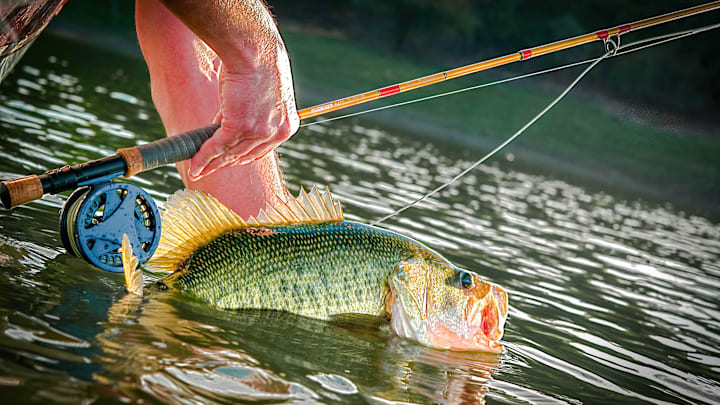
"When the dogwoods bloom, the bass are in the room," was something my dad used to say. It was his way of knowing when largemouth bass were on their beds. Soon after, he knew it would be post-spawn; the fiberglass fly rods would come down from the ceiling, and we'd go out in the yard to practice casting, put together a box full of bass bugs, and throw the jon boat on the trailer.
I can't see dogwood trees in bloom without thinking about my dad and bass. However, I've become a little more sophisticated in my approach to the spawn. I now use water temperature to judge when the bass will be on their beds. When the water temperatures enter the 50s, I start keeping my eyes open for bedding fish. Once the temperatures are in the 60s, you can bet the fish are in the spawn.
Fly Fishing for Bass AFTER the Spawn
My father waited till post-spawn to fly fish for bass. He wasn't a fan of fishing for bedded fish and taught me that when they come off their beds, they are ravenous from not feeding during the spawn. I remember him saying, "They'll darn near hit anything that makes a commotion on top."
Keep an Eye on the Birds
Every season, Dad would tell me how birds are on the nest during this time of year, and redwing blackbirds are known for nesting in the cattails that grow in the shallows. He theorized that baby blackbirds would fall out of the nest, and it would be like a dinner bell for a "big 'ol bass."
One of my father's favorite bass bugs was a large, black mess of feathers and untrimmed deer hair. It was ugly, but it did, in fact, catch fish at the base of cattails.
Fly Fishing Gear for Bass
A 7 or 8-weight rod is perfect for throwing air-resistant poppers. That size rod will deliver large flies and have the backbone to pull strong, heavy fish out of weeds and cover.
What I look for in a bass fly rod.
- Moderately priced. You don't need a high-end fly rod for bass fishing, especially if you only do it a few times a season. This isn't technical fishing, nor sensitive fishing, so the delicacy of presenting a dry fly isn't needed. In fact, most times, I want to get my bass bug out there with a "plop" on the water. This can attract a feeding bass.

- Quality. Going inexpensive doesn't mean you have to settle for cheap. Redington rods have a reputation for building quality rods at an affordable price. I may fish for bass 5-10 times a season. I don't want to spend a thousand dollars on a rod that I don't use that much. I want quality, but I need to save money too.
- Versatility. A rod that I can use for redfish or small striped bass in the salt is an even better investment.
Fly Reel
Again, save your money. You don't need a high-end drag or a fully machined, made from one piece of Aerospace Grade Bar Stock Aluminum fly reel. A largemouth bass will put up a fight, but it won't give you long, blistering runs. A bass is a puncher, not a sprinter. The Pflueger Medalist is a good fit for bass fishing.

Fly Line and Leader
The Scientific Angler Mastery Bass Bug fly line is built for throwing top water bass bugs. You want a line that is thicker, heavier, and shorter in front so it can easily carry and turn over big, air-resistant flies. This will make your casting easier with less work.
Go simple with the leader. 20 lb test monofilament (it floats), 7 ft long. You don't need a long, tapered leader; delicate and stealth aren't a priority. You may have to horse fish out of weeds, and a loud splash when your fly hits the water can be a good thing. Following my dad's instructions, "Make it sound like a baby bird falling out of its nest."
So Many Bass Bugs to Choose From
I don't think bass are as picky on design and color as we give them credit for. The movement you are able to impart on the fly plays much more of a factor in getting a fish to hit than the design. That being said, there are some things in the design that you should pay attention to because they can assist in the type of movement you want out of your fly.
Functional Fly Design
- Diver fly
A diving pattern has a head shape, so when you retrieve it with a sharp pull, the fly will dive under a few inches and then float back up. This is a great action because it causes a big disturbance in a very small space and mimics an escape movement. Noisey, efficient, and tempting to a hungry bass.
Popping Bug
A bass bug with a concave face for noise and water disturbance: This will make for a louder, disturbance-causing retrieve. Snap your fly line, make a commotion, and then let the fly sit. Don't be in a hurry on your retrieve. Move loud, move slow.
Topwater Frog
This is a Jeff Rowley frog tie. The genius of this tie is it's a frog and a diver.
Bass Fishing 101- bass love frogs. The conventional tackle guys know this and will work a floating frog around and through lily pads. With a fly rod and good accuracy, we can do the same, plus cast to an opening space of water in a field of lily pads, work the frog pattern, and lift it out without dragging it through the pads...unless you want to. If you do hook up, this is why you fish a 7-weight. Now you have a rod hefty enough to fight the bass in all that vegetation.
A Simple Design Works Too
Something as simple as a classically tied Tap's Bug will work if you put the right action to it. Springtime bass are, for the most part, hungry bass. You don't have to get fancy. Show them something that "looks like it's alive, and it will be dead."
Spring Time is the Right Time.
You don't have to get fancy, expensive, or highly technical. (Except for the fly line. A bug taper fly line really makes casting easier.) If you time it right, you could be in for a day of fishing you will never forget. And then, every year, when the dogwood blooms, it will take on a whole new meaning. KB
"The gods do not deduct from man’s allotted span the hours spent in fishing.” - Herbert Hoover
Read Next:
 Add us as a preferred source on Google
Ken Baldwin is a Writer/Editor for Fishing On SI, where he writes stories about fly fishing and the lifestyle that surrounds it. His writing and photography have appeared in Men's Journal, Catch Magazine, Fish Alaska, and the American Angler. He also created and hosted the TV show Season on the Edge, which aired on NBC Sports and in seven countries, showcasing travel, adventure, and culture through the lens of fishing. For twenty years, Ken worked as a fly fishing guide in Alaska, which gave him opportunities to hang out with and photograph the Alaskan brown bear. His experience photographing the brown bear helped him land a job with the Netflix documentary Our Planet 2, narrated by David Attenborough. If you dig deep enough in Ken's resume, you will see that he played the terrorist "Mulkey" in the film Die Hard 2 before fly fishing took over his life. Ken is a graduate of the University of Washington.
Follow KenBaldwinOnSI