%22%3E%0A%3Cpath%20fill-rule%3D%22evenodd%22%20clip-rule%3D%22evenodd%22%20d%3D%22M156.868%204.36764C162.691%20-1.45588%20172.132%20-1.45588%20177.956%204.36764C183.779%2010.1912%20183.779%2019.6324%20177.956%2025.4559L167.412%2036L156.868%2025.4559C151.044%2019.6324%20151.044%2010.1912%20156.868%204.36764ZM159.509%207.55761C159.448%207.86849%20159.416%208.39718%20159.416%209.14566V10.4189C159.416%2011.1832%20159.448%2011.7198%20159.513%2012.0267C159.578%2012.3317%20159.778%2012.6168%20160.117%2012.8762C160.456%2013.1376%20160.903%2013.3316%20161.458%2013.4623C162.012%2013.593%20162.6%2013.6584%20163.337%2013.6584C164.073%2013.6584%20164.717%2013.591%20165.269%2013.4524C165.822%2013.3158%20166.261%2013.1178%20166.586%2012.8604C166.911%2012.6029%20167.105%2012.3178%20167.166%2012.0069C167.228%2011.6961%20167.259%2011.1674%20167.259%2010.4189V9.14566C167.259%208.38134%20167.228%207.84473%20167.162%207.53781C167.097%207.23287%20166.897%206.94971%20166.558%206.68834C166.22%206.42696%20165.772%206.23291%20165.218%206.10223C164.663%205.97154%20164.036%205.90619%20163.339%205.90619C162.602%205.90619%20161.959%205.97352%20161.406%206.11213C160.852%206.24875%20160.414%206.44677%20160.089%206.70418C159.765%206.9616%20159.571%207.24673%20159.509%207.55761ZM164.776%2024.8638C168.376%2024.8638%20170.057%2024.2064%20170.057%2021.862V21.858V21.3155C170.057%2019.6581%20169.016%2018.971%20165.752%2018.3136C164.778%2018.1136%20164.408%2017.9136%20164.408%2017.3136V16.9414C164.408%2016.6543%20164.677%2016.5117%20164.913%2016.5117C165.249%2016.5117%20165.418%2016.7137%20165.418%2016.9414V18.1136H169.891V17.3988C169.891%2015.4563%20168.847%2014.4266%20164.677%2014.4266C161.65%2014.4266%20159.396%2015.3414%20159.396%2017.3711V17.7433C159.396%2019.5155%20160.305%2020.3155%20163.701%2021.0303C163.78%2021.0472%20163.855%2021.063%20163.927%2021.0781C164.829%2021.2674%20165.147%2021.3341%20165.147%2021.9174V22.2897C165.147%2022.6619%20165.046%2022.8045%20164.642%2022.8045C164.17%2022.8045%20164.137%2022.5471%20164.137%2022.262V21.2897H159.394V21.7471C159.394%2024.149%20160.976%2024.8638%20164.776%2024.8638ZM170.924%2024.5569H175.425V14.7355H170.924V24.5569ZM172.455%2013.5019H175.425V6.06064H172.592V9.411L170.693%206.06064H167.859V13.5019H170.693V10.1199L172.455%2013.5019ZM163.769%2012.152C163.704%2012.2688%20163.555%2012.3262%20163.325%2012.3262L163.327%2012.3282C163.104%2012.3282%20162.959%2012.2767%20162.898%2012.1758C162.836%2012.0748%20162.805%2011.8074%20162.805%2011.3758V7.90068C162.805%207.51852%20162.852%207.28684%20162.945%207.20962C163.038%207.13239%20163.175%207.09279%20163.351%207.09279C163.559%207.09279%20163.698%207.14031%20163.765%207.23734C163.832%207.33239%20163.866%207.55416%20163.866%207.90068V11.3203C163.866%2011.7579%20163.834%2012.0352%20163.769%2012.152Z%22%20fill%3D%22white%22%2F%3E%0A%3Cpath%20d%3D%22M134.707%2035.9991C129.823%2035.9991%20126.029%2035.0305%20122.478%2033.2547L125.303%2027.7255C127.765%2029.017%20130.227%2029.8242%20133.254%2029.8242C136.684%2029.8242%20138.5%2028.0484%20138.5%2024.9811V24.3354C137.249%2025.7479%20135.191%2027.3623%20132.124%2027.3623C126.433%2027.3623%20122.316%2023.3264%20122.316%2017.2322V17.1515C122.316%2010.9766%20126.514%206.90039%20131.599%206.90039C134.828%206.90039%20136.724%208.11115%20138.339%209.76586V7.42506H147.5V23.8914C147.5%2027.9677%20146.653%2030.7524%20144.635%2032.7704C142.657%2034.748%20139.63%2035.9991%20134.707%2035.9991ZM134.868%2020.6627C137.128%2020.6627%20138.541%2019.1291%20138.541%2017.1919V17.1112C138.541%2015.2143%20137.088%2013.6807%20134.868%2013.6807C132.608%2013.6807%20131.195%2015.2547%20131.195%2017.1919V17.2726C131.195%2019.1695%20132.648%2020.6627%20134.868%2020.6627Z%22%20fill%3D%22white%22%2F%3E%0A%3Cpath%20d%3D%22M96.9492%2029.4629V7.42701H106.111V10.4943C107.523%208.67813%20109.743%206.90234%20112.851%206.90234C117.492%206.90234%20120.398%209.96961%20120.398%2014.9337V29.4629H111.236V17.8799C111.236%2015.9831%20110.106%2014.8934%20108.734%2014.8934C107.362%2014.8934%20106.111%2015.9831%20106.111%2017.8799V29.4629H96.9492Z%22%20fill%3D%22white%22%2F%3E%0A%3Cpath%20d%3D%22M84.8096%205.85202V0H94.2939V5.85202H84.8096ZM84.971%2029.4619V7.42602H94.1324V29.4619H84.971Z%22%20fill%3D%22white%22%2F%3E%0A%3Cpath%20d%3D%22M58.877%2029.4619V0H68.0384V10.3722C69.451%208.55606%2071.6707%206.90135%2074.7783%206.90135C79.4196%206.90135%2082.3254%209.96862%2082.3254%2014.9327V29.4619H73.164V17.8789C73.164%2015.9821%2072.0339%2014.8924%2070.6617%2014.8924C69.2895%2014.8924%2068.0384%2015.9821%2068.0384%2017.8789V29.4619H58.877Z%22%20fill%3D%22white%22%2F%3E%0A%3Cpath%20d%3D%22M47.3991%2029.9876C43.1211%2029.9876%2039.2466%2028.8979%2036.0986%2026.7992L39.2063%2021.5929C41.8699%2023.2477%2044.8565%2024.0548%2047.3587%2024.0548C48.2466%2024.0548%2048.6906%2023.853%2048.6906%2023.3284V23.2477C48.6906%2022.8037%2048.287%2022.5212%2046.0673%2021.9562C40.4977%2020.584%2037.0672%2019.0907%2037.0672%2014.5302V14.4494C37.0672%209.60638%2040.9417%206.90234%2046.6726%206.90234C50.3049%206.90234%2053.8969%207.8306%2056.5605%209.44495L53.6547%2014.8934C51.3139%2013.6019%2048.4888%2012.8351%2046.6323%2012.8351C45.7444%2012.8351%2045.3408%2013.0772%2045.3408%2013.5212V13.6019C45.3408%2014.0458%2045.8251%2014.3284%2048.0448%2014.8934C53.6143%2016.2656%2056.9641%2017.7992%2056.9641%2022.3194V22.4001C56.9641%2027.2028%2053.3722%2029.9876%2047.3991%2029.9876Z%22%20fill%3D%22white%22%2F%3E%0A%3Cpath%20d%3D%22M25.5312%205.85202V0H35.0156V5.85202H25.5312ZM25.6927%2029.4619V7.42602H34.8541V29.4619H25.6927Z%22%20fill%3D%22white%22%2F%3E%0A%3Cpath%20d%3D%22M0%2029.4621V1.21094H23.6503V9.2827H9.44396V12.8746H22.6413V20.2199H9.44396V29.4621H0Z%22%20fill%3D%22white%22%2F%3E%0A%3C%2Fg%3E%0A%3Cdefs%3E%0A%3CclipPath%20id%3D%22clip0_16330_64756%22%3E%0A%3Crect%20width%3D%22182%22%20height%3D%2236%22%20fill%3D%22white%22%2F%3E%0A%3C%2FclipPath%3E%0A%3C%2Fdefs%3E%0A%3C%2Fsvg%3E%0A)
What’s the Best Way to Improve Your Fly Cast?
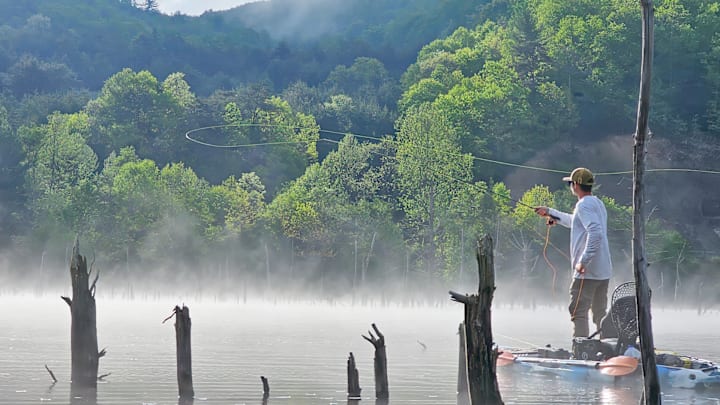
Learning to fly cast isn’t about more fishing—it’s about better practice. Start in a field, put in the reps, and everything on the water gets easier.
Most bad fly casting isn’t a lack of skill—it’s a lack of reps.

Big Improvement
I’ve been fly casting most of my life, including 20 years of guiding in Alaska. I’ve made more progress in improving my casting in the last two years than at any other time. The difference is simple: I started practicing my cast like it was a jump shot. You can swap that for a golf swing or most any physical movement—the truth still holds. Practice on a regular basis, put in the reps, and you get better.
The Magic of Reps
Mastery in fly casting comes from repetition, not instruction. You get better by doing it—again and again—in a controlled environment like a field or your yard. That’s where the brain and body can learn without the distraction of trying to catch a fish.

The Body Knows
The body is intelligent. Like a child learning to walk, it trends toward efficiency, or the path of least resistance. With time and reps, the brain and muscles self-correct, finding what works, and then repeats it.
Outside Help
Instruction, mentors, videos, books—they all help. But nothing moves the needle like consistently showing up and getting the reps in. Instruction help supports the process, but you have to do the process. Deep learning happens in the repetition.
Here’s What Improved My Casting
I committed to casting at least two days a week. If I go less than that, I don’t see progress. The great thing about fly casting is that the feedback is immediate—you can see improvement when it happens.
When I stick to twice a week, my accuracy stays high, and my distance stays near my personal best, with small gains pushing it to new personal best.
My Practice
For this to work, you should be able to cast 30 feet consistently. If you can’t, get a quick lesson or use a simple YouTube video to get there.
Warmup
I start every practice with 5 minutes of casting 30–40 feet of line, just keeping it in the air with continuous forward and back casts. I keep my motion between 10 and 2, and I don't let the line hit the ground.
I focus on the rod tip, I watch how it bends, and let that energy propel the line forward and back while keeping a tight loop.
Master the Fly as a Tool
If you keep the line in the air long enough, your arm will get tired, and your body will start letting the rod do more of the work. Once this happens, you will have a better understanding of the fly rod as a tool and use it more efficiently. That's a good place to start.

Spark Your Competitive Side
After the warmup, I play a few games while keeping the line in the air. I watch the loop—Is it tight? If it is, can I keep it that way while slowing down? How slow can I go and still make a good cast? This will help you develop a smooth, fluid cast.
Slow is smooth, smooth is fast.
Straight Is the Way
Drill: Watch your back cast until it fully straightens. Do this for a minute or two. Don’t transition into a forward cast until the line has completely unfurled behind you. The ability to let your back cast straighten and know when to transition into a forward cast will fix a lot of casting problems. Coming forward too soon is poison.
Learn to Feel the Rod Load
Drill: Get a few casts going. Don't look at the backcast, but wait and see if you can feel the line pull or tug the rod tip when the line straightens. At 40 feet, it won’t be a big tug - but if you pay attention, there will be enough of one that you can detect it. That is the rod loading up as a spring to help launch your fly line forward. The better you become at loading the rod, the less work you have to do, and the better your casting will be.

Same Drills With Different Techniques
I’ll run these drills with different mechanics—elbow tight to the body, elbow free, wrist locked, wrist loose. I’m not chasing a perfect cast. I’m learning how the rod and line work together, and how my mechanics affect the cast.
Repitition and Time
Over time, all the pieces will start to come together, and the physics of casting a fly line will become clear. You will learn to use the rod more and your arm less. You expend less energy, and the whole movement becomes smooth and fluid.
Accuracy With a Fly Rod
I set up stationary targets at realistic fishing distances, or If I’m preparing for a saltwater or flats trip, I’ll call out shots like a guide: “2 o’clock, 40 feet, moving right to left,” and place the fly.
Precision Accuracy
If I’m working on stationary accuracy, I’ll cast to both sides of the target. For fish like redfish or bones, placement matters—you’re not just hitting a target, you’re choosing a side based on what direction the fish is facing while it is feeding.
I’ll also spend time on a backhand cast. You will have fishing situations where you will be glad you did.

Distance Work
I set markers at 70, 80, and 90 feet. To cast long, you have to slow down, use power instead of speed, perfect your timing, learn to double haul, wait on the back cast, and load the rod. Long casting demands excellent technique and will expose your flaws; it will also make you better at every distance.
Personal Instruction
I highly recommend taking a lesson from a professional casting instructor. I thoroughly enjoy lessons because I always come away from them with casting gems and a lot of potential for growth.
Now here's the "But..."
Put in a few months of personal practice before you get valuable time in front of the instructor's eyes and ears. You’ll get more from the teacher because you've practiced—your questions will be better, more specific. The tools you are working with won't be foreign to you. You'll know what your strengths are, and where you are weak. Then take what you learn from the instructor, and go right back to practice.
The Most Important
The most important takeaway in all this is: show up and put in the reps. Give yourself time to practice on your own—get to know your fly rod and line. Experiment. Try new things, Break the rules. Pay attention to how the line moves and where it goes. Make a game of it.
All the instruction in the world won’t matter if you don’t put in the reps. There is magic in repetition. .~Ken Baldwin
 Add us as a preferred source on Google
Ken Baldwin is a writer and editor for Fishing On SI, covering fly fishing gear, travel, and all other aspects of a life well fished. His writing and photography have appeared in Men’s Journal, Catch Magazine, Fish Alaska, and American Angler. Ken also created and hosts Season on the Edge, a television series exploring travel, adventure, and culture through fishing that aired on NBC Sports and in seven countries. For twenty years, Ken guided fly anglers in Alaska, keeping him in close proximity to brown bears and launching his path into wildlife photography. That field experience led to his work as a bear guard and consultant on the Netflix documentary Our Planet II, narrated by David Attenborough. His photography was also featured in the series promotion. His career has taken a few memorable turns – professionally dancing and teaching salsa, bartending at the House of Blues on the Sunset Strip, and played the terrorist “Mulkey” in the film Die Hard 2. Ken graduated from the University of Washington with a degree that had absolutely nothing to do with any of those choices.
Follow KenBaldwinOnSI