
Why So Many Fly Anglers Become Obsessed With Smallmouth Bass
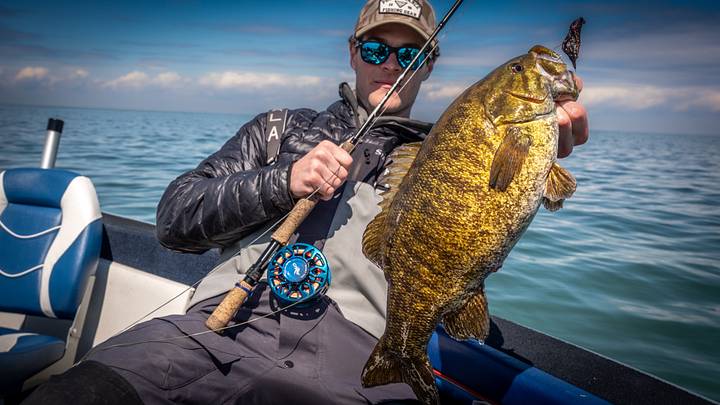
Across the U.S. and into the northernmost parts of the country, the smallmouth bass bite is hitting its stride.
If you are a fly angler who has never specifically targeted smallmouth bass, think they are not truly worthy of a fly rod, or simply haven’t spent much time around them, that perspective is worth changing.

"Achigan” — The Fish That Fights
Smallmouth bass are not a step down in fly fishing by any stretch. They punch far above their weight class, can be aggressive to the point of seeming angry, and fight with a violent mix of slashing, power, and head-shaking. Native Americans from the Algonquian/Ojibwe nation called them "Achigan," which roughly translates to: “One who fights."
If your timing is right, they will crush a topwater fly.
Where to Find Smallmouth Bass
They are a fish that tends to orient around rocks. And the critters living among those rocks—crawdads, minnows, insects, pretty much anything that crawls, swims, or floats—are fair game for food. If forced to pick one favorite, crawdads would probably top the list.
Remember this mantra for all fishing. Find the food, find the fish.
Sudden Changes in Depth
Look for drop-offs, even small ones. A sudden change in depth of three feet can be enough to hold fish.
Shallow Water That Has Deep Water Nearby
The shallows are a good place for smallmouth to find food, and the deep water gives them a fast escape into safety.

When summers get really hot, the smallmouth can hold as deep as thirty feet. I don't fish for them then. I'd rather wait till fall, when they start moving and getting on a feeding spree to fatten up for winter.
Smallmouth Will School Up
It doesn't happen every time, but there will be days you can catch big numbers, and it can be non-stop action. With smallmouth, a 30-fish day is possible.
My Preferred Gear to Catch Smallmouth Bass on the Fly
A 7-weight is a good all-around choice for smallmouth bass. An 8-weight works better when covering big water and throwing big streamers on a full-sinking line.
Fly Reel
Most any fly reel will work, but I've recently become a fan of the new Averon Streamer Fly Reel, designed by Kelly Gallup for Hardy.
It is a wide arbour fly reel that is free-spooling on the retrieve. The wide arbor allows for more line pickup with each turn of the spool. The ability of the reel to free-spool to quickly pick up line is something center-pin steelheaders have been doing for a long time.
Hardy explains it like this on their website: "To further accelerate retrieval, nearly all incoming resistance has been removed—allowing the reel to spin freely and clear slack line quickly with a slap of the handle or rim."

The reel only spins freely on the incoming, it has a soft to medium sounding click on the outgoing.
Fly Lines
The most productive fly line for smallmouth bass is one that sinks. If you want to increase your catch rate, get your streamer down to where the fish are, and that is done best with a sinking line.
My favorite is the Scientific Anglers Sonar Titan 3D Triple Density in the 1/3/5. The end of the line sinks at 5 ips, which I have found to be the sweet spot for sink rate in the rivers and lakes I fish. You should have another reel spooled with a floating line if you plan to throw topwater.
Flies
The flies I like to carry are -
- Large streamers like the Drunk & Disorderly and the Unholy Diver. I use these to mimic jerk baits. The bass anglers that fish the Lower Niagara will tell you that springtime is when you can put up big numbers throwing a jerk bait, they call it the "jerk bite." I also use these streamers as search baits. I can fish it fast and cover a lot of water.

- The Clouser Minnow. If I had to choose one fly to fish for smallies, it would be a Clouser, 3-4 inches, in Chartreuse and White. This fly will consistently catch fish. I think it's the profile and the dropping action that the fish find so attractive.
- A black bunny or marabou leech. I slowly crawl these across the bottom. It catches when fish are slow and inactive.

- Anything that mimics a crawdad.

- A top water fly. This could be a bass bug, a pencil popper, a mouse, or a gurgler. In my box, I have a silver pencil popper that I can manipulate to mimic an injured baitfish. A big Dahlberg Diver that resembles a struggling baby bird when I'm fishing around trees. A deer-hair frog that I use to imitate... a frog.
- And a bass bug with a large concave face, so I can cause a lot of disturbance when the smallies are really aggressive and hungry. (This aggressive bite is the one that will convert you to the "Way of the Smallmouth."
Now is the time
The bite is on across the U.S. Do a little research and find your nearest body of water that holds them. Or plan a trip. I recently visited the Lower Niagara River in upstate New York for my annual smallmouth trip in May. The bite was just starting to happen, and it was not uncommon to catch a smallmouth in the 6lb range.
Smallmouth bass have a following in the fly fishing world, especially in the eastern states. It is a challenging, worthy, and hard-fighting fish that has earned the respect of anglers who take on the challenge of fishing for them. It is one of my favorite fish to target. Now is a great time to fish for them. The bite is on and will remain good until the summer heat pushes them deep. If you haven't fished for them before, I'd give it serious consideration. ~Ken Baldwin Follow me on my Instagram page
"Slow down...listen to the hoppers...be patient with yer wife...eat sardines with hot sauce... catch “Gagger” trout!!!" – Flip Pallot
 Add us as a preferred source on Google

Ken Baldwin is a writer and editor for Fishing On SI, covering fly fishing gear, travel, and all other aspects of a life well fished. His writing and photography have appeared in Men’s Journal, Catch Magazine, Fish Alaska, and American Angler. Ken also created and hosts Season on the Edge, a television series exploring travel, adventure, and culture through fishing that aired on NBC Sports and in seven countries. For twenty years, Ken guided fly anglers in Alaska, keeping him in close proximity to brown bears and launching his path into wildlife photography. That field experience led to his work as a bear guard and consultant on the Netflix documentary Our Planet II, narrated by David Attenborough. His photography was also featured in the series promotion. His career has taken a few memorable turns – professionally dancing and teaching salsa, bartending at the House of Blues on the Sunset Strip, and played the terrorist “Mulkey” in the film Die Hard 2. Ken graduated from the University of Washington with a degree that had absolutely nothing to do with any of the above.
Follow KenBaldwinOnSI