%22%3E%0A%3Cpath%20fill-rule%3D%22evenodd%22%20clip-rule%3D%22evenodd%22%20d%3D%22M156.868%204.36764C162.691%20-1.45588%20172.132%20-1.45588%20177.956%204.36764C183.779%2010.1912%20183.779%2019.6324%20177.956%2025.4559L167.412%2036L156.868%2025.4559C151.044%2019.6324%20151.044%2010.1912%20156.868%204.36764ZM159.509%207.55761C159.448%207.86849%20159.416%208.39718%20159.416%209.14566V10.4189C159.416%2011.1832%20159.448%2011.7198%20159.513%2012.0267C159.578%2012.3317%20159.778%2012.6168%20160.117%2012.8762C160.456%2013.1376%20160.903%2013.3316%20161.458%2013.4623C162.012%2013.593%20162.6%2013.6584%20163.337%2013.6584C164.073%2013.6584%20164.717%2013.591%20165.269%2013.4524C165.822%2013.3158%20166.261%2013.1178%20166.586%2012.8604C166.911%2012.6029%20167.105%2012.3178%20167.166%2012.0069C167.228%2011.6961%20167.259%2011.1674%20167.259%2010.4189V9.14566C167.259%208.38134%20167.228%207.84473%20167.162%207.53781C167.097%207.23287%20166.897%206.94971%20166.558%206.68834C166.22%206.42696%20165.772%206.23291%20165.218%206.10223C164.663%205.97154%20164.036%205.90619%20163.339%205.90619C162.602%205.90619%20161.959%205.97352%20161.406%206.11213C160.852%206.24875%20160.414%206.44677%20160.089%206.70418C159.765%206.9616%20159.571%207.24673%20159.509%207.55761ZM164.776%2024.8638C168.376%2024.8638%20170.057%2024.2064%20170.057%2021.862V21.858V21.3155C170.057%2019.6581%20169.016%2018.971%20165.752%2018.3136C164.778%2018.1136%20164.408%2017.9136%20164.408%2017.3136V16.9414C164.408%2016.6543%20164.677%2016.5117%20164.913%2016.5117C165.249%2016.5117%20165.418%2016.7137%20165.418%2016.9414V18.1136H169.891V17.3988C169.891%2015.4563%20168.847%2014.4266%20164.677%2014.4266C161.65%2014.4266%20159.396%2015.3414%20159.396%2017.3711V17.7433C159.396%2019.5155%20160.305%2020.3155%20163.701%2021.0303C163.78%2021.0472%20163.855%2021.063%20163.927%2021.0781C164.829%2021.2674%20165.147%2021.3341%20165.147%2021.9174V22.2897C165.147%2022.6619%20165.046%2022.8045%20164.642%2022.8045C164.17%2022.8045%20164.137%2022.5471%20164.137%2022.262V21.2897H159.394V21.7471C159.394%2024.149%20160.976%2024.8638%20164.776%2024.8638ZM170.924%2024.5569H175.425V14.7355H170.924V24.5569ZM172.455%2013.5019H175.425V6.06064H172.592V9.411L170.693%206.06064H167.859V13.5019H170.693V10.1199L172.455%2013.5019ZM163.769%2012.152C163.704%2012.2688%20163.555%2012.3262%20163.325%2012.3262L163.327%2012.3282C163.104%2012.3282%20162.959%2012.2767%20162.898%2012.1758C162.836%2012.0748%20162.805%2011.8074%20162.805%2011.3758V7.90068C162.805%207.51852%20162.852%207.28684%20162.945%207.20962C163.038%207.13239%20163.175%207.09279%20163.351%207.09279C163.559%207.09279%20163.698%207.14031%20163.765%207.23734C163.832%207.33239%20163.866%207.55416%20163.866%207.90068V11.3203C163.866%2011.7579%20163.834%2012.0352%20163.769%2012.152Z%22%20fill%3D%22white%22%2F%3E%0A%3Cpath%20d%3D%22M134.707%2035.9991C129.823%2035.9991%20126.029%2035.0305%20122.478%2033.2547L125.303%2027.7255C127.765%2029.017%20130.227%2029.8242%20133.254%2029.8242C136.684%2029.8242%20138.5%2028.0484%20138.5%2024.9811V24.3354C137.249%2025.7479%20135.191%2027.3623%20132.124%2027.3623C126.433%2027.3623%20122.316%2023.3264%20122.316%2017.2322V17.1515C122.316%2010.9766%20126.514%206.90039%20131.599%206.90039C134.828%206.90039%20136.724%208.11115%20138.339%209.76586V7.42506H147.5V23.8914C147.5%2027.9677%20146.653%2030.7524%20144.635%2032.7704C142.657%2034.748%20139.63%2035.9991%20134.707%2035.9991ZM134.868%2020.6627C137.128%2020.6627%20138.541%2019.1291%20138.541%2017.1919V17.1112C138.541%2015.2143%20137.088%2013.6807%20134.868%2013.6807C132.608%2013.6807%20131.195%2015.2547%20131.195%2017.1919V17.2726C131.195%2019.1695%20132.648%2020.6627%20134.868%2020.6627Z%22%20fill%3D%22white%22%2F%3E%0A%3Cpath%20d%3D%22M96.9492%2029.4629V7.42701H106.111V10.4943C107.523%208.67813%20109.743%206.90234%20112.851%206.90234C117.492%206.90234%20120.398%209.96961%20120.398%2014.9337V29.4629H111.236V17.8799C111.236%2015.9831%20110.106%2014.8934%20108.734%2014.8934C107.362%2014.8934%20106.111%2015.9831%20106.111%2017.8799V29.4629H96.9492Z%22%20fill%3D%22white%22%2F%3E%0A%3Cpath%20d%3D%22M84.8096%205.85202V0H94.2939V5.85202H84.8096ZM84.971%2029.4619V7.42602H94.1324V29.4619H84.971Z%22%20fill%3D%22white%22%2F%3E%0A%3Cpath%20d%3D%22M58.877%2029.4619V0H68.0384V10.3722C69.451%208.55606%2071.6707%206.90135%2074.7783%206.90135C79.4196%206.90135%2082.3254%209.96862%2082.3254%2014.9327V29.4619H73.164V17.8789C73.164%2015.9821%2072.0339%2014.8924%2070.6617%2014.8924C69.2895%2014.8924%2068.0384%2015.9821%2068.0384%2017.8789V29.4619H58.877Z%22%20fill%3D%22white%22%2F%3E%0A%3Cpath%20d%3D%22M47.3991%2029.9876C43.1211%2029.9876%2039.2466%2028.8979%2036.0986%2026.7992L39.2063%2021.5929C41.8699%2023.2477%2044.8565%2024.0548%2047.3587%2024.0548C48.2466%2024.0548%2048.6906%2023.853%2048.6906%2023.3284V23.2477C48.6906%2022.8037%2048.287%2022.5212%2046.0673%2021.9562C40.4977%2020.584%2037.0672%2019.0907%2037.0672%2014.5302V14.4494C37.0672%209.60638%2040.9417%206.90234%2046.6726%206.90234C50.3049%206.90234%2053.8969%207.8306%2056.5605%209.44495L53.6547%2014.8934C51.3139%2013.6019%2048.4888%2012.8351%2046.6323%2012.8351C45.7444%2012.8351%2045.3408%2013.0772%2045.3408%2013.5212V13.6019C45.3408%2014.0458%2045.8251%2014.3284%2048.0448%2014.8934C53.6143%2016.2656%2056.9641%2017.7992%2056.9641%2022.3194V22.4001C56.9641%2027.2028%2053.3722%2029.9876%2047.3991%2029.9876Z%22%20fill%3D%22white%22%2F%3E%0A%3Cpath%20d%3D%22M25.5312%205.85202V0H35.0156V5.85202H25.5312ZM25.6927%2029.4619V7.42602H34.8541V29.4619H25.6927Z%22%20fill%3D%22white%22%2F%3E%0A%3Cpath%20d%3D%22M0%2029.4621V1.21094H23.6503V9.2827H9.44396V12.8746H22.6413V20.2199H9.44396V29.4621H0Z%22%20fill%3D%22white%22%2F%3E%0A%3C%2Fg%3E%0A%3Cdefs%3E%0A%3CclipPath%20id%3D%22clip0_16330_64756%22%3E%0A%3Crect%20width%3D%22182%22%20height%3D%2236%22%20fill%3D%22white%22%2F%3E%0A%3C%2FclipPath%3E%0A%3C%2Fdefs%3E%0A%3C%2Fsvg%3E%0A)
Trophy Walleye Fishing Tips: Mastering the Fall Transition
Why Fall Transition Walleye Fishing Produces Trophies
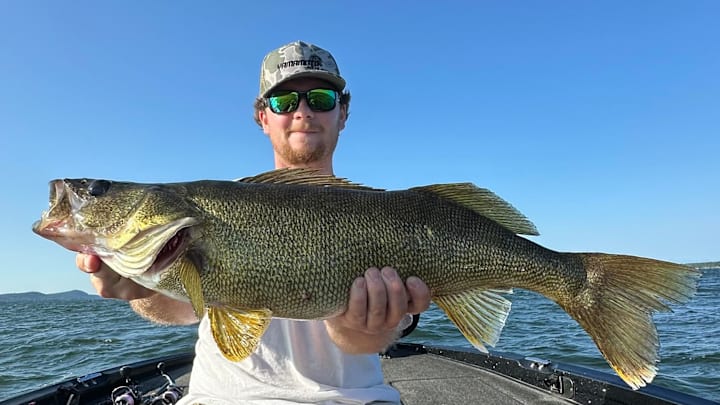
Fall transition walleye fishing can be one of the most challenging times of the year, but also one of the best times to land a trophy walleye. As water temps start to cool and baitfish reposition, walleyes can sense that winter is coming and begin to feed aggressively while they still can. By understanding the subtle seasonal shifts and practicing these simple transitional walleye strategies—from choosing the right lures, to forgetting your preconceived notions, and targeting transition zones—you can dramatically increase your chances of catching your personal best fish right now.
The Difficult Lessons That Led to My Biggest Walleyes
After a lot of time, gas money, and even heartbreak, I’ve dialed in a consistent fall transition bite on the biggest walleyes of my life. This isn’t luck, and it’s not always easy, but it’s repeatable. And when it clicks, these are the fish you dream about.
Walleye (or, Walters as we like to call them) can throw you a curveball as late-summer heads into fall. Fish are scattered. Bait is everywhere. The water is still warm. One day you’re on them, the next day you’re humbled. But remember, there is always a pattern. You just have to be willing to work for it.
Let’s break it down.
Best Locations to Find Walleyes in Early-Fall

First things first: you’re not going to luck into a giant walleye sitting on one spot all day this time. This time of year, the name of the game is movement. Whether you’re fishing a large natural lake, a reservoir, or even a big river system, the big fish are on the move and you have to be too.
I spend more time idling behind the console than casting early in the day. I want to eliminate water and find areas that are actually holding better fish, not just the one random eater you luck into dragging a bottom bouncer.

Use Side Imaging and Smart Mapping to Find Fish

If you’re not running good side imaging this time of year, you’re fishing blind. My setup includes Humminbird MEGA Side Imaging paired with LakeMaster mapping, and that combo is absolutely deadly. Having the VX Premium chip is key to seeing things you've never seen before on mapping.
I’m mainly looking for transition zones: gravel-to-rock edges, isolated boulders, hard-bottom humps, or even subtle depth changes that top out in that 10 to 20 foot range. You’d be shocked how many big walleyes are still holding surprisingly shallow, especially if there’s bait around.
Forward-Facing Sonar for Targeting Giants

You already know this if you’ve used it, but if not, Forward-Facing Sonar (FFS) changes the game.
Once I’ve marked an area that’s holding fish with side scan, I’ll nose in with LiveScope, and this is where things get real. I’m scanning for individual fish or small pods in that 10–20 foot zone.
You’ll often see them hold just off the rock or on top of subtle structure. If they’re positioned right and not stuck on the bottom, you can pitch to them with a jig and plastic or even a glide bait and watch the whole thing play out like a video game. A much heavier presentation than normal seems to get the most inactive fish to react.
Top Lures and Rigs for Fall Transition Walleye Fishing

This time of year, fish are feeding, but they’re selective. The bite windows are often short, and if you’re not throwing walleye baits with the right profile or speed, you’re getting left behind.
Here are the best walleye baits for me right now:
- Small plastic on a heavy jig head -The heavy bait falling by their face often triggers a reaction strike or a least catches their attention. A couple hard rips and they often bite as a reaction. This bait also doubles as a “shaking” minnow if a fish is suspended.
- Jigging spoons or glide baits -(yes, even in late-summer to early-fall) if you’re marking fish tight to the bottom on FFS, these baits can draw fish up and get them to activate. People often put the metal baits up in summer, but I think it could be the best option!
Why Heavy Fluorocarbon Leaders are Best for Big Walleye
This is a small thing that makes a big difference, especially when you're targeting fish over 25 inches. I run at least 15- to 17-lb fluorocarbon leaders, sometimes even 20-lb. You’re fishing around rock, hard bottom, zebra mussels, and toothy fish. Don’t lose the fish of the year because you’re still thinking “they’re going to see it”.
Fluoro is stealthy enough, and if you’re using braided mainline, which I HIGHLY suggest, the shock absorption and abrasion resistance of a heavy fluoro leader gives you a serious edge.
Don’t Overlook Shallow Structure for Trophy Walleye

Everyone thinks late-summer and early-fall walleye are all still deep, but that’s not always true. Some of my biggest fish this year have come in 12 to 16 feet, especially early morning.
They’re on isolated rock humps, inside turns, or even subtle points near feeding flats, especially when bait is pushed up. Don’t ignore shallower structure even if the surface temp still hasn't dropped below 75-degrees. If there’s bait and oxygen, walleyes will be there.
Keep Moving and Stay Sharp for Giant Walleyes

There’s nothing easy about targeting big walleyes heading into the fall transition period. You’re dealing with spread-out fish, short windows, and tons of water to cover. But if you stay mobile, use your electronics to your advantage, and fish confidently with the right gear, you’ll put giants in the boat.
Some of the best fish of the season come right now—when most anglers have packed it in for hunting season or are just out pulling crankbaits hoping for a miracle.
Quick Tips: Mastering the Fall Transition Walleye Bite
- Cover water and eliminate unproductive areas.
- Use side imaging and detailed mapping to efficiently locate transition spots.
- Use small plastic minnows on heavy jigs, jigging spoons, and glide baits.
- Heavy fluorocarbon leaders prevent heartbreak with trophy fish.
- Forward-facing sonar allows you to "snipe" giant loners.
- Don’t forget shallow water, even when surface temps are high.
- Stay mobile, be patient, and expect short feeding windows.
- Don't be surprised if you run into your new personal best!
You Might Also Like These Great Fishing Articles:
 Add us as a preferred source on Google
Kaleb Brown is a tournament angler and recent Lander University graduate who has been competing at the highest levels of collegiate bass fishing for the past five years. Starting his angling journey at age four on Vermont's Connecticut River, Brown quickly developed into one of the sport's most promising young talents, with eight national championship qualifications and a victory at the 2023 Major League Fishing College Fishing Open on Lake Hartwell. With a business degree in hand, pro staff relationships with major fishing brands, and his work as a fishing author published by OnTheWater.com, he now sets his sights on higher level tournaments while pursuing his dream of building a career within the fishing industry. His passion extends beyond bass fishing to include walleye and crappie angling, ice fishing, and even some trout, reflecting a deep love for the sport that has defined his life since childhood.