%22%3E%0A%3Cpath%20fill-rule%3D%22evenodd%22%20clip-rule%3D%22evenodd%22%20d%3D%22M156.868%204.36764C162.691%20-1.45588%20172.132%20-1.45588%20177.956%204.36764C183.779%2010.1912%20183.779%2019.6324%20177.956%2025.4559L167.412%2036L156.868%2025.4559C151.044%2019.6324%20151.044%2010.1912%20156.868%204.36764ZM159.509%207.55761C159.448%207.86849%20159.416%208.39718%20159.416%209.14566V10.4189C159.416%2011.1832%20159.448%2011.7198%20159.513%2012.0267C159.578%2012.3317%20159.778%2012.6168%20160.117%2012.8762C160.456%2013.1376%20160.903%2013.3316%20161.458%2013.4623C162.012%2013.593%20162.6%2013.6584%20163.337%2013.6584C164.073%2013.6584%20164.717%2013.591%20165.269%2013.4524C165.822%2013.3158%20166.261%2013.1178%20166.586%2012.8604C166.911%2012.6029%20167.105%2012.3178%20167.166%2012.0069C167.228%2011.6961%20167.259%2011.1674%20167.259%2010.4189V9.14566C167.259%208.38134%20167.228%207.84473%20167.162%207.53781C167.097%207.23287%20166.897%206.94971%20166.558%206.68834C166.22%206.42696%20165.772%206.23291%20165.218%206.10223C164.663%205.97154%20164.036%205.90619%20163.339%205.90619C162.602%205.90619%20161.959%205.97352%20161.406%206.11213C160.852%206.24875%20160.414%206.44677%20160.089%206.70418C159.765%206.9616%20159.571%207.24673%20159.509%207.55761ZM164.776%2024.8638C168.376%2024.8638%20170.057%2024.2064%20170.057%2021.862V21.858V21.3155C170.057%2019.6581%20169.016%2018.971%20165.752%2018.3136C164.778%2018.1136%20164.408%2017.9136%20164.408%2017.3136V16.9414C164.408%2016.6543%20164.677%2016.5117%20164.913%2016.5117C165.249%2016.5117%20165.418%2016.7137%20165.418%2016.9414V18.1136H169.891V17.3988C169.891%2015.4563%20168.847%2014.4266%20164.677%2014.4266C161.65%2014.4266%20159.396%2015.3414%20159.396%2017.3711V17.7433C159.396%2019.5155%20160.305%2020.3155%20163.701%2021.0303C163.78%2021.0472%20163.855%2021.063%20163.927%2021.0781C164.829%2021.2674%20165.147%2021.3341%20165.147%2021.9174V22.2897C165.147%2022.6619%20165.046%2022.8045%20164.642%2022.8045C164.17%2022.8045%20164.137%2022.5471%20164.137%2022.262V21.2897H159.394V21.7471C159.394%2024.149%20160.976%2024.8638%20164.776%2024.8638ZM170.924%2024.5569H175.425V14.7355H170.924V24.5569ZM172.455%2013.5019H175.425V6.06064H172.592V9.411L170.693%206.06064H167.859V13.5019H170.693V10.1199L172.455%2013.5019ZM163.769%2012.152C163.704%2012.2688%20163.555%2012.3262%20163.325%2012.3262L163.327%2012.3282C163.104%2012.3282%20162.959%2012.2767%20162.898%2012.1758C162.836%2012.0748%20162.805%2011.8074%20162.805%2011.3758V7.90068C162.805%207.51852%20162.852%207.28684%20162.945%207.20962C163.038%207.13239%20163.175%207.09279%20163.351%207.09279C163.559%207.09279%20163.698%207.14031%20163.765%207.23734C163.832%207.33239%20163.866%207.55416%20163.866%207.90068V11.3203C163.866%2011.7579%20163.834%2012.0352%20163.769%2012.152Z%22%20fill%3D%22white%22%2F%3E%0A%3Cpath%20d%3D%22M134.707%2035.9991C129.823%2035.9991%20126.029%2035.0305%20122.478%2033.2547L125.303%2027.7255C127.765%2029.017%20130.227%2029.8242%20133.254%2029.8242C136.684%2029.8242%20138.5%2028.0484%20138.5%2024.9811V24.3354C137.249%2025.7479%20135.191%2027.3623%20132.124%2027.3623C126.433%2027.3623%20122.316%2023.3264%20122.316%2017.2322V17.1515C122.316%2010.9766%20126.514%206.90039%20131.599%206.90039C134.828%206.90039%20136.724%208.11115%20138.339%209.76586V7.42506H147.5V23.8914C147.5%2027.9677%20146.653%2030.7524%20144.635%2032.7704C142.657%2034.748%20139.63%2035.9991%20134.707%2035.9991ZM134.868%2020.6627C137.128%2020.6627%20138.541%2019.1291%20138.541%2017.1919V17.1112C138.541%2015.2143%20137.088%2013.6807%20134.868%2013.6807C132.608%2013.6807%20131.195%2015.2547%20131.195%2017.1919V17.2726C131.195%2019.1695%20132.648%2020.6627%20134.868%2020.6627Z%22%20fill%3D%22white%22%2F%3E%0A%3Cpath%20d%3D%22M96.9492%2029.4629V7.42701H106.111V10.4943C107.523%208.67813%20109.743%206.90234%20112.851%206.90234C117.492%206.90234%20120.398%209.96961%20120.398%2014.9337V29.4629H111.236V17.8799C111.236%2015.9831%20110.106%2014.8934%20108.734%2014.8934C107.362%2014.8934%20106.111%2015.9831%20106.111%2017.8799V29.4629H96.9492Z%22%20fill%3D%22white%22%2F%3E%0A%3Cpath%20d%3D%22M84.8096%205.85202V0H94.2939V5.85202H84.8096ZM84.971%2029.4619V7.42602H94.1324V29.4619H84.971Z%22%20fill%3D%22white%22%2F%3E%0A%3Cpath%20d%3D%22M58.877%2029.4619V0H68.0384V10.3722C69.451%208.55606%2071.6707%206.90135%2074.7783%206.90135C79.4196%206.90135%2082.3254%209.96862%2082.3254%2014.9327V29.4619H73.164V17.8789C73.164%2015.9821%2072.0339%2014.8924%2070.6617%2014.8924C69.2895%2014.8924%2068.0384%2015.9821%2068.0384%2017.8789V29.4619H58.877Z%22%20fill%3D%22white%22%2F%3E%0A%3Cpath%20d%3D%22M47.3991%2029.9876C43.1211%2029.9876%2039.2466%2028.8979%2036.0986%2026.7992L39.2063%2021.5929C41.8699%2023.2477%2044.8565%2024.0548%2047.3587%2024.0548C48.2466%2024.0548%2048.6906%2023.853%2048.6906%2023.3284V23.2477C48.6906%2022.8037%2048.287%2022.5212%2046.0673%2021.9562C40.4977%2020.584%2037.0672%2019.0907%2037.0672%2014.5302V14.4494C37.0672%209.60638%2040.9417%206.90234%2046.6726%206.90234C50.3049%206.90234%2053.8969%207.8306%2056.5605%209.44495L53.6547%2014.8934C51.3139%2013.6019%2048.4888%2012.8351%2046.6323%2012.8351C45.7444%2012.8351%2045.3408%2013.0772%2045.3408%2013.5212V13.6019C45.3408%2014.0458%2045.8251%2014.3284%2048.0448%2014.8934C53.6143%2016.2656%2056.9641%2017.7992%2056.9641%2022.3194V22.4001C56.9641%2027.2028%2053.3722%2029.9876%2047.3991%2029.9876Z%22%20fill%3D%22white%22%2F%3E%0A%3Cpath%20d%3D%22M25.5312%205.85202V0H35.0156V5.85202H25.5312ZM25.6927%2029.4619V7.42602H34.8541V29.4619H25.6927Z%22%20fill%3D%22white%22%2F%3E%0A%3Cpath%20d%3D%22M0%2029.4621V1.21094H23.6503V9.2827H9.44396V12.8746H22.6413V20.2199H9.44396V29.4621H0Z%22%20fill%3D%22white%22%2F%3E%0A%3C%2Fg%3E%0A%3Cdefs%3E%0A%3CclipPath%20id%3D%22clip0_16330_64756%22%3E%0A%3Crect%20width%3D%22182%22%20height%3D%2236%22%20fill%3D%22white%22%2F%3E%0A%3C%2FclipPath%3E%0A%3C%2Fdefs%3E%0A%3C%2Fsvg%3E%0A)
How To Catch Finicky Winter Bluegills: Finesse Tactics for Big Bites
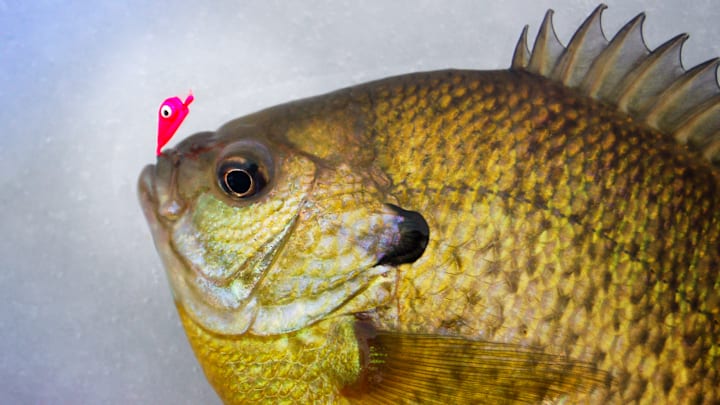
Drop a worm in the water on a summer day and just try to not catch a bluegill. But in winter, sometimes those same big slabs get finicky and only bite best at classic walleye times—dawn and dusk. However, even when targeting bluegills at midday, during a cold front or in mid-winter, there are steps you can take to make those fussy winter ’gills bite.
Downsize Your Gear for Finicky Fish
Downsizing your line size to 2- or 3-pound test … or less … will help. Also, don’t be afraid to downsize your jig as well. The jig’s profile (size and shape) as well as your jigging cadence are things anglers should be cognizant of when dealing with negative or neutral fish.
If you haven’t already, switch to tungsten jigs. Tungsten is denser than lead, so you can use a smaller profile lure but still get down quickly and maintain good feel for your jig. And even though the lure is more dense, fish can still easily suck it in.
Jig profile and jigging cadence are more important than color. Although you can experiment with different colors, switching lure size and jigging speed is often the ticket.
It may seem simplistic, but go with a bait you’re confident with. Some anglers prefer to tip their jigs with spikes or waxies, while others choose soft plastics.
Mastering the Art of Finesse Jigging
Pay attention to the way you jig as well. Don’t jig aggressively. In fact, barely moving your jig may be necessary if fish won’t cooperate.
If you can, keep your jig quivering without actually jigging it up and down. Subtle movement is what attracts fish in the first place. All too often anglers stop the lure, giving the fish a chance to strike, when doing so may actually keep the fish from biting. This is especially true if your lure spins when held motionless, as is often the case when using a spinning reel.

This is where inline ice reels really shine. Unlike spinning reels, they won’t impart spin to your lure, which makes your presentation look much more natural. However, if you do use a spinning reel, the constant quivering should prevent the lure from twisting around in a circle. If you’re not sure, just drop your lure into the water a foot or two and watch what happens to your lure if you stop jigging. A spinning lure is a sure way to keep finicky fish from biting. You could also attach a ball bearing swivel a foot above your jig to mitigate line twist.
Using a spring bobber not only helps you see subtle strikes; it also mitigates some of the movements you make, keeping your jig more still.
A spring bobber can also reveal an “up” bite. That’s when a fish sucks in your jig, and the only indication is the spring bobber actually rises because the act of the fish biting negates the weight of the jig hanging from the rod tip. Sometimes the line will “flicker” at the point where it enters the water – another sign of a subtle bite.

If you wait to feel the classic “thump” of a fish hitting your jig, you’ll miss a lot of subtle bluegill bites. Finicky ’gills will suck in and spit out your jig so fast they don’t hook themselves.
Watch your electronics, or if the water is clear and shallow, simply peer down the hole to see how fish react to your presentation and mix it up until you get bit.
How Water Clarity Guides the Best Approach
Water clarity plays a factor in catching fish, too. At first ice, when fish are shallow and the ice is thin and clear, it’s easy to spook fish. Fish on snow patches to conceal yourself. Stay quiet and don’t move around a lot. When the water is clear, fish may come in from 20 yards away. However, on stained waters, you may have to drop your jig right on a fish’s nose to get bit. In that case, once you’ve found a productive area, drill holes every few feet in order to catch fish.
Reading the Fish’s Reaction
Here’s a good approach to catching finicky bluegills. First, feather your bait down slowly to draw attention. When fish are biting, they may rush to the lure and you’ll mark them on your electronics shortly after your jig reaches bottom. If not, you may have to work them to get bit. If the fish doesn’t bite, right away shake the jig in front of the fish. If it doesn’t bite in a couple seconds, move it away from the fish. Raise it up to see how far it’ll come up. If it won’t come up or react to your lure, subtly quiver the jig just slightly above the fish. If this doesn’t work after a minute or two, move to a new hole.
When to Stay Put vs. Move Around
If you are mobile, you may be able to grind out a few willing biters, even on a tough day. Keep your equipment organized and lightweight so you’re more willing to move. Also, dress properly. Anglers who are cold won’t be willing to move around and will tend to stay in a heated shack in one spot.
However, there are times when it pays to stay put. Sometimes fish just cycle through an area. You may catch a few, then go several minutes before a new school arrives. This is particularly true when fishing away from structure, such as in a deep basin. Then you may actually be better off to wait them out.

Putting the Pieces Together for Ice Fishing Bluegill Success
If the big ’gills refuse your offering this winter, remember these tips: downsize your line and lure size, keep your jigging stroke subtle, use a spring bobber and watch your line to detect light bites and pay attention to how fish react to your presentation. Make the right adjustments and you just might coerce more slabs into striking.
READ NEXT:
Big Baits for Big Crappies: Catching Winter Slabs with Lipless Crankbaits

Ice Fishing Success in Tough Conditions: 4 Easy Tips for Detecting Light Bites

 Add us as a preferred source on Google
Joe Shead is an accomplished outdoor writer, hunter, fishing guide and multi-species angler from Minnesota who will fish for anything, even if it won’t bite. Check out more of his work at goshedhunting.com and superiorexperiencecharters.com.