%22%3E%0A%3Cpath%20fill-rule%3D%22evenodd%22%20clip-rule%3D%22evenodd%22%20d%3D%22M156.868%204.36764C162.691%20-1.45588%20172.132%20-1.45588%20177.956%204.36764C183.779%2010.1912%20183.779%2019.6324%20177.956%2025.4559L167.412%2036L156.868%2025.4559C151.044%2019.6324%20151.044%2010.1912%20156.868%204.36764ZM159.509%207.55761C159.448%207.86849%20159.416%208.39718%20159.416%209.14566V10.4189C159.416%2011.1832%20159.448%2011.7198%20159.513%2012.0267C159.578%2012.3317%20159.778%2012.6168%20160.117%2012.8762C160.456%2013.1376%20160.903%2013.3316%20161.458%2013.4623C162.012%2013.593%20162.6%2013.6584%20163.337%2013.6584C164.073%2013.6584%20164.717%2013.591%20165.269%2013.4524C165.822%2013.3158%20166.261%2013.1178%20166.586%2012.8604C166.911%2012.6029%20167.105%2012.3178%20167.166%2012.0069C167.228%2011.6961%20167.259%2011.1674%20167.259%2010.4189V9.14566C167.259%208.38134%20167.228%207.84473%20167.162%207.53781C167.097%207.23287%20166.897%206.94971%20166.558%206.68834C166.22%206.42696%20165.772%206.23291%20165.218%206.10223C164.663%205.97154%20164.036%205.90619%20163.339%205.90619C162.602%205.90619%20161.959%205.97352%20161.406%206.11213C160.852%206.24875%20160.414%206.44677%20160.089%206.70418C159.765%206.9616%20159.571%207.24673%20159.509%207.55761ZM164.776%2024.8638C168.376%2024.8638%20170.057%2024.2064%20170.057%2021.862V21.858V21.3155C170.057%2019.6581%20169.016%2018.971%20165.752%2018.3136C164.778%2018.1136%20164.408%2017.9136%20164.408%2017.3136V16.9414C164.408%2016.6543%20164.677%2016.5117%20164.913%2016.5117C165.249%2016.5117%20165.418%2016.7137%20165.418%2016.9414V18.1136H169.891V17.3988C169.891%2015.4563%20168.847%2014.4266%20164.677%2014.4266C161.65%2014.4266%20159.396%2015.3414%20159.396%2017.3711V17.7433C159.396%2019.5155%20160.305%2020.3155%20163.701%2021.0303C163.78%2021.0472%20163.855%2021.063%20163.927%2021.0781C164.829%2021.2674%20165.147%2021.3341%20165.147%2021.9174V22.2897C165.147%2022.6619%20165.046%2022.8045%20164.642%2022.8045C164.17%2022.8045%20164.137%2022.5471%20164.137%2022.262V21.2897H159.394V21.7471C159.394%2024.149%20160.976%2024.8638%20164.776%2024.8638ZM170.924%2024.5569H175.425V14.7355H170.924V24.5569ZM172.455%2013.5019H175.425V6.06064H172.592V9.411L170.693%206.06064H167.859V13.5019H170.693V10.1199L172.455%2013.5019ZM163.769%2012.152C163.704%2012.2688%20163.555%2012.3262%20163.325%2012.3262L163.327%2012.3282C163.104%2012.3282%20162.959%2012.2767%20162.898%2012.1758C162.836%2012.0748%20162.805%2011.8074%20162.805%2011.3758V7.90068C162.805%207.51852%20162.852%207.28684%20162.945%207.20962C163.038%207.13239%20163.175%207.09279%20163.351%207.09279C163.559%207.09279%20163.698%207.14031%20163.765%207.23734C163.832%207.33239%20163.866%207.55416%20163.866%207.90068V11.3203C163.866%2011.7579%20163.834%2012.0352%20163.769%2012.152Z%22%20fill%3D%22white%22%2F%3E%0A%3Cpath%20d%3D%22M134.707%2035.9991C129.823%2035.9991%20126.029%2035.0305%20122.478%2033.2547L125.303%2027.7255C127.765%2029.017%20130.227%2029.8242%20133.254%2029.8242C136.684%2029.8242%20138.5%2028.0484%20138.5%2024.9811V24.3354C137.249%2025.7479%20135.191%2027.3623%20132.124%2027.3623C126.433%2027.3623%20122.316%2023.3264%20122.316%2017.2322V17.1515C122.316%2010.9766%20126.514%206.90039%20131.599%206.90039C134.828%206.90039%20136.724%208.11115%20138.339%209.76586V7.42506H147.5V23.8914C147.5%2027.9677%20146.653%2030.7524%20144.635%2032.7704C142.657%2034.748%20139.63%2035.9991%20134.707%2035.9991ZM134.868%2020.6627C137.128%2020.6627%20138.541%2019.1291%20138.541%2017.1919V17.1112C138.541%2015.2143%20137.088%2013.6807%20134.868%2013.6807C132.608%2013.6807%20131.195%2015.2547%20131.195%2017.1919V17.2726C131.195%2019.1695%20132.648%2020.6627%20134.868%2020.6627Z%22%20fill%3D%22white%22%2F%3E%0A%3Cpath%20d%3D%22M96.9492%2029.4629V7.42701H106.111V10.4943C107.523%208.67813%20109.743%206.90234%20112.851%206.90234C117.492%206.90234%20120.398%209.96961%20120.398%2014.9337V29.4629H111.236V17.8799C111.236%2015.9831%20110.106%2014.8934%20108.734%2014.8934C107.362%2014.8934%20106.111%2015.9831%20106.111%2017.8799V29.4629H96.9492Z%22%20fill%3D%22white%22%2F%3E%0A%3Cpath%20d%3D%22M84.8096%205.85202V0H94.2939V5.85202H84.8096ZM84.971%2029.4619V7.42602H94.1324V29.4619H84.971Z%22%20fill%3D%22white%22%2F%3E%0A%3Cpath%20d%3D%22M58.877%2029.4619V0H68.0384V10.3722C69.451%208.55606%2071.6707%206.90135%2074.7783%206.90135C79.4196%206.90135%2082.3254%209.96862%2082.3254%2014.9327V29.4619H73.164V17.8789C73.164%2015.9821%2072.0339%2014.8924%2070.6617%2014.8924C69.2895%2014.8924%2068.0384%2015.9821%2068.0384%2017.8789V29.4619H58.877Z%22%20fill%3D%22white%22%2F%3E%0A%3Cpath%20d%3D%22M47.3991%2029.9876C43.1211%2029.9876%2039.2466%2028.8979%2036.0986%2026.7992L39.2063%2021.5929C41.8699%2023.2477%2044.8565%2024.0548%2047.3587%2024.0548C48.2466%2024.0548%2048.6906%2023.853%2048.6906%2023.3284V23.2477C48.6906%2022.8037%2048.287%2022.5212%2046.0673%2021.9562C40.4977%2020.584%2037.0672%2019.0907%2037.0672%2014.5302V14.4494C37.0672%209.60638%2040.9417%206.90234%2046.6726%206.90234C50.3049%206.90234%2053.8969%207.8306%2056.5605%209.44495L53.6547%2014.8934C51.3139%2013.6019%2048.4888%2012.8351%2046.6323%2012.8351C45.7444%2012.8351%2045.3408%2013.0772%2045.3408%2013.5212V13.6019C45.3408%2014.0458%2045.8251%2014.3284%2048.0448%2014.8934C53.6143%2016.2656%2056.9641%2017.7992%2056.9641%2022.3194V22.4001C56.9641%2027.2028%2053.3722%2029.9876%2047.3991%2029.9876Z%22%20fill%3D%22white%22%2F%3E%0A%3Cpath%20d%3D%22M25.5312%205.85202V0H35.0156V5.85202H25.5312ZM25.6927%2029.4619V7.42602H34.8541V29.4619H25.6927Z%22%20fill%3D%22white%22%2F%3E%0A%3Cpath%20d%3D%22M0%2029.4621V1.21094H23.6503V9.2827H9.44396V12.8746H22.6413V20.2199H9.44396V29.4621H0Z%22%20fill%3D%22white%22%2F%3E%0A%3C%2Fg%3E%0A%3Cdefs%3E%0A%3CclipPath%20id%3D%22clip0_16330_64756%22%3E%0A%3Crect%20width%3D%22182%22%20height%3D%2236%22%20fill%3D%22white%22%2F%3E%0A%3C%2FclipPath%3E%0A%3C%2Fdefs%3E%0A%3C%2Fsvg%3E%0A)
How to Tie the 3 Fishing Knots Every Angler Needs
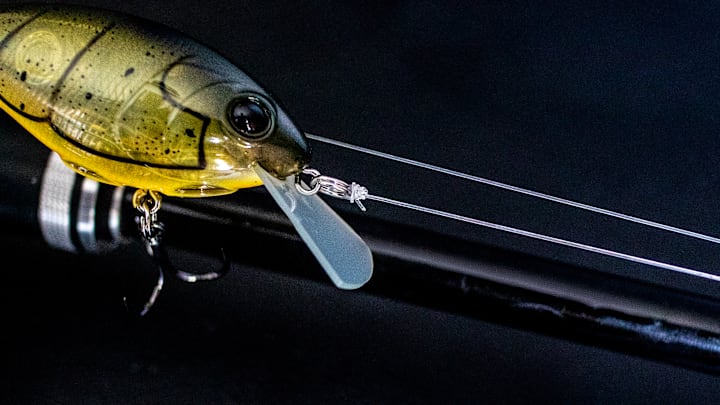
Why Strong Knots Matter
You don't have to have the knot knowledge of a Navy veteran to fish, but knowing a few basic knots will keep your fishing lures tied on securely and your lines tight. A strong knot could also make the difference between landing the fish of a lifetime and heartbreak!
How to Tie an Improved Clinch Knot
The improved clinch knot has long been the standard for tying lures to fishing lines. In fact, it's so universal among anglers that it's sometimes called the fisherman's knot. It's easy to learn, reasonably strong and won't slip.
Step 1. Begin by threading the line through the hook eye.

Step 2. Wrap the tag end around the main line six times.

Step 3. Pass the tag end through the loop created just above the hook eye and then through the larger loop created after you completed your final wrap around the standing line.

Step 4. Moisten the knot to reduce friction. Snug by pulling the tag end. Then pull the main line while holding the lure. The coils of the knot will seat snugly against the hook eye. Trim the tag end.

Once you’ve mastered the Improved Clinch knot, the next one to learn, the Palomar knot, is nearly as easy to tie and very useful.
How to Tie a Palomar Knot
The Palomar knot is super simple to tie with a little practice. The Palomar isn’t recommended for fluorocarbon line, but it works great with monofilament and is a go-to for braided line.
Step 1. Double up your line and thread it through the eye of the hook, split ring or swivel. Run the line back next to itself so you have about 3 or 4 inches of doubled line. Slide the eye of the hook to the middle of the doubled line.

Step 2. Tie an overhand knot in the doubled line and slide it down loosely to the eye of the hook.

Step 3. Now take the long loop (not the one you just slid to the hook eye; the one in the standing line) and pass it over the hook, swivel or lure. (You would need to start with more than 3 inches of doubled line to pass it over a large lure).

Step 4. Pull the loop over the hook and beyond the eye back to the main line. Then moisten and snug up the knot. Trim the tag end.

You've learned a couple of the best knots for attaching a lure to your line, so now you need the Arbor Knot to attach your fishing line to your reel.
How to Tie an Arbor Knot
The arbor knot is useful for tying your fishing line to your reel spool, and it works equally well for spinning, baitcating, or even spincast reels.
Step 1. Wrap your line around the spool. Leave a tag end of about 3 or 4 inches.

Step 2. Tie a loose overhand knot around the main line (not just the spool, but the standing line). Leave it tied loosely for now.

Step 3. Tie another overhand knot in the remaining tag end and cinch it down tight.

Step 4. Tighten that first overhand knot then pull on the main line. The knots will slide together and jam on the spool. Trim the tag end.

Practice Makes Perfect
Fishing knots go mostly unnoticed, but if not tied correctly, they can ruin your fishing success. Whether you’re using 2 lb. test mono for bluegills or chasing trophy muskies with 80 lb. braid, don’t let the knot be your weakest link. Practice these three basic knots until they become second nature. And with these three knots as your foundation, you'll find it easier to learn any of the more advanced or specialized knots that can widen your skill set and improve your fishing success.
Fishing Knot FAQs: Quick Answers Every Angler Should Know
Q1: What are the three primary fishing knots every angler should know?
A1: A perfect starting point for all anglers tying fishing knots are the Improved Clinch Knot, Palomar Knot, and Arbor Knot. Together they cover a wide range of fishing scenarios, are fairly easy to tie, and hold securely.
Q2: What is the easiest fishing knot to tie?
A2: The Improved Clinch Knot is often the first knot beginners learn. It’s quick to learn, holds securely when tied correctly, and works well with monofilament, braid or fluorocarbon lines.
Q3: What is the strongest fishing knot?
A3: The Palomar Knot is well known as one of the strongest all-around fishing knots. Its double line wrap design provides excellent strength and almost never slips, even from shocking jolts of energy on a hookset or heavy pressure from a big fish.
Q4: What is the Arbor Knot used for?
A4: The Arbor Knot is used to attach fishing line to the spool of your reel. It’s very simple but very clever by design. It just gets tighter and tighter the harder you pull. Without it, your line could spin freely on the spool, reducing your pulling power when fighting a big fish.
Q5: How can I keep fishing knots from slipping or breaking?
A5: Always moisten your line before cinching a knot, otherwise the friction of the knots coils could damage and weaken your main line. Tighten knots smoothly and evenly, while trying to keep coils of line neat and organized as they cinch down.
Q6: What type of fishing line works best with these knots?
A6: The Improved Clinch and the Arbor work great with mono, fluoro, or braid. The Palomar isn’t recommended for fluoro because the double wraps will cut into themselves. But the Palomar is a go-to for braided lines.
You Might Also Like These Fishing Stories:
 Add us as a preferred source on Google
Joe Shead is an accomplished outdoor writer, hunter, fishing guide and multi-species angler from Minnesota who will fish for anything, even if it won’t bite. Check out more of his work at goshedhunting.com and superiorexperiencecharters.com.