%22%3E%0A%3Cpath%20fill-rule%3D%22evenodd%22%20clip-rule%3D%22evenodd%22%20d%3D%22M156.868%204.36764C162.691%20-1.45588%20172.132%20-1.45588%20177.956%204.36764C183.779%2010.1912%20183.779%2019.6324%20177.956%2025.4559L167.412%2036L156.868%2025.4559C151.044%2019.6324%20151.044%2010.1912%20156.868%204.36764ZM159.509%207.55761C159.448%207.86849%20159.416%208.39718%20159.416%209.14566V10.4189C159.416%2011.1832%20159.448%2011.7198%20159.513%2012.0267C159.578%2012.3317%20159.778%2012.6168%20160.117%2012.8762C160.456%2013.1376%20160.903%2013.3316%20161.458%2013.4623C162.012%2013.593%20162.6%2013.6584%20163.337%2013.6584C164.073%2013.6584%20164.717%2013.591%20165.269%2013.4524C165.822%2013.3158%20166.261%2013.1178%20166.586%2012.8604C166.911%2012.6029%20167.105%2012.3178%20167.166%2012.0069C167.228%2011.6961%20167.259%2011.1674%20167.259%2010.4189V9.14566C167.259%208.38134%20167.228%207.84473%20167.162%207.53781C167.097%207.23287%20166.897%206.94971%20166.558%206.68834C166.22%206.42696%20165.772%206.23291%20165.218%206.10223C164.663%205.97154%20164.036%205.90619%20163.339%205.90619C162.602%205.90619%20161.959%205.97352%20161.406%206.11213C160.852%206.24875%20160.414%206.44677%20160.089%206.70418C159.765%206.9616%20159.571%207.24673%20159.509%207.55761ZM164.776%2024.8638C168.376%2024.8638%20170.057%2024.2064%20170.057%2021.862V21.858V21.3155C170.057%2019.6581%20169.016%2018.971%20165.752%2018.3136C164.778%2018.1136%20164.408%2017.9136%20164.408%2017.3136V16.9414C164.408%2016.6543%20164.677%2016.5117%20164.913%2016.5117C165.249%2016.5117%20165.418%2016.7137%20165.418%2016.9414V18.1136H169.891V17.3988C169.891%2015.4563%20168.847%2014.4266%20164.677%2014.4266C161.65%2014.4266%20159.396%2015.3414%20159.396%2017.3711V17.7433C159.396%2019.5155%20160.305%2020.3155%20163.701%2021.0303C163.78%2021.0472%20163.855%2021.063%20163.927%2021.0781C164.829%2021.2674%20165.147%2021.3341%20165.147%2021.9174V22.2897C165.147%2022.6619%20165.046%2022.8045%20164.642%2022.8045C164.17%2022.8045%20164.137%2022.5471%20164.137%2022.262V21.2897H159.394V21.7471C159.394%2024.149%20160.976%2024.8638%20164.776%2024.8638ZM170.924%2024.5569H175.425V14.7355H170.924V24.5569ZM172.455%2013.5019H175.425V6.06064H172.592V9.411L170.693%206.06064H167.859V13.5019H170.693V10.1199L172.455%2013.5019ZM163.769%2012.152C163.704%2012.2688%20163.555%2012.3262%20163.325%2012.3262L163.327%2012.3282C163.104%2012.3282%20162.959%2012.2767%20162.898%2012.1758C162.836%2012.0748%20162.805%2011.8074%20162.805%2011.3758V7.90068C162.805%207.51852%20162.852%207.28684%20162.945%207.20962C163.038%207.13239%20163.175%207.09279%20163.351%207.09279C163.559%207.09279%20163.698%207.14031%20163.765%207.23734C163.832%207.33239%20163.866%207.55416%20163.866%207.90068V11.3203C163.866%2011.7579%20163.834%2012.0352%20163.769%2012.152Z%22%20fill%3D%22white%22%2F%3E%0A%3Cpath%20d%3D%22M134.707%2035.9991C129.823%2035.9991%20126.029%2035.0305%20122.478%2033.2547L125.303%2027.7255C127.765%2029.017%20130.227%2029.8242%20133.254%2029.8242C136.684%2029.8242%20138.5%2028.0484%20138.5%2024.9811V24.3354C137.249%2025.7479%20135.191%2027.3623%20132.124%2027.3623C126.433%2027.3623%20122.316%2023.3264%20122.316%2017.2322V17.1515C122.316%2010.9766%20126.514%206.90039%20131.599%206.90039C134.828%206.90039%20136.724%208.11115%20138.339%209.76586V7.42506H147.5V23.8914C147.5%2027.9677%20146.653%2030.7524%20144.635%2032.7704C142.657%2034.748%20139.63%2035.9991%20134.707%2035.9991ZM134.868%2020.6627C137.128%2020.6627%20138.541%2019.1291%20138.541%2017.1919V17.1112C138.541%2015.2143%20137.088%2013.6807%20134.868%2013.6807C132.608%2013.6807%20131.195%2015.2547%20131.195%2017.1919V17.2726C131.195%2019.1695%20132.648%2020.6627%20134.868%2020.6627Z%22%20fill%3D%22white%22%2F%3E%0A%3Cpath%20d%3D%22M96.9492%2029.4629V7.42701H106.111V10.4943C107.523%208.67813%20109.743%206.90234%20112.851%206.90234C117.492%206.90234%20120.398%209.96961%20120.398%2014.9337V29.4629H111.236V17.8799C111.236%2015.9831%20110.106%2014.8934%20108.734%2014.8934C107.362%2014.8934%20106.111%2015.9831%20106.111%2017.8799V29.4629H96.9492Z%22%20fill%3D%22white%22%2F%3E%0A%3Cpath%20d%3D%22M84.8096%205.85202V0H94.2939V5.85202H84.8096ZM84.971%2029.4619V7.42602H94.1324V29.4619H84.971Z%22%20fill%3D%22white%22%2F%3E%0A%3Cpath%20d%3D%22M58.877%2029.4619V0H68.0384V10.3722C69.451%208.55606%2071.6707%206.90135%2074.7783%206.90135C79.4196%206.90135%2082.3254%209.96862%2082.3254%2014.9327V29.4619H73.164V17.8789C73.164%2015.9821%2072.0339%2014.8924%2070.6617%2014.8924C69.2895%2014.8924%2068.0384%2015.9821%2068.0384%2017.8789V29.4619H58.877Z%22%20fill%3D%22white%22%2F%3E%0A%3Cpath%20d%3D%22M47.3991%2029.9876C43.1211%2029.9876%2039.2466%2028.8979%2036.0986%2026.7992L39.2063%2021.5929C41.8699%2023.2477%2044.8565%2024.0548%2047.3587%2024.0548C48.2466%2024.0548%2048.6906%2023.853%2048.6906%2023.3284V23.2477C48.6906%2022.8037%2048.287%2022.5212%2046.0673%2021.9562C40.4977%2020.584%2037.0672%2019.0907%2037.0672%2014.5302V14.4494C37.0672%209.60638%2040.9417%206.90234%2046.6726%206.90234C50.3049%206.90234%2053.8969%207.8306%2056.5605%209.44495L53.6547%2014.8934C51.3139%2013.6019%2048.4888%2012.8351%2046.6323%2012.8351C45.7444%2012.8351%2045.3408%2013.0772%2045.3408%2013.5212V13.6019C45.3408%2014.0458%2045.8251%2014.3284%2048.0448%2014.8934C53.6143%2016.2656%2056.9641%2017.7992%2056.9641%2022.3194V22.4001C56.9641%2027.2028%2053.3722%2029.9876%2047.3991%2029.9876Z%22%20fill%3D%22white%22%2F%3E%0A%3Cpath%20d%3D%22M25.5312%205.85202V0H35.0156V5.85202H25.5312ZM25.6927%2029.4619V7.42602H34.8541V29.4619H25.6927Z%22%20fill%3D%22white%22%2F%3E%0A%3Cpath%20d%3D%22M0%2029.4621V1.21094H23.6503V9.2827H9.44396V12.8746H22.6413V20.2199H9.44396V29.4621H0Z%22%20fill%3D%22white%22%2F%3E%0A%3C%2Fg%3E%0A%3Cdefs%3E%0A%3CclipPath%20id%3D%22clip0_16330_64756%22%3E%0A%3Crect%20width%3D%22182%22%20height%3D%2236%22%20fill%3D%22white%22%2F%3E%0A%3C%2FclipPath%3E%0A%3C%2Fdefs%3E%0A%3C%2Fsvg%3E%0A)
Ice Fishing on a Budget: Affordable Tips for Beginners
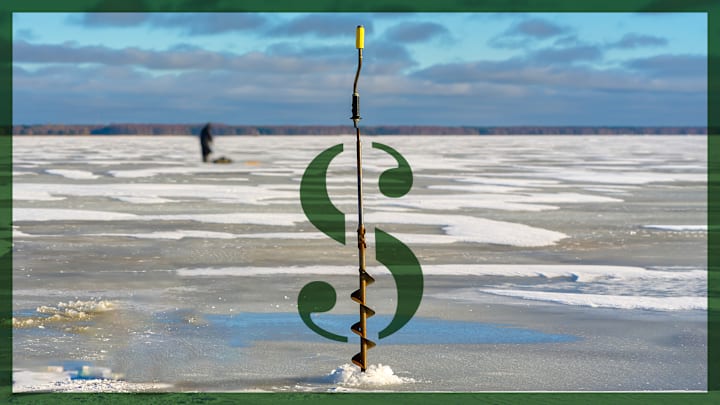
Why Ice Fishing Doesn’t Have to Be Expensive
If you're new to ice fishing, the amount of specialized gear some anglers use can be daunting. Couple that with the cost of a new auger, electronics, perhaps a snowmobile or ATV, or even an RV-style crank-down fish house and a truck to pull it all with, and a lot of people may be pushed right out of the sport.
But it doesn't have to be that way. Yes, ice fishing requires different gear than open-water fishing, but you don't need to break the bank to get started in this fun and exciting sport. Here are some tips on how to break in on a budget.
Table of Contents
- Why Ice Fishing Doesn’t Have to Be Expensive
- Choosing the Right Lake for Budget Ice Fishing
- Beginner Tips to Start Catching Fish Through the Ice
- Affordable Gear Options: Augers, Electronics, and Rods
- The Rest of the Ice Gear
- You Can Get Started Ice Fishing On Less Than $500
Choosing the Right Lake for Budget Ice Fishing
If you're on a budget, choose a small, shallow lake to fish. Then you won't need a snowmobile or ATV to drive great distances across the ice. Look at a lake map on your Department of Natural Resources website and try to triangulate your position between houses, points or other features when you get to the lake. Or check out Google Earth. Shallow areas of the lake may appear brown or green, indicating weeds, while deeper areas appear blue.

Beginner Tips to Start Catching Fish Through the Ice
If you're on a lake that's 10 feet deep or less with little structure, such as a millpond, you can probably get by without electronics or maps. In this case, just fish shallow structure like weeds. You'll likely find northern pike here, along with perch and bluegills. If there's a 10-foot hole in a lake that's otherwise 5 feet deep, you can probably find crappies in the hole.
Assuming multiple lines are legal (check your state's regulations), string a few tip-ups baited with suckers or shiners just above the weeds. In a 5-foot lake, that may mean you're literally fishing just under the ice and that's fine. Pike will grab your minnows if they can see them.
For panfish, hole hop with an ultralight rod with a small jig and a waxworm. Outfit your rod with a spring bobber to detect light bites. If the water is clear and shallow, you may be able to watch fish react to your jig.
Affordable Gear Options: Augers, Electronics, and Rods
Ice Chisel
Before you can pull a fish through the ice, you have to create a hole through it. I started out with just a chisel way back in the Stone Age of ice fishing in the 1980s. It took forever to chop a hole, especially as the ice grew thick, and if I was finally able to chop one, I stayed put and didn't punch any more.
Hand Ice Auger
My world was revolutionized with the simple addition of a hand auger. Suddenly, I had the ability to cut multiple holes, move around and find fish. Today, few people use hand augers and I see them all the time for $5 at garage sales.
But I will say this: a good, sharp hand auger is a formidable tool. In fact, I used to race people: my hand auger versus their power auger. No, I never beat anyone drilling a hole with my hand auger, but if the auger is SHARP and there's only a foot of ice, I was never far behind. If you buy a hand auger at a garage sale, either sharpen the blades or buy a new set. There's a trick to sharpening. You have to get just the right angle. A dull auger is miserable. It won't cut well and you'll be lucky to punch a hole or two. But a sharp auger cuts like a dream.

Power Drill with Auger Adapter
Another cheap option is to use a battery-powered drill with an auger attachment. You may already have a rechargeable lithium-ion drill at home. You can buy an auger to fit in your drill, such as the Lite-Flite Lazer™ Drill by StrikeMaster. Suddenly you have an affordable and lightweight option to punch holes.
Used Gas Powered Ice Auger
Another consideration is finding a used gas-powered auger. The trend these days is toward electric augers, so you may be able to find an unwanted gas model that runs just fine on Facebook Marketplace or Craigslist.
Fishing Apps
An app that shows the lake's contours and your position on the lake is invaluable. Check out Navionics Boating or onX Fish. Knowing where you are in relation to structure is a real game changer.
Sonar Flasher
Sonar electronics are expensive. But they will greatly enhance your fishing experience. In my opinion, they are worth the price. A flasher unit is another tool that I would argue is worth the money. A no-frills Vexilar FL-8 runs about $300 brand new, but again, the used market is a good place to shop. You can usually find units in the $150 to $200 range, especially if you shop during the off-season when there's less demand. They are worth the money and they last a long time. I've been using my first Vexilar for 18 years and it's still running.
With a flasher, you can see your bait, watch fish appear and observe how they react to your presentation. Probably the greatest benefit is just knowing whether there are fish below you. Before I had electronics, I would sit in the same spot, just hoping a fish would come, or varying my jigging, thinking perhaps they didn't like my presentation. With a flasher, you can quickly determine there are no fish present and move.
Ice Shack
Rounding out the big-ticket items is a portable ice house. It’s not even necessary if it’s a warm day. But when it’s chilly it makes fishing tolerable. Hub-style shacks are probably the cheapest option, starting around $100 brand new, but again, you can do better on the used market. And a heater won’t set you back too badly. I’ve found multiple sunflower heater heads at garage sales for $5 apiece. Swipe the 20-pound propane tank from your gas grill, screw on the heater and you’re all set.
The Rest of the Ice Gear
Okay, springing for an auger, electronics and a shack can set you back a little. But it gets cheaper from there.
Ice Rod and Reel
Obviously, you need an ice fishing rod. Go with an ultralight or medium-light rod for panfish and a medium for walleye-sized quarry. A spinning reel is fine and you can even steal the reel off your open-water rod if you want. Ice rod and reel combos are pretty affordable, but again, if you go the garage sale route, you can probably equip yourself for $5 to $10. Or you can buy an inexpensive new combo starting around $30.
Ice Fishing Tackle
To complement your rod, you’ll need some tackle. An assortment of small jigs is perfect for panfish. Add a few spoons for pike and walleyes and you’re all set. Get a small tackle box to store it all in. You can probably get a dozen jigs, a half dozen spoons and a tackle box for $50. Throw in a few soft-plastic baits to tip the panfish jigs and you won’t have to buy live bait. Or, pick the galls off goldenrod plants and carefully cut them open to reveal a small larva inside and you’ve got free bait.
Tip-ups
Tip-ups are a good addition to your fleet as well. They allow you to set out more lines and cover more water. And they are highly effective tools for catching northern pike and walleyes. In the Ice Belt, you can get them for $5 at garage sales. And some of the cheaper models like the HT Polar tip-up only retail for about $10 to $12 anyway. For my money, the Polar tip-up is a great tip-up at a great price.

Live Bait
You’ll need bait for your tip-ups. A dozen suckers or shiners will run $5 to $10, but it’s money well spent to put more fish on the ice.
The Rest of Your Ice Fishing Gear
Completing the gear list is an ice scooper and a 5-gallon bucket in which to haul your gear. It also doubles as a seat. You’ll also want a sled in which to pull your gear. High-sided ice fishing sleds are nice, but pricey. A cheap plastic kids sled will work, although your gear my tip over at times. I got by with my grandma’s old toboggan for a few years. Stuff fell off pretty much every trip. But it was free so I didn’t complain.
You Can Get Started Ice Fishing On Less Than $500
If you did things totally on the cheap, you could probably get on the ice for $500 or less, with your biggest expenditure being electronics. Use a hand auger for a season and decide whether you want to pursue ice angling. Or go in with a buddy on some of the more expensive gear, like an auger and a shack.
Yeah, the guys with all the toys may have a leg up on you when it comes to finding fish. But the fish don’t care if your gear costs $5 or $5,000. All you have to do is get them to bite.
MORE LIKE THIS:
Why Crappies Go Deep in Winter: Understanding Seasonal Fishing Patterns
Top 4 Proven Tricks to Make Winter Fish Bite: Ice Fishing Tips for Perch, Crappie, and More


 Add us as a preferred source on Google
Joe Shead is an accomplished outdoor writer, hunter, fishing guide and multi-species angler from Minnesota who will fish for anything, even if it won’t bite. Check out more of his work at goshedhunting.com and superiorexperiencecharters.com.