%22%3E%0A%3Cpath%20fill-rule%3D%22evenodd%22%20clip-rule%3D%22evenodd%22%20d%3D%22M156.868%204.36764C162.691%20-1.45588%20172.132%20-1.45588%20177.956%204.36764C183.779%2010.1912%20183.779%2019.6324%20177.956%2025.4559L167.412%2036L156.868%2025.4559C151.044%2019.6324%20151.044%2010.1912%20156.868%204.36764ZM159.509%207.55761C159.448%207.86849%20159.416%208.39718%20159.416%209.14566V10.4189C159.416%2011.1832%20159.448%2011.7198%20159.513%2012.0267C159.578%2012.3317%20159.778%2012.6168%20160.117%2012.8762C160.456%2013.1376%20160.903%2013.3316%20161.458%2013.4623C162.012%2013.593%20162.6%2013.6584%20163.337%2013.6584C164.073%2013.6584%20164.717%2013.591%20165.269%2013.4524C165.822%2013.3158%20166.261%2013.1178%20166.586%2012.8604C166.911%2012.6029%20167.105%2012.3178%20167.166%2012.0069C167.228%2011.6961%20167.259%2011.1674%20167.259%2010.4189V9.14566C167.259%208.38134%20167.228%207.84473%20167.162%207.53781C167.097%207.23287%20166.897%206.94971%20166.558%206.68834C166.22%206.42696%20165.772%206.23291%20165.218%206.10223C164.663%205.97154%20164.036%205.90619%20163.339%205.90619C162.602%205.90619%20161.959%205.97352%20161.406%206.11213C160.852%206.24875%20160.414%206.44677%20160.089%206.70418C159.765%206.9616%20159.571%207.24673%20159.509%207.55761ZM164.776%2024.8638C168.376%2024.8638%20170.057%2024.2064%20170.057%2021.862V21.858V21.3155C170.057%2019.6581%20169.016%2018.971%20165.752%2018.3136C164.778%2018.1136%20164.408%2017.9136%20164.408%2017.3136V16.9414C164.408%2016.6543%20164.677%2016.5117%20164.913%2016.5117C165.249%2016.5117%20165.418%2016.7137%20165.418%2016.9414V18.1136H169.891V17.3988C169.891%2015.4563%20168.847%2014.4266%20164.677%2014.4266C161.65%2014.4266%20159.396%2015.3414%20159.396%2017.3711V17.7433C159.396%2019.5155%20160.305%2020.3155%20163.701%2021.0303C163.78%2021.0472%20163.855%2021.063%20163.927%2021.0781C164.829%2021.2674%20165.147%2021.3341%20165.147%2021.9174V22.2897C165.147%2022.6619%20165.046%2022.8045%20164.642%2022.8045C164.17%2022.8045%20164.137%2022.5471%20164.137%2022.262V21.2897H159.394V21.7471C159.394%2024.149%20160.976%2024.8638%20164.776%2024.8638ZM170.924%2024.5569H175.425V14.7355H170.924V24.5569ZM172.455%2013.5019H175.425V6.06064H172.592V9.411L170.693%206.06064H167.859V13.5019H170.693V10.1199L172.455%2013.5019ZM163.769%2012.152C163.704%2012.2688%20163.555%2012.3262%20163.325%2012.3262L163.327%2012.3282C163.104%2012.3282%20162.959%2012.2767%20162.898%2012.1758C162.836%2012.0748%20162.805%2011.8074%20162.805%2011.3758V7.90068C162.805%207.51852%20162.852%207.28684%20162.945%207.20962C163.038%207.13239%20163.175%207.09279%20163.351%207.09279C163.559%207.09279%20163.698%207.14031%20163.765%207.23734C163.832%207.33239%20163.866%207.55416%20163.866%207.90068V11.3203C163.866%2011.7579%20163.834%2012.0352%20163.769%2012.152Z%22%20fill%3D%22white%22%2F%3E%0A%3Cpath%20d%3D%22M134.707%2035.9991C129.823%2035.9991%20126.029%2035.0305%20122.478%2033.2547L125.303%2027.7255C127.765%2029.017%20130.227%2029.8242%20133.254%2029.8242C136.684%2029.8242%20138.5%2028.0484%20138.5%2024.9811V24.3354C137.249%2025.7479%20135.191%2027.3623%20132.124%2027.3623C126.433%2027.3623%20122.316%2023.3264%20122.316%2017.2322V17.1515C122.316%2010.9766%20126.514%206.90039%20131.599%206.90039C134.828%206.90039%20136.724%208.11115%20138.339%209.76586V7.42506H147.5V23.8914C147.5%2027.9677%20146.653%2030.7524%20144.635%2032.7704C142.657%2034.748%20139.63%2035.9991%20134.707%2035.9991ZM134.868%2020.6627C137.128%2020.6627%20138.541%2019.1291%20138.541%2017.1919V17.1112C138.541%2015.2143%20137.088%2013.6807%20134.868%2013.6807C132.608%2013.6807%20131.195%2015.2547%20131.195%2017.1919V17.2726C131.195%2019.1695%20132.648%2020.6627%20134.868%2020.6627Z%22%20fill%3D%22white%22%2F%3E%0A%3Cpath%20d%3D%22M96.9492%2029.4629V7.42701H106.111V10.4943C107.523%208.67813%20109.743%206.90234%20112.851%206.90234C117.492%206.90234%20120.398%209.96961%20120.398%2014.9337V29.4629H111.236V17.8799C111.236%2015.9831%20110.106%2014.8934%20108.734%2014.8934C107.362%2014.8934%20106.111%2015.9831%20106.111%2017.8799V29.4629H96.9492Z%22%20fill%3D%22white%22%2F%3E%0A%3Cpath%20d%3D%22M84.8096%205.85202V0H94.2939V5.85202H84.8096ZM84.971%2029.4619V7.42602H94.1324V29.4619H84.971Z%22%20fill%3D%22white%22%2F%3E%0A%3Cpath%20d%3D%22M58.877%2029.4619V0H68.0384V10.3722C69.451%208.55606%2071.6707%206.90135%2074.7783%206.90135C79.4196%206.90135%2082.3254%209.96862%2082.3254%2014.9327V29.4619H73.164V17.8789C73.164%2015.9821%2072.0339%2014.8924%2070.6617%2014.8924C69.2895%2014.8924%2068.0384%2015.9821%2068.0384%2017.8789V29.4619H58.877Z%22%20fill%3D%22white%22%2F%3E%0A%3Cpath%20d%3D%22M47.3991%2029.9876C43.1211%2029.9876%2039.2466%2028.8979%2036.0986%2026.7992L39.2063%2021.5929C41.8699%2023.2477%2044.8565%2024.0548%2047.3587%2024.0548C48.2466%2024.0548%2048.6906%2023.853%2048.6906%2023.3284V23.2477C48.6906%2022.8037%2048.287%2022.5212%2046.0673%2021.9562C40.4977%2020.584%2037.0672%2019.0907%2037.0672%2014.5302V14.4494C37.0672%209.60638%2040.9417%206.90234%2046.6726%206.90234C50.3049%206.90234%2053.8969%207.8306%2056.5605%209.44495L53.6547%2014.8934C51.3139%2013.6019%2048.4888%2012.8351%2046.6323%2012.8351C45.7444%2012.8351%2045.3408%2013.0772%2045.3408%2013.5212V13.6019C45.3408%2014.0458%2045.8251%2014.3284%2048.0448%2014.8934C53.6143%2016.2656%2056.9641%2017.7992%2056.9641%2022.3194V22.4001C56.9641%2027.2028%2053.3722%2029.9876%2047.3991%2029.9876Z%22%20fill%3D%22white%22%2F%3E%0A%3Cpath%20d%3D%22M25.5312%205.85202V0H35.0156V5.85202H25.5312ZM25.6927%2029.4619V7.42602H34.8541V29.4619H25.6927Z%22%20fill%3D%22white%22%2F%3E%0A%3Cpath%20d%3D%22M0%2029.4621V1.21094H23.6503V9.2827H9.44396V12.8746H22.6413V20.2199H9.44396V29.4621H0Z%22%20fill%3D%22white%22%2F%3E%0A%3C%2Fg%3E%0A%3Cdefs%3E%0A%3CclipPath%20id%3D%22clip0_16330_64756%22%3E%0A%3Crect%20width%3D%22182%22%20height%3D%2236%22%20fill%3D%22white%22%2F%3E%0A%3C%2FclipPath%3E%0A%3C%2Fdefs%3E%0A%3C%2Fsvg%3E%0A)
One Rig That Outfishes Every Lure: The Secret to Fall Muskie Success
Why Fall is Prime Time for Muskie Fishing
Muskies are notoriously hard to catch. But as the water cools in fall, like bears going into hibernation, muskies go on a feeding binge. There's no better time than fall to catch a trophy muskie, and live suckers make these otherwise wary predators become, well, suckers.

Where to Find and Buy Muskie-Size Suckers

Most bait shops in muskie country only carry large suckers in fall when cool water temperatures make it easier for anglers to keep them alive. In popular muskie regions you can still just go to the bait shop and buy your bait, although it's wise to figure out what day they are delivered and buy them as soon as possible before other anglers scoop them up. Yes, the demand is that great! But as the price has gone up for large suckers, which could cost $10 to $20 apiece, some bait shops now make you pre-order and pay for them in advance.
How to Rig Live Suckers for Muskies

Match the sucker harness to the sucker. On the small end, you might be using a sucker in the 10- to 12-inch range. Some anglers in pursuit of trophy fish use suckers over 20 inches long! A variety of sucker harnesses are available. Most are designed for suckers from 10 to 16 inches long. You may have to custom make your own if you'll be fishing with anything larger.
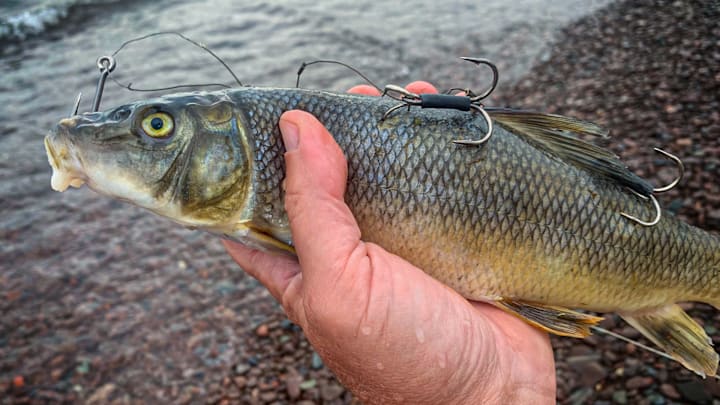
The harness I usually use is made by Joe Bucher Outdoors. It has a single hook that goes in the sucker's sucker and two treble hooks that go along the back. Attached to each treble is a reversed single hook that hooks into the sucker, leaving all three hooks of the treble exposed. This rig has been effective for me, but one downfall is it's hard on the sucker. When dragged around, suckers may go belly up.
Rubber Band vs. Hooked Harness Systems
Some harnesses use rubber bands. You push a rubber band through the nostrils with a bait needle. A second rubber band goes around the body and essentially straps a treble hook to the fish, without penetrating the sucker's body. This setup keeps the sucker livelier.
Setting Up Your Muskie Sucker Rig

Most often, I fish a harnessed sucker below a baseball-sized bobber. I weight the sucker down with a couple barrel sinkers. A bead positioned between the sinkers and foam bobber keeps the sinker from lodging into the bobber. You can use a clip-on style bobber or a slip-style bobber. I prefer the slip-style because it keeps the line from twisting around the bobber. In lieu of a bobber stop, I just stop the bobber with a smaller bobber! This only works when the bobber is set rather shallow, however, and you'll wreck the small bobber on a hookset, so bring extras. But it works well for fishing along shallow structure or when hanging a sucker just under the boat for following fish.
Favorite Sucker Fishing Gear
For fishing a bobber rig, I use a stout, but slightly limber rod in the 7- to 9-foot range. I pair it with a baitcasting reel with a strong clicker and 65-pound braided line. I leave the reel in freespool with the clicker on. Reels with weak clickers will pay out line as you drift if it's choppy.
Fishing a Sucker Rig Without a Bobber
You can fish a sucker without a bobber. Weight it with heavy sinkers and drape it over the side of the boat in a rod holder with the sucker a few feet above structure. Some anglers slowly troll live suckers behind planer boards. You'll definitely want to use a rubber band rig for this method to keep your suckers alive.
Maximizing Muskie Opportunities

In states where multiple lines are legal, I'll pitch a lure while trailing a live sucker fairly close behind the boat. Muskies are not boat shy and the idea is if a fish follows my lure, which they are notorious for, that the muskie may then see the sucker as an easy meal and hit the sucker instead.
Most days the sucker will out-fish any lure. In fact, muskies love the live presentation so much I have hooked a muskie on a sucker, reeled the fish to the boat, lost the fish and had it hit a sucker again!
Hook-Setting Tips for Live Sucker Rigs
When muskies hit a fish, they usually T-bone it from the side, then turn the fish and swallow it headfirst. A quick-strike rig consists of one or two treble hooks placed along the back or side of the sucker. When fishing a two-treble rig, I like to stagger one hook on either side of the backbone to up my hooking percentage.
With a couple trebles rigged along the sucker's body, you can set the hook as soon as a muskie grabs the sucker. When using a bobber, I wait until the bobber is fully underwater so I know the fish has the bait. If possible, quickly use your trolling motor to position the boat so the muskie is swimming away from you before setting the hook. When it's time to set the hook, hit that fish hard!
If I miss the fish on the hookset, I leave the bait sit. Although the sucker may have been ripped off (particularly when using a rubber band rig) if it's still on the hook, it's not uncommon for a missed fish to strike again.
Why Live Suckers Catch More Muskies
Suckers are by far the most effective bait I've ever used for muskies. These otherwise wary predators come unglued when they see one. Plus, it's downright exciting to watch a bobber go under and listen to the clicker scream as a big fish strikes and peels line.
Key Takeaways:
- Use healthy, large suckers and match the rig size to the bait.
- To keep suckers livelier for longer consider using a rubber band rig.
- Always use a quick-strike harness to avoid unnecessary injury to the muskie.
- Don't reel in right away after a missed hookset—muskies often hit twice.
- Especially in the fall, big muskies can't resist a big sucker.
You Might Like This Trophy Muskie Story:

World Record Muskie Caught on Lake Mille Lacs: A Legendary 57.5-Inch Catch
You Might Also Like These Fishing Stories:
 Add us as a preferred source on Google
Joe Shead is an accomplished outdoor writer, hunter, fishing guide and multi-species angler from Minnesota who will fish for anything, even if it won’t bite. Check out more of his work at goshedhunting.com and superiorexperiencecharters.com.