%22%3E%0A%3Cpath%20fill-rule%3D%22evenodd%22%20clip-rule%3D%22evenodd%22%20d%3D%22M156.868%204.36764C162.691%20-1.45588%20172.132%20-1.45588%20177.956%204.36764C183.779%2010.1912%20183.779%2019.6324%20177.956%2025.4559L167.412%2036L156.868%2025.4559C151.044%2019.6324%20151.044%2010.1912%20156.868%204.36764ZM159.509%207.55761C159.448%207.86849%20159.416%208.39718%20159.416%209.14566V10.4189C159.416%2011.1832%20159.448%2011.7198%20159.513%2012.0267C159.578%2012.3317%20159.778%2012.6168%20160.117%2012.8762C160.456%2013.1376%20160.903%2013.3316%20161.458%2013.4623C162.012%2013.593%20162.6%2013.6584%20163.337%2013.6584C164.073%2013.6584%20164.717%2013.591%20165.269%2013.4524C165.822%2013.3158%20166.261%2013.1178%20166.586%2012.8604C166.911%2012.6029%20167.105%2012.3178%20167.166%2012.0069C167.228%2011.6961%20167.259%2011.1674%20167.259%2010.4189V9.14566C167.259%208.38134%20167.228%207.84473%20167.162%207.53781C167.097%207.23287%20166.897%206.94971%20166.558%206.68834C166.22%206.42696%20165.772%206.23291%20165.218%206.10223C164.663%205.97154%20164.036%205.90619%20163.339%205.90619C162.602%205.90619%20161.959%205.97352%20161.406%206.11213C160.852%206.24875%20160.414%206.44677%20160.089%206.70418C159.765%206.9616%20159.571%207.24673%20159.509%207.55761ZM164.776%2024.8638C168.376%2024.8638%20170.057%2024.2064%20170.057%2021.862V21.858V21.3155C170.057%2019.6581%20169.016%2018.971%20165.752%2018.3136C164.778%2018.1136%20164.408%2017.9136%20164.408%2017.3136V16.9414C164.408%2016.6543%20164.677%2016.5117%20164.913%2016.5117C165.249%2016.5117%20165.418%2016.7137%20165.418%2016.9414V18.1136H169.891V17.3988C169.891%2015.4563%20168.847%2014.4266%20164.677%2014.4266C161.65%2014.4266%20159.396%2015.3414%20159.396%2017.3711V17.7433C159.396%2019.5155%20160.305%2020.3155%20163.701%2021.0303C163.78%2021.0472%20163.855%2021.063%20163.927%2021.0781C164.829%2021.2674%20165.147%2021.3341%20165.147%2021.9174V22.2897C165.147%2022.6619%20165.046%2022.8045%20164.642%2022.8045C164.17%2022.8045%20164.137%2022.5471%20164.137%2022.262V21.2897H159.394V21.7471C159.394%2024.149%20160.976%2024.8638%20164.776%2024.8638ZM170.924%2024.5569H175.425V14.7355H170.924V24.5569ZM172.455%2013.5019H175.425V6.06064H172.592V9.411L170.693%206.06064H167.859V13.5019H170.693V10.1199L172.455%2013.5019ZM163.769%2012.152C163.704%2012.2688%20163.555%2012.3262%20163.325%2012.3262L163.327%2012.3282C163.104%2012.3282%20162.959%2012.2767%20162.898%2012.1758C162.836%2012.0748%20162.805%2011.8074%20162.805%2011.3758V7.90068C162.805%207.51852%20162.852%207.28684%20162.945%207.20962C163.038%207.13239%20163.175%207.09279%20163.351%207.09279C163.559%207.09279%20163.698%207.14031%20163.765%207.23734C163.832%207.33239%20163.866%207.55416%20163.866%207.90068V11.3203C163.866%2011.7579%20163.834%2012.0352%20163.769%2012.152Z%22%20fill%3D%22white%22%2F%3E%0A%3Cpath%20d%3D%22M134.707%2035.9991C129.823%2035.9991%20126.029%2035.0305%20122.478%2033.2547L125.303%2027.7255C127.765%2029.017%20130.227%2029.8242%20133.254%2029.8242C136.684%2029.8242%20138.5%2028.0484%20138.5%2024.9811V24.3354C137.249%2025.7479%20135.191%2027.3623%20132.124%2027.3623C126.433%2027.3623%20122.316%2023.3264%20122.316%2017.2322V17.1515C122.316%2010.9766%20126.514%206.90039%20131.599%206.90039C134.828%206.90039%20136.724%208.11115%20138.339%209.76586V7.42506H147.5V23.8914C147.5%2027.9677%20146.653%2030.7524%20144.635%2032.7704C142.657%2034.748%20139.63%2035.9991%20134.707%2035.9991ZM134.868%2020.6627C137.128%2020.6627%20138.541%2019.1291%20138.541%2017.1919V17.1112C138.541%2015.2143%20137.088%2013.6807%20134.868%2013.6807C132.608%2013.6807%20131.195%2015.2547%20131.195%2017.1919V17.2726C131.195%2019.1695%20132.648%2020.6627%20134.868%2020.6627Z%22%20fill%3D%22white%22%2F%3E%0A%3Cpath%20d%3D%22M96.9492%2029.4629V7.42701H106.111V10.4943C107.523%208.67813%20109.743%206.90234%20112.851%206.90234C117.492%206.90234%20120.398%209.96961%20120.398%2014.9337V29.4629H111.236V17.8799C111.236%2015.9831%20110.106%2014.8934%20108.734%2014.8934C107.362%2014.8934%20106.111%2015.9831%20106.111%2017.8799V29.4629H96.9492Z%22%20fill%3D%22white%22%2F%3E%0A%3Cpath%20d%3D%22M84.8096%205.85202V0H94.2939V5.85202H84.8096ZM84.971%2029.4619V7.42602H94.1324V29.4619H84.971Z%22%20fill%3D%22white%22%2F%3E%0A%3Cpath%20d%3D%22M58.877%2029.4619V0H68.0384V10.3722C69.451%208.55606%2071.6707%206.90135%2074.7783%206.90135C79.4196%206.90135%2082.3254%209.96862%2082.3254%2014.9327V29.4619H73.164V17.8789C73.164%2015.9821%2072.0339%2014.8924%2070.6617%2014.8924C69.2895%2014.8924%2068.0384%2015.9821%2068.0384%2017.8789V29.4619H58.877Z%22%20fill%3D%22white%22%2F%3E%0A%3Cpath%20d%3D%22M47.3991%2029.9876C43.1211%2029.9876%2039.2466%2028.8979%2036.0986%2026.7992L39.2063%2021.5929C41.8699%2023.2477%2044.8565%2024.0548%2047.3587%2024.0548C48.2466%2024.0548%2048.6906%2023.853%2048.6906%2023.3284V23.2477C48.6906%2022.8037%2048.287%2022.5212%2046.0673%2021.9562C40.4977%2020.584%2037.0672%2019.0907%2037.0672%2014.5302V14.4494C37.0672%209.60638%2040.9417%206.90234%2046.6726%206.90234C50.3049%206.90234%2053.8969%207.8306%2056.5605%209.44495L53.6547%2014.8934C51.3139%2013.6019%2048.4888%2012.8351%2046.6323%2012.8351C45.7444%2012.8351%2045.3408%2013.0772%2045.3408%2013.5212V13.6019C45.3408%2014.0458%2045.8251%2014.3284%2048.0448%2014.8934C53.6143%2016.2656%2056.9641%2017.7992%2056.9641%2022.3194V22.4001C56.9641%2027.2028%2053.3722%2029.9876%2047.3991%2029.9876Z%22%20fill%3D%22white%22%2F%3E%0A%3Cpath%20d%3D%22M25.5312%205.85202V0H35.0156V5.85202H25.5312ZM25.6927%2029.4619V7.42602H34.8541V29.4619H25.6927Z%22%20fill%3D%22white%22%2F%3E%0A%3Cpath%20d%3D%22M0%2029.4621V1.21094H23.6503V9.2827H9.44396V12.8746H22.6413V20.2199H9.44396V29.4621H0Z%22%20fill%3D%22white%22%2F%3E%0A%3C%2Fg%3E%0A%3Cdefs%3E%0A%3CclipPath%20id%3D%22clip0_16330_64756%22%3E%0A%3Crect%20width%3D%22182%22%20height%3D%2236%22%20fill%3D%22white%22%2F%3E%0A%3C%2FclipPath%3E%0A%3C%2Fdefs%3E%0A%3C%2Fsvg%3E%0A)
Spring Muskie Fishing Guide: Top Tips for the Best Opening Day Fishing
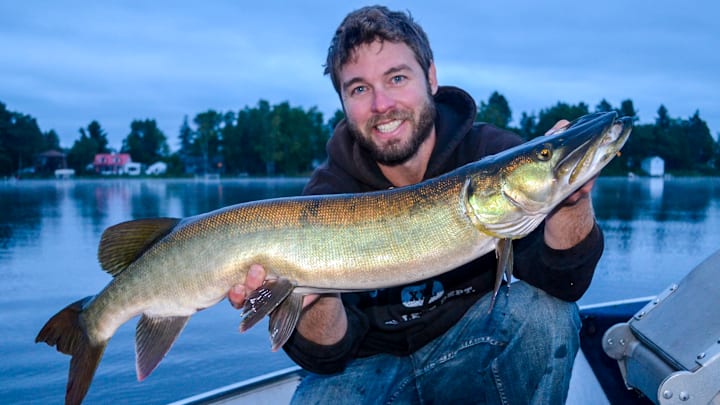
Although some states like Kentucky do permit muskie fishing early in the season, most of the states in native muskie range close the season until after the fish are done spawning.
Why Target Muskie for the Spring Opener?
Fishing can be good right around the spring opener. For one thing, it’s been months since fish have seen lures or felt any kind of fishing pressure, meaning they might be a little more willing to bite. In addition, weed growth is just emerging, making it easier to fish. In some cases, in summer, muskies ambush their prey from weedbeds so thick, they are difficult to fish. That’s not the case in early spring, as weeds just begin to emerge from the bottom.

Where Do Muskie Spawn?
Muskies spawn when the water temperature is in the 50s. Although the eggs of closely related northern pike stick to vegetation, muskie eggs do not, and instead, sink to the bottom. Therefore, muskies spawn over relatively hard bottom, such as sand and gravel, so their eggs do not sink into soft bottom and suffocate. The presence of weeds, wood and rocks is also desirable, giving fry places to hide from predators when they hatch. Bulrush beds are always a good bet because these plants grow on hard bottom and provide cover to both spawning fish and their newly hatched young. Shallow bays with newly emerging cabbage weeds are also solid choices.
Why Target Spawning Areas for Opening Day Muskie?
Fish likely won’t be far from their spawning grounds, so begin your search there. Seek out shallow bays, as these areas will warm up first in spring, particularly those on the north end of the lake, which receive the most direct sunlight. Areas with feeder streams will also warm more rapidly, due to inflowing warm runoff.
Male muskies show up in spawning areas first and may hang around for a month, awaiting the arrival of early females and staying until the last females have spawned. When opening day arrives, you can often find males in shallow spawning areas. These fish may be in water as little as 3 feet deep. Although males run smaller than females, they still provide action, and large males can still top 40 inches.
Females are in spawning areas for only about 10 to 14 days. They leave the area soon afterwards and do not stick around to protect their young like largemouth bass and other species. Weather impacts where muskies will be found early in the season. If it’s a late spring, even female muskies may be right in or close to spawning areas. If the weather warms steadily and remains warm, spawning may be completed days or even weeks before fishing opener.
Odds are, females won’t be far from their spawning sites on opening day. After the rigors of spawning, these fish generally rest a few days before actively feeding. Look for them in adjacent shallow weedbeds, on weedlines, along the first drop-off or along any rock or wood structure in the spawning bay. On warm, sunny days you may even find them sunning themselves in shallow water.

Follow Weather Patterns to Find Spring Muskies
Take weather into account as you plan your search. Also keep in mind that shallow, smaller lakes, or those with stained water will be more advanced in the spawning process than larger, deeper, clearer lakes.
As water warms into the mid-60s, most muskies will eventually move toward deeper summer haunts. If you don’t find fish shallow, look for them in deeper transition areas as fish move toward summer structure. Try drop-offs leading out of the bay, points at bay edges and other moderately deep types of structure, such as saddles and humps. Structure combinations (such as drop-offs along points with newly emerging weeds) are good bets.
Best Lures and Presentations for Spring Muskies
Presentations for early season fish should be slow and small. Water temperatures will still be cool, so a fish’s metabolism will still be slow, especially considering these fish are quite drained from the act of spawning. Fish that have just finished spawning will be very slow to move, while those a few days more advanced will be a bit more aggressive.

Depth and cover dictate your presentation to some extent. When fishing right up in shallow bulrushes, it’s necessary to fish a shallow-running lure to go over newly emerging bulrushes and avoid dead plants from the previous year. Small spinners with a wide Colorado blade ride over the tops of the weeds. Try a size 4 or 5 Mepps spinner here, with or without dressing; not a big muskie bucktail like you would throw in summer. Keep the spinner moving slowly, retrieving it just fast enough to keep it above the cover. Short casts or sometimes even flips are necessary to steer your spinner through the combination of dead plants and newly emerging ones. Work each pocket thoroughly, as fish aren’t likely to travel any great distance to hit your presentation. Using a reel with a slower gear ratio can help you resist the temptation to reel faster and keep your lure moving at a speed more desirable to sluggish fish.
Weedbeds adjacent to bulrush beds are another good bet as you gradually work your way deeper. Weed growth is likely to be tight to the bottom at this point in the year, allowing you to use lures that run a little deeper or to fish sinking baits a little more slowly. Although spinners are good here as well, minnow-shaped twitch baits can also be really effective. Again, keep your presentation slow, twitching your lure to encourage tired, cold fish to chase after an easy meal. Work over the tops of the weeds and in any open pockets of the weedbed where lethargic fish may lie in wait for their prey. At this time of year, smaller 4- to 6-inch baits – even lures generally meant for bass fishing – may be more effective than standard-sized 8- to 12-inch muskie baits.
Use Pike Activity as a Location Clue
I catch a lot of eater-sized pike while fishing for early season muskies. This may simply be because I’m throwing smaller baits, although it’s not uncommon for pike to aggressively attack much larger lures. However, I’ve found that when I’m catching pike, I’ll usually find some early season muskies in that same area. So I use pike as a barometer to indicate that I’m fishing in the right location.

If you fail to catch or at least see some fish in the shallows, work to those deeper transition areas. Perhaps spawning has been over long enough that the fish are starting to disperse from the shallows. If your fish-finder shows the water temps have warmed into the 60s, that may confirm that the fish have already moved deeper.
Transitioning to Deeper Water Patterns
“Deeper” is a relative term, but generally that means from 6 to 15 feet, or maybe even as deep as 20 feet of water. Sometimes springtime muskies situate along drop-offs so they can move shallow on warm days and simply drop down deeper under cold front conditions. Fish even move throughout the day, moving shallower as sun warms the water for the day and sinking back down if it cools off.
When working these deeper transition areas, crankbaits and deeper-diving jerkbaits get the nod. Again, keep your lure size small and your presentation slow to coerce these fish into striking. Fan-cast the area, making each cast closer together than you might when fishing for more aggressive summer muskies. Spring fish aren’t likely to move far to attack your lure, so you’re going to have to drop it right on their noses.
How to Extend the Spring Muskie Bite
This early season pattern won’t last long, as fish disperse to deeper water in just a matter of days. Keep in mind, however, that you can extend this relatively predictable pattern and good fishing by starting the season on shallow, stained waters and moving to deeper, clearer lakes that will warm more slowly. Done properly and with favorable weather conditions, anglers can extend this pattern for a couple of weeks.

Why Fish Opening Day for Muskies?
On opening day, you’re probably not going to catch any record-sized fish. Even if you do tangle with a large female, these fish are going to weigh far less than they will during summer and fall, as their bodies are depleted from decreased feeding over the winter and they’ve lost the added weight of their eggs.
The advantage to early season fishing, in addition to simply being able to get back on the water, is that it actually provides pretty consistent action. You can eliminate main-lake structure and focus your energy around feeder creeks and shallow bays. Then it’s simply a matter of determining whether those fish are still up in the shallows or out on deeper transitional areas. It really does narrow your search quite a bit. Once you figure it out, fishing can be productive and multi-fish days aren’t uncommon.
Of course, given cold water and with energy depleted from the rigors of spawning, these fish may or may not be willing to strike. But that’s no detriment to anglers used to chasing the fish of 10,000 casts. For legions of muskie anglers, opening day is simply a day not to be missed.
Recommended Articles:
 Add us as a preferred source on Google
Joe Shead is an accomplished outdoor writer, hunter, fishing guide and multi-species angler from Minnesota who will fish for anything, even if it won’t bite. Check out more of his work at goshedhunting.com and superiorexperiencecharters.com.