%22%3E%0A%3Cpath%20fill-rule%3D%22evenodd%22%20clip-rule%3D%22evenodd%22%20d%3D%22M156.868%204.36764C162.691%20-1.45588%20172.132%20-1.45588%20177.956%204.36764C183.779%2010.1912%20183.779%2019.6324%20177.956%2025.4559L167.412%2036L156.868%2025.4559C151.044%2019.6324%20151.044%2010.1912%20156.868%204.36764ZM159.509%207.55761C159.448%207.86849%20159.416%208.39718%20159.416%209.14566V10.4189C159.416%2011.1832%20159.448%2011.7198%20159.513%2012.0267C159.578%2012.3317%20159.778%2012.6168%20160.117%2012.8762C160.456%2013.1376%20160.903%2013.3316%20161.458%2013.4623C162.012%2013.593%20162.6%2013.6584%20163.337%2013.6584C164.073%2013.6584%20164.717%2013.591%20165.269%2013.4524C165.822%2013.3158%20166.261%2013.1178%20166.586%2012.8604C166.911%2012.6029%20167.105%2012.3178%20167.166%2012.0069C167.228%2011.6961%20167.259%2011.1674%20167.259%2010.4189V9.14566C167.259%208.38134%20167.228%207.84473%20167.162%207.53781C167.097%207.23287%20166.897%206.94971%20166.558%206.68834C166.22%206.42696%20165.772%206.23291%20165.218%206.10223C164.663%205.97154%20164.036%205.90619%20163.339%205.90619C162.602%205.90619%20161.959%205.97352%20161.406%206.11213C160.852%206.24875%20160.414%206.44677%20160.089%206.70418C159.765%206.9616%20159.571%207.24673%20159.509%207.55761ZM164.776%2024.8638C168.376%2024.8638%20170.057%2024.2064%20170.057%2021.862V21.858V21.3155C170.057%2019.6581%20169.016%2018.971%20165.752%2018.3136C164.778%2018.1136%20164.408%2017.9136%20164.408%2017.3136V16.9414C164.408%2016.6543%20164.677%2016.5117%20164.913%2016.5117C165.249%2016.5117%20165.418%2016.7137%20165.418%2016.9414V18.1136H169.891V17.3988C169.891%2015.4563%20168.847%2014.4266%20164.677%2014.4266C161.65%2014.4266%20159.396%2015.3414%20159.396%2017.3711V17.7433C159.396%2019.5155%20160.305%2020.3155%20163.701%2021.0303C163.78%2021.0472%20163.855%2021.063%20163.927%2021.0781C164.829%2021.2674%20165.147%2021.3341%20165.147%2021.9174V22.2897C165.147%2022.6619%20165.046%2022.8045%20164.642%2022.8045C164.17%2022.8045%20164.137%2022.5471%20164.137%2022.262V21.2897H159.394V21.7471C159.394%2024.149%20160.976%2024.8638%20164.776%2024.8638ZM170.924%2024.5569H175.425V14.7355H170.924V24.5569ZM172.455%2013.5019H175.425V6.06064H172.592V9.411L170.693%206.06064H167.859V13.5019H170.693V10.1199L172.455%2013.5019ZM163.769%2012.152C163.704%2012.2688%20163.555%2012.3262%20163.325%2012.3262L163.327%2012.3282C163.104%2012.3282%20162.959%2012.2767%20162.898%2012.1758C162.836%2012.0748%20162.805%2011.8074%20162.805%2011.3758V7.90068C162.805%207.51852%20162.852%207.28684%20162.945%207.20962C163.038%207.13239%20163.175%207.09279%20163.351%207.09279C163.559%207.09279%20163.698%207.14031%20163.765%207.23734C163.832%207.33239%20163.866%207.55416%20163.866%207.90068V11.3203C163.866%2011.7579%20163.834%2012.0352%20163.769%2012.152Z%22%20fill%3D%22white%22%2F%3E%0A%3Cpath%20d%3D%22M134.707%2035.9991C129.823%2035.9991%20126.029%2035.0305%20122.478%2033.2547L125.303%2027.7255C127.765%2029.017%20130.227%2029.8242%20133.254%2029.8242C136.684%2029.8242%20138.5%2028.0484%20138.5%2024.9811V24.3354C137.249%2025.7479%20135.191%2027.3623%20132.124%2027.3623C126.433%2027.3623%20122.316%2023.3264%20122.316%2017.2322V17.1515C122.316%2010.9766%20126.514%206.90039%20131.599%206.90039C134.828%206.90039%20136.724%208.11115%20138.339%209.76586V7.42506H147.5V23.8914C147.5%2027.9677%20146.653%2030.7524%20144.635%2032.7704C142.657%2034.748%20139.63%2035.9991%20134.707%2035.9991ZM134.868%2020.6627C137.128%2020.6627%20138.541%2019.1291%20138.541%2017.1919V17.1112C138.541%2015.2143%20137.088%2013.6807%20134.868%2013.6807C132.608%2013.6807%20131.195%2015.2547%20131.195%2017.1919V17.2726C131.195%2019.1695%20132.648%2020.6627%20134.868%2020.6627Z%22%20fill%3D%22white%22%2F%3E%0A%3Cpath%20d%3D%22M96.9492%2029.4629V7.42701H106.111V10.4943C107.523%208.67813%20109.743%206.90234%20112.851%206.90234C117.492%206.90234%20120.398%209.96961%20120.398%2014.9337V29.4629H111.236V17.8799C111.236%2015.9831%20110.106%2014.8934%20108.734%2014.8934C107.362%2014.8934%20106.111%2015.9831%20106.111%2017.8799V29.4629H96.9492Z%22%20fill%3D%22white%22%2F%3E%0A%3Cpath%20d%3D%22M84.8096%205.85202V0H94.2939V5.85202H84.8096ZM84.971%2029.4619V7.42602H94.1324V29.4619H84.971Z%22%20fill%3D%22white%22%2F%3E%0A%3Cpath%20d%3D%22M58.877%2029.4619V0H68.0384V10.3722C69.451%208.55606%2071.6707%206.90135%2074.7783%206.90135C79.4196%206.90135%2082.3254%209.96862%2082.3254%2014.9327V29.4619H73.164V17.8789C73.164%2015.9821%2072.0339%2014.8924%2070.6617%2014.8924C69.2895%2014.8924%2068.0384%2015.9821%2068.0384%2017.8789V29.4619H58.877Z%22%20fill%3D%22white%22%2F%3E%0A%3Cpath%20d%3D%22M47.3991%2029.9876C43.1211%2029.9876%2039.2466%2028.8979%2036.0986%2026.7992L39.2063%2021.5929C41.8699%2023.2477%2044.8565%2024.0548%2047.3587%2024.0548C48.2466%2024.0548%2048.6906%2023.853%2048.6906%2023.3284V23.2477C48.6906%2022.8037%2048.287%2022.5212%2046.0673%2021.9562C40.4977%2020.584%2037.0672%2019.0907%2037.0672%2014.5302V14.4494C37.0672%209.60638%2040.9417%206.90234%2046.6726%206.90234C50.3049%206.90234%2053.8969%207.8306%2056.5605%209.44495L53.6547%2014.8934C51.3139%2013.6019%2048.4888%2012.8351%2046.6323%2012.8351C45.7444%2012.8351%2045.3408%2013.0772%2045.3408%2013.5212V13.6019C45.3408%2014.0458%2045.8251%2014.3284%2048.0448%2014.8934C53.6143%2016.2656%2056.9641%2017.7992%2056.9641%2022.3194V22.4001C56.9641%2027.2028%2053.3722%2029.9876%2047.3991%2029.9876Z%22%20fill%3D%22white%22%2F%3E%0A%3Cpath%20d%3D%22M25.5312%205.85202V0H35.0156V5.85202H25.5312ZM25.6927%2029.4619V7.42602H34.8541V29.4619H25.6927Z%22%20fill%3D%22white%22%2F%3E%0A%3Cpath%20d%3D%22M0%2029.4621V1.21094H23.6503V9.2827H9.44396V12.8746H22.6413V20.2199H9.44396V29.4621H0Z%22%20fill%3D%22white%22%2F%3E%0A%3C%2Fg%3E%0A%3Cdefs%3E%0A%3CclipPath%20id%3D%22clip0_16330_64756%22%3E%0A%3Crect%20width%3D%22182%22%20height%3D%2236%22%20fill%3D%22white%22%2F%3E%0A%3C%2FclipPath%3E%0A%3C%2Fdefs%3E%0A%3C%2Fsvg%3E%0A)
Top 10 Tips for Tip-Up Ice Fishing: Catch More Fish This Winter
Why Tip-Up Fishing is a Winter Favorite
Fishing with tip-ups is one of the most low-tech, enjoyable ways to ice fish. When I was in high school, my buddies and I would set out a spread of tip-ups and then just wait for a flag while cooking brats or tossing around a football. It was super simple. And often very effective.
I'm not trying to pretend that catching fish on tip-ups is complicated, but here are a few tips I've learned over the years that have helped me chase more flags.
1.) Keep Your Minnows Alive and Active
Especially if you're using bait from a previous outing that has been sitting in a warm house, I cool the water slowly so the minnows don't get a shock when they hit near-freezing water. Upon leaving the bait shop or home, I scoop in a few scoops of snow, which cools the water gradually like an ice cube. I've seen minnow, particularly golden shiners, go belly up when they go from warm to cold water.
2.) Keep Your Bait Visible
Particularly when fishing for pike, keep your bait high. At the very least, keep the minnow above the weeds to prevent it from getting fouled and to make it more visible. If you set the bait a few feet above the weeds, it's a lot more visible and pike won't hesitate to chase it.

3.) Check Your Tip-Ups to Maximize Success
I can't tell you how many times we fished for hours in our youth, staying huddled in the cab of the truck because it was too cold and nasty to periodically check our tip-ups. And inevitably, you'd pull some lines at the end of the day that had been sitting for hours without bait, meaning they had been utterly useless for hours. Check your lines frequently to make sure your minnow is still on there (and alive if it's supposed to be alive). Also make sure it's free of weeds. And checking tip-ups also keeps your hole open (or only slightly frozen) so you don't have to chop out your tip-up to battle a fish. Plus, if left all day in sub-zero weather, a tip-up can be downright difficult to remove at the end of the day.
4.) The Best Hole Locations for Pike Fishing
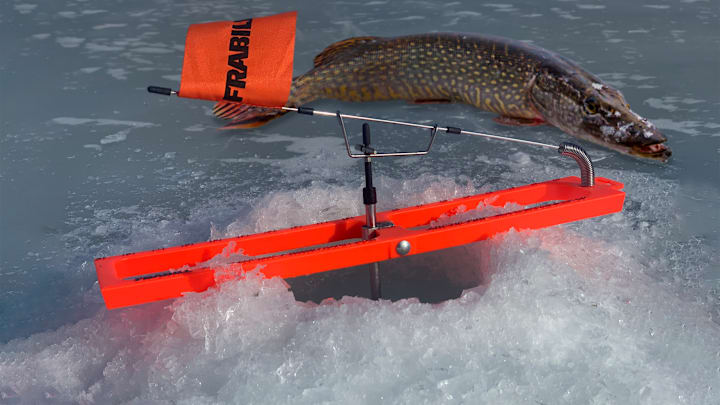
Be thoughtful when you drill your holes. I don't know how spooky pike really are, but if it's a sunny day and there's a blanket of snow on the ice, and then suddenly there's an 8-inch circle of light penetrating into the water, it probably seems odd to fish. Maybe not, but I still like to cover my holes and when there's patchy snow on the ice, I like to pop the holes in the snow, rather than on glare ice. This also helps with traction. Plus, using box tip-ups, insulated tip-ups like the Frabill Pro Thermal lighted model, foam hole covers or even notched cardboard laid over your hole keeps the snow out and helps slow ice buildup.
5.) Walking the Ice Can Trigger More Bites
I firmly believe that walking around on the ice triggers more bites, which is another reason to check those tip-ups. If I haven't had a flag in a while, I walk in a circle around my spread, and then even walk within the spread. Especially in shallow water, I'm convinced this gets fish moving and it's not unusual to get a flag after walking around your spread, when prior to that, no flag had tripped for hours.
6.) Make Depth Adjustment Easy with Line Markers

When you're fishing shallow water, it's easy to reset your line after you get a flag. But when you're fishing over deep water, use a line marker to quickly get your bait back to the proper depth. Drop your bait down with a depth bomb, pull it the desired distance off the bottom or above the weeds, and then slide a buttons or clip on a tiny bobber to the line where it comes off the spool of the tip-up so you know how much line to put out after you get a bite. It sure beats measuring out 25 feet of line every time when it's below zero and the wind is ripping.
7.) How to Manage Big Minnows on Tip-Ups
Sometimes big, lively minnows trip the tip-up, which is annoying. There are a few ways to deal with this. You could cut off the minnow's tail to give it less swimming power. Or, wrap a rubber band around the spindle arm for more friction against the flag arm. Also note which side of the spindle arm you tuck the flag under. If the spindle arm must rotate down the flag to trip, it will create slightly more resistance than if it must travel up the flag to trip. On some tip-ups like the Frabill Arctic Fire you can adjust the spindle height with a set screw. Lower it way down to create more resistance.
8.) Choosing the Right Hook Setup for Your Tip-Ups
Another consideration is the hook setup you use. Some people fish a multi-hook quick-strike rig. Others use a single hook or a single treble hook. The size of the bait, the size of your quarry and whether you're using dead or live bait affects hooking method. Generally, on live suckers or shiners measuring 3 to 6 inches, I use a single treble hook in the back. Pike grab a bait sideways, then turn it to swallow it headfirst. If I plan to release fish, I place the treble hook in the back but closer to the tail so it's less apt to be swallowed. If I expect to keep fish, hooking fish deeply isn't such a concern and you can place the hook farther forward. My thought here is if the pike is going to swallow the bait headfirst, the hooking percentage should be better if the hook is farther forward. This winter I plan to experiment with circle hooks to see if that helps prevent fish from swallowing the bait.
9.) Missed a Flag? How to Get the Pike to Come Back
If you get a flag but miss the fish, don't fret. Often, if you reset your tip-up, the pike will return in a few minutes. Sometimes it helps to punch a hole next to the tip-up and bring fish in by jigging a flashy spoon (you'll have to remove another tip-up so you don't have more than the legal number of lines allowed in the water). This is the ol' one-two punch where the pike can hit the flashy spoon if desired, or go more subtle and hit the minnow.
10.) The Art of Setting the Hook at the Right Time
When to set the hook is another consideration for tip-up anglers. Usually, a fish hits the bait and runs with it, then stops to swallow it, then runs again. I was always taught to hit 'em when they make the second run. Usually that gives you a pretty good hooking percentage, although sometimes it results in deeply hooked fish. It's really just a guessing game. Set too soon and the fish may not have the hook in its mouth. Wait too long and the fish may be deeply hooked. If you use a multi-treble quick-strike rig, however, you should be able to set the hook right away.

11.) Bonus Tip: How Hair Ties Can Make Storage Easy
One thing that has always plagued me about tip-ups is how to store the hook when the tip-up isn’t in use. If it’s just a mono leader, you can wrap up the line on the spool all the way to the hook, although you run the risk of putting memory coils in your leader. When using a steel leader, wrapping your line all the way could produce kinks or bends in the leader. One solution that works for me is to wrap a hair tie or rubber band around the frame of a rail-style tip-up on the opposite end of the spool, hook the hair tie, reel up the line tightly and put the flag arm in the corresponding hole in the spool to keep the tip-up from unraveling.
READ NEXT:
Striker Climate Ice Fishing Suit Review: Never Let a Cold Wind Keep You Off the Ice

Top 4 Proven Tricks to Make Winter Fish Bite: Ice Fishing Tips for Perch, Crappie, and More

 Add us as a preferred source on Google
Joe Shead is an accomplished outdoor writer, hunter, fishing guide and multi-species angler from Minnesota who will fish for anything, even if it won’t bite. Check out more of his work at goshedhunting.com and superiorexperiencecharters.com.