%22%3E%0A%3Cpath%20fill-rule%3D%22evenodd%22%20clip-rule%3D%22evenodd%22%20d%3D%22M156.868%204.36764C162.691%20-1.45588%20172.132%20-1.45588%20177.956%204.36764C183.779%2010.1912%20183.779%2019.6324%20177.956%2025.4559L167.412%2036L156.868%2025.4559C151.044%2019.6324%20151.044%2010.1912%20156.868%204.36764ZM159.509%207.55761C159.448%207.86849%20159.416%208.39718%20159.416%209.14566V10.4189C159.416%2011.1832%20159.448%2011.7198%20159.513%2012.0267C159.578%2012.3317%20159.778%2012.6168%20160.117%2012.8762C160.456%2013.1376%20160.903%2013.3316%20161.458%2013.4623C162.012%2013.593%20162.6%2013.6584%20163.337%2013.6584C164.073%2013.6584%20164.717%2013.591%20165.269%2013.4524C165.822%2013.3158%20166.261%2013.1178%20166.586%2012.8604C166.911%2012.6029%20167.105%2012.3178%20167.166%2012.0069C167.228%2011.6961%20167.259%2011.1674%20167.259%2010.4189V9.14566C167.259%208.38134%20167.228%207.84473%20167.162%207.53781C167.097%207.23287%20166.897%206.94971%20166.558%206.68834C166.22%206.42696%20165.772%206.23291%20165.218%206.10223C164.663%205.97154%20164.036%205.90619%20163.339%205.90619C162.602%205.90619%20161.959%205.97352%20161.406%206.11213C160.852%206.24875%20160.414%206.44677%20160.089%206.70418C159.765%206.9616%20159.571%207.24673%20159.509%207.55761ZM164.776%2024.8638C168.376%2024.8638%20170.057%2024.2064%20170.057%2021.862V21.858V21.3155C170.057%2019.6581%20169.016%2018.971%20165.752%2018.3136C164.778%2018.1136%20164.408%2017.9136%20164.408%2017.3136V16.9414C164.408%2016.6543%20164.677%2016.5117%20164.913%2016.5117C165.249%2016.5117%20165.418%2016.7137%20165.418%2016.9414V18.1136H169.891V17.3988C169.891%2015.4563%20168.847%2014.4266%20164.677%2014.4266C161.65%2014.4266%20159.396%2015.3414%20159.396%2017.3711V17.7433C159.396%2019.5155%20160.305%2020.3155%20163.701%2021.0303C163.78%2021.0472%20163.855%2021.063%20163.927%2021.0781C164.829%2021.2674%20165.147%2021.3341%20165.147%2021.9174V22.2897C165.147%2022.6619%20165.046%2022.8045%20164.642%2022.8045C164.17%2022.8045%20164.137%2022.5471%20164.137%2022.262V21.2897H159.394V21.7471C159.394%2024.149%20160.976%2024.8638%20164.776%2024.8638ZM170.924%2024.5569H175.425V14.7355H170.924V24.5569ZM172.455%2013.5019H175.425V6.06064H172.592V9.411L170.693%206.06064H167.859V13.5019H170.693V10.1199L172.455%2013.5019ZM163.769%2012.152C163.704%2012.2688%20163.555%2012.3262%20163.325%2012.3262L163.327%2012.3282C163.104%2012.3282%20162.959%2012.2767%20162.898%2012.1758C162.836%2012.0748%20162.805%2011.8074%20162.805%2011.3758V7.90068C162.805%207.51852%20162.852%207.28684%20162.945%207.20962C163.038%207.13239%20163.175%207.09279%20163.351%207.09279C163.559%207.09279%20163.698%207.14031%20163.765%207.23734C163.832%207.33239%20163.866%207.55416%20163.866%207.90068V11.3203C163.866%2011.7579%20163.834%2012.0352%20163.769%2012.152Z%22%20fill%3D%22white%22%2F%3E%0A%3Cpath%20d%3D%22M134.707%2035.9991C129.823%2035.9991%20126.029%2035.0305%20122.478%2033.2547L125.303%2027.7255C127.765%2029.017%20130.227%2029.8242%20133.254%2029.8242C136.684%2029.8242%20138.5%2028.0484%20138.5%2024.9811V24.3354C137.249%2025.7479%20135.191%2027.3623%20132.124%2027.3623C126.433%2027.3623%20122.316%2023.3264%20122.316%2017.2322V17.1515C122.316%2010.9766%20126.514%206.90039%20131.599%206.90039C134.828%206.90039%20136.724%208.11115%20138.339%209.76586V7.42506H147.5V23.8914C147.5%2027.9677%20146.653%2030.7524%20144.635%2032.7704C142.657%2034.748%20139.63%2035.9991%20134.707%2035.9991ZM134.868%2020.6627C137.128%2020.6627%20138.541%2019.1291%20138.541%2017.1919V17.1112C138.541%2015.2143%20137.088%2013.6807%20134.868%2013.6807C132.608%2013.6807%20131.195%2015.2547%20131.195%2017.1919V17.2726C131.195%2019.1695%20132.648%2020.6627%20134.868%2020.6627Z%22%20fill%3D%22white%22%2F%3E%0A%3Cpath%20d%3D%22M96.9492%2029.4629V7.42701H106.111V10.4943C107.523%208.67813%20109.743%206.90234%20112.851%206.90234C117.492%206.90234%20120.398%209.96961%20120.398%2014.9337V29.4629H111.236V17.8799C111.236%2015.9831%20110.106%2014.8934%20108.734%2014.8934C107.362%2014.8934%20106.111%2015.9831%20106.111%2017.8799V29.4629H96.9492Z%22%20fill%3D%22white%22%2F%3E%0A%3Cpath%20d%3D%22M84.8096%205.85202V0H94.2939V5.85202H84.8096ZM84.971%2029.4619V7.42602H94.1324V29.4619H84.971Z%22%20fill%3D%22white%22%2F%3E%0A%3Cpath%20d%3D%22M58.877%2029.4619V0H68.0384V10.3722C69.451%208.55606%2071.6707%206.90135%2074.7783%206.90135C79.4196%206.90135%2082.3254%209.96862%2082.3254%2014.9327V29.4619H73.164V17.8789C73.164%2015.9821%2072.0339%2014.8924%2070.6617%2014.8924C69.2895%2014.8924%2068.0384%2015.9821%2068.0384%2017.8789V29.4619H58.877Z%22%20fill%3D%22white%22%2F%3E%0A%3Cpath%20d%3D%22M47.3991%2029.9876C43.1211%2029.9876%2039.2466%2028.8979%2036.0986%2026.7992L39.2063%2021.5929C41.8699%2023.2477%2044.8565%2024.0548%2047.3587%2024.0548C48.2466%2024.0548%2048.6906%2023.853%2048.6906%2023.3284V23.2477C48.6906%2022.8037%2048.287%2022.5212%2046.0673%2021.9562C40.4977%2020.584%2037.0672%2019.0907%2037.0672%2014.5302V14.4494C37.0672%209.60638%2040.9417%206.90234%2046.6726%206.90234C50.3049%206.90234%2053.8969%207.8306%2056.5605%209.44495L53.6547%2014.8934C51.3139%2013.6019%2048.4888%2012.8351%2046.6323%2012.8351C45.7444%2012.8351%2045.3408%2013.0772%2045.3408%2013.5212V13.6019C45.3408%2014.0458%2045.8251%2014.3284%2048.0448%2014.8934C53.6143%2016.2656%2056.9641%2017.7992%2056.9641%2022.3194V22.4001C56.9641%2027.2028%2053.3722%2029.9876%2047.3991%2029.9876Z%22%20fill%3D%22white%22%2F%3E%0A%3Cpath%20d%3D%22M25.5312%205.85202V0H35.0156V5.85202H25.5312ZM25.6927%2029.4619V7.42602H34.8541V29.4619H25.6927Z%22%20fill%3D%22white%22%2F%3E%0A%3Cpath%20d%3D%22M0%2029.4621V1.21094H23.6503V9.2827H9.44396V12.8746H22.6413V20.2199H9.44396V29.4621H0Z%22%20fill%3D%22white%22%2F%3E%0A%3C%2Fg%3E%0A%3Cdefs%3E%0A%3CclipPath%20id%3D%22clip0_16330_64756%22%3E%0A%3Crect%20width%3D%22182%22%20height%3D%2236%22%20fill%3D%22white%22%2F%3E%0A%3C%2FclipPath%3E%0A%3C%2Fdefs%3E%0A%3C%2Fsvg%3E%0A)
Two Elite Cameras, One Tough Call: Sony's a1 II vs. a9 III for Fishing Photography
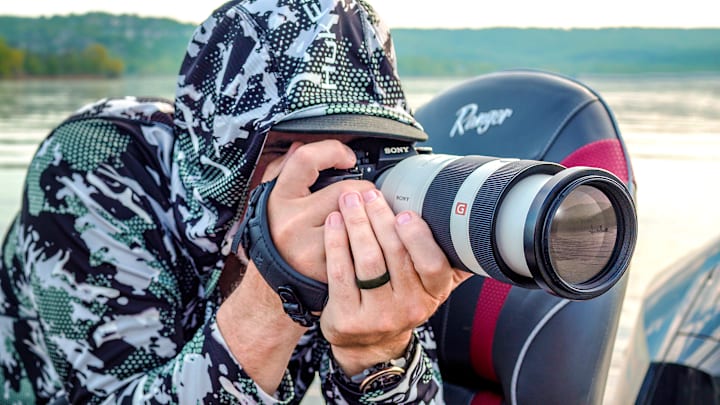
Sony's flagship mirrorless camera, and their already legendary speed-optimized alternative, are priced within $500 of each other, look and feel almost exactly the same—sharing identical bodies, and are both genuinely extraordinary. And while they both do a well above average job at nearly all aspects of capturing images, one is focused on maximizing speed and one is focused on maximizing the amount of information captured.

I've been using Sony's cameras for a while and loving them, but recently I had the very fortunate opportunity to use both of their highest level cameras back-to-back at two of professional bass fishing's biggest events—the a1 II at the Bassmaster Classic in Knoxville, Tennessee, and the a9 III at REDCREST in Springfield, Missouri. Here's what I found.
The a1 II: Resolution as a Competitive Advantage

First, and most obviously, the amount of information this camera captures in each frame is staggering. The a1 II's 50.1-megapixel full-frame sensor completely changes what's possible when photographing fishing at a distance. Among the lenses I chose to cover the Bassmaster Classic, was the Sony 70-200mm G2. In most cases where I’d be shooting from boat-to-boat, or over an auditorium crowd to the weigh-in stage, 200mm might feel like it’s not enough magnification to highlight the details or capture the emotion on the angler’s face.

But when you’ve got that many pixels to work with, you can crop a long way into any shot. It looks like you were using a 400 or 600mm lens, but the 70-200mm weighs almost a pound less than the similarly priced 100-400mm, and you get the advantage of a f/2.8 aperture compared to a f/4.5. That really comes in handy when shooting indoors, inside the arena at weigh-ins.
And because the a9 III’s main selling point is its mind-blowingly fast frame rates, I should mention the a1 II offers rates up to 30 frames per second—very fast, and plenty for most shots.
The a9 III: Built for Speed

I intentionally left the shutter noise feature on the first time I cranked up the frame rate of the Sony a9 III. At 120 frames per second, the whirring sound made me laugh like an idiot. The a9 III uses a global shutter sensor which is a legitimate technological leap. Most sensors capture information in each pixel one row of pixels at a time—top to bottom. Obviously this happens incredibly quickly, but when you’re shooting something moving really fast, you can imagine that the subject may have moved slightly in the time between the first pixel capturing the information and the last—it’s called rolling shutter distortion. The a9 III’s Global Shutter Sensor fires all pixels simultaneously rather than scanning line by line—zero distortion.

Are you trying to get the sharpest image of the fastest action? In addition to the way the sensor captures the image, this camera is capable of shutter speeds of up to 1/80,000 of a second. Plus you can pre-capture up to a full second by pressing the shutter button half-way. If you’re trying to capture a fish blowing up on a topwater bait or a big hookset swing, you’ll always nail the absolute best frame of the action.

With this camera, I did opt for the bigger 100-400mm, f/4.5 lens, because I knew I wouldn’t be able to crop as much as I did with the a1 II. So, that compromises the indoor, lower-light situations a bit. Sony does offer a 400mm, f/2.8 lens, but you go from $2700-$2900 range of the two lenses I used, up to almost $13,000. If you have the means, I’m very confident you’d get some killer results with that big prime lens on the a9 III…maybe, someday. Of course, you would sacrifice real-world flexibility with the fixed focal length and a lens that weighs almost six-and-a-half pounds. But still…maybe, someday.
What Else I Carried

I also wanted to make a quick mention that for the REDCREST event, I had the opportunity to pack my camera gear in a Peak Design 25L Outdoor Backpack with one of Peak Design’s Camera Cube V2 organizers in size “smedium”. First impression: it just feels well-made—thoughtfully designed, good materials, carefully and accurately assembled.

Then I started packing away my camera. Let me tell you, I had that thing pretty loaded with gear—Sony a9 III, 16-35mm lens, 24-70mm lens, 100-400mm lens, a YETI water bottle, and occasionally my MacBook Pro. But without a doubt, the design of this backpack, balanced the weight over my shoulders in a way I had never experienced. Somehow it felt like half the weight I would have expected. For a rugged, lightweight, durable camera bag, perfect for photographers headed into the outdoors, Peak Design makes some great gear.
The Verdict

Yes, these are top-level cameras that are aspirational for many anglers. But if you’re serious about documenting the sport you love, these are both absolutely amazing, high-performance monsters, that would serve any fishing photographer very well. I loved using them both, and feel like I got great shots at both events.
But if I’m forced to choose, and if I'm being uncharacteristically practical, I'd take the a1 II. The super-high resolution plus all of its other top-level performance features mean my photography skills can continue to grow almost indefinitely, while this camera will always outperform me. The a9 III's speed is fun and exhilarating, and opens it up to a whole new exploration of creative, extreme, stop-action photography, but the a1 II’s 30 fps gets the job done almost everywhere it matters.
Of course, in an absolutely perfect world, my kit would include both. As a writer and editor, I can tell you that's exactly the kind of answer a gear budget never wants to hear…but it’s sure fun to dream about.
 Add us as a preferred source on Google
Kurt Mazurek writes about all things fishing and the outdoor lifestyle for Fishing On SI -a division of Sports Illustrated. Before writing On SI he enjoyed a successful career in the fishing industry, developing marketing campaigns and creative content for many of the sport’s most recognizable brands. He is a dedicated husband and father, an enthusiastic bass tournament competitor, YouTuber, photographer, musician, and author of the novel "Personal Best: fishing and life”.