
Toby's Take: It's Time For NASCAR to Get Rid of the Yellow-Line Rule
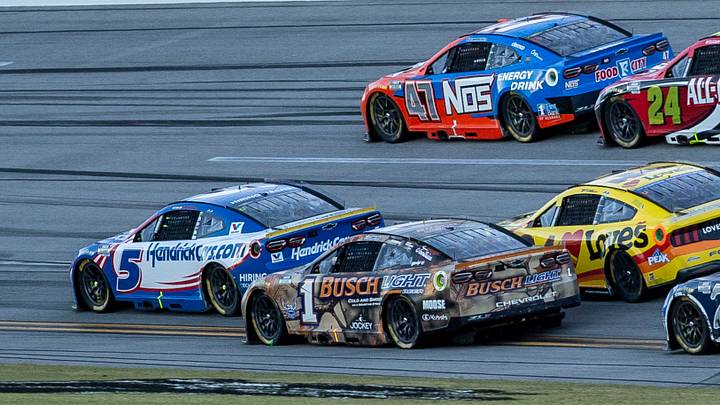
Can we all agree it would just be better to abolish the double-yellow line rule at superspeedways than it would be to continue to tolerate inconsistent rulings from the most annoying rule in NASCAR?
It's Monday, and we should be talking about Kyle Larson's incredible charge from 10th to 1st on the final lap of the YellaWood 500 at Talladega Superspeedway, which has perfectly positioned the Hendrick Motorsports star to claim his third career NASCAR Cup Series title.
We should be talking about Joey Logano's spectacular flip and the fact that Riley Herbst incredibly walked away from one of the hardest impacts seen in recent NASCAR history.
We should also be talking about RFK Racing finally daring to be the only team to choose not to fall in line with the silly fuel-saving games that have plagued superspeedway races in the Next Gen era. And in doing so, that team single-handedly changed how the remainder of Sunday's race was contested and has possibly changed the game going forward.
Instead, we're questioning whether the winner of Sunday's race was the actual winner. That's life at 200 miles per hour with an out-of-bounds line, unfortunately.
As Larson was making his miraculous charge to the front of the field, he dipped his left-side tires just below the double-yellow lines on the frontstretch as he worked his way around Todd Gilliland.
What do you think…
— Dirty Mo Media (@DirtyMoMedia) October 25, 2026
Are Larson’s left side tires on or below the double yellow line? 🤔 pic.twitter.com/qFFGfkob0R
Moments later, Larson charged past Ricky Stenhouse Jr. as he took an incredible victory after an unbelievable rally.
And as you'd expect, NASCAR fans, among the most ardent fans in all of professional sports, were quick to call out that Larson had dipped below the out-of-bounds line on his victory surge via social media.
The fans also quickly pointed out that Ross Chastain made an even more egregious move below the yellow line. And half a lap prior to Larson and Chastain going below the line, Austin Hill clearly went below the yellow line in a battle for position with Larson.
At the checkered flag, no driver was flagged for advancing their position out of bounds.
According to the NASCAR Cup Series rule book, a driver can't advance their position with the left-side tires below the yellow line. The wording of the rule leaves a lot open to interpretation as to what constitutes left-side tires below the yellow line.
Based on the wording in the rule book, which lacks a lot of definition, it appeared that fans were correct.
However, after Sunday's YellaWood 500, NASCAR explained the decision not to penalize Larson. The sanctioning body said that in order to be flagged, Larson would have had to have an entire tire below the yellow line. As his left-side tires were only partially below the yellow line, in NASCAR's view, he hadn't advanced his position below the out-of-bounds line.
Now, we have an official definition from NASCAR of what is, and more importantly, what isn't, going below the yellow line moving forward. There's just one problem: this ruling is inconsistent with how we've seen the below-the-yellow-line rule enforced in the past.
In 2018, NASCAR took a win away from Justin Haley in the NASCAR O'Reilly Auto Parts Series event at Daytona International Speedway for going below the yellow line to win the race. Haley, who definitely didn't have an entire tire below the yellow line, called the decision by NASCAR "a BS call" at the time. And while many agreed with Haley in 2018, looking at the way things were ruled on in Sunday's NASCAR Cup Series race at Talladega, Haley is owed a trophy.
Ironically, that ruling in 2018, handed a victory to Larson. Eight years later, he was the benefactor of the rule being interpreted the opposite way.
What an amazing turn of luck for Larson, one of the notoriously unlucky drivers in superspeedway racing history. But in these instances of judgment calls that are ruled differently for different drivers, you will always have fans wondering if it was luck, if the call was right, or if there is simply favoritism from the sanctioning body in these situations.
We'll likely never know the true answer, but having these types of judgment calls in place, which often come into play on the final lap of superspeedways, is a recipe for disaster when it comes to public perception.
I think it's long time for NASCAR's most ambiguous rule, the out-of-bounds line at superspeedways, to go away, and go away for good.
 Add us as a preferred source on Google

Toby Christie is the Editor-in-Chief of Racing America. He has 15 years of experience as a motorsports journalist and has been with Racing America since 2023.
Follow toby_christie