%22%3E%0A%3Cpath%20d%3D%22M-0.00012207%2027.4428L4.82746%2021.6883C7.76264%2023.9283%2011.1226%2024.8552%2014.2702%2024.8552C15.8923%2024.8552%2016.5875%2024.4303%2016.5875%2023.6965V23.6193C16.5875%2022.8469%2015.7378%2022.4221%2012.8413%2021.8428C6.77781%2020.6069%201.46746%2018.869%201.46746%2013.1724V13.0952C1.46746%207.95862%205.48401%204%2012.9185%204C18.1323%204%2021.975%205.23586%2025.1033%207.70759L20.7006%2013.8097C18.1516%2011.9559%2015.1006%2011.1448%2012.6095%2011.1448C11.2578%2011.1448%2010.6399%2011.6083%2010.6399%2012.2648V12.3421C10.6399%2013.0759%2011.3737%2013.5393%2014.2316%2014.08C21.1447%2015.3545%2025.7599%2017.3628%2025.7599%2022.789V22.8662C25.7599%2028.5434%2021.0868%2032%2013.8454%2032C8.36126%2032%203.43712%2030.4552%20-0.00012207%2027.4428Z%22%20fill%3D%22white%22%2F%3E%0A%3Cpath%20d%3D%22M26.9569%2021.0702V20.9929C26.9569%2014.6978%2031.4755%209.9281%2037.79%209.9281C45.2824%209.9281%2048.739%2015.1419%2048.739%2021.5336C48.739%2021.9971%2048.739%2022.5378%2048.7004%2023.0012H35.1638C35.7817%2024.855%2037.2493%2025.8205%2039.1417%2025.8205C40.7252%2025.8205%2042.0383%2025.0867%2043.4286%2023.6578L48.1404%2027.404C46.0548%2030.1074%2043.081%2031.9998%2038.5431%2031.9998C31.63%2031.9998%2026.9762%2027.6357%2026.9762%2021.0895L26.9569%2021.0702ZM40.7638%2019.1391C40.5707%2017.1309%2039.3735%2015.9722%2037.8286%2015.9722C36.2838%2015.9722%2035.3183%2017.2081%2035.0479%2019.1391H40.7638Z%22%20fill%3D%22white%22%2F%3E%0A%3Cpath%20d%3D%22M50.6707%2010.4298H59.4182V14.678C60.6155%2011.8201%2062.5465%209.9663%2066.0224%2010.1208V19.4091H65.0955C61.3879%2019.4091%2059.4182%2021.456%2059.4182%2026.1291V31.4973H50.6707V10.4298Z%22%20fill%3D%22white%22%2F%3E%0A%3Cpath%20d%3D%22M66.2151%2010.4296H75.3875L78.7861%2020.9923L82.2234%2010.4296H91.2799L82.7447%2031.6516H74.7309L66.2151%2010.4296Z%22%20fill%3D%22white%22%2F%3E%0A%3Cpath%20d%3D%22M90.5847%2021.0702V20.9929C90.5847%2014.6978%2095.1033%209.9281%20101.418%209.9281C108.91%209.9281%20112.367%2015.1419%20112.367%2021.5336C112.367%2021.9971%20112.367%2022.5378%20112.328%2023.0012H98.7916C99.4095%2024.855%20100.877%2025.8205%20102.77%2025.8205C104.353%2025.8205%20105.666%2025.0867%20107.056%2023.6578L111.768%2027.404C109.683%2030.1074%20106.709%2031.9998%20102.171%2031.9998C95.2578%2031.9998%2090.604%2027.6357%2090.604%2021.0895L90.5847%2021.0702ZM104.392%2019.1391C104.199%2017.1309%20103.001%2015.9722%20101.456%2015.9722C99.9116%2015.9722%2098.9461%2017.2081%2098.6757%2019.1391H104.392Z%22%20fill%3D%22white%22%2F%3E%0A%3Cpath%20fill-rule%3D%22evenodd%22%20clip-rule%3D%22evenodd%22%20d%3D%22M122.368%204.36764C128.191%20-1.45588%20137.632%20-1.45588%20143.456%204.36764C149.279%2010.1912%20149.279%2019.6324%20143.456%2025.4559L132.912%2036L122.368%2025.4559C116.544%2019.6324%20116.544%2010.1912%20122.368%204.36764ZM125.009%207.55761C124.948%207.86849%20124.916%208.39718%20124.916%209.14566V10.4189C124.916%2011.1832%20124.948%2011.7198%20125.013%2012.0267C125.078%2012.3317%20125.278%2012.6168%20125.617%2012.8762C125.956%2013.1376%20126.403%2013.3316%20126.958%2013.4623C127.512%2013.593%20128.1%2013.6584%20128.837%2013.6584C129.573%2013.6584%20130.217%2013.591%20130.769%2013.4524C131.322%2013.3158%20131.761%2013.1178%20132.086%2012.8604C132.411%2012.6029%20132.605%2012.3178%20132.666%2012.0069C132.728%2011.6961%20132.759%2011.1674%20132.759%2010.4189V9.14566C132.759%208.38134%20132.728%207.84473%20132.662%207.53781C132.597%207.23287%20132.397%206.94971%20132.058%206.68834C131.72%206.42696%20131.272%206.23291%20130.718%206.10223C130.163%205.97154%20129.536%205.90619%20128.839%205.90619C128.102%205.90619%20127.459%205.97352%20126.906%206.11213C126.352%206.24875%20125.914%206.44677%20125.589%206.70418C125.265%206.9616%20125.071%207.24673%20125.009%207.55761ZM130.276%2024.8638C133.876%2024.8638%20135.557%2024.2064%20135.557%2021.862V21.858V21.3155C135.557%2019.6581%20134.516%2018.971%20131.252%2018.3136C130.278%2018.1136%20129.908%2017.9136%20129.908%2017.3136V16.9414C129.908%2016.6543%20130.177%2016.5117%20130.413%2016.5117C130.749%2016.5117%20130.918%2016.7137%20130.918%2016.9414V18.1136H135.391V17.3988C135.391%2015.4563%20134.347%2014.4266%20130.177%2014.4266C127.15%2014.4266%20124.896%2015.3414%20124.896%2017.3711V17.7433C124.896%2019.5155%20125.805%2020.3155%20129.201%2021.0303C129.28%2021.0472%20129.355%2021.063%20129.427%2021.0781C130.329%2021.2674%20130.647%2021.3341%20130.647%2021.9174V22.2897C130.647%2022.6619%20130.546%2022.8045%20130.142%2022.8045C129.67%2022.8045%20129.637%2022.5471%20129.637%2022.262V21.2897H124.894V21.7471C124.894%2024.149%20126.476%2024.8638%20130.276%2024.8638ZM136.424%2024.5569H140.925V14.7355H136.424V24.5569ZM137.955%2013.5019H140.925V6.06064H138.092V9.411L136.193%206.06064H133.359V13.5019H136.193V10.1199L137.955%2013.5019ZM129.269%2012.152C129.204%2012.2688%20129.055%2012.3262%20128.825%2012.3262L128.827%2012.3282C128.604%2012.3282%20128.459%2012.2767%20128.398%2012.1758C128.336%2012.0748%20128.305%2011.8074%20128.305%2011.3758V7.90068C128.305%207.51852%20128.352%207.28684%20128.445%207.20962C128.538%207.13239%20128.675%207.09279%20128.851%207.09279C129.059%207.09279%20129.198%207.14031%20129.265%207.23734C129.332%207.33239%20129.366%207.55416%20129.366%207.90068V11.3203C129.366%2011.7579%20129.334%2012.0352%20129.269%2012.152Z%22%20fill%3D%22white%22%2F%3E%0A%3C%2Fg%3E%0A%3Cdefs%3E%0A%3CclipPath%20id%3D%22clip0_15160_920%22%3E%0A%3Crect%20width%3D%22148%22%20height%3D%2236%22%20fill%3D%22white%22%2F%3E%0A%3C%2FclipPath%3E%0A%3C%2Fdefs%3E%0A%3C%2Fsvg%3E%0A)
Judy Murray on State of British Tennis: "The Pathway is Flawed"
One of the most fundamental practical problems with tennis as a sport is, at its core, also a moral one. Accessibility, and whether tennis is truly open to aspiring participants from every background, is arguably the most damaging yet least discussed issue within a sport that can, and does, offer so much that is wonderful.
This is a concern that is especially prevalent in British tennis. With the majority of local clubhouses having turned private and now requiring payment as a means to entry, and the already substantial costs of equipment and lessons only increasing, one can't help but feel that only a fraction of the wealth of tennis talent this country has to offer is being unearthed.
To further compound matters, the schools deemed the finest in the land for tennis facilities and training are largely fee-paying, independent institutions, while the extensive costs of travel and accommodation often derail many fledgling careers for those who do progress to knock on the door of full-time, professional tennis.
It is very reassuring, therefore, to learn that a woman who has been an integral figure to British tennis in the 21st century is still out there quietly doing her part for the cause. For someone whose family name is now forever synonymous with one of the finest sporting achievements this nation has enjoyed, Judy Murray is remarkably down-to-earth, conversive and generous with her time.
"I've said for many years, when you live in Britain, and you have the jewel in the crown of tennis, which is Wimbledon, we should be able to produce a lot more players. But I still feel that it is mainly for those who have the means," she tells me.
As the matriarch of modern British tennis, Judy Murray's legacy is already firmly cemented. Yet it is uplifting to see the evident passion she still has for the future direction of this sport, both in her native Scotland, where she now resides, but also within the UK as a whole, despite some sobering assessments about its current landscape.

"If you watch tennis on the TV or you watch Wimbledon and you think, 'I want to go and try that', you're not going to rock up and join the local club.
"You're going to go and try it somewhere. But so many park courts had fallen into disrepair over the years. Many of them have been resurrected, but they have locks on them. So you can book online, but they have to be paid for, whereas park courts always used to be available for free to the public, because everybody pays their local taxes.
"But, you know, I always think with things like that, it's not just about the facility. It's actually about the activation and the infrastructure around it. You need people to create regular activity, so you create a sense of community. And I think that's why, in my opinion, the most important part of tennis in this country is actually about clubs and coaches. Whether that's a club within the park or a club within the school. But many, many state schools have lost their tennis courts over the years.
"They were valuable spaces. But if the tennis courts weren't being used, they turned into car parks, or they were sold for housing, or they became a science block or another sport. And once you lose them, you never get them back. That is the same in a significant number of parks as well. So I don't know. I still think it is perceived as difficult to do, difficult to access, and expensive."
Can Great Britain Learn from the Italian Blueprint for Success?
On hearing this, one's mind wanders enviously over to Italy's set-up. Over the past 15 years, Italian tennis has utterly transformed itself from a bystander on the peripheries of relevance to the dominant powerhouse of the modern game, boasting four players within the ATP's top 20 - one of whom is World No. 1 and generational talent, Jannik Sinner - while the Italian national teams have won the past two Billie Jean King Cup titles and the past three Davis Cup editions.
This extraordinary renaissance is the direct result of the Italian Tennis Federation's grand plan to decentralise development funds from several large national hubs, redispersing those finances to local clubhouses throughout the country. Alongside a massive expansion of lower-rung tournaments on the Challenger and ITF circuits taking place in Italy, and a commitment to free-to-air broadcasting - which hugely increased media exposure and viewing figures - Italy has presented the rest of the tennis world with the ultimate blueprint for phenomenal sporting success.
The question is self-evident, why can't British tennis replicate that model in the UK?
"Probably 15 to 20 years ago, they (the Italians) went away from a centralised system of trying to spot players all around their country and bring them into national centres. They found that hothousing players in this way just wasn't working. It was disillusioning for the coaches in the field. It was disillusioning for the clubs because they were losing all these little kids. The kids weren't playing for the clubs.
"And they completely turned it on its face and went into a huge club and coach development programme. But we have that centralised thing. We have one national academy. We have a number of regional development centres, I don't know how many, but we have only one of those in Scotland. One in Scotland," she pauses and repeats this for emphasis.
"We're two-thirds of the size of England, and there's only one in Scotland. It's bang in the middle of the country, so for anybody who doesn't live in that central belt, it's a real struggle to get there. I think, for me, the pathway is flawed, and I don't think it's a one-size-fits-all for a country like ours. I think you have to look at the individual needs of each area and tailor the programmes to what's required in those areas."
So the diagnosis is clear. But what is the cause of this inertia? Partly, it seems to be down to a general shift in societal trust and the way communities interact in today's Britain.
"So much now around tennis and other sports has become so much about coaching. A programmed activity that they do after school or perhaps on the weekend. But where you go for an hour, and you leave after an hour, and you never go in the clubhouse, you never play a match, you never play for a team. You just go to coaching once a week in the same way that you might go to a piano lesson once a week or do something else.
"It's just the way of the world that kids get programmed into activity, and they get dropped off and picked up. There isn't that kind of community club engagement that there once was.
"And that's probably something to do with safeguarding and just the way that the world has changed. But it wasn't like that when I started, which was a long time ago, and it wasn't like that when Jamie and Andy started. You know, everything at the club was run by volunteers."
Misleading LTA Figures on Participation
But what about the Lawn Tennis Association's - the governing body of British tennis - assertion that engagement is increasing, and always enjoys a spike of activity during and after the Wimbledon fortnight?
"It's not enough for me to read people saying, 'Oh, we've got fabulous statistics, participation's up here, there and everywhere," is Judy's response to this.
"When you break down the criteria for participation, you will find that a junior participant is someone who goes to coaching once a week or more. So all these kids who go once a week and never play the game are counted as a participant. One of the criteria for an adult participant is an adult who plays tennis once a year or more. So somebody who picks up a racket during Wimbledon is suddenly a figure as a participant."
A starkly illuminating perspective from someone with greater experience of British tennis' ecosystem than most others in the country. But it is also one that sparks immense frustration that the sporting potential of a nation is not being optimised.
The WTA Foundation's Come Play Initiative
Yet, there is good reason to take heart. Namely, for the fact that prominent figures such as Judy Murray are still thoroughly engaged and fighting the good fight.
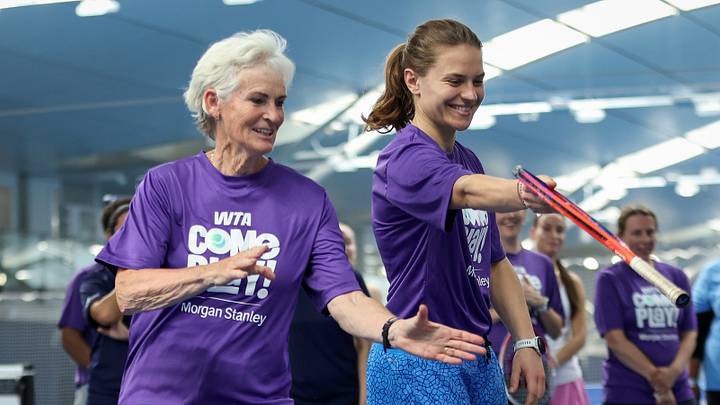
On Friday 26 June, the WTA Foundation's charity initiative, officially titled 'WTA Come Play presented by Morgan Stanley', returned to the National Tennis Centre in London ahead of this year's Wimbledon Championships.
Partnering with the Murray Play and Elena Baltacha Foundations (the former of which was launched by Judy herself), the event saw local youth girls take part in a tennis clinic led by Judy, alongside British No. 6 Katie Swan, World No. 33 Donna Vekic, and Canadian US Open finalist Leylah Fernandez.
Both foundations were also presented with a cheque to support their vision of giving more children the opportunity to learn and play tennis and lead healthy and productive lives on and off the court.

"We'll have 30 spots for Morgan Stanley staff to learn how to be a volunteer. And many of them, of course, are parents. So because Come Play is aimed at those who are starting out in tennis, it's new starters, whether that's kids or teens or adults. It's all fun, doable activities. It's not anything that somebody has to be a competent tennis player to be able to deliver.
"And because many of the volunteers from Morgan Stanley are parents, of course, a lot of it is aimed at developing the skills that you need to be able to play tennis and is particularly appropriate for kids and also for those with special needs. So we always have a really, really good workshop for probably a couple of hours, 90 minutes to two hours, depending on the time that's available."
Through the delivery of these immersive clinics, this initiative has done much over the past few years to extend access to the sport for all backgrounds and skills in the UK. Furthermore, under the Murray Play Foundation, Judy has recently launched the 'Learn to Lead' initiative, a program in Scotland that empowers primary school girls (ages 10–12) to develop leadership skills by coaching younger girls (ages 5–8).
"The 'Learn to Lead' programme that I created, we launched it this time last year. It's been running since last September when the schools went back. It's all about leadership and empowering young girls to run lunchtime clubs or after-school clubs in the school gym or the school playground. But you have these 10 and 11-year-old girls trained by the teachers. We train the teachers. We give the equipment back. We give the video resource backup with all the tips on setting up, what you say, and all the rest of it. We do school visits after they're up and running, and then we bring it all together at the local tennis club so that the kids have their first taste of a tennis club.
"So everything that they've been doing in the school environment, which they're perfectly familiar with, doesn't cost anybody anything."

Ultimate Responsibility Lies with the Governing Bodies
These initiatives are just the nourishment that a lopsided and often expensive tennis landscape needs to feed fresh talent, expand access and increase exposure. But Judy is very candid in her assertion that these events alone cannot plug the gap that currently exists.
"I'm very happy to do it in my small way and share my knowledge, experience, and enthusiasm for this sport. But the job of growing the game is with the governing bodies. And, you know, the LTA is one of the wealthiest governing bodies in sport in the UK. It really lies with them.
"We're not out to take over the world or anything like that. We just want to do a really good job within the areas that we feel passionate about."
The message here is clear. This is not about some grandiose master plan to save British tennis. It is actually much more admirable than that. The Come Play initiative, together with the foundations it supports, is about giving a helping hand to local youth and local communities.
It is about building trust between different age groups of young girls, teaching invaluable skills to both potential coaches and players, while fostering wider community engagement instead of the granular method of private lessons.
Yet this philosophy is precisely what framed the Italian approach. The difference is that the Italian Tennis Federation bought into this philosophy and chose to give it their full financial backing, together with an unwavering long-haul commitment to see it through.
Perhaps British tennis and the LTA might be able to take some lessons from the localised grassroots approach. After all, it should be noted, as an organisation they do much very well. And yet centralised training hubs appear to be stifling progress in the UK to much the same effect as the Italians experienced 15 or so years ago, with little sign of any willingness to fundamentally alter this structure.
For Judy Murray, meanwhile, her own personal mission remains clear, simple and unwavering.
"If I can teach, train, promote, empower, whatever, inspire another generation of female leaders and female coaches, that will be my legacy." Amen to that.
 Add us as a preferred source on Google
Jamie Malachy is a freelance tennis journalist, aiming to provide a unique, nuanced and informative analysis of the sport he loves. He has been documenting tennis since 2019, and writing professionally since 2023. Working in collaboration with Tennis Majors and numerous other sports news outlets, personal highlights include covering six Grand Slam singles finals and the 2024 Paris Olympic Games. You can reach him at: jamiemalachy@gmail.com
Follow JamieMalachy